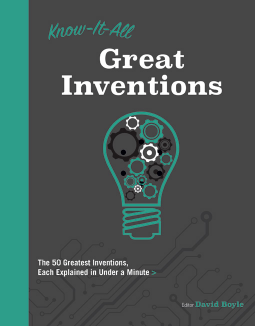
Know It All Great Inventions
The 50 Greatest Inventions, Each Explained in Under a Minute
by David Boyle
Quarto Publishing Group – Wellfleet Press
Wellfleet Press
Pub Date 1 Sep 2017
This title was previously available on NetGalley and is now archived.
Description
Prepare to see a few millennia worth of light bulb moments. Know It All Great Inventions traces 50 of mankinds greatest inventions, from the wheel to in-home air conditioning, and tells their stories.
Universal change is often the ultimate result of one individual’s lightbulb moment—an invention that triggers a ripple effect across countries, continents, or even out into space. Know-It-All Great Inventions looks at fifty of these great ideas that really did change the world.
This title covers a wide range, from early days (the wheel) through materials (the invention of steel and plastic) to communications (the alphabet, printing press, and Worldwide Web) and the conveniences of—relatively—modern daily life (refrigeration, indoor plumbing, and central heating).
It is a sharp reminder that almost every aspect of life in the second decade of the 21st century is the result of someone’s bright idea, one that they actually made work. Along the way you’ll learn the stories behind each and every invention, revealing and intriguing in equal measures.
The Know It All series takes a revolutionary approach to learning about the subjects you really feel you should understand but have never gotten around to studying. Each book selects a popular topic and dissects it into the 50 most significant ideas at its heart. Each idea, no matter how complex, is explained in 300 words and one picture, all digestible in under a minute.
Other titles in this series include: Know It All Anthropology, Know It All Chemistry, Know It All Classical Music, Know It All Energy, Know It All Fashion, Know It All Jazz, Know It All Medicine, Know It All Shakespeare, Know It All Whiskey, Know It All Wine, Space In 30 Seconds, Sports in 30 Seconds.
Universal change is often the ultimate result of one individual’s lightbulb moment—an invention that triggers a ripple effect across countries, continents, or even out into space. Know-It-All Great Inventions looks at fifty of these great ideas that really did change the world.
This title covers a wide range, from early days (the wheel) through materials (the invention of steel and plastic) to communications (the alphabet, printing press, and Worldwide Web) and the conveniences of—relatively—modern daily life (refrigeration, indoor plumbing, and central heating).
It is a sharp reminder that almost every aspect of life in the second decade of the 21st century is the result of someone’s bright idea, one that they actually made work. Along the way you’ll learn the stories behind each and every invention, revealing and intriguing in equal measures.
The Know It All series takes a revolutionary approach to learning about the subjects you really feel you should understand but have never gotten around to studying. Each book selects a popular topic and dissects it into the 50 most significant ideas at its heart. Each idea, no matter how complex, is explained in 300 words and one picture, all digestible in under a minute.
Other titles in this series include: Know It All Anthropology, Know It All Chemistry, Know It All Classical Music, Know It All Energy, Know It All Fashion, Know It All Jazz, Know It All Medicine, Know It All Shakespeare, Know It All Whiskey, Know It All Wine, Space In 30 Seconds, Sports in 30 Seconds.
Prepare to see a few millennia worth of light bulb moments. Know It All Great Inventions traces 50 of mankinds greatest inventions, from the wheel to in-home air conditioning, and tells their stories.
...
...
Description
Prepare to see a few millennia worth of light bulb moments. Know It All Great Inventions traces 50 of mankinds greatest inventions, from the wheel to in-home air conditioning, and tells their stories.
Universal change is often the ultimate result of one individual’s lightbulb moment—an invention that triggers a ripple effect across countries, continents, or even out into space. Know-It-All Great Inventions looks at fifty of these great ideas that really did change the world.
This title covers a wide range, from early days (the wheel) through materials (the invention of steel and plastic) to communications (the alphabet, printing press, and Worldwide Web) and the conveniences of—relatively—modern daily life (refrigeration, indoor plumbing, and central heating).
It is a sharp reminder that almost every aspect of life in the second decade of the 21st century is the result of someone’s bright idea, one that they actually made work. Along the way you’ll learn the stories behind each and every invention, revealing and intriguing in equal measures.
The Know It All series takes a revolutionary approach to learning about the subjects you really feel you should understand but have never gotten around to studying. Each book selects a popular topic and dissects it into the 50 most significant ideas at its heart. Each idea, no matter how complex, is explained in 300 words and one picture, all digestible in under a minute.
Other titles in this series include: Know It All Anthropology, Know It All Chemistry, Know It All Classical Music, Know It All Energy, Know It All Fashion, Know It All Jazz, Know It All Medicine, Know It All Shakespeare, Know It All Whiskey, Know It All Wine, Space In 30 Seconds, Sports in 30 Seconds.
Universal change is often the ultimate result of one individual’s lightbulb moment—an invention that triggers a ripple effect across countries, continents, or even out into space. Know-It-All Great Inventions looks at fifty of these great ideas that really did change the world.
This title covers a wide range, from early days (the wheel) through materials (the invention of steel and plastic) to communications (the alphabet, printing press, and Worldwide Web) and the conveniences of—relatively—modern daily life (refrigeration, indoor plumbing, and central heating).
It is a sharp reminder that almost every aspect of life in the second decade of the 21st century is the result of someone’s bright idea, one that they actually made work. Along the way you’ll learn the stories behind each and every invention, revealing and intriguing in equal measures.
The Know It All series takes a revolutionary approach to learning about the subjects you really feel you should understand but have never gotten around to studying. Each book selects a popular topic and dissects it into the 50 most significant ideas at its heart. Each idea, no matter how complex, is explained in 300 words and one picture, all digestible in under a minute.
Other titles in this series include: Know It All Anthropology, Know It All Chemistry, Know It All Classical Music, Know It All Energy, Know It All Fashion, Know It All Jazz, Know It All Medicine, Know It All Shakespeare, Know It All Whiskey, Know It All Wine, Space In 30 Seconds, Sports in 30 Seconds.
Available Editions
| EDITION | Other Format |
| ISBN | 9781577151609 |
| PRICE | US$14.99 (USD) |
Available on NetGalley
| Download (PDF) |
Featured Reviews
|
My Recommendation
|
|
Love these types of books. Lots of easy to understand information! |
My Recommendation
|
|
My Recommendation
|
|
What a great book! I would not only buy this book, now I want to read the whole series. This book should be a mandatory textbook in any middle school curriculum. |
My Recommendation
|
|
My Recommendation
|
|
A beautifully concise introduction to the most important inventions humans have come to depend upon. I really enjoyed the mixed format of longer entries with shorter bits of quick information! Lovely to look at and fun to read! |
My Recommendation
|
|
My Recommendation
|
|
Made me relook at things around me that I usually take for granted I had previously read one of the Know-it-all series, on Chemistry and I loved the concise way the authors had discussed the main ideas of chemistry. The current book on inventions is just as good. Obviously, in a one-page discussion, not everything or even enough can be discussed on any given invention but there were some things I particularly liked: there were inventions discussed from a broad range of subjects from communications to transportation; enough information was given to explain a little and create curiosity; inventions discussed dated back to prehistory; and it made me think about things I hadn’t really thought about before, like the invention of glass. Disclosure: I received a complimentary copy of this book via Netgalley for review purposes. |
My Recommendation
|
|
My Recommendation
|
|
Perfect book for youth learning how to make a science fair project in their own. I would love to try out a few myself. |
My Recommendation
|
|
My Recommendation
|
|
Great book for kids who are interested in science. Very valuable information about the great inventions. Easy to read. Note: I received a free e-copy of the book via Net Galley in exchange for an honest review. Special thanks to the author for giving me a chance to read it. |
My Recommendation
|
|
My Recommendation
|
|
I found this text quite interesting. I cannot say I ever wondered about the creation of cement, but it was fascinating to hear the history behind it. I think many patrons will find this text useful both for educational studies and natural curiosity. |
My Recommendation
|
|
My Recommendation
|
|
“Know it All Great Inventions: The 50 Greatest Inventions, Each Explained in Under a Minute” by David Boye is everything the title promises. This book is broken up in sections with inventions for each of these categories: Materials, Construction and Engineering, Transport and Location, Medicine and Health, Communication, Economics and Energy and Daily Life. The author notes that because all of these inventions are explained in under a minute that each explanation is more of an introduction to the invention and not a complete explanation. Each section, as explained in the “How this book works” entry in the beginning of the book, includes as much science, technology, and economics of each invention as possible in under a minute. The entries in this book are definitely some of the greatest inventions. This book would be perfect for a classroom or a child’s library. The amount of information given is outstanding considering the amount of time it takes to read each entry. Each entry includes its creator, it’s purpose, and other interesting facts about that invention. I enjoyed looking through this book and reading about the different inventions and their creators. I would recommend this book to anyone interested in how some of the greatest inventions came to be or those just curious for knowledge. I received this book from NetGalley and Wellfleet Press for an honest review. |
My Recommendation
|
Librarian 121315
|
My Recommendation
|
|
This book is for those of us who like to explore and learn new things but do not have much time to do so. The Internet has made it very easy for exploration of different topics, but I think that there is something great about this kind of books that are put together by real experts. Know It All Great Inventions is divided into seven units: Materials, Construction & Engineering, Transport & Location, Medicine & Health, Communications, Economics & Energy, and Daily Life. The book gives readers a variety of study and exploration tools such as glossaries, appendices, and an index among others. I personally loved the units on Communications and Daily Life, but all the other units were very interesting as well. I think elementary teachers can use this book to create a wide variety of leaning opportunities so please check it out. |
My Recommendation
|
|
My Recommendation
|
|
Interesting Factoids I enjoyed this book, but I think you have to approach it as very introductory, more like an annotated list of greatest hits. If you don't really know why a particular invention is important, or have a general sense of how it works, the entries here probably aren't going to be that illuminating. On the other hand, for each invention you do get a sense of the age and culture from which it emerged, (lots of China, India, and the Arab countries here), and a sense of how it fit in to the needs of its time. Naturally, details are skipped, issues are glossed over, a bit of attitude intrudes here or there, and nitpickers could go nuts over many points, (along the lines of "let's have a really big argument about who "invented" the TV"). I thought that for a young STEM oriented reader this could be an intriguing introduction to science, engineering, math, medicine, and both the scientific method and the practical, applied, "inventive" method, and if the idea is to get kids jazzed about science, well, this struck me as a fine place to start or a nice way to keep going. (Please note that I received a free advance will-self-destruct-in-x-days Adobe Digital copy of this book without a review requirement, or any influence regarding review content should I choose to post a review. Apart from that I have no connection at all to either the author or the publisher of this book.) |
My Recommendation
|
Bill C, Reviewer
|
My Recommendation
|
|
Clearly, you can’t expect much depth in a book that warns you up front they’re going to explain the 50 “greatest” inventions in less than sixty seconds. So with that foreknowledge in mind, how does Know-it-All Great Invention: The 50 Greatest inventions, Each Explained in Under a Minute do? It serves as a decent if shallow reference work, one meant to introduce the inventions (“An introduction to” would have been a better title than “explain” I’d say) and pique a young reader’s interest in learning more through a more substantive exploration elsewhere. Editor David Boyle divides the inventions in several broad categories with 6-8 inventions in each (I’ve noted two representative ones in each category): • Materials (cement, iron) • Construction and Engineering (the wheel, the plow) • Transport and Location (the compass, the pneumatic tire) • Medicine and Health (vaccination, the microscope) • Communications (the alphabet, the telegraph) • Economics and Energy (the abacus, paper money) • Daily Life (canning, refrigerators) A helpful glossary begins each category, then each invention gets a single page, subdivide into the main description (centered), a left sidebar with a “3-second survey” (a single fact) and a “3-minute overview” (a few sentences, often placing the invention in some historical context), and a right sideboard offering page numbers for related topics in the book and “3-second biographies” made up of 1 or two sentences about important figures in the invention/development of the invention. Each category also includes a profile of a particularly prominent inventor/scientist, such as Louis Pasteur, Katherine Burr Blodgett, and the Wright Brothers. The language is lucid and fluid, and if the entries are mere snapshots, they do offer up the basics and sometimes some interesting information. It seems a good book for young readers to launch them into more substantive works. For instance, hearing that Chinese papermakers were “captured” to learn their secret might prompt curious reader to find out more about such a fascinating and human interest type of story. |
My Recommendation
|
|
My Recommendation
|
|
Accompanied by beautiful illustrations, David Boyle's picks about the inventions like the Cement, the Plow, Global Positioning System (GPS), Anesthesia, the Birth Control Pill, the Credit Card, and the Lavatory effect just might turn you into a lover of Science & Engineering. It worked for me. The book is structured as a chronological series of one page discussions of breakthroughs throughout history. The articles range from Ancient history (the Alphabets, Abacus) through modern day discoveries like the Smart Phone. This format is good for getting an appreciation of the progress of inventions through history without necessarily delving into details. |
My Recommendation
|
|
My Recommendation
|
|
For general public. This book describes in an easy way the most used inventions of our times. |
My Recommendation
|
|
My Recommendation
|
|
Boyle's list of greatest inventions is an excellent one and he gives his reasoning for each right in the book. While geared more toward young adults and adults, it is still accessible to younger children who already have a bit of a science background. It is definitely not meant for reading in one sitting, though. I liked the plethora of other information in the sidebars and the features on various inventors. They gave good additional context and created links to other inventions and people. Overall, the format was easy to read and well thought out. I even managed to learn a few things! But, overall, it did not scream "read me". I didn't get excited by the stories or find them particularly compelling. It's good if you want to get a quick handle on something and its list of resources at the end provides plenty of options for getting more information. |
My Recommendation
|
sharanya p, Reviewer
|
My Recommendation
|
|
Fifty great inventions were explained. A must book in our kids bookshelf. |
My Recommendation
|
|
My Recommendation
|
|
This is a great series of books. They give a snap chat of information at a glance and would make a great addition to a coffee table book collection in any home. |
My Recommendation
|
|
My Recommendation
|
|
All of the Know-It-All series of books are excellent! Each of them gives a synopsis of the most important things to know on the topic in a brief but well-laid-out manner, and Great Inventions is no exception! These books are a good introduction or a good review, as well as a starting place for discovering which topics you'd like to learn more about afterwards -- and then you can get a more in-depth book on just that topic. |
My Recommendation
|
Additional Information
Available Editions
| EDITION | Other Format |
| ISBN | 9781577151609 |
| PRICE | US$14.99 (USD) |
Available on NetGalley
| Download (PDF) |
Featured Reviews
|
My Recommendation
|
|
Love these types of books. Lots of easy to understand information! |
My Recommendation
|
|
My Recommendation
|
|
What a great book! I would not only buy this book, now I want to read the whole series. This book should be a mandatory textbook in any middle school curriculum. |
My Recommendation
|
|
My Recommendation
|
|
A beautifully concise introduction to the most important inventions humans have come to depend upon. I really enjoyed the mixed format of longer entries with shorter bits of quick information! Lovely to look at and fun to read! |
My Recommendation
|
|
My Recommendation
|
|
Made me relook at things around me that I usually take for granted I had previously read one of the Know-it-all series, on Chemistry and I loved the concise way the authors had discussed the main ideas of chemistry. The current book on inventions is just as good. Obviously, in a one-page discussion, not everything or even enough can be discussed on any given invention but there were some things I particularly liked: there were inventions discussed from a broad range of subjects from communications to transportation; enough information was given to explain a little and create curiosity; inventions discussed dated back to prehistory; and it made me think about things I hadn’t really thought about before, like the invention of glass. Disclosure: I received a complimentary copy of this book via Netgalley for review purposes. |
My Recommendation
|
|
My Recommendation
|
|
Perfect book for youth learning how to make a science fair project in their own. I would love to try out a few myself. |
My Recommendation
|
|
My Recommendation
|
|
Great book for kids who are interested in science. Very valuable information about the great inventions. Easy to read. Note: I received a free e-copy of the book via Net Galley in exchange for an honest review. Special thanks to the author for giving me a chance to read it. |
My Recommendation
|
|
My Recommendation
|
|
I found this text quite interesting. I cannot say I ever wondered about the creation of cement, but it was fascinating to hear the history behind it. I think many patrons will find this text useful both for educational studies and natural curiosity. |
My Recommendation
|
|
My Recommendation
|
|
“Know it All Great Inventions: The 50 Greatest Inventions, Each Explained in Under a Minute” by David Boye is everything the title promises. This book is broken up in sections with inventions for each of these categories: Materials, Construction and Engineering, Transport and Location, Medicine and Health, Communication, Economics and Energy and Daily Life. The author notes that because all of these inventions are explained in under a minute that each explanation is more of an introduction to the invention and not a complete explanation. Each section, as explained in the “How this book works” entry in the beginning of the book, includes as much science, technology, and economics of each invention as possible in under a minute. The entries in this book are definitely some of the greatest inventions. This book would be perfect for a classroom or a child’s library. The amount of information given is outstanding considering the amount of time it takes to read each entry. Each entry includes its creator, it’s purpose, and other interesting facts about that invention. I enjoyed looking through this book and reading about the different inventions and their creators. I would recommend this book to anyone interested in how some of the greatest inventions came to be or those just curious for knowledge. I received this book from NetGalley and Wellfleet Press for an honest review. |
My Recommendation
|
Librarian 121315
|
My Recommendation
|
|
This book is for those of us who like to explore and learn new things but do not have much time to do so. The Internet has made it very easy for exploration of different topics, but I think that there is something great about this kind of books that are put together by real experts. Know It All Great Inventions is divided into seven units: Materials, Construction & Engineering, Transport & Location, Medicine & Health, Communications, Economics & Energy, and Daily Life. The book gives readers a variety of study and exploration tools such as glossaries, appendices, and an index among others. I personally loved the units on Communications and Daily Life, but all the other units were very interesting as well. I think elementary teachers can use this book to create a wide variety of leaning opportunities so please check it out. |
My Recommendation
|
|
My Recommendation
|
|
Interesting Factoids I enjoyed this book, but I think you have to approach it as very introductory, more like an annotated list of greatest hits. If you don't really know why a particular invention is important, or have a general sense of how it works, the entries here probably aren't going to be that illuminating. On the other hand, for each invention you do get a sense of the age and culture from which it emerged, (lots of China, India, and the Arab countries here), and a sense of how it fit in to the needs of its time. Naturally, details are skipped, issues are glossed over, a bit of attitude intrudes here or there, and nitpickers could go nuts over many points, (along the lines of "let's have a really big argument about who "invented" the TV"). I thought that for a young STEM oriented reader this could be an intriguing introduction to science, engineering, math, medicine, and both the scientific method and the practical, applied, "inventive" method, and if the idea is to get kids jazzed about science, well, this struck me as a fine place to start or a nice way to keep going. (Please note that I received a free advance will-self-destruct-in-x-days Adobe Digital copy of this book without a review requirement, or any influence regarding review content should I choose to post a review. Apart from that I have no connection at all to either the author or the publisher of this book.) |
My Recommendation
|
Bill C, Reviewer
|
My Recommendation
|
|
Clearly, you can’t expect much depth in a book that warns you up front they’re going to explain the 50 “greatest” inventions in less than sixty seconds. So with that foreknowledge in mind, how does Know-it-All Great Invention: The 50 Greatest inventions, Each Explained in Under a Minute do? It serves as a decent if shallow reference work, one meant to introduce the inventions (“An introduction to” would have been a better title than “explain” I’d say) and pique a young reader’s interest in learning more through a more substantive exploration elsewhere. Editor David Boyle divides the inventions in several broad categories with 6-8 inventions in each (I’ve noted two representative ones in each category): • Materials (cement, iron) • Construction and Engineering (the wheel, the plow) • Transport and Location (the compass, the pneumatic tire) • Medicine and Health (vaccination, the microscope) • Communications (the alphabet, the telegraph) • Economics and Energy (the abacus, paper money) • Daily Life (canning, refrigerators) A helpful glossary begins each category, then each invention gets a single page, subdivide into the main description (centered), a left sidebar with a “3-second survey” (a single fact) and a “3-minute overview” (a few sentences, often placing the invention in some historical context), and a right sideboard offering page numbers for related topics in the book and “3-second biographies” made up of 1 or two sentences about important figures in the invention/development of the invention. Each category also includes a profile of a particularly prominent inventor/scientist, such as Louis Pasteur, Katherine Burr Blodgett, and the Wright Brothers. The language is lucid and fluid, and if the entries are mere snapshots, they do offer up the basics and sometimes some interesting information. It seems a good book for young readers to launch them into more substantive works. For instance, hearing that Chinese papermakers were “captured” to learn their secret might prompt curious reader to find out more about such a fascinating and human interest type of story. |
My Recommendation
|
|
My Recommendation
|
|
Accompanied by beautiful illustrations, David Boyle's picks about the inventions like the Cement, the Plow, Global Positioning System (GPS), Anesthesia, the Birth Control Pill, the Credit Card, and the Lavatory effect just might turn you into a lover of Science & Engineering. It worked for me. The book is structured as a chronological series of one page discussions of breakthroughs throughout history. The articles range from Ancient history (the Alphabets, Abacus) through modern day discoveries like the Smart Phone. This format is good for getting an appreciation of the progress of inventions through history without necessarily delving into details. |
My Recommendation
|
|
My Recommendation
|
|
For general public. This book describes in an easy way the most used inventions of our times. |
My Recommendation
|
|
My Recommendation
|
|
Boyle's list of greatest inventions is an excellent one and he gives his reasoning for each right in the book. While geared more toward young adults and adults, it is still accessible to younger children who already have a bit of a science background. It is definitely not meant for reading in one sitting, though. I liked the plethora of other information in the sidebars and the features on various inventors. They gave good additional context and created links to other inventions and people. Overall, the format was easy to read and well thought out. I even managed to learn a few things! But, overall, it did not scream "read me". I didn't get excited by the stories or find them particularly compelling. It's good if you want to get a quick handle on something and its list of resources at the end provides plenty of options for getting more information. |
My Recommendation
|
sharanya p, Reviewer
|
My Recommendation
|
|
Fifty great inventions were explained. A must book in our kids bookshelf. |
My Recommendation
|
|
My Recommendation
|
|
This is a great series of books. They give a snap chat of information at a glance and would make a great addition to a coffee table book collection in any home. |
My Recommendation
|
|
My Recommendation
|
|
All of the Know-It-All series of books are excellent! Each of them gives a synopsis of the most important things to know on the topic in a brief but well-laid-out manner, and Great Inventions is no exception! These books are a good introduction or a good review, as well as a starting place for discovering which topics you'd like to learn more about afterwards -- and then you can get a more in-depth book on just that topic. |
My Recommendation
|