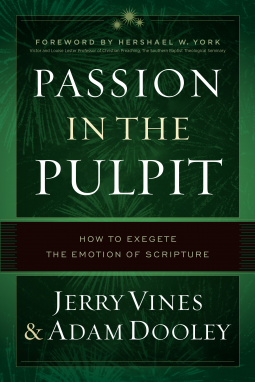
Passion in the Pulpit
How to Exegete the Emotion of Scripture
by Jerry Vines; Adam B. Dooley
This title was previously available on NetGalley and is now archived.
Send NetGalley books directly to your Kindle or Kindle app
1
To read on a Kindle or Kindle app, please add kindle@netgalley.com as an approved email address to receive files in your Amazon account. Click here for step-by-step instructions.
2
Also find your Kindle email address within your Amazon account, and enter it here.
Pub Date 3 Jul 2018 | Archive Date 2 Jul 2018
Talking about this book? Use #PassionInThePulpit #NetGalley. More hashtag tips!
Description
Biblical exegesis doesn’t stop with the words alone. Faithful preachers exegete the emotion of the text as well.
It’s easy to let our own personalities dictate the emotional dimension of our sermons, but the best preachers mirror the Bible’s emotive intent in their sermons. In Passion in the Pulpit, Jerry Vines and Adam Dooley will teach you how to exegete not just the verbal content of Scripture, but its emotional appeal as well. They show you the role the Bible’s emotional intent should play in each stage of sermon prep, and:
- Offer exegetical steps to discern the biblical pathos
- Teach you how to avoid manipulation while making your sermons emotional
- Help you determine the appropriate limitations of emotional appeal
- Give you verbal, vocal, and visual techniques to help convey the biblical emotional intent in your sermons
When we elevate the Bible’s emotional intent above our own, we preach truth rather than personality.
Available Editions
| EDITION | Other Format |
| ISBN | 9780802418388 |
| PRICE | $24.99 (USD) |
| PAGES | 224 |
Average rating from 8 members
Featured Reviews
 Doug N, Reviewer
Rhetoricians all agree effective persuasion must have, as Aristotle said, the logos, ethos, and pathos for effective communication. It's important what you say, it's important who says it, and it's important how it is said. This book deals with the pathos, an emotional side of persuasive communication. But how can you consider the pathos of a sermon, without being manipulative and deceiving? The key is to get in the Scripture, understand what it says until you feel the message yourself. By doing that, your emotion and delivery will match the original author’s emotion and pathos.
This book teaches that you need to read the passage and see the pathos and emotional flow of the original author, and the speaker must match that emotional delivery. If the text is sad, then the speaker must then communicate this sadness of the text through his delivery, illustrations, and mannerism. The text itself will set the bounds for our emotional delivery in the pulpit. In other words, screaming at the top of your lungs, "God loves you!" while banging your fists on the pulpit with an angry scowl probably doesn't communicate the emotional flow of the text. Giggling over the destruction of Jerusalem doesn’t convey the Weeping Prophet’s pathos.
The first section deals with how to determine the Scriptures own pathos in the text, and then moves to ways to incorporate that in the message through language and lastly through delivery. In other words, we exegete the Words of Scripture, we ought to also exegete the pathos of Scripture.
The book is co-authored, but it's clear who is writing what. Dooley writes the majority of the book and Vines has a section called In The Pulpit at the end of every chapter where he summarizes and illustrates the principles of that chapter. This book doesn’t give you whiplash like many co-authored books do when going back and forth between the author’.
Many good thoughts to consider.
Thanks to Netgalley.com for the review copy.
Nathan A, Reviewer
[Note: This book was provided free of charge by Moody Publishers/Net Gallery. All thoughts and opinions are my own.]
Like many readers of this book, I come to this volume having read the author's previous two books on important qualities speakers need with regards to homiletics [1]. It should be noted, though, that this particular book focuses much more on the concern of rhetoric than previous books did. If previous books were all about the rhetorical approach of speakers, it was done in a way that did not require a great deal of knowledge or interest in the forms of classic Greco-Roman rhetoric. In this book, though, it is clear that the author wishes to focus on Christian pathos in giving sermon messages and its connection to ethos and logos. Obviously, these are matters of great importance, in that emotionally fraught manipulation is all too common in our present world and that all too many people give sermon messages without an understanding or appropriate use of pathos, including the biblical pathos that exists in passages. By and large, though, I must admit that as a student and occasional practitioner of rhetoric that I certainly came to this volume with a great deal of sympathy and understanding of the authors' aims.
In terms of its structure and contents, this book is about 200 pages, of similar length to the first two books in the trilogy. The book consists of twelve chapters that show a similar structure and a unified intent to encourage the use of biblical pathos among preachers in their exegetical messages. The authors begin with three chapters that examine the context and dangers of pathos in spiritual communication, by pointing out that pathos is a missing dimension in many messages (1), that we have to be aware of personality-driven preaching that draws attention to us rather than communicating the truths of scripture to our audience (2) and avoiding emotional manipulation but rather motivating our audience to repentance and obedience (3). The next five chapters discuss various approaches that help a speaker to better understand the emotional pathos of a text, such as knowing genre (4), probing the vocabulary and syntax of a given passage (5), examining the world behind (6) and in front of (7) the text, and gauging the reactions one has to reading the text (8). A transition chapter discusses the issue of authenticity and hypocrisy in heartfelt preaching (9) before the authors conclude with three chapters that discuss verbal (10), vocal (11), and visual (12) strategies to move the audience. In the book as I read it the supplementary material like the foreword and acknowledgements were missing. Moreover, each chapter ends with a section by co-author Jerry Vines.
Although I was sympathetic to the authors in reading this book, I found much about the book that was unnecessarily irritating. For one, almost all of the sections from Jerry Vines focused on himself as a great expert of biblically driven pathos. I found it somewhat off-putting for the author to consider himself an expert on rhetoric and wished for a more humble approach that sought to bring more glory to God. The authors' attempt to portray themselves as experts on biblical pathos was greatly hindered by their deliberately antinominan approach--where they deliberately denigrated the importance of God's laws to contemporary believers, except for their passion to receive the tithes of their brethren. Apparently the only laws of God that they are passionate about defending are the laws that give them money. The fact that the authors approach the intersection of logos and pathos from a Southern Baptist perspective means that those who have a very different understanding of the Bible from the authors are left in a position of being critical of the authors and of their self-confidence in their own mastery of biblical truth and its proper emotional expression from the pulpit.
[1] See, for example:
https://edgeinducedcohesion.blog/2017/08/08/book-review-power-in-the-pulpit/
https://edgeinducedcohesion.blog/2017/08/08/book-review-progress-in-the-pulpit/
Readers who liked this book also liked:

Views expressed in promotions/advertisements do not necessarily reflect those of NetGalley or its affiliates.
© 2026 NetGalley LLC
• All Rights Reserved


Views expressed in promotions/advertisements do not necessarily reflect those of NetGalley or its affiliates.