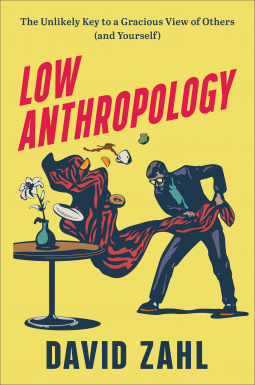
Low Anthropology
The Unlikely Key to a Gracious View of Others (and Yourself)
This title was previously available on NetGalley and is now archived.
Send NetGalley books directly to your Kindle or Kindle app
1
To read on a Kindle or Kindle app, please add kindle@netgalley.com as an approved email address to receive files in your Amazon account. Click here for step-by-step instructions.
2
Also find your Kindle email address within your Amazon account, and enter it here.
Pub Date 13 Sep 2022 | Archive Date 30 Sep 2022
Baker Academic & Brazos Press | Brazos Press
Talking about this book? Use #LowAnthropology #NetGalley. More hashtag tips!
Description
Many of us spend our days feeling like we're the only one with problems, while everyone else has their act together. But the sooner we realize that everyone struggles like we do, the sooner we can show grace to ourselves and others.
In Low Anthropology, popular author and theologian David Zahl explores how our ideas about human nature influence our expectations in friendship, work, marriage, and politics. We all go through life with an "anthropology"--an idea about what humans are like, our potentials and our limitations. A high anthropology--thinking optimistically about human nature--can breed perfectionism, anxiety, burnout, loneliness, and resentment. Meanwhile, Zahl invites readers into a biblically rooted and surprisingly life-giving low anthropology, which fosters hope, deep connection with others, lasting love, vulnerability, compassion, and happiness.
Zahl offers a liberating view of human nature, sin, and grace, showing why the good news of Christianity is both urgent and appealing. By embracing a more accurate view of human beings, readers will discover a true and lasting hope.
Advance Praise
“A remarkably perceptive, funny, subversive, and nourishing book that hasn’t left my mind since I read it. David Zahl shows that transformation—and the kind of hope we can actually rely on—isn’t to be found in the oppressive perfectionism of self-improvement but rather in accepting the liberating truth that we’re all flawed, finite, prone to overconfidence and messing things up, and in need of forgiveness.”—Oliver Burkeman, New York Times bestselling author of Four Thousand Weeks: Time Management for Mortals
“This is the book I have been waiting for: an antidote to all the self-help nonsense that weighs down our bookshelves and our self-regard. I feel lighter, freer, and less alone with every word I read in Zahl’s brilliant and truthful Low Anthropology.”—Nadia Bolz-Weber, author of Accidental Saints: Finding God in All the Wrong People
“I know of few people better equipped to cut through the religious noise of our day than David Zahl, and this book is no exception. While we’re constantly being told to think better and expect more of ourselves, Zahl provides a counterintuitive take. He shows us that there’s goodness in being merely human, and there’s great humor to be found in it too.”—Mike Cosper, author and director of podcasts at Christianity Today
“Human limitation has never looked as good as it does in David Zahl’s Low Anthropology. This book stands as a refreshing and much-needed antidote to our cultural fixation on achievement and self-optimization, and it is brimming with insights that feel both timely and timeless. At a moment when religious concepts like original sin are often misunderstood as vehicles of pessimism and shame, Zahl brilliantly reveals the paradoxical nature of this more humble understanding of human nature, demonstrating how it can become an avenue toward radical compassion, acceptance, and grace.”—Meghan O’Gieblyn, author of God, Human, Animal, Machine
“As we mature in our faith, we can become less tolerant of those who make poor decisions because of their hopeless state. When I look at anyone who is challenged daily, I am reminded of the grace Christ afforded me. I am grateful for the unburdening words of hope that David Zahl offers in Low Anthropology.”—John Mosley, head basketball coach, East Los Angeles College; star of Last Chance U: Basketball
Available Editions
| EDITION | Other Format |
| ISBN | 9781587435560 |
| PRICE | $26.99 (USD) |
| PAGES | 208 |
Average rating from 10 members
Featured Reviews
 Evelyn E, Reviewer
⭐⭐⭐⭐ - A Must-Read
Book Title - Low Anthropology: The Unlikely Key to a Gracious View of Others (And Yourself)
Author - David Zahl
Release Date - Sept 13, 2022
Genre - nonfiction, Christian
"I am convinced that if you want to see an increase in hope, understanding, and unity amid the engulfing mercilessness of today -- indeed, if you want to communicate anything approaching grace -- you must begin with a low anthropology."
Low anthropology, as presented by David Zahl, is a perspective in which we view humanity by its limitations rather than its potential. The text posits this anthropological view by deriving from Christian theology related to original sin and humanity's desperate need for reconciliation with God through Christ.
Zahl's voice is both academic and colloquial as he proposes a worldview that is, in fact, biblical in nature and supported through scripture.
Low anthropology opposes the idea that humans can "life hack" their way to happiness and fulfillment and instead reveals the liberation associated with accepting humanity's finititude.
A low anthropological view indicates that humans are defined by three major characteristics: limitation, doubleness (or the competing forces that drive our behavior), and self-centeredness.
As Zahl states, "The moment my opponent and I acknowledge that we share a predilection for self-centeredness is the moment we see each other as fellow nuisances."
In other words, you annoy me, but I also annoy you. Herein lies the key to communicating, living, and working with others we would otherwise shun, despise, or write off as "toxic": when we realize that we are all bound by our human nature, we can extend grace and love to those who could quickly become enemies rather than mere nuisances in our lives.
I hope that instead of creating further strife in an already decaying world, our lives would be filled with mere "nuisances," annoying little things that we actually wholeheartedly adore, that shape and refine our character and testify to God's love.
Thank you @netgalley for my advanced copy of this book!
 Conrade Y, Reviewer
Do not let the title of the book fool you. This is not a graduate-level textbook about human nature. It is essentially about how we think about human behavior. The title might seem intimidating at first but the contents are inviting. In order to satisfy the curious, author David Zahl at the onset defines anthropology as the "operative theory of human nature." He then gives us a spectrum of examples of what high and low anthropology is all about. In a nutshell, "high anthropology" covers grand optimism about the goodness of being human, that people are basically good, who tend to be at their best behavior usually, altruistic, and also constantly positive about life. It is a path to achieving success as much as possible. At the other end of the spectrum is low anthropology, where sentiments like brokenness, heartaches, self-doubts, shame, and negative perceptions live. It is a path to avoiding failure at all costs. Then, Zahl gives us a twist. The way to higher anthropology is via the paths of low anthropology. He observes that his most effective sermons over his 20 years of preaching are the ones assuming the audience is suffering in some way, or in some area of need. This spurs the making of this book. With society constantly crying out for help, perhaps, the way forward is to begin from where the people are. The premise of this book is that if we want to grow authentically forward, we need to start where we are, be honest with ourselves, about who we are, and learn to experience life as grace. In other words, the way we see human nature will determine how well we behave and live in this world.
The way Zahl begins is not with low but high anthropology. He reflects on the interview process in which many people use the "humblebrag" method to answer what their weaknesses are. A popular answer would be "My greatest weakness is that I am a perfectionist!" Trying to turn a supposedly weak point into a strength essentially hides one's tendency to stress oneself out. This leads to burnout and eventually breakdown. No wonder many people prefer to remain in their constant state of busyness to feel important, justify their usefulness, or avoid any form of inner insecurities. Other examples of high anthropology are:
- Desiring to be perfect in all of their efforts;
- Emotional labour that is never satisfied;
- Crave for control;
- Constantly seeking approval via likes on social media;
- Convictions that would even prefer division instead of unity
- ....
All of these attempts stem from a refusal to acknowledge the lowly human nature. Having described the dangers of attempting high anthropology, Zahl then points out the misunderstandings surrounding low anthropology. The rest of the book not only clears up the meaning of low anthropology, but it also expands on the shape, the mechanics, and the life of low anthropology (LA). On the shape of LA, Zahl shows us the three pillars: "limitation, doubleness, and self-centeredness." How is that a pillar? LA begins when we accept our limitations. Instead of pushing ourselves beyond who we are or our abilities, we need to learn to lower our self-expectations. It is a belief that less is more. It acknowledges that our convictions about certainty might very well be an exercise in futility. Only God is good. Only God is enough. Only God is worthy. The second pillar is doubleness which refers to the "competing forces, or voices, that drive our behavior." It is recognizing that we are often conflicted in our decision-making. Just like Paul's predicament in his spiritual battle of knowing what is good but gravitating toward what is evil. Things like the temptation of extra-marital affairs, or the committing of certain evils. By recognizing that the heart often rules over the head, it helps us appreciate LA as a way to do the right thing. With the freedom to flee from any pretension, one becomes more authentic. The way to persuasion is more often through winning hearts rather than conquering arguments. The third pillar is self-centeredness which most people would reckon as negative. Yet, Zahl observes how the dislike of self-centeredness applies more to others instead of ourselves. The very thing in others that we see with contempt is the same thing that haunts us. How are these pillars of LA help us? Simply put, they recognize the sinfulness in us and make no qualms about exposing them. Like the guilty who admits wrong, a LA enables us to begin truthfully about our flaws and to frankly recognize our faults. Once we arrive at square one of our spiritual reality, we can begin growing toward becoming the person God has made us to be. More importantly, we learn to see the good news as truly good news.
My Thoughts
This book offers us a unique look at the meaning of grace. The best way to understand grace is to feel our need for grace. This is what LA is all about. By peeling away the layers of our sinful selves via the three pillars of LA, we become more authentic with ourselves. We avoid targeting accusations at others just because we want to run away from the very unpleasant sentiments themselves. The key starting point is neither high nor low status but realistic expectations. Although this might make us vulnerable, it also helps us not to be so easily offended. Zahl also notes how the most difficult people Jesus had to deal with were people of high anthropology, the highly strung individuals such as the Pharisees, the rulers, and the powerful leaders of the day. Are we guilty of that as well? Maybe. Zahl also makes a provocative statement: "If success breeds competition and burnout, then failure breeds camaraderie, possibly even love." The way to unity is via shared failures. Something to think about.
Perhaps, one reason why the word "hypocrisy" has been used so often by people, even Church people, is that it is a subtle acknowledgment that what we see fails to connect with what we feel. We tend to exercise double standards by applying some virtuous requirements on others more than ourselves. This is the danger of high anthropology, which is often about our ideal expectations, our perfect requirements, and all kinds of what people should do in life. Such a perspective leads us toward perfectionism and all forms of unhealthy expectations that will ultimately disappoint. We burn out. When we stumble and fall, we get easily depressed and discouraged. A low anthropology enables us to take the pressure off ourselves and others. When we are truly free to know who we are, perhaps, we are also free to recognize grace in its fullest sense. More crucially, we acknowledge a deep need for grace that only God can satisfy.
Readers might find this book a little difficult to follow at first for it runs against the grain of things that we are often so used to. How can anyone understand that the very things that project negative connotations are also the very pillars to help us to embrace grace? Maybe the labels are a little too offensive. Perhaps, once we look beyond the labels and to use them as launchpads to understand ourselves, we are better poised to explore the contours of grace and ultimately jump into the deep embrace of God's grace.
I recommend this book to anyone struggling to make sense of life, of relationships, and of themselves. The way to see grace better is to recognize that we ourselves need grace. This book opens up the so called "can of worms" about our true selves so that we will not be haunted or enslaved by the fear of facing our own authenticity. Once that happens, we can not only be more authentic, we can also be more gracious toward others.
David Zahl is founder and director of Mockingbird Ministries, which receives more than 1 million website pageviews per year and has 35,000 newsletter subscribers and social media followers. He is editor in chief of the Mockingbird blog and cohost of the Mockingcast podcast. Zahl wrote the critically acclaimed book Seculosity: How Career, Parenting, Technology, Food, Politics, and Romance Became Our New Religion and What to Do about It and has written for Christianity Today and the Washington Post. He lives with his wife and three boys in Charlottesville, Virginia, where he also serves on the staff of Christ Episcopal Church.
Rating: 4.5 stars of 5.
conrade
This book has been provided courtesy of Brazos Press and NetGalley without requiring a positive review. All opinions offered above are mine unless otherwise stated or implied.
 Librarian 789836
A great book on introducing the concepts of high and low anthropology, and how it affects all aspects of our lives.
 Heidi G, Educator
Don't be fooled by the highfalutin' title: "Low Anthropology" is not a grad school textbook. It's a book for everyone: a highly accessible, readable look at human nature and the ways our outlook on human nature shapes our view of ourselves and others.
This isn't really a theology book, and in some ways it's not even an explicitly Christian book, although it's written by a priest and ultimately ties everything back to Christ. The core question is this: Are humans fundamentally good and capable of change and improvement? Or are we flawed and incapable of fixing ourselves? And what implications follow from the view we choose to take? How does it affect our interaction with others?
Zahl argues that argues that "low anthropology," viewing humans as fundamentally limited and selfish, is not only a more realistic view, but also allows us to treat ourselves and others with more compassion and grace in our relationships, our social settings, our politics, and our faith communities. It forces us to confront uncomfortable truths about our own limitations and weaknesses, and places us in a position of equal footing with those we'd prefer to view as fundamentally different or lesser than ourselves.
Along the way, we're invited to share in everyday stories of addiction, frustration, shame, and weakness that we can all relate to, and encouraged to take an honest look at the world around us and wonder if we're really as beautiful and perfect as Oprah tells us we are. Can we actually optimize ourselves and achieve enlightenment and perfection in this world if we try hard enough? Can we expect others to act rationally and be on their best behavior all the time? How would we interact with the world differently if the answer was "no?"
The book is written for a wide audience, and if it suffers from theological vagueness, it's specifically because it's geared toward, well, everyone. For me, as a Christian, I was waiting for chapter 9 the entire time, and I'd probably advise other Christians to read the first couple chapters, chapter 9, and then the rest of the book. I found the middle of the book lagged for a few chapters while I waited for that final chapter.
But this is also a core strength of the book: Zahl talks with grace and humor about our limitations, our self-centeredness, and our inability to act on our convictions and values in a way that isn't limited to believers, but invites readers of all backgrounds to consider our own weaknesses and to extend grace to others in their weakness.
It's fabulously and beautifully written, and packs a lot of punch without becoming overwhelming. Highly recommend for book groups and anyone who wants to take a step back and reconsider some fundamentals of human life.
**Disclaimer: I received an advance reader copy of this book from the publisher in exchange for an honest review.
 Fran D, Reviewer
I'm going to be thinking about this one for a long time. Spending much of my formative years in evangelical + reformed churches/circles, the idea and discussion of original sin was one I heard of often - to the point of it feeling like white noise. Zahl has managed to speak of this theology in a nuanced study of the finitude of humans. In a lot of ways, it didn't feel like new information as much as it felt like fresh, clean air in my lungs after years without a deep breath. I'll recommend this to friends and it would be great for a book club/study.
Readers who liked this book also liked: