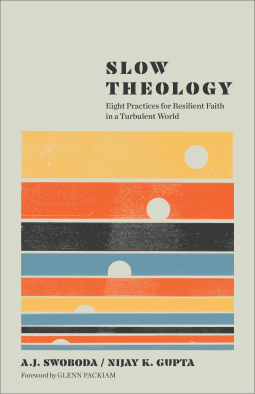
Slow Theology
Eight Practices for Resilient Faith in a Turbulent World
This title was previously available on NetGalley and is now archived.
Send NetGalley books directly to your Kindle or Kindle app
1
To read on a Kindle or Kindle app, please add kindle@netgalley.com as an approved email address to receive files in your Amazon account. Click here for step-by-step instructions.
2
Also find your Kindle email address within your Amazon account, and enter it here.
Pub Date 23 Sep 2025 | Archive Date 17 Dec 2025
Baker Academic & Brazos Press | Brazos Press
Talking about this book? Use #SlowTheology #NetGalley. More hashtag tips!
Description
In our fast-paced world of outrageous headlines and knee-jerk reactions, we struggle to hear God's voice amid the noise. Despite constant connectivity, our lives lack true spiritual connection and depth.
A. J. Swoboda and Nijay Gupta offer a practical theology guide for building resilient faith through Christian discipleship. Addressing spiritual deconstruction and doubt with honesty, they show how to fortify your faith against cultural challenges through eight transformative spiritual practices, including
● taking your time in prayer and Bible study,
● building patience for your spiritual journey and faith formation,
● slowing down your thinking and decision-making process,
● finding peace with unanswered questions rather than demanding easy solutions, and
● facing spiritual difficulties head-on instead of avoiding them.
This Christian living book helps weary believers reconnect with God and neighbor through intentional spiritual growth. With a foreword by Glenn Packiam, it's perfect for devotional reading, small group study, or anyone seeking authentic faith formation.
Advance Praise
“This book is a breath of fresh air—humble and thoughtful but full of conviction that the way of Jesus is worth pursuing. Slow Theology does not merely affirm important theological conclusions, it articulates a way of thinking—and living—theologically. Whether you are skeptical about Christianity or exhausted with theological bickering, A. J. and Nijay present a vision of Christian theology that just might inspire you to greater study of and relationship with God.”—Kaitlyn Schiess, senior editor, Holy Post Media; author of The Ballot and the Bible: How Scripture Has Been Used and Abused in American Politics and Where We Go from Here
“Swoboda and Gupta offer us a way to do theology that is slow in a 24/7 world, focused in a distracted age, thoughtful in judgmental places, and contemplative instead of taking the clickbait. They urge us to find rest in Christ from our worries and labors. A great invitation to slow down, breathe, and believe afresh.”—Michael F. Bird, deputy principal, Ridley College, Melbourne, Australia
“This book reminded me that sometimes we will get to where we are going quicker if we are willing to slow down. A. J. and Nijay are calm voices of leadership in a time of great chaos. Slow Theology will help you endure.”—Heather Thompson Day, author of What If I’m Wrong?
“T. S. Eliot once asked, ‘Where is the life we have lost in living?’ Today, many are asking the same question. We are living at a pace that is unsustainable, doing violence to our souls. In Slow Theology, A. J. Swoboda and Nijay Gupta paint a beautiful, compelling, and deeply theological vision of living and walking with God at a pace that humanizes, nourishes, and leads to the flourishing of our souls.”—Jon Tyson, author and pastor of Church of the City New York (jontyson.org)
“Ours is an age that prizes quick takes, sharp certainties, and tidy solutions. But faith doesn’t rush. Slow Theology invites us to pause—really pause—to dwell with God in the questions, to make peace with mystery, and to journey through the rugged terrain of belief with resilience and hope. A. J. Swoboda and Nijay Gupta offer not only profound theological insight but also pastoral wisdom shaped by suffering, beauty, and a trust in the slow, redemptive work of God. This book does not shy away from the chaos of our time; instead, it dares to suggest that chaos might be the very compost from which Christlikeness can grow. Every page pulses with grace, truth, and an unflinching belief in the God who never rushes but always redeems. I will be recommending this book to pastors, students, and weary saints everywhere.”—Tara Beth Leach, author of The Great Morning Revolution
Available Editions
| EDITION | Other Format |
| ISBN | 9781587436437 |
| PRICE | $19.99 (USD) |
| PAGES | 208 |
Available on NetGalley
Average rating from 12 members
Featured Reviews
 Aaron M, Reviewer
God is omnipotent.
God is omniscient.
God is omnipresent.
God is just
God is faithful.
God is love.
God is slow.
Yes, God is slow. Or so claim A.J. Swoboda and Nijay K. Gupta in their new book, Slow Theology: Eight Practices for Resilient Faith in a Turbulent World (Brazos Press, 2025).
Well, not always slow. The authors point out Psalm 147:15, according to which God’s “word runs swiftly” to accomplish God’s will, and Isaiah 5:26, in which the prophet says God will summon foreign nations “swiftly, speedily.” But, state the authors, “more often than not, God is described as acting slowly. . . . Two to one, God’s slowness is highlighted more than his quickness.”
For example, God could have created the world in a flash, but instead Genesis portrays God rolling it out in six “days,” which I take to symbolize eras best measured in creeping geologic time. Swoboda and Gupta point out that the Bible passage most quoted by other Scripture when describing God’s character is Exodus 34:6-7, which famously says God is “slow to anger.” God is (mostly) slow.
We, too, should slow down. On the seventh day, with the ponderous work of creation complete, God rested. Why? Not because God was exhausted, say Swoboda and Gupta, but to set us an example, to establish a rhythm for human life that is sufficiently slow.
The authors also note the insight of Japanese theologian, Kosuke Koyama, in his 1979 book, Three Mile an Hour God: the incarnate God of Christian faith, Jesus of Nazareth, conducted most of his world-transforming work on dusty roads in Galilee, walking at three miles an hour. If Jesus is the exemplar of humanity, perhaps there is something to learn not just from what he did but how he did it: slowly.
Of course, this call to slow down is meant as an antidote to the blistering pace of contemporary Western culture, according to which we must hone our efficiency, maximize our time, and juice every drop of productivity before rushing to the next thing.
In this call to slowness, our authors are not alone. As they point out, their book joins a growing body of work, including Slow Church by C. Christopher Smith and John Pattison, Slow Kingdom Coming by Kent Annan, The Ruthless Elimination of Hurry by John Mark Comer, Alan Fadling’s An Unhurried Life, and Eugene Peterson’s The Contemplative Pastor.
What struck me as fresh about Slow Theology was that most of the eight practices it offers for slowing down center on the development of a believer’s theology—the cognitive framework of faith.
For example, Swoboda and Gupta counsel patience as we come to know God, accepting the slow unfurling of such knowledge and our ignorance in the meantime. They commend the weekly practice of sabbath as a way to cultivate calm minds capable of reflection, pondering, and thoughtfulness. They encourage us to sit with the theological problems we encounter and not rush on from them with canned answers.
The practice that resonated most for me was that of communal reflection. Swoboda and Gupta write, “we live out . . . faith together, interconnected, interrelated, and in constant need of communal experience. Doing the work of theology together is . . . slower and more difficult. But the end result is bound to be clearer and truer.” Amen.
My denomination, the Presbyterian Church USA, currently has no fixed stance on the marriage and ordination of gay people. Instead, it leaves the matter for congregations to determine for themselves. Although my pastor has long-held convictions that gay marriage and ordination are perfectly acceptable, due to the divisive nature of the issue and the diversity of views in our congregation, our community had never articulated a public statement on the issue.
However, several years ago, after a person who identified as queer quit our church because they didn’t feel welcome, the Session (the board of ruling elders on which I sit) took up the question of whether to post a statement on our website affirming a commitment to welcome people of all sexual orientations fully into the life of our congregation, including its sacraments, membership, ceremonies, and leadership.
For over a year, the Session read biblical scholarship on both sides of the issue, discussed the relevant theological arguments, considered our personal experiences, engaged the rest of the congregation in “listening sessions,” and prayed together about the best course of action. We pursued this communal discernment with fear and trembling, in full knowledge that other churches in our denomination had ruptured while posting similar welcome statements.
In the end, our Session decided in favor the statement. What did not happen was a wrenching split in our congregation. People whose scriptural convictions run contrary to the welcome statement remain in our pews alongside those who support it.
I attribute this happy result to the process of reflection and discussion we undertook together. The Session could have posted the statement after a swift vote at an evening meeting. Instead, we moved slowly, and the result was continued love, unity, and stability, despite what could have been a divisive change. As Swoboda and Gupta suggest, the process was slower and more difficult than simply voting, but it was also better.
Today is a day off from my job, so it’s a writing day. A day I’m hungry for a quiet block of time—some precious hours of unbroken thought allowing me to write something coherent.
Instead, I have contractors in my house. They’ve been here three months, and there’s at least two weeks still to go. I’m writing in snatches, between contractor questions and requests to move furniture so they can paint walls, remove old windows, and drop in new ones.
This contractor work is a gift, a blessing, work for which our old house has ached for years. But it’s also disrupting my writing day and making me anxious, stealing the special time I look forward to once every two weeks, and making me wonder whether I’ll finish this review.
Yet amidst the disruption—as I’m standing on a step stool, removing curtains from rods and folding them as neatly as I can, wishing I were in the writer’s chair—I hear God’s whisper to slow down. To live this book I’ve just read. To be patient with the slow, inefficient, inconvenient pace of life and discipleship. The paint will go up. The windows will slide into place. The words will make their way onto the page. The work will get done.
And so will God’s work in me. God works on God’s own time. The pace of Christian discipleship often feels slow to us. It’s God’s project, and it lasts our entire lifetime. The contribution of Swoboda’s and Gupta’s Slow Theology is to help that fact sink in. Slowly.
 Katie B, Reviewer
In a world of noise, distraction, and shallow connection, this book offers a slower way. With honesty about doubt and deconstruction, it invites readers to resist quick fixes, embrace mystery, and cultivate communal faith. Theologically rich yet accessible, it equips us with practices to steady our walk with Jesus in today’s frenetic culture.
I’ve been a fan of both of these authors for a while! Swoboda’s After Doubt and Gupta’s Tell Her Story have shaped me deeply (I practically quoted After Doubt in its entirety in my master’s thesis 😂). What I respect most is how they model authentic questioning of faith while still holding a high view of Scripture—a rare combination in most conversations about shifting belief. That’s why they’re the perfect duo to guide us in developing a theology that doesn’t crumble every time culture shifts. Instead, they call us to sloooowly think through what we believe. Faith is going to falter if it isn’t yours. This book gives us eight practices to develop just that.
Thank you @brazospress for the ARC 🥰 I love what these authors are contributing to the discipleship/theology discussion.
Perfect for you if you like:
Theology
Spiritual formation
Honest wrestling
Similar to:
Discover the Mystery of Faith by Glenn Packiam
Faith After Doubt by Brian D. McLaren
Mere Christianity by C.S. Lewis
Pete F, Media/Journalist
I truly appreciate the focus on slowness, and found some good things in here. One of my favorite quotes:
"In fact, we often settle for knowing things about God without knowing God himself. We have a word for that: "stalker.""
However, I had difficulty figuring out the narrative voice. It seemed that the book was about both a slow approach to theology (humility and patience, being willing to sit in the messy) and theology that flows out of that slowness (for example, salvation is a long, slow process of sanctification). I didn't find the "practices" language from the subtitle an accurate description of the chapter layout.
Michael T, Reviewer
Slow Theology is a beautiful reminder that following Jesus isn’t a race to the finish line but a pilgrimage. For anyone longing to slow down, to deepen faith beyond the superficial, and to live resiliently in an often frenetic world, this book offers both encouragement and direction. It’s not just theological reflection—it’s a practical guide to cultivating a faith that can endure.
 Richard P, Reviewer
The thing that strikes me about A.J. Swoboda and Nijay Gupta, co-authors for "Slow Theology: Eight Practices for Resilient Faith in a Turbulent World," is that they're slow and steady.
These are not showboating theologians. These are not attention-seekers. There's really not a page of excess contained within the relatively quick read that is "Slow Theology." (NOTE: I say "quick read" primarily directing it toward theology nerds who devour anything and everything theology).
Swoboda and Gupta are refreshing in that there are no real "quick takes" here or theological lightning strikes. Instead, "Slow Theology" leans into a deeper faith found in a gentler, more patient and, yes, slower way of leaning into our Christian faith by utilizing these eight practices not in a legalistic way but in a life-giving way.
"Slow Theology" is less prescriptive and more facilitating of deep faith in the busyness that has become our lives. I can't help but think this is an intentional approach to writing "Slow Theology." In a world of high-volume disagreements and knee-jerk Christianity, "Slow Theology" leans into eight practices capable of transforming and protecting our faith against cultural challenges and techno-impulses.
While I will admit I didn't necessarily resonate with every conclusion made here, I did resonate with these practices encouraging a more patient life of prayer and Bible study, a gentler pace for faith formation, an encouragement against rapid-fire decison-making and drive-thru faith practices and, for me most refreshingly, tackling our spiritual difficulties directly rather than kicking them on down the road.
Some of the conclusions, for example those around social media, feel a tad "easy" to me and more based in stereotype than personal experience. However, these are minor quibbles for a book that provides for a more soothing Christian life and more fulfilling and meaningful connection.
"Slow Theology" is ideal for personal devotional time, small groups and, in my opinion, young adult groups making that transition from childhood faith practices to adulthood faith practices. Even when I didn't agree, I found these ideas worthy of contemplation and valuable to my own life of faith.
Jason A, Educator
Slow Theology is a book about what to expect from the Christian life and how to live it faithfully through engagement with theology in community with the church.
It's pitched for an audience that hasn't learned much theology yet, but wants something more substantial than hot takes. This isn't a theology overview, but rather advice for engaging with theology. I could see this being a helpful group read for a youth group or high school Bible class.
If I could change anything, it would just be the pace. Even for a book called Slow Theology, this is pretty wordy, and the pace drags some.
I received an eARC in exchange for my review.
Freddy L, Reviewer
Slow down and be in God’s presence, that is the heart of Slow Theology, as the authors Nijay Gupta and A.J. Saw is an explored through eight practices what it means to be a slow theology church. Many of the chapters are helpful by reading the chapter title alone, though some of the chapters may suffer a bit from an information dump. As such, those chapters were harder to follow. A summary at the end of each chapter would also help, and possible reflection questions to explore further. Still, the chapters which are clear more than rectify this minor inconvenience, especially the quote about the slowest person in the church reveals the theology of that church is a gem, and our need to abide and be with Jesus is our way to counter the fast food treatment of church programs and products. The chapter on mystery is also illuminating on the historical mistakes of flattening god, and the importance of church and community as a place for communal fellowship while exercising individual gifts hold the tension of what churches are in expression to cheering on one another in service and mission together.
 Christian Shelves -, Reviewer
Even if this book is about pursuing theology in a slow manner, I read it rather quickly twice in one week as there was so much to glean from it. Each of the eight practices that the authors cover in approaching theology from a more deliberate pace are worth delving into at a deeper level, and I found that going through it again in rapid succession (how ironic!) only enhanced my experience of the book. Bringing in examples from the Bible, Christian history, and life today, it's a book that serves as both an introduction to topics such as the Sabbath, pain, and communal theology, and a meatier work to chew on as perseverance and complexity drive many of the insights that are provided.
I appreciate the call to resist fast and easy answers when trying to understand matters beyond human understanding, such as the Trinity, and the reward of walking with God as opposed to just figuring Him out for our own purposes. Undergirding this book is a sense of desiring to abide in Christ as the chief aim in wanting to know Him better; thus, this would make an excellent book for discipleship purposes. If readers are looking for a theology book that infuses life and spirit into why we choose to study God and how we can add to our knowledge about Him, Slow Theology is a vibrant guide to experiencing God that extends beyond our minds.
Readers who liked this book also liked:


Sandra L. Glahn
Christian, Nonfiction (Adult), Religion & Spirituality

Elissa Yukiko Weichbrodt
Arts & Photography, Nonfiction (Adult), Religion & Spirituality