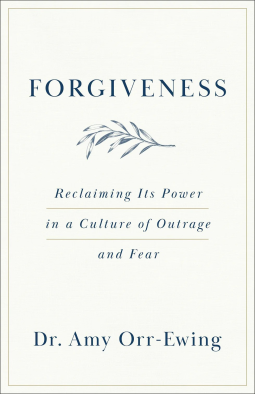
Forgiveness
Reclaiming Its Power in a Culture of Outrage and Fear
This title was previously available on NetGalley and is now archived.
Send NetGalley books directly to your Kindle or Kindle app
1
To read on a Kindle or Kindle app, please add kindle@netgalley.com as an approved email address to receive files in your Amazon account. Click here for step-by-step instructions.
2
Also find your Kindle email address within your Amazon account, and enter it here.
Pub Date 21 Apr 2026 | Archive Date 8 May 2026
Baker Academic & Brazos Press | Brazos Press
Talking about this book? Use #Forgiveness #NetGalley. More hashtag tips!
Description
In a culture shaped by outrage, punishment, and fear, forgiveness is often misunderstood--or dismissed entirely. It can feel impractical, unjust, or even harmful to our mental health.
But what if the opposite is true?
In Forgiveness, public theologian Amy Orr-Ewing explores why forgiveness is not a denial of justice but a powerful path toward healing, freedom, and hope--for individuals and for society. Drawing from theology, psychology, history, and literature, she examines
● why forgiveness is essential to emotional and mental well-being;
● how outrage and cancel culture damage individuals and communities;
● why forgiveness does not excuse harm, but can uphold justice;
● what the Christian vision of forgiveness offers that secular approaches cannot; and
● how breaking cycles of resentment can lead to genuine freedom.
Written for anyone wrestling with anger, hurt, or division--and especially for Christians seeking to live faithfully in a fractured world--this book offers a compelling vision of forgiveness that restores individuals, renews communities, and opens a way forward.
Forgiveness is not weakness. It may be the most powerful response we have.
Advance Praise
“Like a beautiful diamond turned and turned so that its many dazzling facets can all be seen, forgiveness in Amy Orr-Ewing’s skillful treatment shines in a variety of settings. Clear, timely, and helpful, the insights here both comfort and challenge, for all of us as individuals and for our communities and nations too.”—Os Guinness, author of American Homecoming
“The book you are holding in your hands has the potential to change your life—for real. Forgiveness: Reclaiming Its Power in a Culture of Outrage and Fear is the book we need in this moment. Amy masterfully unpacks this profoundly misunderstood and largely forgotten superpower.”—Christine Caine, founder of A21 and Propel Women
“At this juncture in history, forgiveness is not merely an admired virtue but something our polarized world and damaged hearts desperately need. Amy Orr-Ewing has written a wonderful guide to forgiveness—revealing its Christian origins, its importance to our shared history, and our profound need for it in this moment.”—Mark Sayers, lead pastor of Red Church Melbourne; author of A Non-Anxious Presence and Platforms to Pillars
“If you are looking for a theologian who can unpack the most complex issues of life and culture, there are few better than Amy Orr-Ewing. In this book she looks at the thorny issue of forgiveness with her usual depth of theological expertise and wealth of practical experience.”—Nicky Gumbel, pioneer of the Alpha Course
Available Editions
| EDITION | Other Format |
| ISBN | 9781587436079 |
| PRICE | $21.99 (USD) |
| PAGES | 208 |
Available on NetGalley
Average rating from 4 members
Featured Reviews
 Bianca O, Reviewer
Amy Orr-Ewing’s Forgiveness offers a thoughtful Christian exploration of forgiveness in an age shaped by outrage, fear, and polarisation. While some parts of the book didn’t fully resonate with me, other sections offered deep and meaningful reflections, resulting in an overall three-star experience.
The first quarter of the book and parts of the concluding section were less engaging for me personally. However, the theological core contains insights that gave me new ways of thinking about forgiveness—especially the idea that God’s judgment provides a bigger perspective on letting go of vengeance. The conviction that no sin, however outrageous, escapes God’s justice reassures the wounded that releasing anger doesn’t mean injustice disappears. That idea felt both powerful and grounding.
One of the most helpful aspects was the discussion of the four views of forgiveness. I had not previously been familiar with these distinctions, and found them both informative and worth exploring further. Orr-Ewing also defines forgiveness clearly: it means acknowledging that a real wrong has occurred and choosing not to pursue repayment or revenge. Forgiveness does not erase the harm or its consequences; it simply surrenders the right to vengeance to God, a distinction that feels biblically serious and emotionally honest.
The communal dimension of forgiveness also resonated. As the Anglican confession notes—“forgive what we have been, help us to amend what we are, and direct what we shall be”—forgiveness is both mercy and transformation. In communities, it enables relationships to endure and grow. With true repentance, forgiveness can deepen empathy, resilience, and maturity.
I also appreciated Desmond Tutu’s insight: “Forgiving is not forgetting; it’s actually remembering—and not using your right to hit back.” This idea—that forgiveness remembers but chooses not to retaliate—strikes a mature and realistic tone. Memory becomes wisdom rather than a weapon. One of the book’s strongest points is how forgiveness can preserve dignity, resist humiliation, and challenge unfair power dynamics, showing that choosing to forgive is often an act of courage rather than weakness. I’m particularly interested in exploring this further, especially the concept of “turning the other cheek,” which I haven’t studied in depth yet.
Where I struggled was with the section on self-compassion and self-forgiveness. While many Christians affirm these ideas, I found them less persuasive. For me, the book’s strongest contributions lie in its emphasis on divine justice, human dignity, repentance, and surrendering vengeance to God.
While not every section resonated, the book offers meaningful reflections worth engaging—especially for readers seeking a deeper theological understanding of forgiveness in a culture that often confuses it with weakness.
Readers who liked this book also liked:

Elissa Yukiko Weichbrodt
Arts & Photography, Nonfiction (Adult), Religion & Spirituality