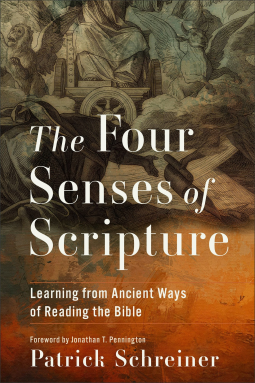
The Four Senses of Scripture
Learning from Ancient Ways of Reading the Bible
You must sign in to see if this title is available for request. Sign In or Register Now
Send NetGalley books directly to your Kindle or Kindle app
1
To read on a Kindle or Kindle app, please add kindle@netgalley.com as an approved email address to receive files in your Amazon account. Click here for step-by-step instructions.
2
Also find your Kindle email address within your Amazon account, and enter it here.
Pub Date 4 Aug 2026 | Archive Date 18 Aug 2026
Baker Academic & Brazos Press | Baker Academic
Talking about this book? Use #TheFourSensesofScripture #NetGalley. More hashtag tips!
Description
Patrick Schreiner doesn't believe modern hermeneutics is wrong but believes that it is incomplete in ignoring these other aspects. Here he seeks to recover this ancient method by explaining it, defending it, and offering a coherent method for using it. With scholars, students, and pastors in view, he argues that this approach, with the senses in conversation with each other, better respects the nature, goal, and ecclesial setting of reading, interpreting, and applying the Bible.
Schreiner begins by giving a brief overview of the four senses and why early Christians used this method. He then examines each sense in detail, exploring the what, why, and how, along with providing examples. Finally, he addresses anticipated exegetical, historical, and allegorical objections to his proposal. The book includes a foreword by Jonathan T. Pennington.
Available Editions
| EDITION | Paperback |
| ISBN | 9781540968791 |
| PRICE | $27.99 (USD) |
Available on NetGalley
Average rating from 3 members
Featured Reviews
 Matthew M, Educator
Patrick Schreiner sets out to argue that the church should recover the four senses of Scripture: the literal, the allegorical, the tropological, and the anagogical. If that terminology is not familiar, this is a simple breakdown:
- Literal sense = The natural sense of words in their historical and grammatical context.
- Allegorical sense = The spiritual, symbolic, and figural sense that pertains to Christ and the church.
- Tropological sense = The moral sense; the moral and practical application of the text.
- Anagogical sense = The eschatological sense, how the text points forward to our ultimate hope.
Going into this book, I was sympathetic to wanting to recover or at least learn from the historic fourfold senses of Scripture. I admit I was not initially wholly convinced that it could be fully recovered, but I became more convinced of the feasibility as Schreiner continued to make his argument. I'm still not sure I'm fully convinced due to some fuzziness in real application, but dang, I was encouraged by the end of the book. Reading about interpreting Scripture brought life to me.
Even if you are not fully convinced of Schreiner's argument, I think the greatest value in his book is pointing us to allow more of the Spirit into our reading of Scripture. I think he rightly contends that our modern applications of the grammatical-historical methods have become too materialistic, too focused on the human authors, and do not, at least in theory, allow enough room for the divine author to speak. He reminds us through his application of the spiritual senses that God may intend more than the human authors ever did. We are not confined to merely what the human authors must have known or even intended; God could have intended greater meanings that point forward to Christ or to the eschaton. In some ways, Schreiner has given me better categories for how the New Testament authors read and interpreted the Old Testament.
Now while the language of the quadriga (the fourfold senses) might seem strange, it really is not entirely foreign to use. We do often engage in it even if we do not wholly recognize it. While I am still not clear on application of the quadriga in all contexts—do we see anagogical readings in Revelation or only the literal sense since its natural context is eschatology?—Schreiner does helpfully include an appendix that was quite clarifying. In simple layman's terms, he contends that the quadriga is teaching the reader to ask four questions of the text:
1. "What does the text mean in its original setting?"
2. "How does the text point me to Christ and the church?"
3. "How does the text form us as people and give us instructions for how to live?"
4. "How does the text point us to our glorious future and Christ's return?"
That's it. It feels very familiar. I can get behind using those questions to guide my Scripture reading and teaching.
My main complaint is I wish there were more examples. Schreiner says in the Preface that he cut a whole section of the book that was devoted to more extended examples of applying the quadriga since the book was too long. In my estimation, that makes the quadriga perhaps more abstract than it needed to be. If that section is not restored before final publication, I hope that he will publish a follow-up book devoted to practically interpreting through the fourfold senses.
I heartily commend this book. It was a blessing to me, and I believe it will be a blessing to others.
Readers who liked this book also liked:
Michael J. Anthony, James Riley Estep Jr. and Kevin M. Gushiken
Christian, Religion & Spirituality



Ruth Anne Reese and Madison N Pierce
Christian
Elissa Yukiko Weichbrodt
Arts & Photography, Nonfiction (Adult), Religion & Spirituality


Views expressed in promotions/advertisements do not necessarily reflect those of NetGalley or its affiliates.
© 2026 NetGalley LLC
• All Rights Reserved


Views expressed in promotions/advertisements do not necessarily reflect those of NetGalley or its affiliates.