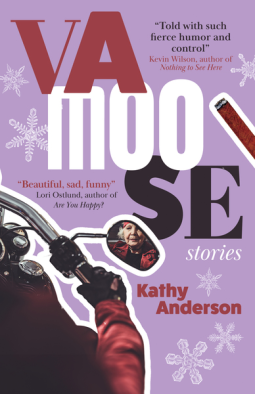
Vamoose: Stories
by Kathy Anderson
You must sign in to see if this title is available for request. Sign In or Register Now
Send NetGalley books directly to your Kindle or Kindle app
1
To read on a Kindle or Kindle app, please add kindle@netgalley.com as an approved email address to receive files in your Amazon account. Click here for step-by-step instructions.
2
Also find your Kindle email address within your Amazon account, and enter it here.
Pub Date 9 Jun 2026 | Archive Date 30 Sep 2026
Vine Leaves Press | Get Red PR
Talking about this book? Use #vamoosestories #NetGalley. More hashtag tips!
Description
*Short Story Collection*
Two lesbian librarians launch a life-changing friendship in the back of a pickup truck at Texas Gay Pride in 1989. The Queen of the Stilt Walkers fights off her larcenous brother to keep her home. A lesbian former foster child endures Kundalini yoga class in her quest for love. A murderous nun takes revenge on her mother for forcing her into the convent. Dogs keep biting a new lesbian couple and they don't know why. Sisters fight off an invasion of mice in the room where their mother is dying.
Filled with crackling humor and surprising loves, Vamoose is a propulsive collection of fifteen stories of women leading lives of self-determination, small triumphs, and subversive pleasures.
A Note From the Publisher
She lives with her wife in Philadelphia, PA.
Advance Praise
"Kathy Anderson has such a masterful touch with short stories, and I've long admired her ability to write about the messiness where need and desire touch up against the limitations of our minds and hearts. In these amazing stories, told with such fierce humor and control, characters reckon with the end of things, the fallout, the cleaning up, but Anderson knows how that loss, that untethering, can create a feeling of ascendancy."—Kevin Wilson, author of Nothing to See Here
"In Vamoose, Kathy Anderson writes with deep compassion and humor, both dark and quirky, of the loneliness of human beings, of their flaws and their small, but meaningful triumphs, all narrated with Anderson's signature playfulness and flair for the unexpected... Vamoose right out the door to buy this beautiful, sad, funny set of stories."—Lori Ostlund, author of Are You Happy?
"This is not Benjamin Franklin's Philadelphia, unless perhaps we're talking about the drag king version on stilts. Put that key on the end of your kite-string, however, because these tender, funny, brave stories are electric: Kathy Anderson's wise and humane writing opens windows into the storm of life-changing moments-read Vamoose and you'll like nothing better than getting soaked in the rain."—Dinah Cox, author of The Paper Anniversary
"Tough or vulnerable, straight or gay, the women in Kathy Anderson's nimbly written collection don't merely ask for the reader's attention, they demand it. Every story in Vamoose is a bright pop of energy: bold, entertaining, and full of wry truth."—Louise Marburg, author of You Have Reached Your Destination and Fancy Meeting You
"Vamoose: Stories is a book of love-love affirmed, abandoned, depleted, rescued, reinvented, mourned... You will laugh out loud-and in the next paragraph find yourself close to sobbing for her vulnerable, complex, ferociously honest characters. I love this book."—Lee Upton, author of The Withers
"Kathy Anderson's award-winning first story collection, Bull, affirmed my initial estimation. Now it's 2026 and here comes Vamoose-a long anticipated follow-up to Bull, equally as compelling, hilarious, sad, heartfelt, smart, thought provoking."—Sara Pritchard, author of Crackpots and Help Wanted: Female
"Vamoose crackles with energy. With characters on the move, changing locations and their lives, these stories delight with quirks and eccentricities. Ultimately, Kathy Anderson reveals her humor and humanity within these pages."—Julie R. Enszer, Editor, Sinister Wisdom
"Vamoose is an exquisite swirl of narrative style, gorgeous writing, and heart. Anderson, a master of the short story, never lets us forget that the stories in a collection, whether they take place in a yoga class, a new relationship, a therapy session, or at the bedside of a hospice patient, must be all yoked together by that "it" factor, the one that leaves you feeling you didn't just read a story, but you had an experience. A brilliant read."—Francine Witte, author of Radio Water
"Kathy Anderson's wonderful new collection explores love, grief, and the impossible but necessary task of saying goodbye. One character discovers that "knowing she could die at any moment made life very dramatic. It was like an excited dog ran by her side the whole time." I loved that, because that's how I felt reading these stories. The characters in Vamoose are so real that I wanted to sit them down and say: Tell me more. Stay a little longer."—Becky Hagenston, author of The Age of Discovery and Other Stories
Marketing Plan
- Goodreads Giveaways
- Podcast and Radio Tour
- National press
- Regional / Philadelphia press
- LGBTQIA press
- Influencer campaign on Instagram and TikTok
- Goodreads Giveaways
- Podcast and Radio Tour
- National press
- Regional / Philadelphia press
- LGBTQIA press
- Influencer campaign on Instagram and TikTok
Available Editions
| EDITION | Paperback |
| ISBN | 9783988322067 |
| PRICE | |
| PAGES | 180 |
Links
Available on NetGalley
Average rating from 8 members
Featured Reviews
 Demetris P, Reviewer
Exit, Pursued by Grief, a Dog Bite, and One Very Bad Hospice Manual
In “Vamoose: Stories,” Kathy Anderson proves that the funniest woman in the room may also be the one taking the clearest measure of love, care, and escape.
By Demetris Papadimitropoulos | April 8th, 2026
“Vamoose” is a comic word for a serious act. It sounds like a joke somebody makes while already backing toward the door – a little flourish of slang, a little dust kicked up on the way out. Kathy Anderson knows exactly what she is doing by choosing it. In “Vamoose: Stories,” that word begins as a wisecrack and ends as something heavier, sadder, and much harder to hear innocently. By the time the title story arrives, “vamoose” has been dragged through breakups, friendship, caregiving, daughters, bodily failure, old rage, and death itself. What at first seems like a lively, voice-rich collection about queer women, oddballs, dogs, nuns, therapists, and the body’s rude paperwork turns out to be a book about exit – about who gets to leave, who longs to, who cannot, and what kind of moral weather gathers around the wish to go.
That is the collection’s hidden verb. Anderson keeps asking the same question in different wigs, uniforms, and bad situations: when is getting out a betrayal, and when is it survival? Her women pace that line in romance, in friendship, in family life, in care work, in the daily maintenance of a self that no longer fits the story assigned to it. Some clear out. Some itch to. Some discover they have been half-gone for years. What gives the book its force is that Anderson never lets those choices stay clean. Leaving may be overdue, cowardly, merciful, selfish, lucid, or some ugly braid of all five. The book does not sort the strands for us. It lets them tighten.
Anderson gets to pain by talking around it until the circle suddenly cinches. Not softeningly funny. Not therapeutic-laugh funny. Not the kind of funny that reassures you the sadness will be manageable if you just stay nimble enough. Her comedy has elbows. It notices what dignity would prefer left offstage – yoga-class farts, cracked lips, dog bites, guacamole in the face, exploding homemade wine, bad lovers, fake boobs, failing knees, hospice manuals fit for the nearest trash can. “Hairy Govinda” is the cleanest proof. A woman takes Kundalini yoga because her girlfriend thinks she is emotionally stunted, and the story turns into a manic snarl of foster-care history, class rage, psychic hokum, sexual taste, bodily panic, and the intolerable vulnerability of corpse pose. It is hilarious. It is also the story of what happens when someone who survives by reflex, sarcasm, and appetite gets trapped inside a ritual meant to hold her still long enough for old terror to rise. Anderson’s jokes do not cushion revelation. They corner it.
The opener, “Alondra and Krissie: A Photo Album,” gets down to business before the book has had time to seem merely charming. Across snapshots dated from 1989 to 2019, Anderson traces the long friendship between two lesbian librarians whose temperaments fit each other crookedly and, for that reason, endure. Krissie is anxious, dutiful, chronically braced for catastrophe. Alondra is Puerto Rican, expansive, socially fearless, impatient with fear as a way of arranging a life. They meet at a conference, ride in the back of a pickup truck to a gay rodeo dance in Texas, mildly appall each other, and remain lashed together for decades anyway. Trips, breakups, money trouble, politics, illness, care, and grief pass through the frame. Lovers come and go. The friendship stays. By the time Anderson gets them under the “Mejores Amigos” sign, she has quietly done something more radical than it first appears. She has let friendship do the work literary fiction often reserves for romance. The book never says this with fanfare. It just proves it.
That quiet revaluation of attachment runs all through the collection. “Welcome New Lesbians,” in which a middle-aged couple entering queer social life together keeps getting bitten by dogs, sounds like a comic sketch and turns into a sly account of initiation, ex-husband residue, and the way small humiliations harden into marital folklore. “My Woman” gives us a sculptor with a wrecked love life making clay women who keep losing heads, limbs, and coherence, then hauling the whole lumpy disaster into therapy, where lust, vanity, grief, and self-mythology keep switching masks. “On the Train from Dublin to Limerick” follows a housekeeper who floods her employer’s mansion and flies to Ireland with a suitcase and the beginning of criminal relief. “Come as You Are” gives an aging stilt walker deciding who deserves her costumes, her stilts, and whatever of her might outlast her. Anderson likes a premise with one wheel loose. Better still, she knows when to stop admiring the wobble and let the hurt take the room.
The sentences are where the mess gets handled. Anderson is quick on her feet, idiomatic, and dead-on. Her narrators talk fast because sitting quietly with the truth would hurt. She likes lists because lists let obsession impersonate control. She likes one bodily detail that can double as judgment. She likes a phrase tossed off so casually you miss its teeth until it closes. Bodies are where these characters lose the argument with dignity, and her language meets them there – bitten wrists, hospice lips, yoga knees, sponge baths, hunger, bunions, old mattresses, ill-fitting bras, fake serenity, the paper trail of dying. Even when a voice seems to be improvising, the pressure is exact. The comedy flies because the observation is exact. The hurt lands because the prose will not pad it.
There are tonal bearings nearby – “Wants” by Grace Paley, “Birds of America” by Lorrie Moore – but mostly to clarify what Anderson is not. She is less aphoristic than Paley, less sentence-showy than Moore, and more interested than either in the grubby mechanics of money, tending, appetite, bodily failure, and queer couple life once the parade floats are packed away. The intelligence here is working, not posing. It pays rent. It cleans up after itself. It knows the cost of groceries and the smell of fear and the kind of joke people tell when they do not want to be caught needing too much.
The order of the book matters almost as much as the prose. This is not a collection that merely arranges a series of good pieces and trusts that tonal consistency will pass for design. The sequence itself is an argument. Early pages move through friendship, flirtation, parties, breakups, queer social weather, comic damage, self-presentation. Later pages move into harder rooms – mothers, illness, caregiving, bedpans, old lies, hospice, the clerical drag of mortality. That is not drift. It is the screw tightening. Early on, people leave parties, lovers, jobs, versions of themselves. Later, the question gets uglier. May one leave the dying? May one ever quite leave a mother? Can a body be released before those around it are ready? Read casually, the collection may look various. Read closely, it feels like an escalation in consequence.
That escalation is why the late stories matter so much. “Grand Total,” one of the book’s load-bearing pieces, follows Toni Ann as she tends her husband Charlie through his final decline, hating the cheery hospice script, hating the book that keeps trying to turn death into a lesson plan, hating the entire apparatus that wants to neaten what cannot be neatened. The story is savage and loving at once. Toni Ann is furious, exhausted, devoted, bored, protective, and ready to throttle almost everyone in the room, including, on a bad enough day, the dying man she loves. The brilliance of the story lies not simply in refusing sentimentality but in refusing the sentimental replacement for sentimentality – the flat pose of stoic truth-telling. Toni Ann is not nobly unsentimental. She is a mess. She is also right. The same is true, in a different key, of “Mother House,” in which a nun wheels her mother toward train tracks while demanding the truth about the family lie that delivered her to convent life. The story is grotesque, funny, bitter, and unexpectedly tender, and it understands something many books about mothers do not: love can persist without gratitude, and damage can remain damage even after it has become family history.
Then comes “Vamoose,” the closer, where sisters keep vigil over their dying mother while mice scratch in the walls and an exterminator asks whether the mice might simply find their own way out. The image is rude, exact, and perfect. Death, vermin, boredom, daughters rubbed thin, the clutter of a house and a life – everything is in the room at once. That story does not merely conclude the collection. It retroactively sharpens it. By then, “vamoose” no longer means only comic disappearance. It has become a word for release under conditions that are neither pure nor pretty. The mother’s final ascent does not erase the mice, the resentment, the fatigue, or the mess. It happens above them.
What Anderson can do, when a story really catches, is not tonal dexterity for its own sake but moral exactness under comic pressure. She makes comedy carry feelings that would curdle in a softer style. Care here is never cleaned up for display. It is tangled with boredom, fury, appetite, disgust, habit, and the fantasy of escape. Toni Ann in “Grand Total” loves her husband and wants to throttle the hospice script that has arrived to manage his disappearance. The sisters in “Vamoose” are dutiful, exhausted, and sick of waiting. Krissie and Alondra sustain one another for decades while also judging, needling, and baffling one another. These women are not mascots for liberation or damage. These couples are not offered as proof of virtue. These caregivers do not become saints because the work is ugly and hard. The book will not flatter anybody into nobility just for having suffered. That refusal is how it gets to tenderness the hard way.
Its weakness is that the same tonal glue that holds it together can make too many pages smell faintly alike. Across fifteen stories, the emotional weather can start to feel familiar – abrasion, grievance, asymmetrical devotion, relational fatigue, the itch to get out. Sometimes that recurrence is the point. Sometimes it narrows the range. A few pieces are more memorable for voice or setup than for the depth they finally reach, and some secondary figures arrive as comic types and stay near that function. None of this sinks the collection. The best stories still leave teeth marks. Even where a piece loosens, the whole book keeps hold. But the sameness is real, and in a collection this strong it is worth naming precisely because the peaks are so good.
The book never goes hunting for currentness, yet currentness keeps knocking. It understands elder care as labor before it is uplift. It treats queer couple life as ordinary weather – petty, loving, tired, mean – rather than as showcase or argument. It knows how shaky permanence feels now, how often devotion coexists with the wish to bolt, how self-preservation can look selfish until it suddenly looks like the last move left on the board. Anderson is too sly to turn any of this into commentary. She does something better. She gives these pressures flesh.
For me, this lands at 88/100, or 4 stars: a collection I admire strongly, recommend without strain, and expect to deepen on reread, even if I can also feel where its repeated stresses verge on self-repetition. The best stories bite all the way through. The book stays in the nerves longer, and with more grit, than its packaging lets on.
What remains is not the score but the room-pressure change. Anderson begins with a word that sounds like a dodge and ends by making it impossible to hear as innocent. By the end, leaving has stopped sounding jaunty. The mice are still in the walls, the daughters still rubbed thin, the house – standing in for the world – still full of junk, duties, and unfinished business. And somewhere above all that racket, something finally comes loose.
 Reviewer 2013564
I am very appreciative to have the opportunity to read a digital ARC of this collection.
I thoroughly enjoyed Vamoose. The prose was beautiful, the emotions were real, and the descriptions transported you directly into those rooms. The exploration of grief, love, and the world around us was beautifully done. I admired the author's ability to change her writing style for each short story without sacrificing quality or depth- I had to go back and make sure this was a collection by one author, not multiple. Vamoose explores emotions from the perspectives of many different people in the world with grace.
Rated 4.25 stars
 Claire P, Reviewer
wow, what an incredible collection of stories!
I laughed and teared up; it was very emotional, and so deep. The writing is truly fascinating.
The stories are very diverse, with the characters, the setting, relationships etc, which probably made it so captivating and unputdownable.
 Ashton C, Reviewer
Thank you to NetGalley and to Vine Leaves Press for the opportunity to read an ARC in exchange for an honest review.
From lesbian librarians and stilt walkers to vengeful nuns and gassy yogis, Vamoose is a collection of 15 queer-centered short stories that approach grief, loss, love, and friendship with radical, raw, hilarious honesty.
This collection will be a stand-out for anyone who enjoys deep, moving, character-driven fiction. Kathy Anderson created richly developed, complex characters who are all asked to grapple with the question of loss through a different lens: loss of love, loss of comfort, loss of identity, loss of opportunity, and the loss of those we hold closest. Each journey features a different character to fall in love with, and fall I did. There are several of these stories that will have infinite re-read potential for me as I approach seasons of loss or grief or redefining in the years to come.
Verdict: ⭐️⭐️⭐️⭐️
(And a great one to add to your TBR if you need a quick but impactful read to get you caught up on your reading goals for the year!)
Reviewer 2084607
This book was definitely worth the read! My favorite of the short stories were Horsing Around in Church and Come As You Are. Although I loved them all :). The stories about people being on hospice were realistic and comparable to my own experience. 5/5 stars!
Readers who liked this book also liked:
AJ O. Mason; Dominic Bustamante
Comics & Graphic Novels, LGBTQIA, Teens & YA
Views expressed in promotions/advertisements do not necessarily reflect those of NetGalley or its affiliates.
© 2026 NetGalley LLC
• All Rights Reserved


Views expressed in promotions/advertisements do not necessarily reflect those of NetGalley or its affiliates.