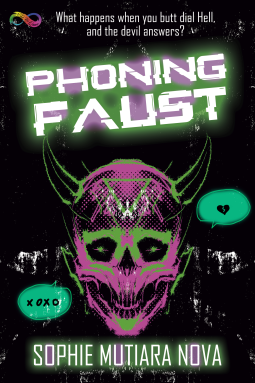
Phoning Faust
LGBT+ Gen Z Retelling of Goethe's Faust
This title was previously available on NetGalley and is now archived.
Send NetGalley books directly to your Kindle or Kindle app
1
To read on a Kindle or Kindle app, please add kindle@netgalley.com as an approved email address to receive files in your Amazon account. Click here for step-by-step instructions.
2
Also find your Kindle email address within your Amazon account, and enter it here.
Pub Date 2 Jun 2026 | Archive Date 8 May 2026
Talking about this book? Use #PhoningFaust #NetGalley. More hashtag tips!
Description
A devilishly Sapphic Gen Z take on GOETHE'S FAUST highlighting mental health, queer identity, & unrestricted internet access (WE'RE ALL GOING TO THE WORLD'S FAIR x EVERYONE IN THIS ROOM WILL SOMEDAY BE DEAD).
Queer mixed Indonesian college student Dian Faust attempts to call the suicide hotline only to dial the wrong number, her finger slipping and typing in six three times (the mark of the Devil). The mysterious voice on the other end of the line is revealed to be a charming scam caller named Memphis with a penchant for chattiness, trapped in a dingy bus stop bathroom, wanting to learn a concerning amount about the lonely Dian’s life.
The Devil themself has come to collect Dian’s soul, and “Memphis” is actually Mephistopheles—Hell’s foremost golden-tongued agent and notorious liar lurking in the pixels on Dian's screen.
In this Faustian bargain, will Dian save her soul before time runs out—or will she fall prey to the renowned storytelling deception of the infamous Mephistopheles?
A Note From the Publisher
Advance Praise
"There is something fascinating about blending pop culture, religious trauma, and metaphysical philosophy into a singular story... enraptured to read in one sitting." (Mourning Star -- Author of Necromantic: True Love)
GOODREADS REVIEWS
"Phoning Faust feels like making a late-night call you instantly regret… except the voice on the other end already knows your secrets... A fresh, tech-twisted take on Faustian bargains."
"...kept me guessing until the end. And BOY what an ending it is."
"mental health and queer representation straight from the start. Devoured it in just one day...characters are so fascinatingly constructed. And the way everything turns on its head like 3/4 through??? Wow wow wow. Loved."
"The twist of what is and what isn't true kept me on my toes. I will be recommending this to my friends."
"This skilled story features the complex character of Mephistopheles (whom I adored as an intense teen), retold by Sophie Mutiara Nova within the veil of mental health, friendship, and attraction. It is really well written and manages to be dark as well as cute."
"...rollercoaster of emotions... with a twist at the end."
Available Editions
| EDITION | Ebook |
| ISBN | 9781648908927 |
| PRICE | $4.99 (USD) |
| PAGES | 219 |
Available on NetGalley
Available to Buy
Buy on Amazon Buy on Bookshop.org Buy on Kobo Buy on WaterstonesAverage rating from 29 members
Featured Reviews
 Vera Kelly A, Reviewer
If you'd like to read this review with the spoilers censored, make sure to view it on Goodreads (@The Reading Frog) or Storygraph (@the_reading_frog).
Thank you to Sophie Mutiara Nova, NineStar Press & NetGalley for this free ARC in exchange for my honest review.
Rating: 3.75/5 ⭐
CW: Nothing too graphic is described. It does, however, go in depth when it comes to mental health and suicide. Check the CWs if you need them.
Explicit | Depression, drowning, suicidal ideation.
Moderate | Pandemic, past loss of loved ones, homophobia, suicide attempt, religious bigotry.
Mild | Suicide, dissociation, involuntary outing, weed, blood, vomit, murder of a pregnant woman, murder in general, overdose.
"Was it a sin? To live? To love? Was it a sin just to exist?
For some, the answer was yes."
Dian intends to call the suicide hotline, but a slipped finger leads to an unexpected recipient of her call for help.
For when one dials 666, a devil might answer.
Representation
╰┈➤ Queer, Lesbian, Demisexual MC
╰┈➤ Bi/Pan MC
╰┈➤ Unspecified BIPOC MC, character is described as having brown skin
╰┈➤ Southeast characters, including the MC (half Indonesian, half German-American) and an SC (half Filipina, half Black)
╰┈➤ WLW dynamic
╰┈➤ Trans woman SC
╰┈➤ Genderqueer MC, character switches pronouns around
Themes
Isolation, loneliness, COVID/pandemic/quarantine, Faustian bargain, the philosophical concept of 'the problem of evil/the problem of suffering', digital age, finding meaning in the senseless, inevitability, invisibility/being seen, agency, being an active or passive participant in one's own life, mental health, sacrifice, wanting to be 'normal' vs wanting acceptance, mental health and suicidal ideation, rebirth.
What I liked/loved
✧ I wasn't familiar with Goethe's Faust, but that didn't seem to impact my reading experience.
✧ Calling out the American healthcare system on the first page is a 10/10 move.
✧ Takes place during the COVID-19 pandemic, which is kind of crazy to look back on now. Certainly brought back some memories.
✧ Probably no one cares about this except for me, but as someone who is immunocompromised, I appreciate that this group was addressed in the context of a pandemic.
✧ Discourse on comparative suffering/self-invalidation/emotional minimization.
✧ Discourse on martyrdom and how female suffering/sacrifice is viewed.
"I reframe my time alone here as a martyr's sacrifice, a saintly retreat, like all those macabre stories I learned from Sunday school. Like Joan of Arc burning in her armor, cursing out the enemies of Satan and giving up her life for all of France. Or maybe she was crazy like I'm crazy. Maybe I'm just as bad as her, continuing a cycle of women who thought they had to die rather than live and be "too much.""
✧ Very introspective and character-driven, which I appreciate.
✧ This amazing Demi representation couldn't have come at a better time! I needed it after recently reading some bad rep in another book. As a demisexual, I felt like the rep was written incredibly well. I also appreciate that it wasn't just something mentioned once or twice; it is an important part of our MC's character.
✧ There is some essence of 'camp' to this, but it was still able to go serious and deep. I think Sophie Mutiara Nova shines when switching effortlessly from deep philosophical to lighthearted comedy, back to emotional turmoil. This book threw me around in the bedroom, and unexpectedly, I didn't mind it.
✧ I appreciated how this book represented suicidal ideation. The end of your life feels different when you're the one in control of it; meanwhile, death happening to you feels different. I loved the discourse about choice, that choice being taken away, and agency.
✧ Without spoiling anything, there is an amazing chapter called Rose that almost reads like folklore or a fairy tale.
✧ Some chapters were so (emotionally) descriptive and immersive that I felt like I was there. I love when writing can completely suck me into a character's headspace as it did here.
✧ I don't know a lot about Indonesia, but I know enough about the culture and language to catch many of the references, which was really cool. I can imagine this could hit different to someone who is (partly) Indonesian.
✧ There was some amazing bird symbolism and imagery.
✧ Discourse on which creatures should be loved and which should be dammned, and if those distinctions even matter or are sound to make.
✧ Discourse on centering oneself as the source of a problem vs centering it on the lack of kindness/sympathy from those around.
✧ Discourse on homophobia and religion-based bigotry.
✧ Discourse on 'The problem of evil/The problem of suffering.' (The philosophical and theological dilemma questioning how an all-powerful, all-knowing, and perfectly good God can coexist with the existence of suffering and evil.)
✧ There are some BANGER quotes in this book. I made lots of annotations because of it. Example:
"They're called wear patterns. Like grooves in a wall where weary travelers rest their heads. Or indentations on steps where pilgrims walked in prayer. They're well-worn areas that prove humans used something and used it often. To be loved into oblivion."
What I didn't like/felt lackluster about
✦ I'm unsure if this happened because I was having some bad reading days, but I felt a bit disconnected from the story in the last third of the book. The last few percent grabbed me again, though.
✦ Some things felt a little unexplained/underdeveloped and too fast-paced, which made me feel lost at times.
✦ All the pop-culture references will probably only hit for a specific demographic. I read it at camp and could thus enjoy it, but I can imagine that it might be a bit much or a miss for some readers.
Conclusion/Notes
There were many things I loved about this book: the philosophical dilemmas, the examination of religion, amazing queer rep, the feminist takes, the themes of loneliness and isolation, and respectful yet relatable depictions of mental health/suicidal ideation.
Yet I somehow lost some of my motivation to read during the last third of the book. Once again, this might be because of the bad reading mood I was in, so take this with a grain of salt. Still, it impacted my reading experience, which is why I rated it 3.75/5 ⭐
Regardless, I think this book felt unique and took an interesting approach to breaching these heavy topics. It wrapped them in levity and comedy without diminishing or brushing over them. This wasn't a writing style I thought I'd enjoy, but somehow it really worked for me here specifically.
If you love reading about relatable queer characters, mental health struggles, philosophical think pieces, and the concept of religious guilt, you should definitely give this one a try once it is published on June 02 2026.
 Sara B, Reviewer
Finding the words to describe how this book made me feel has been difficult, to be honest, because I went into it expecting a queer monster romance type of thing and what I got... wasn't that, at least not in it's entirety. It's so, so much more.
Full disclosure I'm not all too familiar with Goethe's Faust, but that didn't take away from my enjoyment of the story.
A lot of this story covers suicide, mental health, religious trauma, being queer in a community where it's not accepted, loneliness, and trying to find oneself in the midst of the COVID-19 pandemic, where you feel like you have no one to call and no one to turn to. Dian, our main character, was so relatable but the book also had me feeling so empathetic toward her and just wanting to give her a hug and tell her that she isn't alone.
Nova's writing is, frankly, beautiful. There were so many passages I highlighted, quotes that stuck out to me, and moments that made me both laugh and tear up depending on the context. I had a few small gripes with how it felt like the tone changed fast enough to give me whiplash and sometimes it felt like there wasn't a reason given, but overall the writing drew me in and kept me there.
This book is one that I'll be rereading in the future because it feels like a book that needs a reread, to fully immerse yourself and see things that you missed the first time around; as you're just trying to get your bearings and figure out what's happening.
This book made me feel so many emotions involving my own mental health that I've kept bottled up for ages, and it reminded me of my own experience during the COVID-19 pandemic, and how I, too, as a college student, struggled with the isolation and how empty everything felt.
There were a few parts I felt weren't the best explained and things moved incredibly fast; but I also feel like that was a plot choice. I definitely felt like it could've used maybe another 100 pages of fleshing things out, developing our main relationship more and setting us up in the world.
Overall this book was a 4.25/5 stars, and I'll be looking into Nova's other works, as I think their writing style lends really well to a contemporary setting!
 Nicolas M, Reviewer
The Phoning Faust is a very interesting and unique read, the writing isn’t something you usually see in books which made me more interested and attracted to the book.
It was a fast paced and engaging from beginning to end. It had themes like mental health which we don’t see in a lot of books and religious trauma from a queer person’s perspective. There were some parts of the book that sometimes adds to much details but it’s something I could get over without it ruining my reading experience but it definitely was the reason the book isn’t a five star as well as the writing style was not one I was completely familiar with it was definitely more casual then the books I’ve read.
As a whole I really enjoyed the book and definitely would recommend it for people who enjoy retellings .
Thank you Sophie Mutiara Nova for asking me to read the arc of their book. Thank you to net-galley and NineStar press for giving me this eARC
* Social platform where the review will be posted: TikTok @nico.writerreader
* Run date: 21st April 2026 On TikTok
 Reviewer 1707866
i was pleasantly surprised by how much i enjoyed phoning faust. as a modern, queer retelling of goethe's faust, i was unsure of how well the faustian aspect of the tale would be depicted. but sophie mutiara nova honestly did really well. there was such great explorations of religious identity, queer identity, mental health, loneliness etc.
dian and memphis were both compelling characters. the imagery was great. in some sections i did think it dragged a little, but overall it was a great read.
 Yulieth S, Reviewer
Phoning Faust was such a unique read and really stood out to me. The writing style felt poetic with a deeper tone that pulled me in.
I enjoyed the characters from the beginning. They were interesting and kept me invested in the story. The book is a fast, fun read but also explores themes like mental health and religious trauma. I loved how the author represented them in such a meaningful way.
The ending was different and left me thinking. It was disturbing in a way, yet fascinating.
Overall I enjoyed this book and would recommend for anyone interested in a modern retelling with a strong story!
Thank you NetGalley, Sophie Mutiara Nova and NineStar Press for this eARC.
 Galen B, Reviewer
“This is not a cry for help.
This is a scream.
Please, please, please.
I don’t want to die alone.“
Queer mixed Indonesian college student Dian Faust attempts to call the suicide hotline only to dial the wrong number, her finger slipping and typing in six three times- calling up someone called Memphis- better known as Mephistopheles.
Dian Faust exists against a backdrop of bedrotting and depression which felt very real to me. Pick this one for a high-concept fantasy involving cosmic entities, supernatural deals, through a lens of existential dread with a
claustrophobic setting during the COVID pandemic.
Deals seriously with mental health and queerphobia. LOVED the inclusion of Dian’s grandmothers in this too. It was also really nice to see representation of a demisexual in a novel like this!
Thank you to NetGalley and to NineStar Press for providing me an ARC in exchange for my honest review!
 Kate M, Reviewer
Representation: Dian is of mixed Indonesian heritage and is a queer demisexual lesbian with gender feelings.
Heat Rating: 0.
Tl;dr: Queer modern Faust remix.
Rating: 3.75
Struggling with her queer identity and religious trauma during the isolation of the COVID-19 outbreak, depressed college student Dian Faust accidentally commits her soul to the Devil when she misdials the suicide hotline.
The Good:
Good characters. Dian is a great main character: she is complex and sympathetic, and it's easy to see how her mental health has deteriorated during quarantine as she's trapped alone with her worst thoughts. Memphis was suitably sketchy and sweet.
Writing and prose. Besides a few awkward, self-conscious areas, Nova’s writing is an excellent balance of both readable and eloquent, capturing simple and effective emotional insight and complicated emotions while slipping in bits of banter and unexpected humour.
Working through religious trauma. Nova does an excellent job showing Dian processing her religious trauma and reflecting on her complex relationship with religion and her queerness, and how both influence her family and overall perspective.
Mental illness. The “whatever is cheap and easiest to eat” depression life is REAL. Diana's neglect of spatial and personal hygiene, the hollowness… Nova knows what's up. God, some Dian's lines and thought.processes where exact things suicidal friends have said to me.
COVID-19. Media set during the panic has been hit-or-miss for me. (The Grey's Anatomy C19 season was actively triggering for me.) Phoning Faust captured the essence of uncertainty and isolation without harming the reader.
The Bad:
There is a sort of self-conscious/trying-too-hard element to Nova’s writing at times. Particularly in the opening chapter, it feels like Nova is desperately trying to convince the reader Dian is severely depressed, even though the circumstances speak for themselves. Some of the lines are also abrupt or choppy.
Technically commits a huge writing sin. But between how Nova manages the scope of the setting and the actual thematic elements… it makes sense and I liked the choice?
Reviewer 2077052
Thank you, the author and NetGalley, for eARC.
A very queer reimagening of Ghoethe’s ‘Faust’.
Dian Faust is severely depressed and accidently calls a devil instead of the intended suicide hotline.
Obviously TW: suicidal thoughts, talk about suicide
The book itself is fast-paced (it’s set mostly over one night), but the prose is a little too flowery, too many analogies and references, that the text gets convoluted. The author clearly is very intellectual and eloquent, but this book suffers from trying to mention too many concepts in such short amount of time.
Dian is truly a very deep character and you cannot help but emphatize with her fears, wants and even mistakes. She truly is the star of the book and her mental health struggles, her religious trauma is depicted beautifully. Memphis, on the other hand, was not very likeable (even if her backstory was very interesting), but I don’t think her point was to be liked. She is a devil after all.
I’d say it was 3/5 stars for me. It’s not what I expected, but it also surprised me in the end.
Reviewer 1563355
Thank you to NetGalley for the ARC.
This is one of those gorgeous books where the writing is beyond poetic, where reading it feels like bathing in song, where... I just feel confused by the storyline. The vibes? Immaculate. My understanding of the plot? Nope.
I understand the idea of a Faustian story - or at least I really think I do - but parts of this just had me lost. I've still rated it highly because it was a stunning piece of queer art, even if it wasn't exactly right for me. I am certain that other readers will be obsessed with this interpretation.
Reviewer 1221430
Wow... just wow. This book made me feel things that I currently cannot explain and I love it.
I was hooked from the very first page. I'm a sucker for lyrical, introspective writing with a focus on character development and relationships and I got just that. Add in sapphic yearning, deep religious trauma, and mental health struggles and I'm sooo in (in fiction, not real life lol).
I'm going to be honest; I had no idea what was going on half the time but that just added to my enthrallment. Reading this felt like a dream. A nightmare? I don't know.
Do check your TWs for this one. Mental health struggles, COVID isolation, and suicidal ideation are at the forefront of this story.
I'm not all that familiar with Goethe's Faust so that really had no bearing on my enjoyment of this story. I hope to read so much more from Sophie in the future. A very much needed voice in literature.
Thank you to NetGalley, Sophie Mutiara Nova and NineStar Press for an eArc of this book.
 Alicia C, Reviewer
Phoning Faust by Sophie Mutiara Nova follows Dian, a young person dealing with identity and isolation in the height of the Covid pandemic. When they try to call for help, they end up calling Hell instead and begins a conversation that will change their life forever.
This is one of those books that feels uniquely written for me. The writing was beautiful and thought provoking. I felt like the characters were well rounded and realized. This book had heavy themes but also some bits of comedic relief that helped had some levity to the story.
I loved Dian as a character. The struggles they are going through with trying to figure out their identity and what to do next felt very relatable. I feel like the desire to tell a stranger all your secrets just to get them off of your chest is something we can all relate to at least a little so when Dian is monologuing about their feelings, it felt very natural.
As someone who identifies as demisexual, this book meant so much to me. I feel like it is such a strange identity to try to explain to people. A lot of people don’t understand but reading Dian’s thoughts about it helped me quite a bit.
This is a short book and to me is best read in a single sitting if you can to fully feel absorbed. It is comped to “We’re All Going to the World’s Fair” which I think is a great comp. There is something about this book that feels very liminal and I loved it!
 Ezra A, Reviewer
First, I got this as an ARC - thanks to Netgalley, the Author and the publisher. The book was free but my opinions are my own.
I adored this book. The POV character's struggles were so intensely relatable to me and communicated very well. I loved how this reminded me of The Screwtape Letters except on the other side of the religious trauma. The explanation of demi sexuality is almost exactly how I would explain it in my own life. The romance between Memphis and Dian was Beautiful. And I very much love how the story wrapped up.
My only downside was that it was a little slower paced than I prefer but thats a me thing.
I can't wait to read more by this author!
 Bridget W, Reviewer
3.5 stars
Phoning Faust is a queer love story about a suicidal college student who accidentally calls Hell instead of the suicide hotline and ends up making a deal with the devil. It is strange, sad, romantic, and very committed to its Faustian premise.
Nova uses a lot of Christian mythology, but the book does not feel like it is only interested in being a Faust retelling. The mythology gives the story a frame, but for me, the stronger parts were about Dian’s loneliness, queerness, and isolation from her family and culture.
My favorite parts were the pieces of Dian’s Indonesian background. The book does not spend much time directly explaining her family’s rejection of her queerness, but it still makes the loss felt. Through Dian’s memories, cultural references, and ties to her family, Nova shows us what she once had, which makes its absence hurt.
The book didn't fully work for me. Christian mythology is not usually my thing, so some of that material just did not hit me as hard as it might for another reader. I also had some issues with the pacing. Some sections felt slow, while other important developments moved very quickly. There were moments where I was not totally sure how we got from one point in the narrative to the next.
Still, I liked a lot about this book. Nova is clearly a smart writer who does their research. In this book, they weave together theology, film, queerness, depression, family, culture, and Faustian myth, and I want to read what they do next because I am curious to see where their mind goes.
Thank you to NetGalley and NineStar Press for the ARC of this book in exchange for my honest review.
 Marissa M, Reviewer
Thank you NetGalley for a Review Copy!
At just over 200 pages Mutiara Nova does a great job of making us quickly feel for Dian Faust and just how bad her mental health has gotten during the Covid 19 pandemic.
How do you unmake a deal with the devil when they are everything you wish you could be?
This story is so unabashedly queer both in the characters and the story it is telling. The content is incredibly heavy but what queer story isn’t? I cried for the last 5 minutes and I will be telling everyone to read it.
 Shaan A, Reviewer
The concept of this book as a whole is deeply compelling - what if instead of calling a suicide hotline, you accidentally called your local hot sapphic devil who was actually emotionally intelligent enough to help you through the hardest time of your life? The premise had me invested before I even started the book. And a note to anyone like me, who knows nothing about Goethe's Faust - you can enjoy this retelling regardless!
Phoning Faust also had a lot of representation I appreciated - sapphic rep, Indonesian rep, and a nuanced portrayal of depression that showed all of the layers and seemingly contradictory ways depression can manifest both in the mind and on the outside. I appreciated that the author never shied away from showing these aspects, and made Dian's mental health an integral part of the story arc and the character's progression. The question of how choice factors into suicidal ideation and what happens when that choice is taken away is also explored in depth. I also appreciated that content warnings were included at the beginning of the book, as this isn't always the case, and that there were mental health resources listed at the beginning of the book - both pretty straightforward things that go a long way!
Thank you to Sophie Mutiara Nova and NetGalley for this eARC!
 AUDREY E, Reviewer
Phoning Faust starts as a fun flirty distraction from the internal thought of our main character during the deviating time of COVID lock down. The isolation, loneliness and fear that pressed down on all of us. This story slowly flips into a thriller and emotional psychological mystery. It touches on themes of religion and sexuality and the unique relationships that drive us to strive and fight for another day. I was captivated by the story and how it was going to play out. The mind is a scary place and this story reflects that. Mental health is an important topic to discuss and to understand. The Big Bad can always get to us and that in itself is the most interesting aspect of the story for me.
 Ashley Q, Reviewer
PHONING FAUST is a queer Faustian retelling that takes place over one fateful night during the early days of COVID lockdown. When Di, a queer, mixed Indonesian college student, attempts to dial a crisis hotline, her shaking fingers slip and hit 6…6…6. The voice that answers is silky smooth and, quite frankly, hot. And very, very dangerous.
~~~
Everyone can enjoy this book (I promise!), but one of the things I love is how clearly this is written by a queer author for queer readers. They were so many turns of phrase and observations that could only have been written by someone in our community. This is an incredibly fun and entertaining read and that also addresses very heavy topics. This felt so personal - it’s exactly the kind of dark humor you’d hear my wife and I using in our private conversations.
This is a modern Faustian retelling, which is super interesting as a queer story (The category is—#queerreligioustrauma). Every time I thought I knew where the story was headed, I was proven wrong. I’m so grateful that the publisher reached out to me with a free ARC because this wasn’t on my radar at all.
Reviewer 2075579
This weighs heavy on you. It's a perfect way to start pride month. If you're looking for an amazing queer read then this is for you. Dian will quickly become one of your favorite characters. The story was so well written that you'll want to jump right in. The vivid scenes made me feel like I was watching a movie.
Cheyenne O, Reviewer
Thank you to NetGalley, Sophie Mutiara Nova, NineStar Press, and the publisher for providing me with an advanced copy of Phoning Faust in exchange for my honest review.
Phoning Faust was not at all what I expected, and I mean that in the best possible way.
Going in, I anticipated a queer fantasy romance with a Faustian twist. While those elements are certainly present, this book ended up being a much deeper and more introspective exploration of loneliness, mental health, identity, faith, and the search for connection during one of the most isolating periods in recent history.
Set during the COVID-19 pandemic, the story follows Dian, a college student struggling with depression and overwhelming feelings of isolation. A misdialed phone call connects her with Memphis, a mysterious being who quickly becomes both a source of comfort and a catalyst for change. Their relationship unfolds against a backdrop of grief, uncertainty, and self-discovery, creating a story that is equal parts heartbreaking and hopeful.
One of my favorite aspects of this book was the writing itself. Sophie Mutiara Nova has a beautiful way with words, crafting passages that are thoughtful, emotional, and often incredibly quotable. The discussions surrounding mental health, religious trauma, queer identity, and the desire to simply be seen felt genuine and handled with a great deal of care.
I also appreciated the queer representation throughout the novel. The characters felt authentic, and the exploration of identity was woven naturally into the story rather than feeling like an afterthought.
My biggest struggle was with the pacing in parts of the book. There were moments where events moved so quickly that I felt a little disconnected, and I occasionally wished certain relationships and plot points had been given more room to breathe. Some elements also felt intentionally ambiguous, which worked at times but left me confused in others.
Even with those minor frustrations, I found myself deeply invested in Dian's journey. This is a story that asks difficult questions about suffering, faith, purpose, and survival while still offering moments of humor, warmth, and hope.
If you're looking for a queer fantasy that goes beyond romance and isn't afraid to tackle heavier themes, Phoning Faust is absolutely worth picking up. Thought-provoking, emotional, and unlike anything else I've read recently, it's a story that will stay with me long after the final page.
 Tanya H, Reviewer
3.5 stars rounded up.
I went into this book curious about the premise, and I ended up appreciating it more for what it was trying to do than for how much it personally worked for me.
One of the biggest strengths of Phoning Faust is how thoughtfully it handles difficult subjects. The author’s note at the beginning was genuinely beautiful and helped set the tone for the story. You can tell Sophie Mutiara Nova approached the heavier themes with care and intention.
I also really liked Memphis. Her backstory added a lot of depth, and I found myself invested in her journey. I was pleasantly surprised by the demisexual representation as well. It felt meaningful and added another layer to the story.
The relationship was where I struggled a bit. I never fully connected with Dian, and the romance moved faster than I would have liked. The instant attraction and strong feelings developed so quickly that I had trouble buying into them. Honestly, I might have enjoyed seeing a friendship grow between them even more.
I did love the setting. Having so much of the story centered around the apartment gave it a unique feel compared to other books I’ve read recently.
Overall, this was an interesting and creative story that uses a clever premise to explore some very serious topics. It just ended up being a little heavier than I was in the mood for, and I never quite found myself fully hooked. Sometimes it’s simply a case of the right book at the wrong time.
 Reli ., Reviewer
Overall Rating: ⭐️⭐️⭐️⭐️⭐️
Wow. I think that single word could sum up my entire reading experience. This read like a fever dream. You are following Dian during the covid-19 pandemic. She is lonely, depressed, and contemplating suicide. She misdials and accidentally calls the devil.
Insert Memphis. She is flirty, quick, dangerous, and sharp. Her alluring gaze set on Dian and daring her to stay with her until sunrise. What starts as a strange but flirty video chat shifts into something out of a nightmare.
I was surprised at how much I enjoyed this book. I wasn't sure what to expect with how short it was but the author utilized every word and page. This was a trippy experience. It shines a light on some dark topics.
If you enjoy trippy, fevered, dark, but semi-humorous experiences; then this is the perfect book for you.
Readers who liked this book also liked: