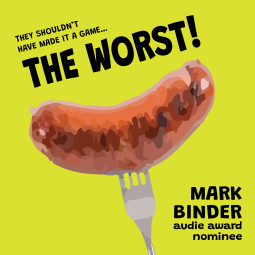
The Worst
with Mark Binder (Narrator)
Sign In or Register Now to see if this title is available for request.
Buy on Audible Buy on Kobo Buy on Libro.fmSend NetGalley books directly to your Kindle or Kindle app
1
To read on a Kindle or Kindle app, please add kindle@netgalley.com as an approved email address to receive files in your Amazon account. Click here for step-by-step instructions.
2
Also find your Kindle email address within your Amazon account, and enter it here.
Pub Date 16 Sep 2026 | Archive Date 17 Sep 2026
Light Publications | Independent Book Publishers Association (IBPA), Members' Audiobooks

Talking about this book? Use #TheWorst #NetGalley. More hashtag tips!
Description
Written and narrated by an Audie Award Finalist for Best Original Work
Their eighth grade was the best, and the worst.
And then, on the last day of school, a high school student showed up with a gun…
For the boys and girl in “Team Bomb Shelter,” their final year at Jerome Marco K-8 was packed with disasters, inside jokes and a talent show. They called the daily chaos of middle school “the worst” — and somehow meant it as a compliment.
It should have ended with a celebration. Instead, everything changed.
“Nobody and nothing prepared us to deal with what happened when our middle school was attacked by a school shooter. We never saw it coming.”
THE WORST spins stories of friendship, joy, courage, and choosing hope when fear takes over. Fast-paced, funny, and unforgettable, it explores the moments that define who we become when things fall apart.
"…humor, and humanity make these stories a pleasure for all ages." – AudioFile Magazine
THE WORST is the thrilling stand-alone conclusion to the Groston Middle Series. New readers can jump right in.
Mark Binder is the Audie Award nominated author and storyteller of more than two dozen books. He tours the world telling stories to readers and listeners of all ages.
A Note From the Publisher
Softcover: 9781940060699
eBook: 9781940060705
Hardcover: 9781940060750
Dyslexia Font Hardcover: 9781940060767
Additional Book Formats with (ISBN-13):
Softcover: 9781940060699
eBook: 9781940060705
Hardcover: 9781940060750
Dyslexia Font Hardcover: 9781940060767
Marketing Plan
Author Book and Signing Tour. Author live performances. Author School Programs
Author Book and Signing Tour. Author live performances. Author School Programs
Available Editions
| EDITION | Audiobook, Unabridged |
| ISBN | 9781940060712 |
| PRICE | $6.99 (USD) |
| DURATION | 5 Hours, 51 Minutes |
Available on NetGalley
Available to Buy
Buy on Audible Buy on Kobo Buy on Libro.fmAverage rating from 25 members
Featured Reviews
 Lisa D, Reviewer
I was worried that this would be too dark because of the topic but it was balanced and realistic. I enjoyed the school activities and friendships and I even laughed out loud multiple times. The family relationships and supports were great. Okay, the ending may not have been realistic but it was really good and it's important-- we don't have to just wait and see what will happen next when we can take action. The narration was excellent and really enjoyable. Thanks to NetGalley for letting me listen to this
 Kelly P, Reviewer
ARC Review: The Worst! by Mark Binder
(Thank you to NetGalley, Mark Binder, and the publisher for the opportunity to read an Advance Reader Copy of The Worst!. As an educator (my last placement was teaching middle school ELA), I was particularly interested in how this novel would approach its challenging subject matter for a middle-grade audience. The opinions expressed below are my own.)
Review of the audiobook itself:
I enjoyed Mark Binder's narration of his novel and feel like he did a good job keeping it interesting with his tone and inflection. My only note is that in "Chapter 5" of the audio, there was a small error, as the phrase "which was a massive breach in security" was said twice, back-to-back, so I originally thought my audio glitched at first. (This occurred at 68.0% into the audiobook)
Review of the novel/storyline:
Before starting The Worst!, I was unsure what to expect from a middle-grade novel centered on a school shooting. Given the seriousness of the subject matter, I had concerns about whether the story could address gun violence in a way that was both age-appropriate and respectful. As an educator who previously taught sixth-grade English Language Arts, and as the older sibling of a soon-to-be eighth grader, I found myself evaluating the novel through the lens of the students I have taught and the young readers who may pick up this book.
Fortunately, Mark Binder accomplishes something surprisingly difficult: he writes about a terrifying act of violence without allowing that act to become the entirety of the story. Instead, The Worst! is fundamentally a novel about friendship, adolescence, identity, and resilience.
From the opening chapter, Binder signals that this will not be a conventional tragedy. The narrator directly references the literary principle that "if you show a gun in the first act, it's got to go off by the end of the play," establishing both foreshadowing and a self-aware narrative voice. Yet, he immediately complicates this expectation by insisting:
“I for one never want my life to be defined by one random and horrific event. I want to remember the good times with my friends. We’d hang out in Rover’s basement bomb shelter, get into trouble, and then we’d get ourselves out of it.”
Ultimately, this tension becomes the novel's central idea: while terrible events can shape lives, they should not be allowed to define them. On a related note: One thing that I had noticed upon starting the novel and passing the “Contents” section was the way that the chapters were named/titled. To be specific, the first 13 chapters ARE titled based on the events that take place, such as “The Barn Dance,” “The Snow Day,” “The Talent Show,” etc. The last “titled chapter” called “Stopping the Shooter” then leads to the following thirty chapters. These thirty chapters are simply numbered from “Chapter 1” to “Chapter 30.”
Reflecting on this, it is my personal interpretation that this was possibly done purposefully by Binder with the intentions in staying true to that idea (“I for one never want my life to be defined by one random and horrific event. I want to remember the good times with my friends. We’d hang out in Rover’s basement bomb shelter, get into trouble, and then we’d get ourselves out of it.” Titling the chapters in the way he did is SUCH a smart way to express this by choosing to give name to these cherished memories and to refuse to give power or “define” this “one random and horrific event” as explained by the narrator.
One of the novel's greatest strengths is its cast of characters. The narrator repeatedly introduces his friends through their talents and positive qualities. Helen Beagle is described as "beautiful and brilliant" despite the physical challenges she faces. Dave Rover is a scientific genius. Jesús Ramirez is a world-class artist. Sean Chang is gifted in economics and statistics. Even Charlie Johnson, nicknamed "Fat Charlie," is presented as generous and athletically talented. These descriptions are significant because Binder consistently resists reducing people to stereotypes, disabilities, appearances, or labels. Instead, he emphasizes individuality and humanity. The characterization of each character in this novel was wonderfully done and I loved the way I was able to end up feeling like I knew each character individually. In other words, the friends all played important roles and didn’t feel merely like “side characters” but instead, they felt like various realistic personalities that provides different possibilities for the reader to find at least one person to identify with/relate to.
This idea extends to one of the novel's most compelling literary choices: the refusal to fully characterize the shooter. In Chapter 21, the narrator questions whether the reader's mental image of Billy Kinty matters at all, as following:
“Even though I haven’t really described Billy Kinty, by now you have probably made a picture in your head of what he looks like. Does it matter? I have told you that he was 17 and male. Was he tall? Or short? Blonde with blue eyes or dark haired with brown eyes? ... Our English teacher, Mrs. Martin, would say that painting a clear picture of the villain was important in literature. In this case, I disagree.”
Here, Mark Binder challenges the conventional literary expectation that villains require detailed descriptions and motivations. Instead, he argues that what mattered during the crisis was not the shooter's appearance or identity, but the safety of his friends. This narrative decision mirrors the novel's later discussion about refusing to glorify acts of violence or create copycats. Binder effectively shifts attention away from the perpetrator and back toward the people affected by his actions.
The structure of the novel reinforces this focus. Much of the book consists of humorous, seemingly disconnected episodes from the narrator's final year at Jerome Marco K-8 School. At first, these stories can feel episodic, but they ultimately serve an important purpose. The reader comes to know the characters as real kids navigating friendships, insecurities, embarrassing moments, crushes, and personal struggles. As a result, when the shooting occurs, the stakes feel deeply personal and it is clear that Binder put careful thought and attention towards the purpose of evoking empathy from the readers/audience. The crisis then has a more powerful impact on the reader because the reader has already learned to care about the people involved.
Binder also skillfully balances humor with darker subject matter. The novel frequently breaks the fourth wall, allowing the narrator to comment on storytelling itself. An example of this is, as follows:
“By now, you’re probably wondering the same thing I was: “what the heck was going on in Professor Synkowitz’s classroom?” If I was an omniscient narrator, or if we had had video cameras in the classroom back then, I could tell you with certainty that Billy Kinty had just… [text cut here to prevent spoilers] … but I’m not an omniscient narrator. Instead, I’m going to try to give the best account I can based on the semi-conflicting reports I got later from my friends and classmates.” (81.9%)
Sidenote: the discussion of “omniscient narrator” here would be an excellent connection for students when introducing P.O.V and different narrator options, as well as taking it a step further to consider author’s choice (why would an author choose one perspective over another? When might one be preferred over another? What do readers need to keep in mind when reading based on the narrator type?) It is important for students to understand that sometimes they need to “read between the lines” or consider what is being left unsaid, as certain narrator types may either be biased or not have key information [yet].
Speaking to the balance of humor and sensitive topics: During moments of tension, humor becomes a coping mechanism for the friend group rather than a distraction. Even after the traumatic events, the friends go back to Rover’s basement to hang out and ultimately, to process what happened and the seriousness of what they had all just endured. Once he had noticed the awkwardness and unease of the group, the narrator “broke the ice” which, fortunately, led to the friends’ open, honest, and vulnerable discussion before then continuing to joke with one another (which is how they know that they will all be “okay” despite it all because they had each other. This reflects a truth that many young readers will recognize, which is that people often use humor to process fear, grief, and uncertainty.
Another notable strength is the way Binder addresses a variety of adolescent experiences beyond the central conflict. The novel explores fitting in, insecurity, ADHD medication debates, disability, friendship, and questions of personal and sexual identity. One particularly memorable moment occurs after the crisis when Sam unexpectedly kisses the narrator. Rather than forcing a clear conclusion about what this means, Binder allows the moment to remain uncertain and authentic to adolescence itself. The novel repeatedly acknowledges that young people are still figuring out who they are.
Perhaps the most effective literary device in the novel is the recurring emphasis on friendship as a balancing force. Early in the story, the narrator recalls Professor Synkowitz's explanation of centripetal and centrifugal forces balancing one another. This seemingly incidental lesson functions as a metaphor for the friend group. Each member reacts differently under pressure, bringing unique strengths and weaknesses to the situation. Helen attempts empathy and conversation. Rover focuses on practical tasks. Sean thinks strategically. Adam acts decisively. No single person saves the day alone. Instead, the group's collective efforts—and their loyalty to one another—allow them to endure.
The novel's conclusion is particularly powerful because it refuses to end with hero worship. After the crisis, the adults repeatedly ask the children, "What were you thinking?" (referring to the ways in which they personally involved themselves in the incredibly dangerous scenario in efforts to stop Billy, as well as to save their friends, teacher, classmates, and themselves). The students are hugged, yelled at, and reminded how close they came to being killed. There is no triumphant celebration. Instead, there is relief, fear, exhaustion, and gratitude. The emotional honesty of these scenes prevents the story from romanticizing danger, which is incredibly important—especially considering the intended audience including adolescents who are, inherently, rather impressionable.
Most importantly, Binder returns to the idea introduced in Chapter One: people should not be defined by the worst thing that ever happened to them. In the final chapter, the friends gather, laugh, reflect, and begin planning for the future. When someone declares, "Yesterday... that was the WORST!" the statement becomes both an acknowledgment and a rejection of the event's power over them. The novel ends not with trauma but with possibility, as the characters decide they want not just "the best," but "the AWESOME."
• “Yesterday… Yesterday, that was the WORST!” We laughed, we held back some sniffles, then we began making plans for the summer.”
• “It wasn’t anything we consciously did or even talked about, but from that moment on, we were done with the worst. It stopped being our thing. Now, we wanted the best. But not just the best—we wanted the AWESOME.”
Overall, I feel that Binder’s novel, The Worst! succeeds because it treats young readers with respect. It does not shy away from difficult realities, but neither does it exploit them. Instead, Mark Binder crafts a thoughtful, often funny, and surprisingly nuanced coming-of-age story that asks readers to focus not on violence itself, but on the friendships, courage, and humanity that persist in its aftermath.
Readers who liked this book also liked:
We Are Bookish
Sci Fi & Fantasy, Teens & YA
Kathy Hoopmann
Children's Nonfiction, Health, Mind & Body, Parenting, Families, Relationships
Kathy Hoopmann
Children's Nonfiction, Health, Mind & Body, Parenting, Families, Relationships
Kathy Hoopmann
Children's Nonfiction, Health, Mind & Body, Parenting, Families, Relationships