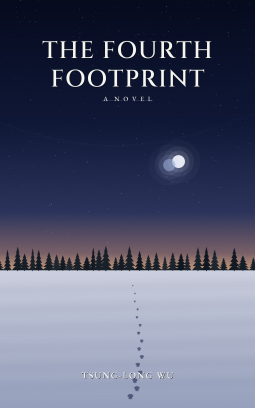
The Fourth Footprint
A Novel
This title was previously available on NetGalley and is now archived.
Send NetGalley books directly to your Kindle or Kindle app
1
To read on a Kindle or Kindle app, please add kindle@netgalley.com as an approved email address to receive files in your Amazon account. Click here for step-by-step instructions.
2
Also find your Kindle email address within your Amazon account, and enter it here.
Pub Date 29 Jun 2026 | Archive Date 8 Aug 2026
Talking about this book? Use #TheFourthFootprint #NetGalley. More hashtag tips!
Description
Sarah Wu is one of the finest neurosurgeons alive—a woman who has spent nineteen years standing between strangers and the end of them, and refusing to let it come. She has a husband, four children, and a life built with the same impossible patience she brings to the operating table. Then, in the quiet of a November night, counting the breathing of her sleeping family in the dark, she does not let herself notice that one of the breaths she counts is a breath she cannot actually hear.
When a phenomenon begins to tear at the edges of the known world—surfacing first as ghostly waves in the EEGs of Sarah’s own research—a family flees to a cabin in the mountains, three hundred miles from the widening seam. There, in the cold and the silence, the boundary between what is real and what is remembered grows thin, and Sarah must confront a question larger than any surgery: what, and who, is she truly trying to save?
Told through the intimate lens of one mother and one family, THE FOURTH FOOTPRINT is a work of literary science fiction that makes the cosmic feel personal and the impossible feel like grief. For readers who love immersive, emotionally resonant speculative fiction that lingers long after the final page.
“Beautiful literary science fiction… Wu makes the impossible feel intimate by keeping the rupture close to one family.”—Jamie Michele, Readers’ Favorite (5 Stars)
Available Editions
| EDITION | Ebook |
| ISBN | 9798235600911 |
| PRICE | |
Available on NetGalley
Available to Buy
Buy on Amazon Buy on Bookshop.org Buy on Kobo Buy on WaterstonesAverage rating from 3 members
Featured Reviews
 Naori B, Reviewer
I was captivated by Tsung-Long Wu’s brief but pervasive novel about one family navigating echoes of grief during a global catastrophe. Sarah Wu, a brilliant neurosurgeon is renowned for her research on the neurological process of how the brain constructs the present. “Each moment… is reconstructed at a delay of approximately 80 milliseconds and then presented to consciousness as if it were simultaneous…We live all of us 80 milliseconds in the past. What we call ‘now’ is a story the brain tells itself about what was just true.” (85) However, in the quiet of her own mind, the question has always surfaced: well if the mind can carry out this process of memory construction to create the present, isn’t it conceivable that it could do the opposite and leap back? This idea has always stayed submerged until the day that the earth inexplicably, itself starts doubling, pausing, and turning backwards. As people watch the laws of physics unravel around them, Sarah watches her private theory become reality. Every patient attached to an EEG monitor in the hospital not only shows a normal forward-moving brain wave, but also a second ghostly backwards one. The book then takes us on the simultaneous journey of humanity’s and Sarah‘s reckoning with a collapsing universe.
The astonishing and refreshing thing about this novel is that, in this genre, it is expected that things fall apart, that we witnessed the carnage, the baseness, as well as the ingenuity of humanity. But this book refuses to go there. This was like a soft shoe tap dance with the end of the world. Just a toe dip into the apocalypse where the author, much like someone leaning over the edge of a precipice, is at the very last minute pulled back from the brink of disaster by a t-shirt grab from behind. The machines we have come to depend on fail, supernatural phenomenon challenges our perception of “the known”, the breakdown into survival- mode occurs, and just when we’re all building up arsenals and hoarding supplies…the lights come back on. The phenomenon is understood, is reckoned with, is navigated. Tsung-Long Wu ask the question, what would it look like if it didn’t get that far? What would “we” look like if the ugliness at the end of the world began: the reckoning, the mistrust, the cleaving of what is human and what is animal, what is violent and what is not. And then, right when that process began, before we all turned into monsters, it ended and we had to face our own darkness. If we had to face what we knew was now in us, and the fear that we could return to being those selves, if something this bad ever happened again.
“… because the first thing you rebuild, after the lights, is the memory of what the dark cost… a civilization is not its machines… Civilization is the things it refused to let the dark erase” (138)
It was a clever literary tactic for the novel to follow an inverted pattern: as the world begins to grow dark, as it starts to reckon with a “natural” disintegration, the Wu family emulates a physical and supernatural reckoning. The reader doesn’t feel the heaviness that often comes with an apocalyptic-esque book because yes, you are in the darkness of the outside world but your attention is on the sanctity of the Wu family. In an isolated cabin, separated from the insanity of the world, they confront the nearly catastrophic and achieve a reckoning amidst the darkness.
I genuinely would recommend this book to almost anyone. It is binding, emergent and clings to you long after the story is over. It is an all-in-one-sitting kind of tail. Fantasy, high science fiction, medical magical realism, semi-apocalyptic, and familial at its core. The one and only thing that bothered me about the book was its tendency towards repetitive phrasing. I’m not sure if this was an editing issue or an authorship issue, but there were several places in the text were the same phrase was repeated on more than one page - ex. “ a grid to lay over a world that had stopped offering one”. There were also chapters where the author kind of got stuck on one word and used it a lot - ex. “load-bearing” in reference to emotional baggage. But these are minor, minor complaints.
Whenever a book stays with me, humming passages, revolving in my mind, it is worth both reading and spending the time to be listened to.
 D. D, Reviewer
This is a quiet literary novel that uses the fracturing of the world to explore the ways in which grief can shape a family. It features mostly small actions with big emotional impact. The Wu family faced with impending systemic collapse retreat to a remote cabin, the coping mechanisms under which they have for years functioned are disassembled and ultimately released, there is loss and also hope. The writing is deftly handled, despite the need to lay out in explicit terms much of the emotional landscape of the characters.