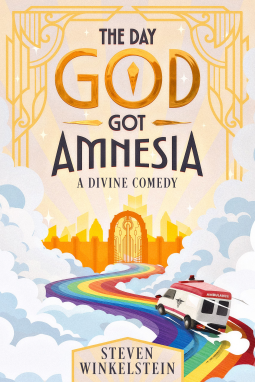
The Day God Got Amnesia
A Divine Comedy
Sign In or Register Now to see if this title is available for request.
Buy on Amazon Buy on Bookshop.org Buy on WaterstonesSend NetGalley books directly to your Kindle or Kindle app
1
To read on a Kindle or Kindle app, please add kindle@netgalley.com as an approved email address to receive files in your Amazon account. Click here for step-by-step instructions.
2
Also find your Kindle email address within your Amazon account, and enter it here.
Pub Date 13 Oct 2026 | Archive Date 15 Feb 2027
Steven Winkelstein | Sarcastic Crow Press
Talking about this book? Use #thedaygodgotamnesia #NetGalley. More hashtag tips!
Description
When God is knocked into a coma by a giant box of frosted cornflakes, all Hell literally breaks loose.
In the spiritually over-caffeinated bubble of Boulder, Colorado, a gay atheist barista named Slinger is already struggling with the usual modern crises: existential dread, romantic confusion, and the soul-numbing grind that comes with working in a coffee shop tinged with burnt espresso and spiritual superiority. Then the demons arrive.
What begins as a bizarre supernatural disturbance quickly spirals into a full-scale unraveling of the celestial order. With Heaven in disarray, Hell on the move, and divine leadership temporarily out cold, Slinger must navigate a divine disaster involving ancient forces, bureaucratic dysfunction, and a fight he is wildly unqualified for.
Armed with little more than sarcasm, caffeine, his eccentric coffee shop friends, his possibly straight hippie crush, and a mysterious rabbi who may know more than he's letting on, Slinger must face his own demons, actual demons, and the terrifying possibility that his abandoned faith might actually matter.
Because if he can't stop the apocalypse, humanity is going to Hell.
Advance Praise
“Readers are in for a wild ride in Winkelstein’s hands.”
“The humor stays witty, alternating between deadpan and outright silly.”
“Irreverent, sharply funny comedy of Heaven, Hell, and a God in a coma.”
— BookLife Reviews, Editor’s Pick
Read the full review: https://www.thedaygodgotamnesia.com/reviews
Available Editions
| EDITION | Hardcover |
| ISBN | 9798994792513 |
| PRICE | $26.99 (USD) |
| PAGES | 144 |
Links
Available on NetGalley
Available to Buy
Buy on Amazon Buy on Bookshop.org Buy on WaterstonesAverage rating from 41 members
Featured Reviews
 Reviewer 1243265
Witty, hilarious, and downright chaotic. And can we talk about the whimsical chapter header graphics that tie in with each chapter?! This book honestly is my exact brand of humor and I found myself chuckling as I read. It’s so eloquently done with just the right level of quirky in a read-in-one-sitting, bite-sized-story format. I need another installment ASAP!
Be sure to grab a copy when it’s released on October 13, 2026!
Thank you to Steven Winkelstein & Sarcastic Crow Press for providing this eARC for review consideration via NetGalley. All opinions are my own.
 Katy T, Reviewer
This book had me chuckling constantly. It was fast paced and my kind of humour. i kind find that jumped around a lot with many different povs and I lowkey hated how the ending just stopped. I need to know what happens. I need part two. Can't wait.
 Fleur M, Reviewer
This book is so unserious but in the absolute best way. Ate this book in one sitting. I need the sequel yesterday, no cap.
 Rudi M, Educator
The Day God Got Amnesia by Steven Winkelstein is a strange, thought-provoking, and surprisingly emotional read. I went into this one expecting something completely different, but I really enjoyed the way it blends the absurd with bigger questions about faith, identity, humanity, and what happens when the answers we rely on suddenly disappear.
There’s a wonderfully unconventional quality to the story that kept me turning the pages. It made me laugh in places, think in others, and occasionally sit back and wonder where the story was going next.
Definitely an unusual book, but sometimes those are the ones that stick with you. A creative and entertaining read for anyone looking for something outside the ordinary.
Thank you to NetGalley and the publisher for the advance copy. All opinions are my own.
 Nick P, Reviewer
As a silly boy who loves writing silly stories, I have a pretty high standard for humor. I won't crack a smile or guffaw for any humdrum run-of-the-mill comedy movie or show. It's even harder to get me to chuckle while reading a book. So, high marks to Winkelstein for getting me to crack a few smiles and light laughs while reading this. The quirkiness was reminiscent of Pratchett, Adams, and Moore.
The colorful cast of characters from Earth and the afterlife kept me entertained and engaged. Slinger was a memorable lead and the afterlife EMTs were a delightfully bumbling pair. It was also fun to see some historical figures pop up on the Heaven side of things. At 144 pages, I blew through this wacky novella pretty quickly.
One little note: I may have missed something, but based on what happens in the story, I feel like the title is mildly misleading since God spent basically all the story unconscious. He may have amnesia, but at least in this book, we don't find that out.
Analena K, Reviewer
There are two main story arcs happening at once in this book: In heaven, got was suddenly found unconscious and is being treated by a mysterious doctor and two very incompetent EMTs. Meanwhile, at the same time a horde of demon from hell has invaded the town of Boulder and is wreaking havoc on Earth.
The humor is of a very absurdist, over the top type. The characters are in many cases almost ridiculous charicatures and plot points are intentionally silly. I generally enjoy such storytelling and while this didn't hit the mark 100% for me, I still found it overall engaging and funny to read.
The book also has a large amount of characters and different POVs which is again something you either like or dislike. I don't mind it.
I think there were a lot of references and jokes that somewhat went over my head that could have made me enjoy the book a bit more, but overall I still had a good enough time reading it.
I also only realized when I got to the end of the book that it is a Part 1, it therefore ends pretty abruptly when it feels like the story has just really gotten started.
 Bryan C, Reviewer
I didn't know what to expect when I started this one, but I had a great time. It's a surprisingly funny premise, and it doesn't take itself too seriously, but it doesn't treat itself as the joke either. It's a tough line not to cross, but this book does it perfectly. It's not often I find myself physically smiling when reading comedies like this, but I couldn't help myself.
I will definitely be giving a copy of this to my family when it's released. Steven, you've got a fan out of me!
 Sarah C, Reviewer
That cliffhanger was diabolical.
I've finished this like 2 days ago but I just couldn't make my mind up. It was really witty and I found myself actually chuckling out loud. The characters were memorable, loveable and extremely on brand for this queer comedy. I loved those aspects and I especially enjoyed slingers inner monologue which was still witty but went a bit deeper. There were some people you should definitely know to enjoy a joke more or put on the tunes that are being mentioned because they really just fit so well and it took the whole scene from words on a book to a literal sketch in your head.
I really enjoyed that it was a quick book and the chapter headers are absolutely beautiful!
The scenery is described in a very lush way - which fits because the imagination Winkelstein has deserves to be brought to life.
However it felt like too many POVs at once somehow? You always have that one POV you just don't enjoy that much.
I was constantly waiting for them to finally combine and for the story to actually fully get started but right when it did the book just ended.
While I really appreciate that it was a short book I also wouldn't have minded it to be longer instead of two parts (or maybe I'm wrong you never know what the author has planned)
Reviewer 2044337
I was unable to finish this book but I really really enjoyed the start of it!
I am excited to try to read this again when it's out in physical form.
Reviewer 2096660
The Day God Got Amnesia is weird, chaotic and completely ridiculous – sometimes in a really fun way and sometimes a little too much for me.
The whole idea of God being knocked unconscious by a giant box of cereal while Heaven falls into chaos and demons start causing trouble on Earth is so absurd that I had to see where it was going. There are some genuinely funny moments, especially when the book plays with the idea of Heaven having the same annoying everyday problems as the rest of us.
The humour was a bit hit or miss for me, though. Some jokes really worked, while others felt random or slightly dated. There are also A LOT of characters and the story keeps jumping between different POVs and settings. For such a short book, it sometimes felt surprisingly difficult to keep track of everyone.
I liked the religious references and all the strange little details about Heaven and Hell, and I think there are some really fun ideas hidden in all the chaos. I just wish the story had spent more time developing them instead of constantly moving on to another character or joke.
My biggest problem was the ending. Just when everything finally starts coming together and the actual story feels like it’s about to begin... it ends. 😭 It honestly feels more like the first half of a book than a complete story, especially since even the title hasn't really happened yet.
Definitely a very specific type of humour, but if absurd comedy and completely unhinged versions of Heaven and Hell are your thing, this could be a lot of fun. I’m curious enough to see what happens in part two, but I wish this one had given us a little more first.
 Melissa D, Reviewer
This book surprised me in more ways than one.
First of all, it was funny. Of course this was to be expected, but a lot of "comedies" are not actually funny.
I laughed out loud with a couple of scenes in this book.
I was also amazed at how all of the knowledge of different elements regarding religion is very well-used.
I feel like I have learned more about certain devils, or other creatures that had a role in creation.
Also other religions, next to christianity, were used, and that was fascinating to me.
The last surprise was the ending. As I was seeing the percentages go up to 95 - 98%, I was already quite sceptical as to how the story could wrap up in not a lot of pages.
And I was correct, because there will be a second book, that I for sure would love to read.
An extra, 'maybe spoilery but not really'-surprise: The title of the book... It had not happened yet?
So I am thinking there could be many more books in the series?
Reviewer 2193994
I like the story and how different POVs connected the story. I like the depiction of different characters, but they could've been developed more. I wanted to know about the characters more. The ending was abrupt. I was expecting a cliffhanger, but not this. I had more questions at the end than when I started the book. But I really enjoyed the story, and I'll be waiting for the next book.
Ven V, Reviewer
★★★.7/5
Absurd, chaotic and funny.
The story was really interesting and soo full of chaos. And did felt tiny bit overwhelming at times but the humor was top-notch ( the banter betwen Einstein, Gandhi, Dali and other guy was elite).
The ending has left me with questions ( and why angela has a whole tape) so awaiting book 2 👀
Karin P, Reviewer
This was a fun quick read. I listened and read using the assistive reader, and will be following this author for future novels. I loved the satire, and little references to pop culture sprinkled throughout. For example God is knocked out by a Kelloggs frosted flakes box to start off an adventure and chaos between good and evil with earth as the playground. The story looks at religion with humor. It also delves deeper into what is missing from the main characters life, adding layers and depth to the story.
 Demetris P, Reviewer
God Has Instructions, the Portafilter Is Gold, and Nobody Has Answered the Actual Question
Steven Winkelstein’s “The Day God Got Amnesia” is at its sharpest when cosmic certainty collides with the inconvenient fact that purpose cannot be reduced to a heavenly job assignment
By Demetris Papadimitropoulos | October 4th, 2026
Drowning in purpose can look suspiciously like looking for it. Early in Steven Winkelstein’s “The Day God Got Amnesia,” Slinger – born Jacob, reinvented in Boulder, gay, Jewish, atheist, caffeinated – lies awake running through a ladder of “if onlys”: if only he could accomplish something, become somebody worthwhile, meet somebody worthwhile, be good at something besides coffee, figure out what he is doing on the planet at all. The repetition widens as it goes. Accomplishment becomes worth, worth becomes companionship, competence becomes existence. Coffee sits awkwardly near the bottom, not because Slinger is bad at it but because he cannot imagine ordinary work answering a metaphysical question. Elsewhere, God has just been knocked unconscious by an enormous box of Frosted Flakes. The universe loses its center at the same moment Slinger admits he cannot locate his own.
Every component of that premise seems built for sacrilege at high speed. Dabria, God’s four-faced Cherub arch-secretary, panics; Heaven runs on telephone etiquette, medical protocol, committees, vacations, titles, and petty grievance; Jack Kevorkian becomes God’s doctor; a sixth Flatiron appears in Boulder; Hell sends demons down it with all the discipline of a doomed corporate retreat. Slinger, meanwhile, works at Café Celeste, deflects his mother’s attempts to send him to Rabbi Ahasuerus, tolerates his conspiracy-minded friends, and lusts after Zara, a hippie father whose son Xavier gradually matters almost as much as the father does. The apocalypse keeps bumping into errands. Milk and ripe peaches must still be remembered while the geography of damnation rearranges itself.
Mercifully, Heaven is not allowed to become majestic just because the stakes are cosmic. When Dabria calls for an ambulance, God is bleeding on the floor while a heavenly operator insists on proper ceremonial phrasing; she finally snaps that God is down and, yes, she means that God. The scene is funny because bureaucracy has survived even the collapse of the being who supposedly gives the institution its reason for existing. Hospitals, surveillance systems, meeting rooms, departments, equipment labels, administrators, and terrible staffing decisions clutter Winkelstein’s afterlife. Revelation later arrives with the efficiency of customer service. The novel does not disprove transcendence. It makes transcendence wait on hold.
Even the celebrity joke has a tighter screw inside it. Slinger establishes the date as June 3, 2011. Jack Kevorkian really died that day, as PBS NewsHour reported at the time, so his almost immediate arrival as Heaven’s newly dead physician is less stunt casting than macabre clockwork. That fact describes Winkelstein’s method in miniature. The novel likes to look as if cereal, philosophers, brands, angels, demons, pop songs, and sacred history have all been flung into the same blender. Some of the apparent randomness has been measured down to the date.
The sentences carry that same appetite for excess. Winkelstein favors quick dialogue, profane undercutting, comic catalogues, brand names, pop-cultural shorthand, and similes that arrive already elbowing for room. His Boulder introduction inventories hippies, foodies, yoga regulars, vegans, start-up types, trust-fund idealists, and coffee-shop fauna before treating an impossible sixth Flatiron as one more civic inconvenience. The rhythm tends to expand until a punch line snaps it shut. That gives the book terrific forward pull. It also creates a recurring problem: prose trained to fill every pocket of silence can begin to treat emotional space as unfinished business.
Religion, for Slinger, is not an idea he discarded cleanly. “Jacob” survives in his mother’s voice, his bar mitzvah, Aunt Sarah, the rabbi he refuses to call, and a family history that remains his even when God does not. His mother’s insistence that “this is what your community is for” is annoying partly because the novel later proves her right in the narrowest possible sense. Community does become necessary. Rabbi, aunt, friends, lover, child: these are the people through whom crisis becomes personal. But the vindication stops there. Synagogue has not secretly been the cure for everything, and atheism is not revealed as an adolescent error waiting for celestial correction.
In Café Celeste, belief first cracks through the least glamorous route available: a disgusting creature leaking mystery fluids on the floor. Slinger tells himself that he is a science guy, a believer in “logic… data… explanations.” Myth, he has assumed, belonged to the period before explanations got better. The creature refuses the arrangement. Winkelstein wisely denies Slinger a conversion speech; he gets shaking hands instead. He cannot yet say what he believes, only that the categories he trusted no longer contain what he can see. Evidence does not make Slinger faithful. It makes certainty expensive.
Plot is withheld from Slinger even while the reader watches it assemble around him. We know God is incapacitated, Hell is moving, the sixth Flatiron is a gate, and Heaven’s leadership is failing while Slinger is still making coffee, shopping, flirting, drinking, and insisting on rational explanations. He is emotionally central long before he is causally central. That delay pays off when the universe finally points at the barista after pages of gods, demons, scientists, bureaucrats, and ancient beings. It also charges interest. In 144 pages, every celestial detour is time Slinger’s own arc cannot recover, and the book eventually asks its final chapter to convert a long preparation into a hero’s launch almost at once. The cliffhanger is therefore not objectionable because it withholds victory; it is objectionable because it withholds most of the test. The same deferment governs the book’s mysteries: God has circled June 3 on His calendar and left “the original building blocks of the universe” underlined in His journal, but Book 1 treats those clues as promissory notes rather than payoffs. The problem is not simply that the story continues. It is that so many of its most charged questions become sequel material just as Slinger finally has reason to ask them.
A sixth Flatiron, a birth name, a crush, a portafilter: the novel’s best craft lies in changing the function of things it has taught us to treat lightly. The mountain begins as a geographical punch line, becomes a scientific anomaly, then an infernal gateway and finally the destination of Slinger’s mission. “Jacob” moves from a government name that startles him to the name through which mother, rabbi, and God address a history he has not escaped. Attraction to Zara widens because Xavier is always nearby. The portafilter, absurd in its handmade holster and proof that Slinger is perhaps too invested in the one job he thinks does not count, becomes the cleanest example of a joke acquiring consequence without losing its comic shape.
Precisely because the portafilter spends so long looking ridiculous, its later symbolism does not feel imported from another novel. Slinger discovers no sword and inherits no ancestral weapon. During the Pub fight, a demon laughs at him for trying to fight Hell with espresso equipment. Slinger feels foolish, throws the portafilter anyway, and actually drops the demon with it. He retrieves it, charges Moloch, gets punched into a pinball machine, and watches the tool snap in two beside him. Ridicule, throw, impact, retrieval, breakage: in a handful of beats the object changes jobs five times. It is useful before it is magical. Its later consecration arrives only after Slinger has acted with the insufficient thing he already owned and failed with it in public.
After Heaven restores the portafilter in gold, the symbol becomes less tidy. Slinger’s private shame is that making coffee cannot possibly count as a meaningful life. The restored tool seems to answer him: what he dismissed as trivial contained the form of his calling all along. Yet gold can mean recognition or authorization. If coffee already mattered, Heaven is finally naming a value Slinger could not see. If coffee matters because Heaven gilds the tool, the novel has quietly accepted Slinger’s premise that ordinary competence needs a grander institution to certify it. Both readings remain available, and the friction is better than a clean inspirational lesson would have been.
Desire gives Slinger another possible answer and then immediately contaminates it. Sitting with Rabbi Ahasuerus and Zara, he is finally told that God, Hell, and demons are materially real. His mind flashes back to his loneliness and briefly wonders whether God was what he had been missing; almost at once he recoils, looks at Zara, and decides perhaps it is “not religion, but passion.” Then comes the turn: Asmodeus is flooding the Pub with supernatural lust. The book has already given Slinger and Zara enough tenderness that their attraction cannot simply be reduced to demonic interference, but the timing matters. What distinguishes desire that returns Slinger to himself from appetite imposed from outside? Book 1 notices the question without quite knowing what to do with it.
Identity is where that uncertainty sharpens. Slinger has spent much of adulthood resisting meanings assigned by other people. His mother calls him Jacob and offers religion; Boulder gives him Slinger and reinvention; rationalism gives him a method for refusing claims he cannot verify; desire offers one possible future. The contrast is sharpened by Bobcat, whom the narrator says Slinger knows only by the name he chose after abandoning his government name. The novel accepts that choice without ceremony. God, by contrast, reaches past Slinger’s adult name and calls him Jacob. Whether that asymmetry is deliberate or incidental, it gives the divine summons a faint coercive edge. Then God tells him he has been chosen and gives him a task. The chosen-one plot gratifies Slinger’s hunger to matter. It also produces an awkward question the book cannot answer before it ends: being assigned a purpose is not obviously the same thing as choosing a meaningful life.
Moloch turns toward Xavier before any of that can be settled. Zara looks upward in panic. Slinger follows: for the first time in adulthood, he prays too, hoping somebody is listening. The order is better than any conversion speech could be. Slinger does not first settle the existence of God and then behave like a believer. A child he cares about is in danger, so belief becomes an action before it becomes a doctrine. Care outruns conviction. Then he reaches for the portafilter.
In the Pub, Winkelstein’s usually crowded comedy suddenly learns what subtraction can do. The Coffee Klatch charges, chairs fly, bottles break, Slinger is mocked and then succeeds for one astonished second, Sarah fights toward Xavier with a ferocity that strips away her earlier comic framing. Moloch knocks her down. Xavier is carried out. The door slams. A broken pinball machine buzzes. Patrons whimper. Slinger watches blood gather around Sarah and cannot move. The prose contracts with his attention: less social inventory, fewer comic digressions, shorter units of sensation. After so many pages of noise, the change in acoustic texture does more than announce defeat. It lets defeat occupy the room.
The stale mozzarella stick arrives a few moments too early for the lesson to hold. Just before Sarah reaches Moloch, the narrator wonders whether the object she drives into Asmodeus might be a broken bottle, a fork, or a stale mozzarella stick. The issue is not propriety. A comic novel is allowed to joke while people are in danger. The issue is pressure. Sarah’s movement toward Xavier has accumulated fear and love, and the extra gag vents some of it before the scene has finished using it. Winkelstein’s tone is impressively stable; occasionally it is stable past the point where a shift would be stronger.
Range, rather than mere volume, is the larger stylistic question. Nearly every realm breathes the same comic air, which gives the ensemble coherence but can blur individual voices. The demon expedition, the Mustache Menagerie, the Heavenly Situation Room, and the mythological cameos are often funny; they are not equally necessary. The best secondary characters change under repetition. Sarah becomes more than a formidable aunt. Kevin becomes more than an inexperienced foil. Others remain terrific entrances waiting for second acts. In a longer novel, that might feel like promise. Here it sometimes feels like space borrowed from Slinger.
On paper, Heaven should have every advantage. Its Situation Room is packed with ranks, degrees, offices, supernatural power, and procedural expertise, yet God’s empty place exposes how little the institution can do once its center disappears. Café Celeste has almost nothing resembling legitimate authority – only Bobcat, the Coffee Klatch, improvised plans, and people grabbing whatever is near. The celestial institution has procedure without judgment; the coffee-shop community has judgment without procedure. Winkelstein’s bureaucracy jokes are sharpest when they rearrange prestige this way, not when they merely prove that officials can be ridiculous.
Purpose, meanwhile, keeps shrinking from the metaphysical toward the particular. Slinger has already removed religion as the organizing explanation of his life, but none of his substitutes quite holds. Career ambition feels thin. Dating apps feel thin. Geographic reinvention feels thin. Even desire refuses to stay simple. What begins to give his life shape is not an idea large enough to explain everything but a set of people specific enough that he can no longer remain outside the problem. Zara, Xavier, Sarah, Bobcat: the answer gets smaller as the stakes get larger.
Once Slinger enters the Ether, the novel stages the difference between instruction and explanation with almost cruel efficiency. God’s voice tells him to go to the Hell Gate, invokes the Ancient Ones, warns him not to fail, and announces that he has been chosen. Slinger asks why him. God says He has no idea because this is a prerecorded message. The comedy is excellent, but the form of the exchange matters more than the punch line. Revelation arrives as a string of imperatives. Slinger contributes one human question. The system has no field for it. He receives obligation without rationale, marching orders where he wanted an account of his life.
Unlike a cleaner hero’s awakening, Slinger’s consecration is yoked immediately to loss. He wakes beside the portafilter that broke during his failure. It has been restored, turned gold, stamped as property of the Department of Heavenly Artifacts, and declared unsafe for the dishwasher. He says, “Okay… Okay… I believe.” Then Bobcat tells him Xavier is gone and Sarah is dead. Belief does not lift him out of consequence; it removes the luxury of disengagement. Yet the volume stops almost there. God remains incapacitated, the Hell Gate remains open, Dabria’s search continues, and Slinger has only just received the quest. That sharp deferral is the chief reason my admiration stops at 81/100, or 4/5 Goodreads stars.
Look again at the portafilter and the book’s achievement and uncertainty sit in the same object. Slinger begins by treating coffee as the embarrassing remainder of a life that failed to become important. He ends with the same tool repaired in gold, as if Heaven has stamped an official seal on the competence he could not respect in himself. But the portafilter was already in his hand when Xavier needed him. It had already injured a demon before anyone declared it sacred. Heaven adds spectacle, authorization, perhaps destiny. Slinger had already supplied use.
One problem survives the miracle. If purpose exists because authority announces it, Slinger has escaped drift by accepting somebody else’s script. If the divine commission instead makes him recognize commitments already taking shape – Zara, Xavier, Sarah, friends, craft, community, even the Jacob he has not entirely stopped being – then the gold is belated recognition rather than promotion. “The Day God Got Amnesia” does not settle which version is true. Plotwise, that incompletion frustrates. Thematically, it keeps the chosen-one machinery from closing too neatly around him.
Slinger ends Book 1 with gold beside him and grief above him, the joke and the wound sharing the same sticky bar floor. Somewhere beyond the door, Xavier is being carried away still gripping his little blue Lego, another mundane object surviving contact with cosmic stakes. God has supplied instructions, not understanding. The portafilter gleams, but it was already Slinger’s before Heaven touched it. He wanted to know what he was on the planet for. The novel ends by giving him a job and leaving him to discover whether that is the same thing.
Ed T, Reviewer
Before I begin with the review, I want to say that this book doesn't end like a normal book does. It just .... stops. And when I say that, I mean that there is no conclusion. It's as if someone ripped a book into thirds and only gave you the first third of the book to read,
I got an early e-ARC version of the book from NetGalley and I was excited to read it because the summary perfectly matches the off-beat humor I enjoy in books.
But after I finished what I was given, I was confused. The book doesn't have a cliffhanger ending or give the reader any clue that the book is wrapping up. It just stops at the end of a chapter. I don't know if it is intentional and the author is trying to create a 1940s style radio drama series or if the author was rushed into releasing what he had completed up to this point. And there is nothing I could find online to suggest when the next portion of the book will be released.
If there was a greater level of detail as to *why* the book was released in this manner, I might be a lot more willing to suggest it to friends. But not knowing anything aside from what I was given, I would never tell my friends to read this. Yet.
Onto the book review: From the portion of the book I have read, I am eagerly looking forward to finishing the novel because it is the perfect brand off off-beat humor and absurdist thinking that i love. The book bounces between three realms - the heavenly realm, the Earthly realm, and the Underworld. The book bounces between those locations in each chapter and each chapter clearly delineates where the action is taking place.
The human characters in the novel are all stereotypically absurd, but totally believable. An aimless nomad with an exceptional skill for slinging coffee. A group of engineers/nerds who gather in the coffee house on a daily basis. A scientist who is willing to accept the impossible in the name of research.
The heavenly creatures range from angels to newly deceased humans to gods from other religions who all seem to coexist in the great byond.
The underworld creatures are all extreme caricatures of how they have been taught to us based on past religious texts. And honestly, so far, they are my favorite part of the book. When all three of thse realms collide, crazy things are going to happen.
I only wish I knew WHY they were happening because, as I said earlier, the book doesn't end. It just stops. And the explanation for why these groups are suddenly comingling has not yet been revealed. We know almost nothing about God and his condition and the book title is honestly, not yet something that can be explained.
Hopefully someone can give us an update as to why
Readers who liked this book also liked:





Kumi Makimura
Children's Fiction, Comics & Graphic Novels, Science

Shari LaRosa
Children's Fiction, Children's Nonfiction, Parenting, Families, Relationships