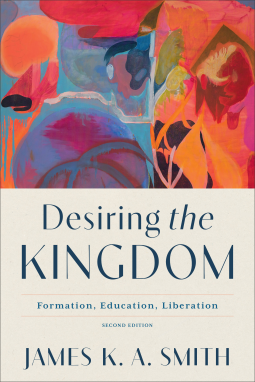
Desiring the Kingdom
Formation, Education, Liberation
Sign In or Register Now to see if this title is available for request.
Buy on Bookshop.org Buy on WaterstonesSend NetGalley books directly to your Kindle or Kindle app
1
To read on a Kindle or Kindle app, please add kindle@netgalley.com as an approved email address to receive files in your Amazon account. Click here for step-by-step instructions.
2
Also find your Kindle email address within your Amazon account, and enter it here.
Pub Date 3 Nov 2026 | Archive Date 17 Nov 2026
Baker Academic & Brazos Press | Baker Academic
Talking about this book? Use #DesiringtheKingdom #NetGalley. More hashtag tips!
Description
The first edition of Desiring the Kingdom has been widely used in a variety of educational settings. In this substantial revision, popular speaker and award-winning author James K. A. Smith rearticulates his core argument, that human beings are lovers shaped by liturgies, for a new cultural context. Smith helps us recognize the way cultural practices form--and deform--us. In this fully revised edition, he
● reveals cultural liturgies at work, showing how cultural phenomena from the Apple Store to Instagram, from the football stadium to the frat house, immerse us in the liturgies of neoliberalism and consumer culture;
● reimagines the human person as a lover and "liturgical animal," shaped more by practices and social imaginaries than by ideas alone;
● reframes Christian worship as a pedagogy of desire and liberal arts education as liberating; and
● shows how holistic education can liberate us from the smoke screens of ideology and our unconscious captivation to idols.
At the heart of Desiring the Kingdom is an account of Christian assimilation to rival gospels. These liturgies turn us into consumers who confuse happiness with acquisition and consumption. When we fail to see cultural practices as liturgies, we end up turning the church into a den of robbers with the best of intentions, often in the name of "relevance."
This makes Smith's account of Christian worship and education urgent. The goal is an education in character that, far from producing mere moral conformity, teaches us to want what God wants for the world.
Ideal for courses in theology, culture, worldview, worship, and philosophy, Desiring the Kingdom is also essential reading for scholars, pastors, church leaders, and teachers.
Available Editions
| EDITION | Other Format |
| ISBN | 9781540968838 |
| PRICE | $27.99 (USD) |
| PAGES | 272 |
Available on NetGalley
Available to Buy
Buy on Bookshop.org Buy on WaterstonesAverage rating from 2 members
Featured Reviews
 Reviewer 151386
James K. A. Smith's Desiring the Kingdom is one of those rare reads that somehow manages to be both deeply academic while offering profound relevance and application for spiritual formation. Although it was first published in 2009 and has since grown into a three-volume Cultural Liturgies series, Smith now revisits his text, updating and revising it for this cultural moment. Having not read the first edition nor any of the other volumes but being familiar with other works by Smith, I was ready to dive in.
For those who have read the first edition, this updated version allows Smith to provide fresh cultural examples, which make his points feel immediately applicable to our current situation. There is also a strong focus on justice and liberation and how our habits intersect with systemic issues like racial capitalism and nationalism.
Smith’s main idea really flips traditional discipleship on its head: that is, we aren't just some "thinking heads" driven by doctrines; we are desiring creatures driven by what we love. And what we love is trained far more by our daily habits, or our "liturgies," than by intellectual information alone. (By the way, on the topic of daily liturgies, I would also highly recommend Tish Harrison Warren’s book Liturgy of the Ordinary.)
As a chaplain within a retirement community and skilled nursing facility, I see this reality played out constantly. The routines, rituals, and habits of our lives shape our hearts and spirits, operating in what cognitive science calls the "adaptive unconscious." I was compelled by Smith's insights on secular spaces (i.e., malls, consumer technology, sports arenas) not being simply containers of information. Rather, they are (albeit, covertly) designed to teach and habituate our desires toward some version of the good life without our conscious consent. The way, then, in which we structure our church services and community chapel gatherings can be spaces of true counter-formation.
Of course, no book is without its flaws, and Smith's framework has produced some valid pushback. For instance, there is a bit of a false dichotomy created between thinking and loving. After all, biblically speaking, the heart includes the mind, and conscious reflection on solid teaching is a huge driver of belief formation. Furthermore, participating in those historic, high-church liturgies is wonderful, but it does not automatically turn someone into a loving disciple. Routines can just as easily become rote, even hypocritical. The last thing I'll mention here is that by labeling nearly every compelling cultural routine (from the Apple Store to the ball game) as a "liturgy," there is some risk to stretching the term so thinly that it loses some of its theological punch. Having said that, this second edition allows Smith the opportunity to address some of these critiques.
There are moments when the book is a bit philosophically dense and academic, but I really do think there is great payoff in his observations. So, whether you are a ministry leader in some capacity or just trying to figure out why your heart feels pulled in a million different directions, Desiring the Kingdom is worth your time. It will make you rethink not just what you teach (if that's your role), but also the habits and rhythms you create for the people around you.
I would rate this book a 4.25 out of 5 stars. I am deeply grateful to NetGalley and the publisher for providing an advance reader copy in exchange for an honest review.
 Jeremiah P, Reviewer
We are lovers more than thinkers, and our desires are shaped by the habits we practice, that is the core argument of this book. Updated examples, from the Apple Store to Instagram, show how everyday cultural practices work as liturgies that quietly train us to confuse happiness with consumption.
The book's strength is its diagnosis. Smith shows how Christians absorb rival visions of the good life, and how churches chasing "relevance" can reinforce the very formation they should resist. His account of worship as a pedagogy of desire, and of education as forming character rather than merely transferring content, is a challenge for pastors and teachers alike.
Some readers may find the cultural analysis broad and want more practical guidance for local congregations. Still, this is a foundational work, now more timely.
Essential reading on worship, education, and discipleship.