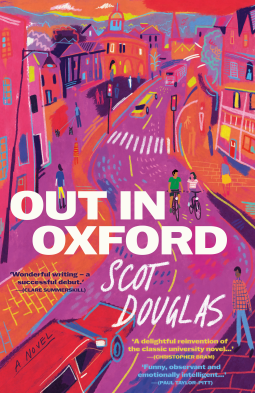
Out in Oxford
Sign In or Register Now to see if this title is available for request.
Buy on Amazon Buy on Bookshop.org Buy on Kobo Buy on WaterstonesSend NetGalley books directly to your Kindle or Kindle app
1
To read on a Kindle or Kindle app, please add kindle@netgalley.com as an approved email address to receive files in your Amazon account. Click here for step-by-step instructions.
2
Also find your Kindle email address within your Amazon account, and enter it here.
Pub Date 28 Sep 2026 | Archive Date 20 Oct 2026
Talking about this book? Use #OutinOxford #NetGalley. More hashtag tips!
Description
Out in Oxford is a sharp and funny contemporary novel about middle-aged reinvention.
Returning to Oxford as a mature student, Russell pursues sex and love amid academic politics, online hook-ups and tangled friendships. As scandals unfold and relationships falter, he confronts the gap between instant gratification and genuine connection, learning that love, like education, is unfinished business.
Out In Oxford is a witty take on midlife experience, blending campus satire with emotional honesty.
A Note From the Publisher
Available Editions
| EDITION | Ebook |
| ISBN | 9781835746349 |
| PRICE | £3.99 (GBP) |
| PAGES | 368 |
Available on NetGalley
Available to Buy
Buy on Amazon Buy on Bookshop.org Buy on Kobo Buy on WaterstonesAverage rating from 10 members
Featured Reviews
 Demetris P, Reviewer
Oxford Has an Admissions Problem, and So Does Russell Cox: On Scot Douglas’s “Out in Oxford”
A lively queer social comedy discovers that colleges and lovers share one inconvenient habit: both make people believe that being selected will settle everything.
By Demetris Papadimitropoulos | September 5th, 2026
Douglas’s Oxford is a city of doors, but the telling objects are the things that let people through them: a student card, a college invitation, a supervisor’s favor, a bedroom key. Russell Cox, forty and newly escaped from deputy-headship, returns for a DPhil with the slightly touching hope that Oxford can confer more than a degree. He wants a new flat, a new body, a new romantic life, perhaps a version of himself he finds more convincing. The university’s exclusivity is part of the seduction. He does not merely want to be admitted; he half hopes admission might improve the person being admitted. Russell has spent years looking in from one direction or another; now he would like the view from inside.
Everything about the restart has a prospectus sheen. There is Summertown, running gear, academic work, a social calendar, and considerably more sex than Russell allowed himself when younger. Men are easy to find. Second dates are not. He can scroll, arrange, undress, recover, try again. What he cannot do is make abundance behave like intimacy. Douglas gets plenty of comedy from the gap, but there is a bruise beneath it: Russell has reached middle age with freedoms his younger self barely used, and he expects those freedoms to produce the settled life he imagines he missed.
Much of the comedy comes from watching him misfile lust under destiny. A handsome classmate becomes a possibility before he becomes a person; an attractive professional can acquire a hypothetical future over the course of a drink. Russell can recognize the pattern and repeat it almost immediately, which is both his charm and his nuisance. At one point he worries that his worldly, horny persona has become an “embarrassing broken record.” Douglas does not need to rescue him from the charge. The repetition is the point, even when it occasionally becomes the reader’s problem too.
Elsewhere, Russell’s dating habits start to resemble the institution around him. Students wait to be admitted. Junior academics court senior approval. Researchers need committees to release money. Lovers hope to become somebody’s first choice. Employees worry about the reference that will open or close the next door. Oxford is full of people submitting themselves for judgment, and Douglas is shrewdest when he lets the academic language of selection leak into private life rather than announcing the parallel.
The pressure point is Bea. She has already achieved what Russell initially treats as proof of arrival: she got into Oxford. Yet after she is caught submitting work that is not her own, the city changes around her. Dining societies, memberships, restricted rooms, student cards, the question of where one may study or eat or drink begin to feel less like tradition than sorting. The old buildings remain beautiful, but the gates start looking like gates. Bea’s unhappiness gives Russell’s fantasy its necessary reverse image. Admission can make exclusion easier to see.
Russell moves the other way. Oxford’s libraries, colleges and ceremonies seep into his routine until the university becomes less spectacle than habitat. He also learns its less printable rules. Late in the novel, Lorenzo, a resentful librarian, tells Russell he plans to break into Professor Peter Warren’s office to find evidence of bought admissions. Russell asks exactly when he intends to go. Lorenzo is caught; after fleeing the office, he hears Russell’s voice inside with Peter. Douglas never explains the arrangement outright. Good. The implication is nastier for not being diagrammed. At minimum, the guileless newcomer of September is gone. Russell has learned that institutional belonging may include knowing what to conceal, whom to warn and when innocence is useful theater.
It would be easy, from that description, to make “Out in Oxford” sound grimmer than it is. Douglas judges his people, then keeps inviting them to dinner. Vanity comes with vulnerability attached. Hypocrisy often has a hangover. A man can be odious in committee and forlorn by closing time. Very few characters are reduced to the worst thing they have done, and almost nobody gets the luxury of disappearing after making a mess. They must go on seeing one another. That is where much of the comedy, and some of the mercy, lives.
Place does some of Douglas’s driest work. Many chapters begin with an Oxford fact, a local institution, a historical scrap or an academic definition, then tilt it toward the scene that follows. The Radcliffe Camera’s grandeur frames Russell and Bea’s inability to stop monitoring the attractive Nik. A former prison houses a confrontation about patronage and entrapment. An observatory precedes Bea’s collapsing academic confidence. When the device works, the city supplies the joke. When it does not, Douglas has the slight tour-guide habit of explaining why the joke is funny.
As prose, the novel prefers timing to display. Academic language about supervision, mentoring, funding, assessment and access keeps colliding with sex, booze, jealousy, furniture and bodily mishap. A wedding ideal founders on logistics; a five-star hotel accommodates a grubby bargain; a library produces as much surveillance as study. Douglas is especially good with the deflating physical detail, the thing that makes pomp look suddenly mortal: a strained outfit, an unhelpful mirror, a badly timed bodily function, a room whose expensive surfaces cannot improve the conversation inside it. His comic comparisons sometimes press too hard, but the instinct behind them is sound. Status has never cured anyone of being mammalian.
Perhaps “Tales of the City” by Armistead Maupin is the most useful comparison, not least because Douglas names Maupin as an influence. They share an appetite for entanglement: overlapping queer lives, sexual candor, recurring gathering places, the pleasure of discovering that one person’s subplot has wandered into another’s kitchen. “Lucky Jim” by Kingsley Amis shadows the academic satire, though Douglas is much warmer. “Less” by Andrew Sean Greer catches something of Russell’s gay midlife self-delusion. Russell, however, is less solitary than Arthur Less. His natural element is other people’s business.
Across seventy-three short chapters, that business receives the Oxford academic year as its timetable. The cast list itself is divided into town and gown, as if the categories might remain orderly. They do not. Michaelmas brings appetite and entry; Hilary complication; Trinity consequence and departure. Russell initially wants study and sex, friendship and romance, university life and everything outside it to remain distinct. By spring, nearly everyone knows somebody who has slept with, supervised, employed, funded, rejected or blackmailed somebody else. Oxford turns out to be a small town with unusually elaborate stationery.
Douglas likes collisions more than mysteries. Someone walks into the wrong flat, hears the wrong conversation, kisses the wrong person or turns up at a party where several private arrangements become public at once. The Eurovision gathering is the purest example, but the same mechanism runs through the book. Information keeps changing hands. Profiles, references, admissions files, dossiers and overheard remarks make people legible to institutions and useful to one another. Gossip is infrastructure.
In this crowd, Jane becomes Russell’s most important counterweight. Jen and Rebecca turn supervision into a test of intimacy and authority; Rebecca’s decision to withdraw from Jen’s direct supervision before pursuing the relationship is one of the few moments when desire is made to wait for an ethical adjustment. Chrissie discovers that attraction to accomplished men has become tangled with a wish to become necessary to them. Rich, initially defined by youth, muscle and impatience with older gay men, slowly acquires work, purpose and obligations. Sean’s marriage to the much younger Eden turns the pleasure of being wanted into a mirror in which aging becomes impossible to ignore. These lives do not decorate Russell’s story. They keep correcting it.
More difficult is Chrissie, whose plot shows both what Douglas can hold together and where his grip loosens. Sex work, money, academic hierarchy, male power, assault and self-invention all meet in her storyline. When she tells Jane that she repeatedly seeks clever men whose success allows her to feel powerful, the scene moves beyond gossip into self-recognition. Yet the novel barely settles there before another event begins. Douglas’s briskness is a pleasure until consequence starts to feel booked into a thirty-minute slot.
If the book has one persistent weakness, it is this shortage of aftermath. Chrissie’s assault, Bea’s plagiarism and Sean’s marital collapse leave marks that the narrative acknowledges but seldom inhabits for long. Comedy need not become solemn when pain enters the room. It does, however, sometimes need to surrender the microphone. Douglas’s snapshots are often alive with movement; a few disappear before the atmosphere has had time to change.
The short chapters create that problem at the same time they solve several others. They give Douglas breadth, surprise and the pleasurable sense that everyone is three acquaintances away from somebody else’s mistake. They also make several figures in the corruption plot harden into functions of appetite or leverage. Peter, Charles, Jeremy and Lorenzo can begin to resemble administrative departments of self-interest. The machinery remains entertaining, but one starts to hear it operating.
Russell’s romantic auditions produce a smaller fatigue. Repetition belongs to his character, but the reader usually learns the lesson before he does. One or two fewer men would not have impoverished his education; they might have allowed the remaining disappointments to bruise more deeply. Douglas is most affecting when Russell drops the pose and admits that academic work, however difficult, at least feels trainable, while finding a partner does not. For once there is no tactic, only bafflement.
Outside the university’s competitive rooms, Northgate Hall offers another kind of social life. It is neither prestigious nor profitable, and no committee has to pronounce its visitors worthy. Its value lies in repeated presence: mentoring, drinking, helping, noticing who has not turned up. Its closure therefore lands harder than the plot space devoted to it might suggest. In a novel crowded with rooms whose value depends on who is allowed through the door, Northgate matters because its best work is simply letting people stay. Douglas understands that access to other queer people is not the same thing as a shared life. A crowded room and a community are different achievements.
Precisely because Russell’s coming-out story is already over, Douglas can ask a less frequently dramatized question: what is queer freedom supposed to become afterward? Russell has sexual possibilities his younger self barely permitted himself to imagine, but permission arrives without instruction. He does not need to discover whom he desires. He needs to discover what desire can and cannot build. The answer is comic because he tries nearly everything and melancholy because abundance never quite quiets the wish to be somebody’s first choice.
Online life gives the mid-2000s setting an unexpectedly sharp aftertaste. Russell’s world predates the fully matured app economy, yet its logic is familiar: more profiles, easier encounters, scarcely more certainty. Technology enlarges the menu without teaching anyone how to order a life. The university plots rhyme with that without becoming an allegory. Rules can be rewritten; appetite, dependency, patronage and the usefulness of knowing something damaging about somebody else have much longer histories.
Unfinished adulthood is where the novel finally settles. Jane changes jobs and cities but imports her romantic expectations. Chrissie declares independence after repeatedly attaching her worth to powerful men. Bea reaches Oxford and discovers she may not want what admission was supposed to certify. Russell changes profession, city, body and routine, yet remains himself enough to be exasperating and touching. Reinvention here is not replacement. It is revision with tracked changes left on.
Late in the year, the running joke has hardened into a pattern: nearly everyone wants in somewhere, and almost nobody finds entry conclusive. That coherence lifts “Out in Oxford” above its looser passages. I rate it 80/100, corresponding to 4/5 on Goodreads. Its social intelligence, warmth and design outweigh its repetitions, but the repetitions are real, and several darker turns deserve more room than Douglas grants them.
One kindness Douglas grants Russell is refusing to make wisdom arrive on schedule. He improves untidily. He becomes a better student, a more embedded Oxford resident, perhaps a shrewder institutional player and certainly a more attentive friend. Yet he remains capable of seeing an attractive stranger and composing a future before learning the man’s surname. Growth may be cumulative, but temptation has excellent attendance.
So the final scene withholds the certificate Russell has spent the year trying to earn. He and Jane sit over coffee, both single, hopeful, preparing for more study and more mistakes. Russell calls finding a man, like the doctorate, “work in progress.” What neither quite says is that they have already formed one of the book’s least competitive and most durable attachments: neither auditioned for the other. Above them the dreaming spires remain beautiful and useless as guarantors of happiness. Russell ends not transformed but more inhabited, with a city, a degree in progress, a friend he will miss and another term waiting. For a novel so preoccupied with getting in, its finest turn is discovering that belonging begins after the door has closed behind you.
 Jasmine H, Reviewer
Thanks to NetGalley and The Book Guild for the advance copy. All opinions on this book are my own. Scot Douglas has provided this book with plenty of dialogue and plot to keep the story going. This book contains mystery and intrigue that would make the storyline interesting to read. I would recommend this book to anyone who loves reading books with a continuous plot.
 Reviewer 2064863
I love campus novels and academia romances of the not Dark Academia kind, and I spent a year at Oxford doing postgraduate study (though I think I like that place more on page than I liked it in life). A novel about a mature and queer Oxford grad student should be right up my alley, and in many ways it is. I can easily picture the Jericho cinema—I lived down the block—and imagine myself cycling toward Summertown. It gets even more specific with a trip to the Old Bookbinders’ Pub (my local—all Oxford pubs are apparently forever) and a Eurovision Song Contest Party. I can also easily imagine the interdepartmental meetings, the pressure to get more funding, having stayed on in academia, though some of the storylines here get pretty crazy, and there are also too many of them. I feel for Russell through the various rather unsatisfying encounters and hookups, which are often quite funnily sketched, while he longs for something less transient. I also liked that he is, in a way, both town and gown, having grown up in Oxford. It’s written in a vignette style, with shifting perspectives and characters, and I suppose I wish the vignettes felt slightly less disjointed. There is something a bit staccato about both the prose and the structure, and there are a lot of characters and plotlines to keep track of, so I don’t fully connect with a lot of them. I enjoyed this as a trip down memory lane more than as a piece of fiction.
3.5 stars.
The review will go in my roundup of September reads on http://plenitude.substack.com
 Rudi M, Educator
I really enjoyed this one! Out in Oxford is a fun, engaging read with a great sense of place and plenty to keep the story moving. I especially enjoyed the atmosphere and the way the characters brought the story to life.
There’s a nice balance of mystery, tension, and character-driven moments that made this an easy book to get invested in. It kept me curious throughout, and I found myself wanting to see where everything would ultimately lead.
A solid read that I’d recommend to anyone looking for an entertaining story with an intriguing setting and compelling characters.
Thank you to NetGalley and the publisher for providing me with an advanced copy in exchange for an honest review.
Readers who liked this book also liked:






Mathew Tekulsky
General Fiction (Adult), Historical Fiction, Novellas & Short Stories

Lexi Davis
Novellas & Short Stories, Romance, Women's Fiction