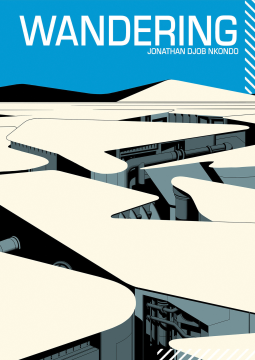
Wandering
with Jonathan Djob Nkondo (Illustrator)
This title was previously available on NetGalley and is now archived.
Send NetGalley books directly to your Kindle or Kindle app
1
To read on a Kindle or Kindle app, please add kindle@netgalley.com as an approved email address to receive files in your Amazon account. Click here for step-by-step instructions.
2
Also find your Kindle email address within your Amazon account, and enter it here.
Pub Date 20 Oct 2026 | Archive Date 30 Sep 2026
Oni Press | Magnetic Press
Talking about this book? Use #Wandering #NetGalley. More hashtag tips!
Description
Though they never meet, their lives mirror and resonate with each other, creating a haunting sense of synchronicity and missed connection. Set in a world where the surface has become a vast, arid desert dotted with strange geometric creatures and billabongs, Wandering imagines a society that has retreated underground. Beneath the scorched crust, life continues in sprawling subterranean complexes—theaters, malls, food courts, and highway interchanges—forming a claustrophobic echo of the world above.
Themes of alienation, routine, freedom, and the trappings of modern life turn this textless, nonlinear, and atmospheric graphic novel into an unsettling contemplation of the trappings we choose to surround ourselves with.
Available Editions
| EDITION | Other Format |
| ISBN | 9781962413794 |
| PRICE | $29.99 (USD) |
| PAGES | 200 |
Available on NetGalley
Available to Buy
Buy on Bookshop.org Buy on WaterstonesAverage rating from 32 members
Featured Reviews
 Reviewer 2117051
I wasn’t quite sure what to expect when I picked this one up, and I’ll admit it was mainly the author’s name that drew me in since I LOVED Scavenger’s Reign. I certainly wasn’t expecting a graphic novel with no dialogue or narration, told entirely by visuals alone. However, as I continued through the book, I really enjoyed the way the story unfolded. The stunningly minimalistic illustrations show a bleak world, and the two sides that inhabit it. The parallel to Scavenger’s Reign certainly exists, though this story takes place in a cityscape rather than the wilderness of a strange planet, but I found it gave me that same feeling of an immense world and unlikely survival. Overall this was very quick to get through, and I’m probably less qualified than someone who knows more about art to analyze the intricacies of how visual storytelling is used, but I found the story very interesting and would certainly recommend it to someone who enjoys a book that requires interpretation, with a meaning hidden in the details.
 Joe M, Reviewer
Wandering is the tale of silent, parallel lives lived in tandem across the literal-strata of a cyberpunk cityscape. The story follows a well-to-do disaffected middle-aged man in a dense urban cluster, and a young man living in an artificial simulacrum of paradise, or at least his own interpretation thereof.
Completely wordless, Nkondo’s work strings together moments with an immaculate economy of timing through its primarily one-panel-per page structure. This pacing adds a LOT of weight to the visual comparisons Nkondo strikes between the two lives – an explosion from the city is mirrored by a silent cannonball’s splash into a body of water. A slurp of ramen juxtaposed against the gnashing of teeth into hunted flesh.
These page-sized panels have the knock-on effect of dramatically magnifying the impact of page-turn reveals. Reflective observations stretch out like taffy, in one instance following the descent of liquid droplets down a ravine-of-sorts for 10-whole pages. Meanwhile, we have another character traversing a busy cityscape in just a few panels.
Nkondo’s got a real mastery of the push and pull of timing here, and it’s only rivaled by the composition of his pages. Really beautiful, striking imagery, each page of which I’d love to throw up on the wall.
The only other comic work of Nkondo’s I’ve read has been a story in Ex.Mag #1, which I enjoyed quite a bit. I’m very excited to read through Peaceful Remission, the companion book to this which was kickstarted in a collection with this one. I should almost definitely get around to watching Scavenger’s Reign at some point, too
This review copy was provided by Magnetic Press via NetGalley
 Emilyann O, Reviewer
I’ve never read anything quite like this before. The artwork is stunning, especially the way nature is brought to life with so much detail and texture. There were moments when I found myself slowing down just to look at the pages rather than moving on with the story.
What stayed with me most was the way the different worlds are connected. The patterns woven between them gradually begin to reveal themselves, and I loved seeing those connections take shape. There is something almost mesmerizing about the way the story builds those layers without making them feel forced.
I honestly think this is a book that needs two or three read-throughs to catch everything, and even then, I’m not sure you ever fully do. There is so much commentary on society woven into the story that I know I’ll find myself coming back to it in the future and noticing things I missed the first time.
It is imaginative, beautiful, layered, and completely different from what I normally read. The combination of the artwork, the worldbuilding, and the ideas underneath it all made this feel like something I experienced rather than simply read.
 Libby K, Reviewer
Thanks to NetGalley and Oni Press for the ARC!
Wandering is sparse, starkly beautiful, experimental, and odd in the best way possible. Nkondo's art is monumental and perfectly poised, and his work manages to ride the line between telling the reader a story and allowing them enough space to make up their own mind about what they think is happening.
Everything in the setting of Wandering has this strange, surreal feeling, highlighted by Nkondo's bold, unyielding use of shape, line, and his limited black and white colour palette. Both the characters feel like they're in this strange, alien landscape. Man A lives in a city made weird by the enormity and vastness of the architecture, which is very effectively highlighted in the final panels when we're shown just how far down it is from the surface to the lower levels. Man A is constantly being dwarfed by the city around him, made small and insignificant by all the monumental architecture and other lives flowing all around him. Man B also feels like just a small speck in the vast openess of the arid desert, yet somehow he feels at home and easy there, like he's made himself a part of the landscape. There's a casual ease with which he moves through his environment, an interesting mirror to the aimless lack of purpose in Man A. Though often surrounded by crowd scenes full of individuals and interesting details, something about the lack of complete details (especially full facial features) on all the other figures and the black and white style blends them into one flowing mass, even when Nkondo clearly sketches out details that denote different hair and gender and age. All these people should make the city feel alive, but somehow it still feels soulless, with Man A just lost in the flow. It's a really neat effect!
But the world above isn't totally comfortable. It's wonderfully strange, with the vast open whiteness of the desert and the enormous, alien creatures that are only roughly in the shape of animals. But there's something odd and almost creepy about Man B's introduction to us being him sleeping alone right in the middle of a blank desert, with no shelter or landmark to mark this as a place of home or rest, as if he's just dropped down as soon as he felt tired. That's a mark of his freedom, but also his homelessness, his rootlessness (his Wandering, to point to the title). Him drawing the woman in the mud shows us this little crack in his seemingly careless facade, allowing us to know that he knows he's alone and has complicated feelings about that.
What's great is that all this is conveyed entirely without dialogue. In fact, Nkondo barely uses any text in this comic at all. Instead, everything rides on the reader being able to pick up what Nkondo is putting down - and in my opinion, he gives us just the right amount of clues and hints to get what's going on, while leaving us room to make interpretations of our own.
If you're not willing to work and put some effort into understanding the story of Wandering, then this definitely isn't going to be the comic for you. If, however, you're in the market for a comic that really makes you think and feel, this will be perfect for you.
 Mariana C, Reviewer
Wandering is a stunning piece of visual poetry. The fact that Jonathan Djob Nkondo can build a compelling story entirely without dialogue—using only pure imagery and pacing—and still make it completely clear is seriously impressive.
The book follows two men wandering in a vertical parallel: one on the scorched surface living wild and free doing whatever the hell he wants, and one below in an underground city lost in routine and alienation. Even though their environments are polar opposites, their journeys mirror each other in this eerie, quiet way. It’s a really cool exploration of loneliness and how, beneath all the structures and societal trappings we build around ourselves, the human condition isn't actually that different.
And when their paths finally collide near the end? The ultimate equalizer between their two worlds.
Readers who liked this book also liked:

Osamu Tezuka
Comics & Graphic Novels, Entertainment & Pop Culture, Mystery & Thrillers
Shirow Masamune
Arts & Photography, Comics & Graphic Novels, Sci Fi & Fantasy