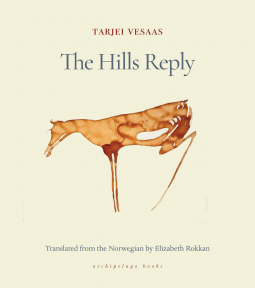
The Hills Reply
This title was previously available on NetGalley and is now archived.
Send NetGalley books directly to your Kindle or Kindle app
1
To read on a Kindle or Kindle app, please add kindle@netgalley.com as an approved email address to receive files in your Amazon account. Click here for step-by-step instructions.
2
Also find your Kindle email address within your Amazon account, and enter it here.
Pub Date 10 Dec 2019 | Archive Date 25 Oct 2019
Talking about this book? Use #TheHillsReply #NetGalley. More hashtag tips!
Description
An intensely graceful novel recounting scenes of the Norwegian countryside from one of Norway's most beloved 20th-century writers
Tarjei Vesaas’s final work, The Hills Reply, is a flow of intensely lyrical autobiographical scenes. The vivid beauty of the wilds of Norway grounds the narrator’s interior flashes.
The first sketch finds a boy, his father, and their packhorse clearing a logging road buried in snow as their surroundings give way to a crisis. Profound insights into human behavior, solitude, and nonverbal communication stand up to the power and immensity of the natural world. The land speaks to (and at times almost swallows) the central character, as he is pushed to the edge of what a body and mind can endure.
The hypnotic pulse of Vesaas’s prose blurs the line between memory and hallucination, as it stares bravely into the unblinking eye of Nature. An unforgettable book, The Hills Reply is a visceral salute to the human spirit, to the ecstasy of wilderness, and to their tender overlapping.
Advance Praise
"This final work by one of Norway’s most significant writers of the 20th century has the abstract, colorist strangeness of Matisse’s late wall-hangings. What would happen if landscape entirely superseded people (as if this doesn’t happen when we die). Here’s a beautiful, arresting answer." –John Freeman, Lithub "Tarjei Vesaas is the best and most interesting Norwegian writer after the Second World War. His language is so sensitive, so open to his characters' minds and the landscape they inhabit, that it gives form to that space between - between people and other people, between people and nature - the space where our lives unfold." -Karl Ove Knausgaard "A clear crystal of imagination...a rare kind of masterpiece" -Daily Telegraph "A rare mixture of creative vitality, conviction and artistry." -Guardian "An excellent translation by Elizabeth Rokkan catches the quiet, poetic mood." -Sunday Telegraph "Infinitely calm and strong." -Daily Telegraph "Disturbing and beautiful...elaborate and powerful." -Sunday Times "A book of great strength and beauty." -The Times
Available Editions
| EDITION | Other Format |
| ISBN | 9781939810380 |
| PRICE | $18.00 (USD) |
| PAGES | 272 |
Available to Buy
Buy on Amazon Buy on Bookshop.org Buy on WaterstonesAverage rating from 13 members
Featured Reviews
 Kasa C, Reviewer
Impressionistic and yet naturalistic, this release from Archipelago publishing house presents a work of Tarjei Vesaas, one of Norway's most honored authors, as yet unavailable in translation. Semi biographical scenes present Norwegian rural life, but it is unclear as to the era. Versaas was born in 1897, so the coming of age sequences are more identifiable. I was particularly taken by an evening in which the narrator sits motionless as a "tussock" (even more so because tussocks to respond to breezes) in order to watch the dance of the cranes. A phenomenon described beautifully by Richard Powers in The Echo Maker. Here, Versaas presents man and nature, giving personality not only to the marshes, animals, and a horse, but also to the rocks. The river. Almost shockingly, there is a chapter recounting an episode of war, so haunting and clear, a reader feels as if they're present despite the poetry of the execution.
 Educator 211653
Thank you Net Galley. Beautiful and lyrical. a short but excellent read. Loved it. The descriptions of nature are poetic and the situation of the self in it are very moving.
Jacqui H, Reviewer
An intriguing set of essays that read as short stories. It's written in a beautiful way expressing feelings about landscape, waterscape and nature extremely vividly. Any people mostly seem rather incidental but certainly part of the landscape. Some stories are distinctly bizarre with no obvious pattern through them, others gentle ambles through the trees or water or rocks. Life goes on at a very slow and steady pace. - the plodding of the boy, his father and horse pulling logs out of a snowy forest, watching dancing cranes, floating down a stream, dreaming of mother. Well worth reading just for the use of language. Thanks to NetGalley and Archipelago for an advance copy in exchange for my honest review.
Kathleen D, Reviewer
'Yet the face is deformed now, distorted and unlike itself, the result of the misfortunes that have come like avalanches- there behind him, where he has left his half-lived life.'
In prose and poetry this is the last book by Norwegian Author Tarjei Vesaas, said to be one of Norway’s greatest writer’s of the twentieth century. Memories flow, with nature ever present, indifferent to human longings, joys, love, and sufferings. Nature both capable of beauty and brutality,
As It Stands in the Memory, a father and son stand in the “sifting snow and sifting thoughts”; the silence of the snow disrupted only by the sternness of the father and failure. A boy who doesn’t know his father, who keeps his thoughts, his forgotten dead dream to himself. A moment, when the son is shamed and will carry it on for the rest of his life, snow and a wounded horse as witness.
In the Marshes and on the Earth he feels eyes upon him, and these eyes belong to the cranes. The beauty of the birds so beautiful he wonders, is this a dream? He is the eyes now, the watcher, delighting in the dance of the cranes. He is in thrall of the flock.
Spring in Winter is about snowdrifts, heartbreak and the bewilderment in the holding of hands. How can one burn when they are so frozen by the elements, chilled by waiting for the heart’s desire? Sent as the bearer of bad news, only to see a beautiful girl in a different light?
Smashed mirrors, kicking out blindly for survival, the danger in the reflective surface of bodies of water, the “wet body is as heavy as stone”, so easy to drown. A thing (a person) can drown as easily as be saved. Rain falling upon the dead, “Five men. That’s not many. One for each finger on your hand.” How did those five men end up where they are, forgotten, nothing. “No one will find them but the flies.” Lyrical writing for so brutal an ending. A deadly ‘quiet’ in a grove. Nature absorbs what a young man feels, about a blushing girl.
It is a book moving through an old man’s life, I think. What better way to tell it then through lyrical delights? Sure, ‘the heart grows lonely’ and everything changes with time, ‘laws, highways, waterways’ and yet the memories plant themselves and remain waiting to be plucked.
I am also, after reading this fine book, very interested in reading The Birds by Vesaas, about a disabled man being cared for by his lonely older sister in an isolated land. I think nature as character is one of the hardest and yet most rewarding works one can conceive. It feels like a mystical experience, a dream (as with the cranes verses within) when one moves with nature, and it is perfectly captured here. A beautiful literary fiction book for anyone who loves lyrical prose. Tarjei Vesaas (1897-1970)
Publication Date: December 10, 2019
Archipelago
 Annie B, Reviewer
The Hills Reply is a collection of short vignettes by Tarjei Vesaas, translated from Norwegian by Elizabeth Rokkan. Originally published (in Norwegian) in 1968, this reformat and re-release in English is due out 10th Dec 2019. It's 272 pages and will be available in ebook and paperback formats.
These are stark introspective and poetic scenes. There is no index, no table of contents and no precisely discernible order to the collection. There is no plot and no real narrative arc. The translation work is perfect but in no way invisible. The prose has a distinct Norwegian flavor. It's pared down and spare, efficient and quite beautiful.
This would be an excellent selection for a number of academic settings such as foreign literature in translation, modern Scandinavian literature/poetry, possibly even some language translation work. It would also be a great pick for people who appreciate and seek out freeform poetry, modern literature, etc.
Four stars for me, five for lovers of fine literature (which I am also, but this one was so full of sentence fragments and poetic 'bits' that it was a hard slog for me).
Readers who liked this book also liked: