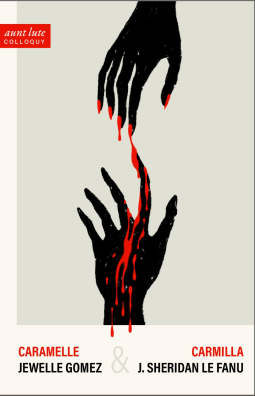
Caramelle & Carmilla
This title was previously available on NetGalley and is now archived.
Send NetGalley books directly to your Kindle or Kindle app
1
To read on a Kindle or Kindle app, please add kindle@netgalley.com as an approved email address to receive files in your Amazon account. Click here for step-by-step instructions.
2
Also find your Kindle email address within your Amazon account, and enter it here.
Pub Date 14 Oct 2025 | Archive Date 28 Feb 2026
Talking about this book? Use #caramelleandcarmilla #NetGalley. More hashtag tips!
Description
Two vampire stories, two authors, two striking meditations on dependency and desire.
For readers of Octavia E. Butler, Tananarive Due, and Gwendolyn Christie, comes Caramelle, Jewelle Gomez’s latest addition to the universe of The Gilda Stories. This short story offers a supernatural alternate history where vampires seek love, laughter, and blood in 1860s slavery America.
Inspired by a glimpse of affection in Joseph Le Fanu’s 1872 classic vampire novella Carmilla, Caramelle follows two vampires who arrive at a way station on the Underground Railroad not to stalk their prey but to seek sanctuary, intertwining the haunting legacy of American slavery with gothic horror and the resilience of Black women.
In Carmilla, included here alongside Caramelle, Le Fanu serves the sensual, sapphic, and spooky packaged into the experience of girlhood in 19th Century Austria. This original vampire story predates Dracula and introduces the genre as reliant on themes of gender, sexuality, and race.
Gomez’s foreword deftly links the two works by exploring the historical and cultural contexts that surround these two powerful iterations of the vampire genre.
“As in the past we still hold our freedom and our pleasure in our own strong hands. Hands made even stronger when holding on to the hands of others.” —Jewelle Gomez
Caramelle & Carmilla is the first book in the new series Aunt Lute Colloquy, a publishing space dedicated to fostering feminist conversations across literary generations.
Advance Praise
"Jewelle Gomez is the master of show-don’t-tell. Caramelle uses superb speculative storytelling, taking us back into the world of Gilda to reflect, alongside Carmilla by Sheridan Le Fanu, on times when women’s power was suppressed and revealed at the same time."
—Linda D. Addison, award-winning author, HWA Lifetime Achievement Award recipient and SFPA Grand Master.
Available Editions
| EDITION | Other Format |
| ISBN | 9781951874094 |
| PRICE | $15.95 (USD) |
| PAGES | 170 |
Links
Available on NetGalley
Average rating from 51 members
Featured Reviews
 Laura M, Reviewer
I really enjoyed this pairing of stories. This work combines two previously published stories. First is Jewelle Gomez’s short story "Caramelle," which was sharp and engaging. It left me curious to explore more of her work, especially The Gilda Stories (Gilda makes a minor but intriguing appearance here). It is followed by Sheridan Le Fanu’s "Carmilla" before, which I had never read before, so it was a treat to finally dive into this classic vampire tale. It’s fascinating to see how it still resonates and how modern writers like Gomez play with and expand on its themes.
I’d also recommend Hungerstone by Kat Dunn, another excellent retelling of Carmilla, which I read awhile back and loved. Together, these stories show just how much life there still is in this gothic, vampiric lineage.
Thank you to NetGalley and the publisher for an early copy in exchange for an honest review. All opinions are my own.
 Reviewer 589132
I thoroughly enjoyed reading both Caramelle and Carmilla's stories in this book. Carmilla is a classic part of the vampire canon whilst Caramelle is a newer addition but slots beautifully in as if it was always there. I am a big fan of The Gilda Stories so finding out that Caramelle is a sort of prequel was a real treat and I loved the introduction we got from Gomez about the legacy of sapphic vampires and writing vampires to represent all communities and readers.
This was a real treat to read!
 Kim J, Reviewer
This collection starts off with a foreword written by Jewelle Gomez where she explains her feelings about Le Fanu's sapphic vampire novella "Carmilla" and how it partially inspired her to write her own version with the short story "Caramelle." Gomez's insight was very interesting — I especially enjoyed her takes on both the positives and negatives of "Carmilla" — and really helped me see that these two stories are connected by a little more than just lesbian vampires.
The first story you'll read here is Gomez's "Caramelle" (originally published in 2011), which is about a girl and her father who escaped from slavery themselves and now work as part of the Underground Railroad to help other African Americans escape as well. One night their newest refugees are a mother and daughter pair, who seem largely normal aside from the fact that they sleep during the day and only awaken at night.
Although it is a rather short story, "Caramelle" managed to catch my attention quickly and kept hold of it throughout. The prose was smooth and showed you exactly what you needed to know without wasting time on unimportant matters. And even though the relationship between Elisabeth and Caramelle developed very quickly, it still felt natural to the story and didn't really feel rushed. It's also quite tame as far as vampire stories go (dare I say we're treading on wholesome cottagecore vibes with this one?), which was a nice change of pace for me. So even though it is rather short, it's still a satisfying read and I'd definitely recommend it to those who might be looking to get a quick vampire fix in their day!
The other story in this collection is "Carmilla" — a novella that was originally published way back in 1872 that also served as a large inspiration for Bram Stoker's "Dracula" (which was published a whole twenty-five years later in 1897). This is a story about a girl named Laura who lives a rather secluded life with her father and their servants in an old Austrian castle. Due to a carriage accident occurring right outside Laura's home, a girl named Carmilla is rather suddenly left under the care of the family. Amidst strange happenings in the nearby towns involving people unexpectedly dropping dead from an unknown illness, Laura and Carmilla develop a strong friendship that ends up evolving into Carmilla showing romantic advances towards Laura.
Like most of the old classics, "Carmilla" is filled with rather flowery prose and it may be a bit daunting to people who are not used to that style. I myself am not the biggest fan of this style of prose, but I think this was one that was easier to read overall — although the fact that it was a lesbian vampire story did make it feel more worth the effort! Overall it has an interesting plot and I really enjoyed how we have a dual mystery where the characters are trying to figure out Carmilla's oddities while also wondering about the unexplained deaths going on around them.
If you're interested in sapphic vampire literature, and you've either never read either story before or only have read one of them, then I highly recommend picking "Caramelle & Carmilla" up! And honestly even if you've read both before, and enjoyed them, maybe this would still be worth picking up just for Gomez's rather insightful foreword at the beginning.
Reviewer 838786
I loved this, a companion two well written novellas side by side speaking volumes and sharing paralleled themes but with opposite intentions. Caramelle shows development of race at time when slavery was abolished and black people were trying to find safety out in the world seeking refuge amongst their travels to safer land. In this time similarly the sexuality of both girls and women would have been frowned upon but one story chose to share their vulnerability, intimacy and strength where as the other story saw the weakness and desire as a monstrous act depicting a beast. I really enjoyed the different contrasts the two stories had and they clearly where very different Vampire stories which also created a nicely made contrast.
 Kate C, Reviewer
Carmilla is one of my favorite classic horror tales, and Caramelle, Gomez's novella in this publication is a new story very loosely based on Carmilla was an interesting read. Gomez's foreword on Carmilla and how it inspired her story was honestly the most compelling part of this publication to me.
In Caramelle, a young girl named Elizabeth, and her father escaped slavery some years ago and now are part of the underground railroad, helping others find their way to freedom. When Elizabeth becomes close to one young girl while she and her mother stay at their home, she learns there is more to her new friend Caramelle than meets the eye. This story is very short but manages to pack all the necessary components into the story. It's not really a re-telling of Carmilla but more uses the vague basis of Carmilla to tell its own tale.
Thank you to NetGalley for an eARC of this novel.
 Vasileia O, Reviewer
Having recently read Carmilla, I was instantly drawn to Caramelle, a retelling of shorts taking place during the American Civil War and lacking the demonization of women's desires as depicted in Carmilla.
Caramelle is the short story of the meeting and connection between Elizabeth, who along with her father helps escaping slaves, and Caramelle a vampire, who along with her mother, is on the run both from slavers and from the other vampires. In a few pages, the story manages to depict both the terribleness of the times and also the hopefullness of the connection between the two girls. It serves as a prequel of the author's book "The Gilda Stories" that I would definitely be picking up. And of course, rereading Carmilla alongside this story adds to the understanding that no matter the queerness that I perceive in vampire stories, Le Fanu's story is deeply influenced by the time it was written, ending in the oppression of women's lust rather than the hopefullness of Caramelle and Elizabeth finding each other.
 Gracie K, Reviewer
aaaaand welcome back to the stage sapphic vampires!!!!!!! Carmilla is the iconic OG sapphic vampire and even one of the OG vampires (hello....she was before Dracula.....herstory has its eyes on her) and I loved the short story Caramelle that takes Carmilla and applies it to a story about the underground railroad.
So many cool themes colliding here and I loved how this book (now out today oct 14!!! go read it!!!) combined the two stories and included a foreword by Jewelle Gomez to contextualize both. It made me super intrigued by the author's full length work, The Gilda Stories (whose titular character is featured in Caramelle) and just everything she has to say in general about this subgenre of literature!!!!
Carmilla has been on my TBR forever, and it is honestly a 5 star classic. maybe 4.5. The writing reminds me as a reader that not all prose has to be flowery to be beautiful. Le Fanu writes very concisely but his words are high impact. Caramelle, on the other hand, I gave 3.5 stars because I find it hard to give short stories any higher than 4 stars if they're only 30 or so pages (prob a flaw of mine). But I have to say I would've loved it as a full length story and short stories in general don't perform well with me bc I like to read something over multiple days/weeks to really absorb its content and think about it and a short story usually just goes in one ear and out the other.
anyways I really enjoyed this and I think combining the short story with the original novella was fabulous.
Media/Journalist 1615215
I find this idea of uniting Caramelle and Carmilla into one volume, with a short but poignant and comprehensive foreword by the very author of the former, is excellent.
I was not aware that there was such thing as Black lesbian vampires as a subgenre, so finding it out via Caramelle, and the aforementioned foreword, was quite cool. I am determined to read The Gilda Stories now, anf quite curious.
As for Carmilla, I had tried to read it before in a wobbly translation and could not get hooked for the life of me, but the original is much cleverer and it really helped me dive into the mood. I remembered a horror film I watched some years ago that happened in Styria as well, so now there are a lot of connecting dots in my head.
Bookseller 1489970
Firstly, I want to say I really enjoyed the foreword. The author is clearly an expert in the field of lesbian vampires, which is pretty damn cool actually. I really enjoyed her insights. The Caramelle story itself wasn’t BAD by any means, I still enjoyed it, and think the premise is really intriguing and unique. However, I do think it fell a little flat within the context it’s being presented. It is being set up as, if not a retelling of Carmilla, a short story that takes heavy inspiration. Particularly after such a strong foreword that touched upon issues I had with the original Carmilla, I was looking forward to reading a short story that really played off of it. Again, Caramelle certainly wasn’t bad, but in comparison to the original short story it feels half-baked. There is no build-up of suspense or build-up of romantic tension between Caramelle and Elisabeth. It is very clearly a companion work to the other vampire novel the author has written, which is totally fine, but it doesn’t feel like it has legs on its own. It was kind of disappointing because from how knowledgable the author clearly is and how interesting of a premise she had set up I feel like she could have done so much more even if she didn’t want to expand the story into something longer. I feel like I’m sounding very negative, because it was still an OK short story, it just fails to shine next to Carmilla.
 Rachel M, Reviewer
I already loved the story of Carmilla and feel in love with the story Carmelle. If you like vampire stories these are truly two stories you should read. A look at female love as well. I think if your familiar with Carmilla you will find Carmelle equally as intriguing as I did. Carmelle is about a girl and her father helping slaves on the underground railroad. Two women come to stay with them but there's more to them than meets the eye.
 Nicole R, Reviewer
I really enjoyed this book. Revisiting Carmilla was a treat; it still holds up all these years later. It’s a bit creepy and lovely in a strange way, with this quiet tension that runs through the whole story.
The relationship between Laura and Carmilla is intense and a little confusing; you’re never totally sure if it’s affection, danger, or something in between. That weird mix of feelings really captures how complicated relationships between women can be, especially in a world that tries to control them.
Caramelle, by Jewelle Gomez, was entirely new for me, and I’m so glad I read it. It’s set during the era of slavery in the American South and offers a distinctly different spin on the vampire story. It incorporates Black and queer perspectives in a way that feels authentic and grounded. The vampires in this story aren’t out to harm anyone; they’re looking for safety, connection, and a place to belong. It’s not just a supernatural story; it’s also about survival, love, and finding strength in a really harsh world.
Both stories explore identity, desire, and the complexities of connecting with someone when the world makes that feel dangerous or forbidden. I liked how the book brings these two stories together. But they are very different, but they speak to a lot of the same themes.
This was also my first time reading Jewelle Gomez, and I’m definitely interested in reading more of their work now.
Big thanks to NetGalley and Aunt Lute Books for the e-ARC in exchange for an honest review. I’m looking forward to checking out more from their catalogue.
Emma H, Reviewer
”Caramelle” is a short story inspired by the iconic ”Carmilla” which is also included in this edition.
The short story was a quick read and I just wanted it to continue. I think it’s part of a series so I might check that out:)
The foreword is also very insightful!
𝙈𝙖𝙣𝙮 𝙩𝙝𝙖𝙣𝙠𝙨 𝙩𝙤 𝙉𝙚𝙩𝙜𝙖𝙡𝙡𝙚𝙮 𝙖𝙣𝙙 𝘼𝙪𝙣𝙩 𝙇𝙪𝙩𝙚 𝘽𝙤𝙤𝙠𝙨 𝙛𝙤𝙧 𝙡𝙚𝙩𝙩𝙞𝙣𝙜 𝙢𝙚 𝙧𝙚𝙖𝙙 𝙩𝙝𝙞𝙨 𝙗𝙤𝙤𝙠 𝙞𝙣 𝙚𝙭𝙘𝙝𝙖𝙣𝙜𝙚 𝙛𝙤𝙧 𝙖𝙣 𝙝𝙤𝙣𝙚𝙨𝙩 𝙧𝙚𝙫𝙞𝙚𝙬!
Amelie M, Reviewer
Thank you to NetGalley and Aunt Lute Books for providing me with an ARC of this book in exchange for a review.
<i>Carmilla</i> is an oft-reviewed text that has existed for a long time, so I will focus this review on Jewelle Gomez’s story “Caramelle”, and the presentation of this anthology.
Firstly, I should note that I absolutely adored her novel <i>The Gilda Stories</i>, which I was extremely excited to see rereleased last year. The novel is at once an excellent piece of historical fiction, a coming-of-age story, a supernatural gothic and an important work of Afrofuturism. When I read it, I remember observing the accuracy of historical detail and the vampire canon, which Gomez’s introduction to the anthology makes clear.
The story “Caramelle” takes place in the <i>Gilda</i> universe, acting somewhat as a prequel—however, I think this can be enjoyed just fine without having read the latter. Elisabeth, the narrator, lives with her father in a northern state during the American Civil War, acting as a stop along the underground railroad for escaping slaves. The similarity to <i>Carmilla</i> comes as they invite Caramelle and her mother into their home, and a closeness develops between the two young women.
Gomez states in her introduction that, while <i>Carmilla</i> was extremely influential to inventing the world of <i>Gilda</i>, she wanted to break away from the violence that descends in the original story. Carmilla the vampire comes off as predatory and duplicitous, at least in the eyes of men: Caramelle, like Gilda, takes blood respectfully and does not kill, and subsequently is not killed off in the resolution. She tells of other vampires who use their power for evil, which she hopes to break away from, as does Gilda. I certainly hope that anyone who enjoyed “Caramelle” is urged to pick up the masterpiece that is <i>The Gilda Stories</i>.
It feels remiss to say this about a short story, but I do wish it had been longer. The central relationship, robbed of time and space on the page, accelerates quickly: while I definitely enjoyed reading it, it was a shame not to experience more of a developing process. There is also something teased at the end that I would love to see continued into another work of fiction. But despite that, I still think this was good, and is a great taster of Gomez’s amazing prose.
Lastly, I think the anthology might have read better if <i>Carmilla</i> was presented first, rather than second. Putting “Caramelle” first sort of assumes the reader has already read <i>Carmilla</i>, which I actually hadn’t. This meant that the influences in the first story weren’t clear to me until I’d read the second. I also think that because the ending of “Caramelle” is so much more hopeful, it would’ve been a better note to end on. Presenting them like this together, though, is still a very good idea.
 Gerta K, Reviewer
Jewelle Gomez wrote Caramelle as an ode to female desire and freedom. While Le Fanu’s novel showed female desire as something sinful, she wished to show the romance as something sweet and gentle, to be sought after.
According to Gomez, she saw a parallel to the Underground Railroad in Carmilla, and so, in the centre of her story, there is a girl and her father who offer a way station to escaping slaves. This brings a mother and a daughter into their house, who are not as they seem. While there, the two young girls connect and share a moment that is transcendental to them both.
There is no shame in female desire, and it is so closely linked to our freedom, which is easy to take away if we do not stand up for it. Thus, the setting of the story also helped emphasize the strenght people have to fight for a better, more fair life.
It was a short, quick read, and it was great to read Carmilla immediately after as a chance to reflect and see how the two gothic stories compared.
 Marilia P, Reviewer
Carmilla is one of my favorites vampire stories and one of my favorite gothic classics. It's always a joy to read inspirations or retellings, even better when it's followed by a comparison and a quick study.
The foreword is inspiring, especially if you already know Carmilla.
Here, Jewelle Gomez brings us in 1860s where a gril and her father run from slavery to help other slaves escape.
An intense short story perfect for vampires aficionados.
 Helene V, Reviewer
I already read Carmilla, so I was interested in how Carmelle adapted and reworked it. I really enjoyed the story, despite it being quite short. I also appreciated the introduction where the author elaborated on her inspirations. It connected the two and highlighted how Carmelle added a racial dimension to a sapphic classic.
Part of me wished this was a full length novel to explore how Carmelle's setting interacts with vampirism some more. The allegory of draining people's life and slavery is too good not to pass up on.
Readers who liked this book also liked: