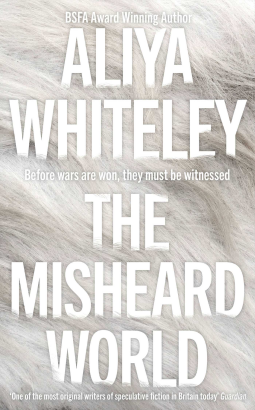
The Misheard World
This title was previously available on NetGalley and is now archived.
Send NetGalley books directly to your Kindle or Kindle app
1
To read on a Kindle or Kindle app, please add kindle@netgalley.com as an approved email address to receive files in your Amazon account. Click here for step-by-step instructions.
2
Also find your Kindle email address within your Amazon account, and enter it here.
Pub Date 31 Mar 2026 | Archive Date 22 Feb 2026
Rebellion | Solaris
Talking about this book? Use #TheMisheardWorld #NetGalley. More hashtag tips!
Description
Elize Janview is a soldier, one of the few survivors of an unimaginably terrible weapon, which ended the long détente between the North and the South and plunged them back into all-out war. She enlisted with a dream of finding those responsible, of somehow getting revenge for the deaths of everyone she knew, but was posted to guard the prison at Crag, the fortress of the South, which has never fallen to the enemy.
Janview’s life is transformed when a rough wooden box is delivered to Crag, holding the performer and spy Marius Mondegreen, agent of the North: the Misheard Word, who can read minds, breathe fire, and make objects appear and disappear. Janview is to witness Mondegreen’s interrogation by his captor, the beautiful and cruel Allynx Syld, who promises the end of the war. As recorder – and by degrees participant – in the interrogation, Janview comes to question everything she knew about the war, and the very world she lives in…
Advance Praise
“The Misheard World is riveting, weird, unpredictable, and magnificent. This is Aliya Whiteley at her inimitable best.” — Oliver K. Langmead, author of Hugo Award-nominated Calypso
“The Misheard World is riveting, weird, unpredictable, and magnificent. This is Aliya Whiteley at her inimitable best.” — Oliver K. Langmead, author of Hugo Award-nominated Calypso
Available Editions
| EDITION | Other Format |
| ISBN | 9781837866915 |
| PRICE | £18.99 (GBP) |
| PAGES | 272 |
Available on NetGalley
Available to Buy
Buy on Amazon Buy on Bookshop.org Buy on WaterstonesAverage rating from 24 members
Featured Reviews
 Geonn C, Reviewer
The only problem I have with this book (other than it not being out yet) is that I can't really go into why I love it without spoiling what makes it so great. I was hooked on the first few pages. And it's one of those rare books that make you want to flip back to page 1 and start reading again immediately. I loved Skyward Inn, I had... issues with Three-Eight-One that were more about me than the book (I listened to the audio and the use of footnotes made it very difficult for me to find my footing). I think this book seals her as someone I'll definitely add to my must-buy list.
The main issue may come with the ending, which I can see being divisive. It definitely makes you think, and I really think people will have a wide range of opinions on it.
 Rachael T, Reviewer
I have been following Aliya Whiteley for a while now and am always pleased by the uniqueness of the world's she creates. What starts as a medieval-esque fantasy spy thriller soon turned into a daring tale of alternate dimensions, where you're never quite sure who to trust. She paints wonderful characters whilst giving you very little of them (I had no idea of the protagonists gender for the first few chapters, because it felt like it could land either way!) The ending was a thinker, and I enjoy the way that Whiteley is an author who plays around with the words we see on the page; which is very refreshing in a world where everything seems to be a repeat of something else.
 ABE W, Reviewer
I am at a loss at how to introduce this book without betraying it and depriving the Reader of the pleasure of discovering it for herself. The story unfurls humbly from a conventional beginning set in a fantasy setting (a devastating war, a captive magician interrogated in a pinnacle of a prison-stronghold, stories spun unhurriedly as the war edges ever closer). And then, an escalation. One would be tempted to say the plot thickens, but it is more like a blossoming in vivid technicolour, or a metamorphosis, or a passage into another world that locks the fantasy in a reality that is both fascinating and frightening. The Misheard Word pits one world against another in a sort of game of double bluff, and the conclusion/collision/collusion is most thrilling. I will stop here. If I say any more, I will say too much.
I read, and greatly enjoyed, a couple of Aliya Whiteley’s books, but I absolutely loved this one. In Whiteley’s trademark fashion it is unpredictable and surreal, metaphysical and poignant. It is a fantasy, magical realism and existentialism blended together into something highly original and engrossing. The characters are dynamic. They are revealed, layers of mystery peeled off them slowly, with the Reader not really knowing them until the very end. Whiteley modulates her prose expertly to fit within each world and match it to each narrator. The tale has left me thinking about the true nature of our world and its many faces, about who controls it and who controls them in turn, and how little does it take to destroy it. Themes of cultures coming together and clashing, and scrambling over each other, and the role a humble individual plays in such a clash of titans are wonderfully explored.
As with any great book, The Misheard World will appeal to different readers in different ways, but appeal it will.
 Media/Journalist 1096447
A magic trick of misdirection; a russian nesting doll of contradictions. Grimly clever, an unflinching actor strutting implacably on a tightrope that asks whether a moral choice ever exists—or if that’s just a bedtime story we tell ourselves to sleep better. THE MISHEARD WORD is smart and compelling, with a surprise at every turn.
J R, Reviewer
Wildly weird. starts out as a standard spy drama before spinning wildly out of control to something much more unique. 5 stars. tysm for the arc.
 Vivian H, Reviewer
This is a novel best entered blind because half its power lies in how quietly it leads you astray.
The Misheard World begins as something deceptively straightforward - an interrogation between spies, a soldier with secrets of her own, a war that feels familiar in its machinery and moral compromises. At first reading like a taut meditation on conflict, power and truth. Then Aliya Whiteley starts to turn the lens and what seemed like traditional commentary fractures into something far more layered, inventive and unsettling.
This is wildly imaginative fiction, alive with ideas. Whiteley’s prose is phenomenal. She toys with language and dual meanings, inviting the reader to read between the lines of reality itself and uncover the truth for themselves. Meaning here is not just delivered — it’s discovered.
At its heart, The Mishear World is a celebration of stories and how truth is shaped, how memory is weaponised, how perception can both liberate and deceive. Whiteley works with extraordinary sleight of hand. Every time you think you understand where the story is going - what the characters mean, what the war is - she draws back the curtain just enough to widen your perspective, defying expectation and drawing you deeper into her mind bending spell.
The characters remain lightly sketched, sometimes even deliberately elusive, with the emotional weight carried by theme, implication and slow reveals, layer by layer until you realise how carefully you've been guided - and misled.
Katherine L, Librarian
Thank you to Solaris and NetGalley for the e-ARC in exchange for an honest review.
Wow, just wow. It's been a long time since a speculative fiction novel has so disoriented and disquieted me, and it is going to be difficult to describe without spoiling what makes this book special. What I will say to potential readers is that this book is Literary Speculative Fiction, with an emphasis on challenging and disorienting the reader, in misdirection, ambiguity, and re-framing until the world looks very different when you start this book than when you finish it. If that emotional experience intrigues you, pick this book up with no other information and let it carry you. This book is, in some ways, an extended magic trick that Whiteley pulls off deftly, never showing her hands fully to the audience, only just enough information that you start to think you understand what is happening. It is a book about how power distracts, about the illusions of othering, and the pull of gambling. It is, often, a cold impersonal book, except when describing what has been lost. I feel so lucky to have had the wool pulled over my eyes by this book and I am excited to go explore Whiteley's backlist!
Trevelyan W, Reviewer
Alicia Whiteley is rapidly emerging as a genre all of her own: operating on the border of sci-fi, fantasy, magical realism and literature, always with an interest in the unreliability and trustworthiness of the narrative and the narrator. What’s the story? Who is telling it - and why?
The Misheard World starts with a foot firmly in fantasy. We’re at the end of bitter cold/warm/ now hot war between the north and south - in which soldier Elize is one of the few survivors of a war crime that has wiped out the entire city of Droad. At fortress Crag - shades of Gormenghast - one of the North’s most potent and elusive spies, Mondegreen, arrives for interrogation. Elize is enlisted as recorder of questioning led by the haughty Allnyx, who promises their work will end the war.
There’s enough here in the slippiness of the questions and answers, of who Mondegreen and Allynx are, and what Elize’s role is, to fascinate - but a third of the way in Whiteley pulls the rug out from under the reader in spectacular fashion. So spectacular it would be a crime to give it away in a review. From this point on any reserve I had about this book was shattered. If I can draw a parallel with China Mieville’s City and the City, it’s to illustrate how expertly Whiteley keeps the world of Mondegreen, Allnyx and Elize in the air while introducing another overlapping reality entirely. A giant leap forwards from one of the fastest developing writers in UK speculative fiction.
 Frasier A, Reviewer
The Misheard World is an ode to the power of storytelling, how the things we hear can shape our identities, our loyalties, and our very realities. It’s a stunning work of speculative fiction that left me changed for having experienced it.
If the act of telling stories makes us teachers, then you can’t find a better professor than Aliya Whiteley. She’s written some of the most beautiful, interesting and exquisite speculative fiction, weird and wild, imaginative and illuminating. But this is by far her most accessible book, while also being one of her lengthiest offerings to date.
It all surrounds the repercussions of a conversation between two characters from either side of a long-laboured war. To say anymore than that would be to spoil the surprise and the nuance of the way this story unfolds. Sufficed to say, just as a conversation builds, so too the book grows and expands, shifting in unexpected and mind-altering ways.
Expect changes in perspective and direction, mysteries raised and solved, and an atmosphere about the world that will captivate you (rather appropriately, I might add). Holding it all together are the three participants in this huge conversation: the questioner, the answerer, and the listener.
The book is framed from the viewpoint of the listener, raised as a soldier, she has the most to learn about the reasons for the conflict that has been her life. She’s strong-willed, capable, and intuitive. But most of all, despite the thirst for revenge that burns inside her, she’s a gentle soul embroiled in the needs of a violent world. I loved how her quietness permeated the entire book, how the wildness simmering inside of her patient heart is also acting as an undercurrent that drives the narrative forwards.
Then there’s the illusionist. He’s the one with all the answers, and his intrigue is matched only by his flamboyance. What an enigmatic character! From the moment he becomes the target of interrogation, you can’t look away. His words drip with magic, and the secrets he’s hiding are every bit as fantastic as you hope them to be.
And finally, the questioner. The interrogator. A woman who commands authority and respect, whose fierceness is tempered only by the fur she wears. She’s written with the presence of a predator, and you’re never sure whether she’s about to pounce.
Each character is so strong in their own right, but when they all come together, the story comes alive. It acts as an absolute masterclass in how to create drama from dialogue, how to make a conversation epic, and how to imbue power into words. You don’t know who to trust. You don’t know what games are being played and by whom. And as the answers begin to come, you won’t believe how many layers are peeled back.
The unfolding plot will take you to new places and give you so many things to ponder. It’s a conversation starter, and you’ll find yourself wanting to talk about the themes it raises: the nature of conflict, the consequences of control, the accountability of knowledge, the yearning of discovery, the dynamics of loyalty, and the shifting balance of our relationships with ourselves, each other, and the worlds we build.
The prose is beautiful. The structure is sublime. The world-building is incredible. The craft that has gone into this story is second to none. Aliya Whiteley has always been a master of her own peculiar brand of weird fiction, but this feels like something new, something broader, something with a scope that is altogether more intimate and infinite at the same time.
And as for the ending, well, I’ll leave you to decide on that one.
Let the conversations commence. Let the stories be told. But let them all reflect the achievement that is The Misheard World. Aliya Whiteley strikes again. This is a masterpiece. Yes, I said masterpiece. And no, you have not misheard.
Matt C, Reviewer
There are countless stories with a war key to them. Not just science fiction and fantasy but historical stories, crime fiction and its something we find compelling to a drama. What is more important than when the world as you know it is ending around you. However, there are less stories exploring war itself as a concept and the disturbing idea that war itself is a form of storytelling. For those of us who hold the power of words dear to us that may sound alarming, but everything has a dark side so why not stories? In Aliya Whitely’s intricate novel, The Misheard World we are taken to a world plunged into war where finally someone finds out what the war is for.
The North and the South have been at war for many years, and the fighting has got more desperate. One of the most alarming incidents was when the South’s city of Droad that both sides held in high esteem was totally destroyed by a new and devastating weapon. This has now made the war a cause both sides cannot afford to lose. Elize is a soldier of the South who has opted for reasons of her own to work at Crag, the infamous high tower that also serves as a prison for those captured in wartime. The prison though finds that they are about to receive a high-status new inmate in the form of the legendary Marius Mondegreen, spy, storyteller and magician. To interrogate him will be the powerful Allynx Syld a socialite noble who turned from the North to support the South against this aggression. Elize has been chosen to observe these observations and report to the prison’s governor what occurs. Prisoner and interrogator who know each other well swap barbs and stories but slowly Elia finds they may hold the key to why the war wages itself.
This is a story that changes shape to make its points. The first half told by Elize feels in many ways the most traditional that would easily fit into any epic fantasy or science fiction tale. Elize’s world is secondary to ours. Not quite as technical despite the new mysterious weapon that has been used nor magical in nature. Mondegreen is an accomplished conjurer more than wizard (it is thought). Elize in her own worlds explains the prison, the life she has and importantly we see this not just at the high end of the two powers battling their wits but the common soldier’s banter and the prisoners who we see actually all seem to respect one another. This is not a tale of two sides who are yet out for each other’s total which does suggest there is some mystery as to what is this war is actually about even the leaders we meet seem unsure. We learn that Elize is from that destroyed city of Droad and so her decision to work at Crag hints at her own agenda, but we are not immediately sure in what way.
The energy from this section comes from the characters of Mondegreen and the deliciously named Allynx Syld. They are both the kind of compelling hyperreal characters who own their respective stages. Clearly, they are Powers on both sides, privy to the world’s secrets and intriguingly know each other. The interrogation scenes are captivating as we watch them try to tease secrets from each other and they’re doing this in the form of little unusual stories they tell each other. Here stories are clearly metaphors and we as observers to this world are looking for the perhaps secret messages being transmitted. Like Elize we must try and unpick what is going on. It’s a war where we have these mighty lead characters in charge, trying to turn events to their own agendas and Elize looks like she is destined to be swept up into the war’s next stage. There is just one fascinating rumour we hear that suggests this war is not quite what we think. Events build and build and then we reach a fascinating turning point that completely blindsides the reader as to what is actually going on.
I’m going to be a little vague here but having built up Mondegreen and the Allynx Syld up then Whiteley unexpectedly decides to halfway give us their full origin stories. We move from a more traditional story of mighty Powers into exploring where and who these two characters actually are and why they are doping what they are doing. It is hard not to think of all those powerful mentor figures we have seen in fiction but then Whiteley pulls off the dashing cloaks, the sparkling repartee and shows us that underneath it all these great Powers are actually quite mortal but not quite in the way you’d expect.
This part of the story really brings the science fictional elements to the fore but for me they are also an opportunity for Whiteley to unpick what is a war. All wars are deep down about the stories of why we must fight, why we must defend and all sides have their storytellers. The people who know the world and acts that bring people to their flags. Why do those people do this? Honour, power and status? Is this creating propaganda or trying to make a truth out of events? Done for money, status or just a pure love of the game? We are taken behind the theatrical stage of war to see how the conjuror works and what happens when they drop their stage act when the spotlight is off them. In some ways those of us expecting grand mysteries and ancient secrets may initially be disappointed but actually Whiteley reminds us war is often about the more basic needs of people – power, wealth and sometimes because they just feel like they’d like to have a war for the fact that they are powerful people and so they can. War is often where other powers than simply nations and their leaders are at play and there is always someone else behind the curtain pulling strings. After all the metaphor and allusions these sections are decidedly ordinary and personally told to Elize and a huge contrast to the more traditional first part of the story in terms of language and glamour to reflect the back-stage nature of the tale
The stories final act is then what do you do when you see the world as it may actually be? Do you ignore it? Do you join forces to stop it? Do you escape it? Elize has several changes of role thrust upon her and we feel her understandable confusion at what she is told and has to decide if this is js another clever form of story she is hearing. How will those in power react to knowing someone else has been shared the actual rulebook they’re playing by? If you’re expecting a straightforward resolution again, you’ll be disappointed and indeed Whiteley has a fascinating way of creating an open ending to the story. Wars unlike stories do not end simply, and the outcomes are never certain. For me the ending works as that is the point of the whole story and that the story is confident enough to do this pulling everything together and yet still leaves it up to us to decide what actually happens next.
I have to say reading The Misheard World when my news alerts suddenly told me of yet another war starting with huge consequences for the world and no clear outcome made reading it a powerful experience. However applying this story, the real world was quite useful and indeed a minor plot point as to what is going on I was shocked to see was also being reported to be occurring with this story. Wars are like many crimes all about the wealth it may create. I’ve always enjoyed a Whiteley story but this one… this feels incredibly apt for the times we again live in and is strongly recommended!
 Roseanna P, Reviewer
A young woman, Elize, stuck in a dreary fortress far from the front of the war, is given a strange task. It's a break in the monotony of her days, but one she doesn't fully understand, and that no one will really explain to her. Each day, she must sit in the tower room as a famous magician and escape artist is interrogated by an equally famous socialite. She herself must not speak, must not draw attention to herself in any way, only observe and report back to the commander of Crag what these two strange visitors discuss. Their conversations are cryptic and unfathomable, relying on a shared history she cannot access, but they all seem to circle around the city of Droad - destroyed by a likewise unfathomable weapon, leaving a ragged chasm and a poisoned earth to which no one can return. They're supposed to be ending the war. But are they?
The Misheard World, Aliya Whiteley's new novel, is a story of misdirections and subversions, where the unfolding of the story pivots the reader's understanding of the world again and again.
While the story begins in a vaguely described alternate world, one with elements that seem potentially fantastical - the magician whose tricks defy understanding, the giant cat of legend befriended by a socialite - as Elize listens to the stories of these two strange people and to the possibly mad pronouncements of her old tutor, it becomes clear that some power is operating on the world beyond her scope of understanding. Eventually, the story moves out of her observations into the world into several other characters narrations of their own perspectives, each of which shows the reader something about the world that upends their previous understanding of it, and its relationship with genre likewise. The story slips between the speculative and fantastical, and between worlds, as well as between points of view.
Those points of view - and how well they're captured - are for me what really sells this novel. The opening section, in Elize's viewpoint, has a clear, direct voice, of someone who knows her own mind but not her purpose. She's a keen observer but not knowledgeable about the wider context of the story. She presents little nuggets of information the reader can pause over because they think they can add something to it to make it make a little more sense - while Elize may not know about radiation, the blinding and sickening of the remains of Droad definitely give some hints to someone in our 21st century. Her life is episodic, constrained by timelines apart from her own, a rhythm of days and duties well captured in her short, to the point chapters.
This contrasts with the second POV, Mondegreen, the magician. His section has no breaks, forming one extremely long run on chapter. His voice too is easily distinguished, more self-assured, more charismatic, more meandering... and yet conversely more purposeful. Where he is now, he knows what he wants to achieve, and the whole of his story bends towards that purpose. It is also one with a much richer set of familiar details.
Well... familiar to the reader. When the narrative shifts back to Elize, we are once again confronted by the difference in levels of knowledge between her and us. And I loved this. It is not uncommon that I read a book in which a character fails to spot some critical piece of information, one that I myself have spotted any number of pages earlier, and find myself frustrated by the artificiality of it, and by the constraints of extra-narrative information weighing down on the plot. I know stories, and apply the metalogic I read into them, so of course I will make assumptions about the direction about the plot, of course I am willing to believe in aliens and magic as a solution easily - I know the parameters of the story and so can intuitively judge in a way the characters are constrained against. Whiteley takes that tension and makes a deliberate plaything of it. The POV shifts back to Elize and reflects on pieces of information provided by Mondegreen - things that are entirely unremarkable to the reader - and renders them once again incomprehensible. By opening a crack in the fourth wall in this way, the frisson of ignorance/knowledge becomes a shared game, rather than a source of frustration.
But it's also entirely the point of the story. The entire crux of it rests on - who correctly understands the parameters at work here? Who has the right meta framing for what's going on? And so by introducing that in the first two sections, Whiteley primes us for what will be one of the primary pillars of the story as a whole.
And then of course, by priming us in this way, she likewise sets us up to ourselves be unsettled, to have our own assumptions subverted. It is not only the characters who don't quite know what's going on, and the clarity of character voice can become a tool just as easily of confusion when deployed unexpectedly out of context. If Elize suddenly no longer sounds like Elize... what are we supposed to think about all the sections that came before, in which we relied on her obvious distinctiveness, her simple forthrightness?
Alongside all of this playing with perspective and framing, there's a parallel set of assumptions about technology, superiority and reality occurring, feeding into the question of exactly which viewpoint is the "real" one. Multiple characters offer their own viewpoint, framing their world, their understanding the be the default one, the one with power to enact upon the others in the story, with the secret knowledge that underlies the flawed understanding others have. First Mondegreen takes this role, viewing Elize as some pseudo-historical bumpkin - never saying it but clearly communicating it in how he narrates his own story to her. But then someone else comes along and sets forth their own stall on exactly who has the power to shape the story, and introduces their own contradictions. Mondegreen is just as ignorant as Elize? Maybe.
Nothing in this story is presented as unimpeachable fact, and that is quite possibly its greatest strength. Whiteley asks the reader to think around the gaps, to compare and contrast multiple flawed approaches to the events we have witnessed or been informed of, and create connection points of our own. The ending is the culmination of this, offering not one but three separate possibilities. Which, if any of them, is right? That is for the reader to decide, based on their own interpretation of the events as presented.
I don't always like ambiguously ended books, but Whiteley has done the groundwork throughout the story to reinforce that ambiguity is the point, at every stage, that it felt not only right but inevitable that it would continue right to the last page. The story is so heavily grounded in different people's telling of their stories - with their own agendas, points of view, prior knowledge and relationships - that to offer something absolute at the last would have been a betrayal of every page that went before. Every chapter asserts: "you do not know the whole story". Why would the story as a whole suggest any different?
It's skillfully done, reminiscent of the careful patience of her previous novel Three Eight One, which likewise used perspective to excellent effect.
But what is it all for? At one point, a character says:
"When everyone has a story of loss to tell, nothing is worthy of the grand title of tragedy. Each tale contributes only to a mound of sadness: heaped, unclimbable, the stories slowly bleeding into each other until they are impossible to tell apart".
I would argue that this is also the crux of it - it is both an absolutely true statement about the story as a whole, and one that the novel seeks to refute. Because the tragedy of the stories - all of them, however much we choose to believe their narrators - never leaves. This is a story of a war going on for decades, manipulated by those who do not themselves suffer in it. It is a story of lives disrupted by tragedy and death, for a gain we never really see or fully understand. But it is also a story in which a myriad lives are lost off page, where tragedies are blurred together, and where narrators actively do confuse and manipulate the stories, making them harder to distinguish.
Somewhere, under the careful artifice of players who think they know the game, who think they set the rules, there is something deeply, powerless and human going on here. There are moments where we can connect with it. But it is just as human that it is buried deep, inaccessible even to those who are suffering the most in a war whose terms remain incomprehensible. Whiteley crafts a story precisely around this paradox. The argument occupies all levels of the storytelling, right down to chapter length and voice, right up to the title of the book itself, and it is from this totality that it finds its power. When you reach the end, all of them, it becomes clear how thoroughly this has been the point all along. No answers, of course, but a definitive question. Questions are sometimes more fun anyway.
The Misheard World feels, at every moment, intensely carefully crafted, and it is a delight to be left unsettled by it, all the way to the last.
Readers who liked this book also liked: