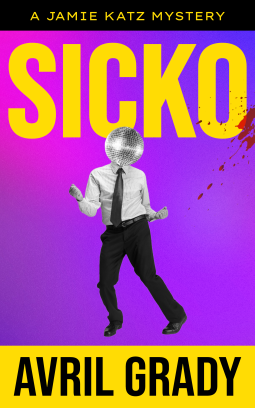
Sicko
This title was previously available on NetGalley and is now archived.
Send NetGalley books directly to your Kindle or Kindle app
1
To read on a Kindle or Kindle app, please add kindle@netgalley.com as an approved email address to receive files in your Amazon account. Click here for step-by-step instructions.
2
Also find your Kindle email address within your Amazon account, and enter it here.
Pub Date 23 Jun 2026 | Archive Date 30 May 2026
Talking about this book? Use #Sicko #NetGalley. More hashtag tips!
Description
Jamie Katz is a certified Florida Man and swamp creature, even if he is living in California and begrudgingly working as a writer for his two-time ex-husband Paul’s porn outfit, Scorch Studios. It wouldn’t be a bad gig except for Paul’s new wife and second-in-command, an uptight Southern Belle named Tater.
When Paul is found shot to death in the alley behind Scorch, every clue points to Jamie. Which is insane because why would Jamie kill one of the only two men he ever loved? Okay, yes, the obscenely expensive wedding rings Paul desperately needed back were hiding among Jamie’s nipple ring collection. And, sure, he was still sleeping with Paul, and Paul had just fired him. And, you know what, yeah, Jamie had just blown up Paul’s life and possibly marriage after getting fired. Of course he had! What, being hot isn’t enough, now he has to be a saint too?
Well, Jamie hasn’t survived four decades of his own bad ideas to go down for something he didn’t do. Between a jealous Tater and Scorch’s sketchy crew and wild porn stars, there are still plenty of suspects. So, if the cops are hell-bent on proving his guilt, then he’s just gonna have to solve this case himself.
And if Jamie’s brand of investigation means jumping into bed with every guy in California, hey, that’s just a hard day’s work.
Advance Praise
"I've never read a book like this one." —Booksprout
"An absolutely unhinged storyline that keeps getting better and better." —Booksprout
"I fell totally in love with Jamie. All my expectations were blown out of the water. Read this now!" —Gay Romance Reviews
"I thought it would be just another mystery read with a gay main character. Whatever this book is I was not expecting it ... It was absolutely wild." —Gay Romance Reviews
"The story balances outrageous humour with a surprisingly bittersweet look at turning forty and facing the consequences of a lifetime of questionable choices. Jamie’s voice is sharp, self-aware, and often hilariously delusional yet there’s vulnerability underneath the bravado ... I need more!" —Booksprout
"Grady’s novel is an unvarnished portrait of queer desire and the messy work of becoming accountable to the people you love. She’s crafted a protagonist who’s simultaneously self-aware and self-sabotaging, his sardonic narration cutting through sentiment with brutal honesty, especially when he reflects on his pattern of destroying relationships before they can destroy him." —Kirkus Reviews ("Get it" verdict)
"Grady’s writing deftly balances the local color of the San Fernando Valley with sharp, irreverent humor. Jamie is an instantly magnetic protagonist who is, as he admits, “an acquired taste.” The novel’s themes of lingering obsession and the cosmic entanglement of past relationships give the mystery significant emotional weight. The narrative keeps readers hooked until the final page. Anyone who enjoys dark humor and character-driven thrillers with a protagonist who is gloriously, unapologetically a “sicko” will find this a must-read." —Booklife (Editor's Pick)
Available Editions
| EDITION | Ebook |
| ISBN | 9798218894122 |
| PRICE | $6.99 (USD) |
| PAGES | 276 |
Links
Available on NetGalley
Available to Buy
Buy on Amazon Buy on Bookshop.org Buy on Kobo Buy on WaterstonesAverage rating from 27 members
Featured Reviews
 Harrison L, Reviewer
Thank you to NetGalley and Avril Grady for an eARC of this book!
I have no idea what I just read, but I loved it!
Following the misadventures of Jamie, a once-Florida-stripper twink, now a Los Angeles has been, working for his (twice) ex-husband at his porn studio as a scriptwriter. This was an amazing amalgamation of noir, dark comedy, coming-of-age, and romper fiction. I’m so glad that Jamie will return in a sequel, and can’t wait for it to come out!
 Reviewer 2028391
Sicko, at its core, is essentially a book about the dangers of fearing twink death. There is a lesson to be held here in Jamie Katz — a 42 year old twink supreme who just kind of fucks everybody and gets real Florida about it all.
And it was fun! Sicko is an extremely fun read, compulsively easy to get through, leaving you wondering what in the hell did I just finish? After completion, I don’t have much thoughts to share outside of: what was that, why are ovipositors mentioned so many times, and fucking SNIFFIES?
As a young gay person, this book has taught me to not fear twink death. Instead, I will embrace it when my time comes, and I will become the anti-Jamie Katz. Thank you.
 RG P, Reviewer
4.5 out of 5 stars.
I've been sitting here wracking my brain over how to rate/review this one since I finished it. This was a book that I picked up because the cover looked wild, the description sounded unhinged, and the whole concept was so perplexingly intriguing I couldn't resist. I've settled on 4.5 stars (naturally rounded up to 5) out of a total of 5 stars.
Right off the bat, Sicko presents itself exactly as it means to go on. For me, I had a strong sense that this was going to be one hell of a ride after reading just the first page, and boy did it not disappoint. The early chapters have a tendency to lean into absurd comedy, with a penchant for catty quips and diversions into Jamie's storied history as an ex-Florida Man. So I was truly shocked that by the midway point, this story had hooked me and I found myself emotionally invested. The gradual development of our protagonist is so beautifully thoughtful and meticulous that by the time we get to the big moments of emotional catharsis in the second half, they feel spectacularly satisfying and well-earned. And it's all written with such a light touch that I didn't realize I had been so thoroughly hooked until I was getting teary over a man who's been arrested for wrestling alligators without a permit more than once.
Perhaps the biggest strength of this work is the interpersonal relationships. I never could have predicted how emotionally invested I would be in the growing solidarity and friendship between Jamie and Suzanna at the start of the novel. But there is something so powerful in the platonic bond they develop, in learning to trust someone you've always found yourself pitted against, and finding the person who understands your grief is the very person who stood between you and someone you loved. On top of that, Jamie's bonds with his friends and coworkers, his family back in Florida, and his string of ill-fated relationships make this such a rich tapestry of human connections that the world feels incredibly fleshed out and real.
Something else, and I almost can't believe I'm saying this about such a silly book, Sicko has a very cohesive story structure and pacing. On the surface, it feels like it would be incapable of taking itself seriously, but before you know it you've been swept up in this absurd adventure and the emotional gut punches sure hit hard. Beneath the veneer of (admittedly very funny) comedy, the novel itself is well plotted and every reveal about Jamie's past is a morsel you can't help but savor. Lately I have read many books that took themselves much more seriously than this but struggled with plot progression, so this was an unexpected but very welcome surprise.
To get a little bit more into some vague spoilers (I'll keep it to some vague plot notes and one quote without context, but skip this paragraph if you like) I was truly so taken with the ending of this novel. There is a flashback in one of the final chapters, at such a pivotal moment in the story, where we learn exactly what happened the last time Jamie saw Joe in Florida. Absolutely devastating moment for us to glean this information. Avril Grady does a brilliant job sign posting exactly what is going through the mind of the non-POV characters and Jamie has simply no clue. Gorgeous use of a flashback and limited omniscient POV, even if it has victimized me personally. I feel like a lot of authors think more is more and try to provide too much information to the reader, but it creates much more dramatic tension to withhold information and a clever writer knows how effective it is to just hint at their characters' state of mind. Sicko, of course, falls into the latter category. And I can't forget to mention this but the phrase, "Wouldn't it be so much easier to be a project instead of a person?" has been rattling around my head since I read it. Astounding bit of prose. Did I expect a sincere meditation on relationships and self worth in this crazy book? Certainly not, but it was so evocative and earned in that moment that it took my breath away.
In terms of things I disliked, there really is not a long list. (Disclaimer: these are all minor quibbles and did not seriously impede my enjoyment) I thought that the first few chapters skewed just a smidge too catty for me in a couple of specific moments. In the big climactic sequence near the end, I got the sense that Jamie was the only one doing anything and it felt like the other characters should have been doing something more to help. I also kind of disliked the ending tagline about the sequel, it felt a bit too Marvel Cinematic Universe, like "Captain America will return in Avengers: New Movie Spend More Money." It's entirely possible that the sequel tagline was intended to evoke this comparison, but I thought the ending was so strong and poignant that I would have liked to sit with it for longer, instead of the immediate sequel bait jump scare.
For one final random observation, I feel like this novel would make an absolutely hilarious film or tv adaptation. The dialogue is so snappy and the comedy is expertly executed, I can see how it would play out on screen and it would be amazing. Someone get on this, please!
I honestly really recommend this book, it's a wild, unhinged romp but surprisingly full of heart and sincerity at the core of it. An absolute blast to read, give it a shot and you will not regret it.
 Mercury H, Librarian
I know a mystery novel is supposed to be a quick read, but the rate at which I devoured this was truly incredible. Jamie Katz is everything I want from a protagonist, chaotic, witty, and all sorts of fun. The supporting cast are equally interesting, which really helps keep you fully engaged and invested, despite the absolutely insane ride you’re being brought on.
The writing style is simple and flows well, but still delivers devastating lines that punch you right in the feelings. The dialogue is truly the best part, the conversations felt both engaging and real, and the humor of the author is exactly my style.
All in all I came away with one major takeaway: I need more of Jamie Katz, immediately.
 Tara H, Reviewer
What can I say other than "man, I really loved this"? I was drawn in by the cover, this jaunty little disco ball guy (and since the story has nothing to do with disco balls or even suits I'll take it more as a vibe) and I was honestly just delighted by this whole little book!
What do you do when your mutually toxic ex-husband gets killed the same day as you have a fight, get fired by him, but also before that sleep with him in-office (of the porn studio he owns), as-adultery (on his part), and you're the main suspect? Well.. ham-handedly investigate, of course!
This is a wild cast of characters and super funny while also being really... really, actually, full of heart and taking on the legitimacy of grief (not just over death, but over what once was, or what couldn't be since sometimes two magnets oppose as much as they attract) and finding a place for yourself in people maybe you wouldn't have suspected. This was just so good, such a fun romp through mystery and murder and mayhem and sex and being very, very gay I absolutely cannot wait for book 2, like! I expected to have a decent time and I did not expect to have a GREAT time.
Thank you to Small Alligator Books and NetGalley for the eARC - I'll be keeping an eye out for more from Grady!
 Jolanta B, Reviewer
I've got to hand it to whoever wrote the ad copy for this book, because they succeeded in conveying the sheer lunacy and (this is the even more deranged part) the love. I, at least, began “Sicko” expecting … I’m not sure what, but certainly not Jamie Katz: a wildly unreliable gay tomcat of a protagonist with no apparent impulse control or understanding of his own emotions, who makes a mess wherever he goes and who somehow, by the end, convinced me of his vast capacity for love and for a species of fidelity that has nothing to do with who he bangs.
Unfortunately for Jamie, he’s the prime suspect in the murder of his ex-ex-ex-husband, Paul. (That’s one ex- for the first divorce, a second ex- for being a former ex-husband after they marry again, and a third ex- for the second and final divorce.) This is because the murder takes place immediately after they have a blazing row over the two engagement rings Paul gave Jamie — one for each marriage, see — which Paul wants Jamie to return, and which Jamie insists he pawned ages ago. Also Paul, who is Jamie's boss at the porn film company where Jamie writes scripts, has just fired him.
As it happens, Paul was not alone in wanting those rings, so Jamie finds himself in a lot more trouble than mere suspicion of murder; shenanigans ensue.
If I’m making “Sicko” sound funny — yes, it sometimes is. But things get dark and violent in a hurry; Jamie and a couple of friends barely escape with their lives. As opportunities for personal growth go, I wouldn’t recommend being targeted by both law enforcement and ruthless criminals (yes, yes, I know), but it seems to work for Jamie. Not that he’s through making bad decisions (conjugal visits with that guy, Jamie? really?), but he’s acting on a couple of varieties of love that he maybe failed even to notice before. (See: no understanding of own emotions, above.)
“Sicko” will not be to everyone’s taste, or maybe it’s better to say that Jamie won’t be to everyone’s taste. I liked him and his personal growth a lot, and I wish him luck in book two; I can’t wait to read it.
4.5 stars rounded up for the loony-ness and because Jamie Katz won my heart; thanks to Small Alligator Books and NetGalley for the ARC.
Readers who liked this book also liked:
We Are Bookish
General Fiction (Adult), Mystery & Thrillers



We Are Bookish
LGBTQIA, Romance, Sci Fi & Fantasy