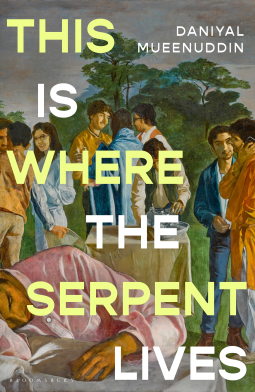
This is Where the Serpent Lives
This title was previously available on NetGalley and is now archived.
Send NetGalley books directly to your Kindle or Kindle app
1
To read on a Kindle or Kindle app, please add kindle@netgalley.com as an approved email address to receive files in your Amazon account. Click here for step-by-step instructions.
2
Also find your Kindle email address within your Amazon account, and enter it here.
Pub Date 13 Jan 2026 | Archive Date 20 Jan 2026
Bloomsbury Publishing Plc (UK & ANZ) | Bloomsbury Publishing
Talking about this book? Use #ThisisWheretheSerpentLives #NetGalley. More hashtag tips!
Description
Intimate and epic, elegiac and profoundly moving: a tour de force destined to become a classic of contemporary literature
Moving from Pakistan’s sophisticated cities to its most rural farmlands, This Is Where the Serpent Lives captures the extraordinary proximity of extreme wealth to extreme poverty in a land where fate is determined by class and social station.
Daniyal Mueenuddin’s This Is Where the Serpent Lives paints a powerful portrait of contemporary feudal Pakistan and a farm on which the destinies of a dozen unforgettable characters are linked through violence and love, resilience, and tragedy. Yazid rises from abject poverty to the role of trusted servant to an affluent gangster; Saqib, an errand boy, is eventually trusted to lead his boss’s new farming venture, where he becomes determined to rise above his rank by any means necessary. Saqib’s boss, the wealthy landowner Hisham, reminisces about meeting his wife while she was dating his brother while Gazala, a young teacher, falls for Saqib and his bold promises for their future before learning about his plans to skim money from the farm’s profits.
In matters of both business and the heart, Mueenuddin’s characters struggle to choose between the paths that are moral and the paths that will allow them to survive the systems of caste, capital, and social power that so tightly grip their country.
Advance Praise
• Praise for Daniyal Mueenuddin: Probably the best fiction ever written in English about Pakistan, and one of the best to come out of south Asia in a very long time - William Dalrymple, Financial Times
• Each of the stories opens a door on to a life you had never expected, shines a light for a while and quietly closes the door again ... Mueenuddin writes with the freshness of an exile and the intimacy of an insider about Pakistani culture - Observer
• Intense with emotion ... So engrossing that there is a wrench when one ends and the next must begin - Sunday Times
• Marks the arrival of a highly sophisticated literary talent - Guardian
• In Other Rooms, Other Wonders may be fiction but it is of such an authentic stamp that it is history as well, more so by the day, and deserves to be read as such - The Times
• Mesmerising … In this labyrinth of power games and exploits, Mueenuddin inserts luminous glimmers of longing, loss and, most movingly, unfettered love - New York Times Book Review
• The voice of Pakistan from within Pakistan ... A fresh perspective - Wall Street Journal
Available Editions
| ISBN | 9781037200052 |
| PRICE | £18.99 (GBP) |
Links
Available on NetGalley
Available to Buy
Buy on Amazon Buy on Bookshop.org Buy on WaterstonesAverage rating from 14 members
Featured Reviews
 Nemra N, Reviewer
Daniyal Mueenuddin’s This Is Where the Serpent Lives is a restrained and incisive exploration of class, power, and moral compromise in contemporary Pakistan. Set around a declining feudal estate, the book traces the lives of servants and landowners bound together by dependence and inequality.
Mueenuddin’s prose is controlled and unsentimental, allowing psychological depth to emerge without overt judgment. His characters are shaped by desire, fear, and resignation, revealing how social hierarchies persist through habit and emotional loyalty as much as authority.
Quietly unsettling and thematically cohesive, This Is Where the Serpent Lives offers a nuanced portrait of postcolonial society and stands as a significant contribution to South Asian fiction in English.
 Stephen D, Educator
'This Is Where the Serpent Lives' is a magnificent, sweeping novel about life in Pakistan between the 1950s and 2000s. The novel is essentially comprised of four interlinked novellas, following the lives of four men of different social standings: Yazid, an orphaned street boy who is quick to earn others' trust; Rustom, attempting to assert his authority on his family's land after returning from his studies in America; Rustom's cousin Hisham who looks back on his courtship of his wife Shahnaz; and Hisham and Shahnaz's favourite servant (and Yazid's protégé) Saqib who is determined to make something of his life.
Mueenuddin explores so much in the stories of these characters' lives: feudalism, inequality, changing social mores, loyalty, betrayal, corruption and violence. The longest - and most compelling - story is Saqib's, the last and by far the longest, but the earlier stories lay effective foundations for what Saqib experiences: his relationships with Hisham, Shahnaz and Yazid, and his hopes for the future. Its horrifying conclusion thus feels both devastating and grimly predictable. Many thanks to NetGalley and the publisher for sending me an ARC of this novel to review.
Jill W, Educator
This is a special book and I wouldn't be surprised to see it on a lot of book award shortlists over the coming months.
It is in the form of 4 linked short stories (making it quite a long novel overall) which gives a no holds barred picture of life in Pakistan and the interactions of class, power, wealth and poverty that contiune through generations. It opens with one recurring character, Yazid, appearing as a small boy, abandoned in a Rawalpindi bazaar clutching a pair of plastic shoes. He is taken in by the owner of a tea stall where he lives until late adolescence when he has to leave.
The next story is in the countryside where a young man, Rustom, returns from the USA, hoping to introduce some of the gentler behaviours he has learnt oversees. But the embedded corruption makes this very difficult.
After this the author gives us an account of a marriage, where Yazid is now working as a chauffeur and is supporting and acting as mentor for a young boy from the local village, Saquib, who manages to become highly valued by their employers.
Saquib and Yazid's stories continue into the final, sometimes quite violent section, which I found difficult to read at times. Their stories prove how difficult it is to go beyond the accidents of birth that control their destinies.
I found the writing style generally gripping , though there are some parts when the story moves along slowly, deliberately I imagine, but I occasionally found it overlong and slow.
Overall all though I am very glad I read this book. Many thanks to the publisher and netgalley for a review copy.
 Ben D, Reviewer
Daniyal Mueenuddin is the Pulitzer Prize finalist behind In Other Rooms, Other Wonders, a superb collection that marked him out as a writer to watch. This is Where the Serpent Lives is his first novel and is already highly anticipated.
This is a novel of stories too - Rawalpindi in the 1950s, before moving through decades. We meet a breadth of characters - Yazid, the entrepreneur, Zain the intellectual, amongst others - and Mueenuddin crafts each of them beautifully on the page. He draws Pakistan so clearly on the page you can smell it's streets, feel it's heat. There is a Dickensian feel to his work, but transplanted to the Pakistan cities and countryside. The story, though vast in its scope, is never less than engaging, is at times funny, and always making you want to read one.
I took my time with this one, treating each section as a new novella, which when grouped together formed a novel, and this approach allowed me to luxuriate in Mueenuddin's prose, in his Pakistan, and grow to love his characters and their world. This is a very fine novel, and already a potential standout for 2026.
Many thanks to Netgalley and the publishers for the ARC.
 The Secret B, Reviewer
This Is Where the Serpent Lives by Daniyal Mueenuddin is a powerful, unsettling, and deeply absorbing book that examines class, power, and survival in contemporary Pakistan.
Moving between urban centres and rural farmland, the book captures the stark proximity of extreme wealth and extreme poverty in a society where social position often determines fate. Through a loosely interconnected structure, the lives of multiple characters are woven together across decades, revealing how violence, ambition, loyalty, and love operate within a rigid and corrupt feudal system.
Each section is narrated from a different perspective, gradually building a wider picture of a world shaped by caste, capital, and inherited power. Characters such as Yazid, Saqib, Hisham, and Shahnaz are complex and often deeply flawed, navigating moral compromises in order to survive or rise within systems designed to keep them in place. Ambition frequently clashes with ethics, and the consequences are often brutal.
The strength of this book lies in its scope and emotional depth. Mueenuddin illuminates both the insulated lives of wealthy landowners and the precarious existence of servants, drivers, and estate workers who live beneath them, often unseen and exploited. The contrast between Western education, privilege, and the medieval brutality of estate rule is striking and uncomfortable.
Some sections are stronger than others, but taken as a whole, the book is intricately constructed and richly detailed. It offers an unflinching portrayal of inequality and the human cost of entrenched social hierarchies, spanning fifty years of personal and political history.
This is a demanding but rewarding read, intimate in its character studies and epic in its ambition. It is elegiac, disturbing, and profoundly thought provoking, leaving a lasting impression long after the final page.
Read more at The Secret Book Review.
Rida B, Media/Journalist
As a Pakistani reader, Daniyal Mueenuddin's writing has always spoken to me in its vivid storytelling of power imbalances and class in Pakistan's feudal society. This sprawling novel or rather four interlinked novellas continue that preoccupation. Mueenuddin's gift as a novelist is in eschewing moral grandstanding and in proposing questions about power without offering conclusive answers. My only critique would be that women characters felt flattened and the lack of a female perspective and exploration of interiority felt like a missed opportunity.
 R V, Reviewer
This is what you call a proper novel: a rich Pakistani landowning family, servants rising through the ranks, forbidden love, class, corruption and ambition. It spans decades and shows you all the corners of Pakistan, from Lahore to Karachi to
There is some White Tiger and Half of a Yellow Sun, as it's the servants who take centre stage. It's in no way formally innovative, but very engrossing.
The book consists of three big parts, each with a different main character. I found it hard to say goodbye to my character as each part ended, because the writing is such that you really start caring for them and need to know what happened next. It felt cruel jumping forward a decade or more.
At some point I was worried the book would fizzle out, but thankfully the ending is thrilling and brings it all together....
4,5...I may round up later...
b j, Educator
Wow what a read. Engrossing, engaging and entertaining. I was sorry to finish it. While it seems like four separate stories told over a period of more than fifty years, there are many links between them. The description of the land and country gave many insights into Pakistan, you could see and almost smell the land.The characters were each unique and well developed,although my favourite was Saquib. It brought alive power based on heredity wealth and the entitlement of old families. An excellent read
 Kate V, Reviewer
This Is Where the Serpent Lives offers a powerful and insightful account of life in Pakistan from the 1950s the early noughts. The four point-of-view characters span different classes but are all connected to the Atar family, who encompass feudal landholdings, urban political power and US educated sons. They are all men. There are some significant women in the story who are all archetypal strong female characters but we only see them through male eyes.
This is a society in flux, yet one where the rules of hierarchy and power somehow stay constant. Yazid, an abandoned child raised by a food-stall owner, educates himself and is befriended by an educated, liberal family. He is accepted into their home, but soon learns the limits of how far he can move from his origins.
Saqib is a bright young boy taken in as a servant by the Atar family. He knows how to please them and works hard, contemptuous of the petty graft he sees around him. He is ambitious and innovative and attempts to transcend the old ways.
Even the apparently privileged are enmeshed in this system, unable to escape the grip of generations-old alliances and traditions. Rustum, a relative of the Atar family, returns from the United States. He is determined to run his landholdings differently, but soon comes up against obstacles. He sees how his life looks from the outside, trying to picture how he could explain the privilege and power to his American girlfriend, while feeling helpless against the machinations of the villagers and even his own staff.
At the heart of all their stories is Hisham, the scion of the Atar family. His easy opportunism has led him to be equally at home in the US, Lahore or his ancestral village. He is apparently the least complicated of the four characters, self-indulgent and swayed by the tide, but isn’t the lesson of our current moment that these are the ones who thrive?
My one gripe with This Is Where the Serpent Lives is that it’s missold as a novel, while it’s actually four linked stories. I can see why authors like the form, it’s a less daunting prospect than a novel, more lucrative than a short story collection, and there are opportunities to publish your work in progress. But it’s not one I find particularly satisfying as a reader (unless you’re Elizabeth Strout).
It means we become invested in the protagonist of the second story, Rustom, but then he pretty much disappears (apart from a cameo role in the third) and we never know what happens to him. Characters who are significant figures in the earlier stories are given a formal introduction later as if we had never met them before.
Each story also has those literary non-ending endings, which I’m not keen on. I don’t need my stories tied up neatly with a bow, and I’m quite happy with ironic or ambiguous endings, but I like a sense that something has shifted, that I’m being provoked to see the character’s world differently. Here they just sort of stop.
All that sounds a bit negative but actually I found this an absorbing and atmospheric read with its vivid depiction of the dynamics of power set against the details of daily life. Changing attitudes and technology permeate society and yet there is a core of distinctiveness and continuity. We hear about national political figures but they are distant, offstage. It is the immediate, personal presence of landowners, their managers, the local police, who loom large in the lives of the peasants, and one another.
There are some beautiful vignettes, in particular when Saqib returns to his village and is full of admiration for his mother, who retains her dignity and strength despite her crushing poverty, but he is unable to feel close to her, his life and experience so far removed from that of his family, even though he’s barely an adult. Or the delicate portrayal of Yazid’s relationship with Saqib. Saqib is his protégé, who has made the same journey as he once did, through self-education and patronage. Saqib, thought, has chosen a different path between loyalty and advancement, a different interpretation of the unwritten codes which supersede corruption and law. Which has more to celebrate or to regret?
*
Note: I would recommend you don’t read the book description before embarking on this book – it gives away far too much!
Emma O, Reviewer
"I know men like you. You come here and have new ideas but in this country, there's only one idea that matters. Money."
I enjoyed In Other Rooms, Other Wonders when I read it a few years ago so I was excited to try this latest offering by Daniyal Mueenuddin. This is Where the Serpent Lives is a novel, but it feels more like a collection of loosely connected short stories or novellas. Spanning several decades in the late 20th century, it follows four men from different backgrounds -- homeless orphan Yazid, wealthy landowners Rustom and Hisham, and ambitious domestic worker Saqib -- as they try to make (or maintain) their fortunes in a changing Pakistan. In cities modernisation has presented new opportunities for social mobility, but in the rural lands where the story is primarily set, feudal systems hold strong. Money matters here, but not more than class and tradition, and this provides one of the central tensions of the novel.
I expected all the different strands to come together at a certain point but some storylines appear only briefly before disappearing altogether. That being said, I think all the different narratives link together very well thematically. There are flashes of drama -- violence and betrayal -- but most of the story unfolds slowly, a character-led exploration of inequality, power, and corruption. I really enjoyed it, even though the ending made me sad. Thanks Bloomsbury and NetGalley for the ARC!
Readers who liked this book also liked:

Jess Mills
Biographies & Memoirs, Nonfiction (Adult), Parenting, Families, Relationships

Céline Fitzmaurice
Biographies & Memoirs, Mystery & Thrillers, True Crime


Beth Brower
Historical Fiction, Literary Fiction, Women's Fiction