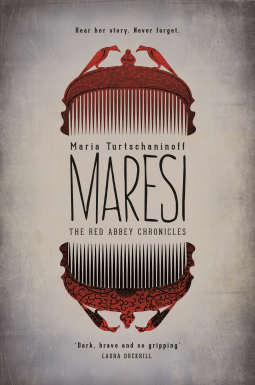
Maresi
The Red Abbey Chronicles
by Maria Turtschaninoff
Pushkin Press
Pushkin Children's
Pub Date 14 Jan 2016
Description
In a world where girls aren't allowed to learn or do as they please, an island inhabited solely by women sounded like a fantasy. But now Maresi is here, and she knows it is real. She is safe.
Then one day Jai - tangled fair hair, clothes stiff with dirt, scars on her back - arrives on a ship. She has fled to the island to escape terrible danger and unimaginable cruelty.
And the men who hurt her will stop at nothing to find her. Now the women and girls of the Red Abbey must use all their powers and ancient knowledge to combat the forces that wish to destroy them. And Maresi, haunted by her own nightmares, must confront her very deepest, darkest fears.
A story of friendship and survival, magic and wonder, beauty and terror, Maresi will grip you and hold you spellbound.
Maresi came to the Red Abbey when she was thirteen, in the Hunger Winter. Before then, she had only heard rumours of its existence in secret folk tales.
In a world where girls aren't allowed to...
Description
In a world where girls aren't allowed to learn or do as they please, an island inhabited solely by women sounded like a fantasy. But now Maresi is here, and she knows it is real. She is safe.
Then one day Jai - tangled fair hair, clothes stiff with dirt, scars on her back - arrives on a ship. She has fled to the island to escape terrible danger and unimaginable cruelty.
And the men who hurt her will stop at nothing to find her. Now the women and girls of the Red Abbey must use all their powers and ancient knowledge to combat the forces that wish to destroy them. And Maresi, haunted by her own nightmares, must confront her very deepest, darkest fears.
A story of friendship and survival, magic and wonder, beauty and terror, Maresi will grip you and hold you spellbound.
A Note From the Publisher
ABOUT THE AUTHOR Maria Turtschaninoff was born in 1977 and has been writing fairy tales since she was five. She is the author of many books about magical worlds. She has been awarded the Swedish...
A Note From the Publisher
Advance Praise
"A beautifully painted, fantastical setting like no other; this story will resonate with me for a long time." - Ben Alderson, booktuber
"Atmospheric, immersive and definitely original, Maresi has a quiet urgent magic that makes her story powerful, poignant and memorable." - For Books' Sake
"Full of courage. Dark, brave and so gripping you will read it in one sitting." - Laura Dockrill
"A beautifully painted, fantastical setting like no other; this story will resonate with me for a long...
Advance Praise
"A beautifully painted, fantastical setting like no other; this story will resonate with me for a long time." - Ben Alderson, booktuber
"Atmospheric, immersive and definitely original, Maresi has a quiet urgent magic that makes her story powerful, poignant and memorable." - For Books' Sake
Available Editions
| EDITION | Hardcover |
| ISBN | 9781782690917 |
| PRICE | £10.99 (GBP) |
Available on NetGalley
| Send To Kindle (PDF) |
| Download (PDF) |
Featured Reviews
|
My Recommendation
|
|
A unique and beautiful coming-of-age story. Maresi lived in a secluded abbey, surrounded by other women. With a huge focus on education and knowledge, the novices are trained not only to serve the goddesses, but the people of the world too. The set-up is threatened by the arrival of a new girl, Jai, pursued by her family, and the stage is set for the women of the Red Abbey to use every power at their disposal to protect Jai and preserve their way of life. Told sparingly, and hauntingly, it's a story like no other I've read. |
My Recommendation
|
|
My Recommendation
|
|
Dark, fantastical, gripping - everything I want from a fantasy book. Turtschaninoff weaves in fantasy with feminism brilliantly. The setting is flawlessly described by Turtschaninoff, enabling her to seamlessly create changes in the atmosphere throughout the book. Just amazing. |
My Recommendation
|
|
My Recommendation
|
|
I absolutely loved this book. Maresi isn't something I would normally reach for. I'm a bit of a YA Fantasy / Sci Fi nut. However the only problem with YA Fantasy and Sci Fi is that you often end up getting the same thing over and over and over...this is nothing like anything I’ve read before. Maresi was, for me, a breath of fresh air. Distinctly feminist and empowering, yet not a manifesto of any kind. Strong writing supported a great, diverse, interesting cast of characters (almost exclusively female). A fascinating setting. Even the plot, simple and surrounding, for the most part, one event in these women's lives, was incredibly effective. I felt like the length of this was perfect too - there was no fat, but everything was rounded, whole and full. Turtschaninoff has a great talent for making a simple piece incredibly grand. I am very excited at the hint that there will be more in this series and, overall, cannot recommend this book highly enough. |
My Recommendation
|
|
My Recommendation
|
|
Maria Turtschaninoff's startling YA novel begins with an arrival. A silent, traumatised girl disembarks from a ship in a remote place; money changes hands. The women who live on the island have been expecting her, with some apprehension. She barely says a word, except to give her name, Jai, and to ask, with fear, if there are any men there. There are not. She has made it on a long lonely journey to the fabled Red Abbey, an island settlement in the middle of a wide ocean populated entirely by women. The Sisters are the devoted to the three aspects of the Goddess - the Maiden, Mother and Crone - and to the care and education of young girls in all the arts of life. The girls, each with her own story and from all corners of far-away lands, live at the Abbey as novices until they decide whether to stay forever or to take their skills back out into the world. Some are sent by their families, others like Jai are fleeing some horror. Men are forbidden to step a foot on land; when they come to trade they bob about in boats at the quayside. The Abbey is otherwise entirely self-sufficient, making it's money from a precious dye found only on the island. It sounds like a paradise. Our narrator, the eponymous narrator Maresi, certainly thinks so. She arrived at the Red Abbey some years before Jai, half-starved and grieving for the younger sister who didn't survive the famine she fled. Her life before the hunger had been happy, her parents loving. It is nature that has been cruel to her. At the Abbey she learns about a different kind of life, one of rhythm, harmony, peace, in which everybody has a place, it entitled to the same in all things and nobody wants. She cares for her fellow novices - although she is getting a little old not to have been apprenticed to a Sister yet - and takes Jai under her wing. She shows her the Abbey's ways, and even allows her to share in her most personal and thrilling pleasure: reading. Maresi has been taught her letters and languages by the enigmatic Sister O, and each evening retires to the scriptorium to read histories, science books, memoirs of ancient times. Slowly slowly Jai emerges from her silence, learning to trust the women around her, and shares a shocking secret. Once the revelation is out in the world it's impossible that the peace of the Abbey should hold. Because Jai is being pursued, relentlessly and ruthlessly, by a man who should love her better than he does, and he will never never never stop. Safety is an illusion. I can't say much more without spoilers, and I really wouldn't want to spoil this compelling story for anyone. Maresi is a book that grew and grew on me as I read it. It starts out as a lulling pre-lapsarian boarding school story, exploring the Abbey through Maresi and Jai's eyes. Instead of midnight feasts and bun breaks there are morning rituals and seasonal celebrations; mythology and herbcraft are taught rather than maths or geography. The girls chase goats over the mountain side rather than playing lacrosse. You get the idea. Underlying the brand-newness of the world of Red Abbey are all the familiar tropes. The Sisters are like school mistresses, each with her foibles. The relationships between the junior and senior novices in their dormitories are like those between the big girls and the shrimps. Then, bam, Jai's story jolts the world and tips it sideways. The book becomes something infinitely darker, disorientated by horror taken straight out of our real cruel world. The realities of misogyny and violence flood into the Red Abbey, reclassifying the story from school saga to feminist, humanist fable. What seems like a sweet book about friendship and love becomes an unflinching confrontation between hate and humanity. In what follows Maresi is forced to face up to the darkest parts of herself, the bits that the Crone breathed on as she took her sister, while Jai is brought to the brink of self-annihilation. The other Sisters and novices at the Abbey are tested in their own ways too. What must they give to protect their way of life? By the end, the story is breathless and ferocious. Belief in a better way to live powers Maresi from beginning to end. It's a book about hope, an exercise in utopia, and about how women might change the world. I had planned to post about it yesterday, on International Women's Day and then things got in the way. Ah well, every day is a day for women around here. Listen: don't wait for next year to read this beguiling, compelling book. It's the first in a series and the next will be a prequel about the founding of the Abbey, Naondel. I'm told it's out next January, which is precisely when I will be reading it. (If I can't get my cheeky hands on a review copy that is.) Join me. |
My Recommendation
|
|
My Recommendation
|
|
I got interested in Maresi -written by Maria Turtschaninoff – as soon as I saw the cover and read that the author was from Finland. As you might know by now, I like my stories weird and I recently read that Finland has a thriving community of writers who love to spin these type of stories. And I’m very happy that my brain might have made a weird leap there, because Maresi was so worth it. Maresi doesn’t seem very weird on the surface. We are slowly introduced to Maresi and the all-female island she lives on. She’s writing her story down because of something that happened – the first hint at strangeness – but elects to start at the beginning. This means telling us about the place of women in the world and how they often aren’t allowed to do or learn what they want. Throughout the first half of the book Turtschaninoff throws in details that flesh out the world, like having Maresi tell the story of how the Sisters settled on the island and founded the Red Abbey and how many of the young girls who have come there since had to flee from either poverty, war or violence. These are problems women and girls in our world deal with as well, and even though we don’t have an island that functions as a safe haven for women, the book is still firmly set in reality. Then Turtschaninoff delves deeper into the mythology of The Mother and uses magic and mysticism to write about womanhood. The whole island worships The Mother, which means all aspects of the woman: the Maiden, the Mother and the Crone. It tells us how all women have all three of these aspects in them and how these are powerful in their own way. Many have called Maresi a feminist book and although I definitely feel that this book is showing that women are equal to men and should be treated as such, just calling it feminist would do the book short. To me, a very important part of the book centered around sisterhood, on being there for the women and girls around you and about creating a safe environment in which they can explore who they are. This is clear in the friendship between Maresi and Jai, but also the protectiveness of the Sisterhood for girls and woman in need and the fierce attitude all the girls have when push comes to shove and they need to protect the youngest ones from danger. And there’s definitely danger in the book. A group of evil men make their way to the island, threatening the good life the Red Abbey promises. The girls stand together against these men, facing their violence and using their own power to save others and to defeat them. The book is filled with folklore and myth about womanhood and the scariest among this is The Crone. She means death in a scary and very violent way no man or woman can stand against. Turtschaninoff doesn’t shy away from portraying things that actually scare us, showing the threat of sexual violence, child slavery and being buried alive. This book is definitely not going to be for everyone. The narrative starts out very slowly, the first half of the book just being an introduction to Maresi, the Red Abbey and all the other women. When you get near the 50% mark though, the book suddenly lurches into action and doesn’t stop until the final pages. It’s marketed towards young adults and I can see many of them giving up a quarter of the way in because not a lot happens. There are no wild love stories, no cute boys and no plucky heroine making sassy remarks. Sure, Maresi herself is a little bit of an outlier, but not the type of girl we usually meet in typical YA novels. But because this book was anything but typical YA, it felt like a breath of fresh air for me. I was getting a little tired of all these girls worshiping romantic love and really enjoyed reading a novel aimed at a younger audience that shows the strengths of who you are, not who you love. |
My Recommendation
|
|
My Recommendation
|
|
It's a young adult fantasy about a matriarchal society, which is a pretty interesting concept. Matriarchal societies don't have as much attention as they deserve. I would like for more authors to explore it, but not in a negative way. This particular book was such a wonderful and kind exploration of the topic. It' s about a girl named Maresi that lives in somewhat of a monastery on a secluded island where only women are welcomed. They have a pretty neat society where all the girls have their own chores - some of them look after younger girls, some of them cook, some of them clean, some of them sew and etc. And also they have the sisters who are older women that look after the island and that can be seen as teachers. This book has pretty light fantasy elements that have to do with nature and paganism. Whole magic system revolves around religion - the island believes in mother nature, that has three faces. Young girls appear on the island when their parents send them away to be taught something or when they run away from their abusive backgrounds. But most of these girl are not going to be left in the Abby - they learn things and then help their own settlements with this knowledge. But then one of the girls appears on the island and she drags a lot of trouble after herself. It's a very slow-build book with low-key magic elements. I wouldn't say that everything was done to the highest degree, but it was a pleasant read. Some difficult topics were brought up, but still it read young. In some way it reminded me of contemporary coming of age novels about girls going to all-girls boarding schools. Which are basically matriarchal societies, except for occasional male professor. And they happen to be my favorite novels, because the setting allows women to explore their lives in friendly and equal environment. |
My Recommendation
|
Additional Information
Available Editions
| EDITION | Hardcover |
| ISBN | 9781782690917 |
| PRICE | £10.99 (GBP) |
Available on NetGalley
| Send To Kindle (PDF) |
| Download (PDF) |
Featured Reviews
|
My Recommendation
|
|
A unique and beautiful coming-of-age story. Maresi lived in a secluded abbey, surrounded by other women. With a huge focus on education and knowledge, the novices are trained not only to serve the goddesses, but the people of the world too. The set-up is threatened by the arrival of a new girl, Jai, pursued by her family, and the stage is set for the women of the Red Abbey to use every power at their disposal to protect Jai and preserve their way of life. Told sparingly, and hauntingly, it's a story like no other I've read. |
My Recommendation
|
|
My Recommendation
|
|
Dark, fantastical, gripping - everything I want from a fantasy book. Turtschaninoff weaves in fantasy with feminism brilliantly. The setting is flawlessly described by Turtschaninoff, enabling her to seamlessly create changes in the atmosphere throughout the book. Just amazing. |
My Recommendation
|
|
My Recommendation
|
|
I absolutely loved this book. Maresi isn't something I would normally reach for. I'm a bit of a YA Fantasy / Sci Fi nut. However the only problem with YA Fantasy and Sci Fi is that you often end up getting the same thing over and over and over...this is nothing like anything I’ve read before. Maresi was, for me, a breath of fresh air. Distinctly feminist and empowering, yet not a manifesto of any kind. Strong writing supported a great, diverse, interesting cast of characters (almost exclusively female). A fascinating setting. Even the plot, simple and surrounding, for the most part, one event in these women's lives, was incredibly effective. I felt like the length of this was perfect too - there was no fat, but everything was rounded, whole and full. Turtschaninoff has a great talent for making a simple piece incredibly grand. I am very excited at the hint that there will be more in this series and, overall, cannot recommend this book highly enough. |
My Recommendation
|
|
My Recommendation
|
|
Maria Turtschaninoff's startling YA novel begins with an arrival. A silent, traumatised girl disembarks from a ship in a remote place; money changes hands. The women who live on the island have been expecting her, with some apprehension. She barely says a word, except to give her name, Jai, and to ask, with fear, if there are any men there. There are not. She has made it on a long lonely journey to the fabled Red Abbey, an island settlement in the middle of a wide ocean populated entirely by women. The Sisters are the devoted to the three aspects of the Goddess - the Maiden, Mother and Crone - and to the care and education of young girls in all the arts of life. The girls, each with her own story and from all corners of far-away lands, live at the Abbey as novices until they decide whether to stay forever or to take their skills back out into the world. Some are sent by their families, others like Jai are fleeing some horror. Men are forbidden to step a foot on land; when they come to trade they bob about in boats at the quayside. The Abbey is otherwise entirely self-sufficient, making it's money from a precious dye found only on the island. It sounds like a paradise. Our narrator, the eponymous narrator Maresi, certainly thinks so. She arrived at the Red Abbey some years before Jai, half-starved and grieving for the younger sister who didn't survive the famine she fled. Her life before the hunger had been happy, her parents loving. It is nature that has been cruel to her. At the Abbey she learns about a different kind of life, one of rhythm, harmony, peace, in which everybody has a place, it entitled to the same in all things and nobody wants. She cares for her fellow novices - although she is getting a little old not to have been apprenticed to a Sister yet - and takes Jai under her wing. She shows her the Abbey's ways, and even allows her to share in her most personal and thrilling pleasure: reading. Maresi has been taught her letters and languages by the enigmatic Sister O, and each evening retires to the scriptorium to read histories, science books, memoirs of ancient times. Slowly slowly Jai emerges from her silence, learning to trust the women around her, and shares a shocking secret. Once the revelation is out in the world it's impossible that the peace of the Abbey should hold. Because Jai is being pursued, relentlessly and ruthlessly, by a man who should love her better than he does, and he will never never never stop. Safety is an illusion. I can't say much more without spoilers, and I really wouldn't want to spoil this compelling story for anyone. Maresi is a book that grew and grew on me as I read it. It starts out as a lulling pre-lapsarian boarding school story, exploring the Abbey through Maresi and Jai's eyes. Instead of midnight feasts and bun breaks there are morning rituals and seasonal celebrations; mythology and herbcraft are taught rather than maths or geography. The girls chase goats over the mountain side rather than playing lacrosse. You get the idea. Underlying the brand-newness of the world of Red Abbey are all the familiar tropes. The Sisters are like school mistresses, each with her foibles. The relationships between the junior and senior novices in their dormitories are like those between the big girls and the shrimps. Then, bam, Jai's story jolts the world and tips it sideways. The book becomes something infinitely darker, disorientated by horror taken straight out of our real cruel world. The realities of misogyny and violence flood into the Red Abbey, reclassifying the story from school saga to feminist, humanist fable. What seems like a sweet book about friendship and love becomes an unflinching confrontation between hate and humanity. In what follows Maresi is forced to face up to the darkest parts of herself, the bits that the Crone breathed on as she took her sister, while Jai is brought to the brink of self-annihilation. The other Sisters and novices at the Abbey are tested in their own ways too. What must they give to protect their way of life? By the end, the story is breathless and ferocious. Belief in a better way to live powers Maresi from beginning to end. It's a book about hope, an exercise in utopia, and about how women might change the world. I had planned to post about it yesterday, on International Women's Day and then things got in the way. Ah well, every day is a day for women around here. Listen: don't wait for next year to read this beguiling, compelling book. It's the first in a series and the next will be a prequel about the founding of the Abbey, Naondel. I'm told it's out next January, which is precisely when I will be reading it. (If I can't get my cheeky hands on a review copy that is.) Join me. |
My Recommendation
|
|
My Recommendation
|
|
I got interested in Maresi -written by Maria Turtschaninoff – as soon as I saw the cover and read that the author was from Finland. As you might know by now, I like my stories weird and I recently read that Finland has a thriving community of writers who love to spin these type of stories. And I’m very happy that my brain might have made a weird leap there, because Maresi was so worth it. Maresi doesn’t seem very weird on the surface. We are slowly introduced to Maresi and the all-female island she lives on. She’s writing her story down because of something that happened – the first hint at strangeness – but elects to start at the beginning. This means telling us about the place of women in the world and how they often aren’t allowed to do or learn what they want. Throughout the first half of the book Turtschaninoff throws in details that flesh out the world, like having Maresi tell the story of how the Sisters settled on the island and founded the Red Abbey and how many of the young girls who have come there since had to flee from either poverty, war or violence. These are problems women and girls in our world deal with as well, and even though we don’t have an island that functions as a safe haven for women, the book is still firmly set in reality. Then Turtschaninoff delves deeper into the mythology of The Mother and uses magic and mysticism to write about womanhood. The whole island worships The Mother, which means all aspects of the woman: the Maiden, the Mother and the Crone. It tells us how all women have all three of these aspects in them and how these are powerful in their own way. Many have called Maresi a feminist book and although I definitely feel that this book is showing that women are equal to men and should be treated as such, just calling it feminist would do the book short. To me, a very important part of the book centered around sisterhood, on being there for the women and girls around you and about creating a safe environment in which they can explore who they are. This is clear in the friendship between Maresi and Jai, but also the protectiveness of the Sisterhood for girls and woman in need and the fierce attitude all the girls have when push comes to shove and they need to protect the youngest ones from danger. And there’s definitely danger in the book. A group of evil men make their way to the island, threatening the good life the Red Abbey promises. The girls stand together against these men, facing their violence and using their own power to save others and to defeat them. The book is filled with folklore and myth about womanhood and the scariest among this is The Crone. She means death in a scary and very violent way no man or woman can stand against. Turtschaninoff doesn’t shy away from portraying things that actually scare us, showing the threat of sexual violence, child slavery and being buried alive. This book is definitely not going to be for everyone. The narrative starts out very slowly, the first half of the book just being an introduction to Maresi, the Red Abbey and all the other women. When you get near the 50% mark though, the book suddenly lurches into action and doesn’t stop until the final pages. It’s marketed towards young adults and I can see many of them giving up a quarter of the way in because not a lot happens. There are no wild love stories, no cute boys and no plucky heroine making sassy remarks. Sure, Maresi herself is a little bit of an outlier, but not the type of girl we usually meet in typical YA novels. But because this book was anything but typical YA, it felt like a breath of fresh air for me. I was getting a little tired of all these girls worshiping romantic love and really enjoyed reading a novel aimed at a younger audience that shows the strengths of who you are, not who you love. |
My Recommendation
|
|
My Recommendation
|
|
It's a young adult fantasy about a matriarchal society, which is a pretty interesting concept. Matriarchal societies don't have as much attention as they deserve. I would like for more authors to explore it, but not in a negative way. This particular book was such a wonderful and kind exploration of the topic. It' s about a girl named Maresi that lives in somewhat of a monastery on a secluded island where only women are welcomed. They have a pretty neat society where all the girls have their own chores - some of them look after younger girls, some of them cook, some of them clean, some of them sew and etc. And also they have the sisters who are older women that look after the island and that can be seen as teachers. This book has pretty light fantasy elements that have to do with nature and paganism. Whole magic system revolves around religion - the island believes in mother nature, that has three faces. Young girls appear on the island when their parents send them away to be taught something or when they run away from their abusive backgrounds. But most of these girl are not going to be left in the Abby - they learn things and then help their own settlements with this knowledge. But then one of the girls appears on the island and she drags a lot of trouble after herself. It's a very slow-build book with low-key magic elements. I wouldn't say that everything was done to the highest degree, but it was a pleasant read. Some difficult topics were brought up, but still it read young. In some way it reminded me of contemporary coming of age novels about girls going to all-girls boarding schools. Which are basically matriarchal societies, except for occasional male professor. And they happen to be my favorite novels, because the setting allows women to explore their lives in friendly and equal environment. |
My Recommendation
|