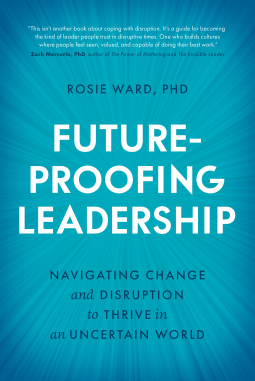
Future-Proofing Leadership
Navigating Change and Disruption to Thrive in an Uncertain World
This title was previously available on NetGalley and is now archived.
Send NetGalley books directly to your Kindle or Kindle app
1
To read on a Kindle or Kindle app, please add kindle@netgalley.com as an approved email address to receive files in your Amazon account. Click here for step-by-step instructions.
2
Also find your Kindle email address within your Amazon account, and enter it here.
Pub Date 2 Jun 2026 | Archive Date 8 Jul 2026
Talking about this book? Use #FutureProofingLeadership #NetGalley. More hashtag tips!
Description
Change is constant.
Disruption is inevitable.
Burnout is widespread.
And most leaders are woefully unprepared.
In Future-Proofing Leadership, Dr. Rosie Ward presents a bold, human-centered blueprint for thriving in the face of uncertainty. Drawing on years of coaching, consulting, research, and lived experience, she unpacks the hidden forces that keep us stuck—what she calls the “Stuckness Zone™”—and reveals the faulty inner programming that quietly sabotages our effectiveness.
Through real stories and data from 250 leaders across industries, Rosie uncovers the seven “Faulty Programs” that hijack our leadership: the Counterfeit, Overachiever, Perfectionist, People-Pleaser, Control Freak, Mime, and Martyr. These subconscious scripts, formed in childhood, still drive our reactions today more than we like to think—especially under stress. Left unchecked, they keep us clinging to outdated leadership models and quick fixes that don’t work.
But there is a way forward.
Part leadership guide, part inner-work manual, Future-Proofing Leadership equips readers to upgrade their mindset, lead with greater courage and humanity, and build teams and cultures that are resilient, purpose-driven, and adaptable in the face of uncertainty. Whether you’re an executive, emerging leader, or change agent, this book will help you get out of your own way in a sustainable way—and empower others to create environments where leaders of all levels can thrive in this disruptive environment.
The future demands a different kind of leader. Are you ready to meet the challenge?
Advance Praise
"The book is packed with concrete advice, and the tone is friendly and encouraging. . . . Leaders looking for clear language to help them get 'unstuck' will find plenty of helpful scripts and encouragement here."
—BlueInk Review
“This isn’t another book about coping with disruption. It’s a guide for becoming the kind of leader people trust in disruptive times. One who builds cultures where people feel seen, valued, and capable of doing their best work.”
—Zach Mercurio, PhD, author of The Power of Mattering and The Invisible Leader
“As our world at work rapidly changes, we risk losing what makes us strongest: our connections to each other—and ourselves. That’s why I love that Dr. Ward centers and celebrates our shared humanity in Future-Proofing Leadership. She doesn’t just offer a path forward; she dives deep into what makes us who we are and how we can leverage that to shape the future. Whether you’re a seasoned leader or just starting out, Future-Proofing Leadership is your road map for learning how to thrive through change and stay grounded in what matters most.”
—Kristen Hadeed, author of Permission to Screw Up
“Dr. Rosie Ward has written the definitive guide for leading in an era of nonstop disruption. By exposing the faulty programs that quietly sabotage even the most well-intentioned leaders, she gives us the tools to upgrade how we think, relate, and show up. Future-Proofing Leadership belongs in every leadership development library.”
—Alain Hunkins, bestselling author of Cracking the Leadership Code: 3 Secrets to Building Strong Leaders
“Future-Proofing Leadership is a timely and essential guide for any leader navigating today’s relentless pace of change. Rosie brilliantly normalizes the messiness of being human while offering a practical blueprint for leaders to move beyond self‑limiting narratives and thrive in disruption. Her insights into the ‘Stuckness Zone™’ and the faulty programs that hold us back are both eye‑opening and actionable. This book doesn’t just prepare leaders for the future—it empowers them to create it with courage, adaptability, and authenticity.”
—Brian Garish, chief client officer, Mars Veterinary Health
“The world won’t get less chaotic, but you can get more intentional. In Future-Proofing Leadership, Dr. Rosie Ward shows readers how to navigate disruption by mastering the messy inner game first. With candor, compassion, and a little sparkle, she gives leaders the tools to replace fear with courage, control with connection, and burnout with purpose.”
—Morag Barrett, executive leadership coach, global keynote speaker, and award-winning author of Cultivate and You, Me, We
“As someone who spent a career helping high-performing teams build championship cultures, Future-Proofing Leadership is a game-changer. Dr. Rosie Ward reminds us that ‘culture is everyone’s responsibility’—a message I champion deeply because winning organizations are built person by person, moment by moment, habit by habit, Monday by Monday. A must-read for leaders and beyond!”
—Paul Epstein, former NFL & NBA executive; two-time bestselling author; founder, WIN MONDAY™
Available Editions
| EDITION | Hardcover |
| ISBN | 9798891388154 |
| PRICE | $30.00 (USD) |
| PAGES | 264 |
Links
Available on NetGalley
Average rating from 5 members

Featured Reviews
 Demetris P, Reviewer
A Vocabulary for the Fear Beneath Competence
Rosie Ward’s “Future-Proofing Leadership” gives workplace self-protection a language before it becomes workplace damage
By Demetris Papadimitropoulos | May 19th, 2026
Many leadership books begin with the fantasy that better leaders simply need shinier instruments. A script for feedback. A model for change. A framework for accountability. A calendar hack, preferably one that wears a blazer. Rosie Ward’s “Future-Proofing Leadership” begins somewhere more uncomfortable and more useful: in the gap between knowing what leadership requires and being able to do it when the body has already voted no.
Ward’s argument is that leaders often do not fail because they lack information. They fail because, under pressure, the right behavior feels unsafe. The leader knows she should give candid feedback, but an old alarm insists candor means rejection. The executive knows he should delegate, but delegation feels like disappearance. The manager knows she should set a boundary, but a private courtroom convenes and declares her selfish before she has even closed the laptop. In Ward’s language, these reactions come from “faulty programs,” early self-protective scripts that once helped people survive embarrassment, volatility, abandonment, criticism, or not-enoughness, and now circulate through the workplace in adult shoes with a recurring meeting invite.
The book’s sharpest contribution is its attention to the pressure point where leadership knowledge becomes suddenly unavailable to the person who needs it. “Future-Proofing Leadership” is most persuasive not as prophecy but as diagnosis. Its jacket-facing promise – disruption, AI, burnout, generational change, VUCA – gives it scope, but the more compelling drama is older and more intimate: the child-self still trying to earn safety by being perfect, productive, pleasing, indispensable, invulnerable, right, or silent. The title promises futurism; the pages keep returning to archaeology.
Ward, founder of Salveo Partners and a longtime consultant-coach, builds the book around the “Stuckness Zone,” the widening gap between what a world of chronic disruption demands and what people do when their early alarm systems take over. The world asks for adaptability, candor, collaboration, learning, curiosity, and courage. The nervous system, unmoved by workplace strategy decks, often prefers control, avoidance, blame, overwork, retreat, or a little light resentment simmered over low heat for several fiscal quarters.
The distinction on which the argument turns is between technical and adaptive challenges. Technical problems can be addressed through information, process, training, or known expertise. Adaptive challenges require transformation: altered assumptions, tolerated discomfort, and the surrender of identity habits that once produced success. That places Ward near the lineage of “Leadership on the Line” by Ronald Heifetz and Marty Linsky and “Immunity to Change” by Robert Kegan and Lisa Lahey without making “Future-Proofing Leadership” feel like an academic descendant. When a team cannot have honest conversations, the problem may not be the absence of a feedback template. The problem may be that honesty feels like exposure, conflict, betrayal, incompetence, or danger.
Ward illustrates this through Susan, a senior director whose team has already been given change-management tools, communication workshops, and process frameworks. None of it works because the team’s problem is not lack of knowledge. It is fear, fatigue, unclear belonging, and the defensive choreography of people who feel acted upon. Only when Ward’s work helps them name the adaptive nature of the challenge do they begin to move from blame toward collaboration. The scene keeps the book, early on, from collapsing into tool-kit predictability. Ward’s best question is not “What skill is missing?” but “What belief makes this skill unusable?”
Part 2 turns that diagnosis into a cast of workplace masks: the Counterfeit, the Overachiever, the Perfectionist, the People-Pleaser, the Control Freak, the Mime, and the Martyr. Three “cousin” programs – the Dropout, the Fraud, and the Protector – later show how defenses rarely arrive alone. The names are sticky, almost too sticky, but they do what strong facilitator’s shorthand is meant to do: make invisible patterns discussable in tense rooms.
The Counterfeit hides the authentic self out of fear of vulnerability. The Overachiever turns productivity into proof of worth. The Perfectionist treats mistakes as unrecoverable. The People-Pleaser lives on the circumference of other people’s expectations rather than the core of personal values. The Control Freak tries to make uncertainty behave itself, a doomed but energetic project. The Mime maintains artificial harmony, which can look peaceful until one notices the graveyard of unsaid things. The Martyr shoulders burdens alone, calls it service, and wonders why resentment keeps raiding the pantry.
Ward’s own story gives the framework its origin scene. As the youngest of five girls in a high-achieving family, she felt unlike her sisters and became convinced she did not belong. When an older sister told her she was adopted and that the neighbors were her real parents, young Rosie believed her. She packed a teddy bear, blankie, pillow, and Tinkertoy tub and walked down the driveway toward her supposed birth family. The scene is funny, sad, and telling. It contains the whole book in miniature: a child’s longing to belong, a story formed too early, and the adult life built around proving that one is enough.
Ward is candid about her own faulty programs: Counterfeit, Overachiever, Martyr, Perfectionist, and People-Pleaser. This is not decorative candor; it is part of the method. She wants the reader to lower the armor enough to admit, “Yes, I do that.” Her tone is persistently shame-reducing. Again and again she tells readers that there is nothing wrong with them. They are not broken; they are human. This reassurance can become repetitive, but it is not trivial. Many leadership books smuggle shame into improvement. Ward’s book tries to make improvement possible by escorting shame out of the room.
The stories show how professional masks send bills home. Michael, a surgeon running the Counterfeit and Perfectionist programs, lashes out in the operating room because old stories about intelligence, goodness, and appearance make imperfection intolerable. Chad, a manufacturing executive, learns that his obsession with winning has shaped not only his leadership but also his relationship with his son, who dreads the car ride home after games because his father’s approval feels tied to sports performance.
Rebecca, a new executive, learns to stop answering every work call and email during family time, then later chooses to miss a high-profile meeting to care for her son during a mental-health crisis. In one of the book’s more piercing examples, Travis, a Black gay leader shaped by strict religious shame, spends decades hiding himself, overachieving to compensate, and feeling like a stranger in his own skin before slowly practicing disclosure, self-compassion, and a less punitive relationship to ambition.
A faulty program does not clock out. The same inner script that produces a harsh email may also produce a child’s dread, a spouse’s loneliness, a missed vacation, a body on the edge of collapse. Leadership, in Ward’s telling, is not a costume one puts on after breakfast. It is a pressure test of the stories one lives by everywhere else.
The prose has the rhythm of a facilitated session: name the pattern, lower the shame, offer the next small practice. Ward’s sentences are built for uptake, not afterglow. She favors phrases that can survive a meeting: “head trash,” “the story I’m telling myself,” “ten-year-old self,” “above the line,” “below the line,” “easy button,” “struggle bus,” “crap sandwich,” “sparkle.” Some of this language is genuinely usable under pressure; some arrives with neon laces.
The informality lowers the emotional temperature around painful material. “Head trash” is less intimidating than clinical terminology; “faulty program” is less damning than flaw. The reader is invited into recognition without being marched through a diagnostic corridor. But the brightly informal tone can rub against the gravity of the material. Burnout, suicidal ideation, identity shame, family trauma, loneliness, and workplace harm appear beside quips and catchphrases. For many readers, that tonal lightness will make the book usable. For others, it may feel like a cushion placed too quickly over the bruise.
Structurally, the book is built for use and built heavily enough that the seams show. Part 1 establishes the case for adaptive leadership in a volatile world. Part 2 lays out the faulty programs one by one. Part 3 applies the model to individuals and organizations, arguing that future-proofing requires inner development, team-based courage-building, and systems that reinforce new behavior after the post-workshop glow has worn off. That progression keeps the book from leaving the burden entirely on the individual leader’s psyche. Ward is at her best when she admits that a changed person cannot be dropped into an unchanged environment and expected to behave differently by sheer force of enlightenment.
The organizational chapters are not the sleekest pages in the book, but they may be the ones that keep it honest. Ward argues against one-and-done leadership workshops and for developmental journeys: repeated sessions, practice between meetings, psychological safety, shared language, feedback norms, succession planning, cleaner meetings, values alignment, and measurement. She describes an executive team that initially dismisses vulnerability work as nonsense, sends the millennial leaders first, then eventually joins the process as the shared language begins to alter behavior. “The story I’m telling myself is . . .” becomes less a phrase from a workbook than a way to slow down judgment before it hardens into policy.
Without that organizational turn, “Future-Proofing Leadership” would collapse inward. It would risk becoming self-help in leadership clothing, asking individuals to metabolize organizational dysfunction through personal growth alone. Ward does not entirely escape that risk, but she sees it. Her argument is not simply that leaders need to heal their inner scripts. It is that organizations must build containers in which healthier leadership can survive Monday morning.
Still, the book’s central limitation is inseparable from its usefulness. The faulty-program model explains a great deal, and sometimes too much. Silence, overwork, perfectionism, reactivity, avoidance, weak delegation, poor feedback, burnout, blurred boundaries, lack of empathy, team dysfunction – all can be routed through the model. This makes the map easy to use, but its diagnostic generosity can become diagnostic overreach. Some workplace dysfunction is driven by old fear. Some is driven by bad incentives, impossible workloads, unclear strategy, hierarchy, punitive executives, weak governance, or cultures where candor has historically been punished. Ward eventually addresses systems, but the emotional gravity of the book remains tilted toward inner programming.
The repeated chapter design also costs the book momentum. Each faulty-program chapter follows a familiar arc: definition, fear, behaviors, origin, case study, adaptive goals, upgrade process, reassurance. This makes the book useful as a field manual. A reader can go straight to the chapter that stings most and find the method intact. But read straight through, the pattern begins to announce itself. The cases differ, but the rhythm repeats: childhood wound, adult pattern, feedback interviews, new narrative, calmer leader, improved relationships, better performance. Ward acknowledges relapse and ongoing resets, yet the arcs often resolve with a neatness that life, never the tidiest participant, does not always provide.
There is also a visible consulting ecosystem around the book: QR-linked resources, proprietary programs, named assessments, Salveo Partners material, podcast references, client examples. This gives the book field authority, but it also makes the machinery hum audibly. One can feel the workshop slides just offstage. For readers seeking immediately applicable tools, this will be a virtue. For readers hoping for a leaner argument, the apparatus may feel crowded.
The notes mirror the method: sturdy beams, lighter scaffolding, and a few pieces one would not want to lean on too hard. Ward draws from durable leadership and development sources – Kegan and Lahey, Heifetz, Amy C. Edmondson, Brené Brown, Kim Scott, Simon Sinek, Kristen Neff – as well as industry reports, workplace surveys, podcast conversations, and practice-based client data. “Future-Proofing Leadership” is not trying to be “Immunity to Change” by Robert Kegan and Lisa Lahey, nor “The Fearless Organization” by Amy C. Edmondson, though it stands near both. It is closer in tone to the courage-and-vulnerability world of “Dare to Lead” by Brené Brown, but more typological, more tool-laden, and more explicitly oriented toward leadership-development practice.
The pressures Ward gathers under the future-proofing banner are real, though the book is sharper on the present than on the future. AI is treated as one more accelerant of human anxiety, and Ward is right that automation heightens, rather than diminishes, the value of empathy, ethical judgment, connection, and clarity. Her discussion of Gen Z and “native digitals” is timely but should be handled with care; it is most persuasive when framed not as a complaint about younger workers but as a challenge to leaders who must understand different formations of attention, belonging, and emotional need. The stronger relevance lies in leadership burnout and the strain on the leadership pipeline. If management looks like stress, sacrifice, and emotional depletion, fewer people will want the role. Ward’s book asks what would have to be redesigned for leadership to look less like promotion-shaped punishment and more like a human craft.
“Future-Proofing Leadership” does its best work as translation and naming. Ward understands that a leader may receive the best feedback model in the world and still avoid the conversation because some ancient internal counsel has declared it socially fatal. She understands that overachievement can look virtuous while quietly demanding tribute from the body. She understands that harmony can be counterfeit, that helpfulness can be control in a cardigan, that perfectionism is often terror with good stationery.
At its best, the book gives self-protection a workplace vocabulary before self-protection becomes workplace damage. Its central limitation is that the map can look cleaner than the terrain. But even this limitation has a humane source. Ward is trying to make difficult change speakable. She is trying to help readers recognize the masks without despising the person beneath them. That effort, when not overpackaged, has force because it is trying to help, not impress.
The temperature of the book is best captured by an 82/100, or 4/5 stars: strong, humane, practical, and usefully diagnostic, though held back by repetition, an overelastic model, and the visible scaffolding of the consulting world from which it emerges.
Near the end, Ward asks readers to consider what their ten-year-old selves need to hear: You do not have to be perfect. You are enough. You matter. In a less careful book, this might land as sentiment. Here, after all the masks and meetings, the overfull calendars and swallowed sentences, it feels more like a leadership intervention smuggled in the language of a lullaby. The future, Ward suggests, may not belong to the leaders who can predict what comes next. It may belong to those who can notice when an old fear has climbed into the driver’s seat – and gently, firmly, finally ask it to move to the back.
 Reviewer 294918
A transformative guide for navigating today’s volatile, uncertain world. Rosie introduces the "Stuckness Zone"—the gap between what our disruptive environment demands and our instinctive self-protective reactions. The book’s core insight is that most leadership development fails because it doesn’t address the psychological barriers that prevent real change.
Rosie identifies seven core faulty programs (e.g., The Counterfeit, Overachiever, Perfectionist) and three "cousin" programs—self-limiting narratives formed in childhood that keep us trapped in unproductive patterns. Her three-step upgrade process (Name it, Own it, Challenge it) provides a practical framework for overcoming these barriers.
The book emphasizes the growing need for human-centric leadership in the age of AI. As technology handles more routine tasks, uniquely human skills like empathy and adaptability become crucial. Rosie explores generational differences between "native analogs" and "native digitals," showing how these can create additional challenges.
A compelling aspect is Rosie’s focus on the mental health crisis in workplaces, particularly among Gen Z. She presents alarming statistics about burnout and loneliness, arguing that leaders must address these human needs. A key takeaway: 69% of employees believe their manager has as much impact on their mental health as their spouse.
Structured in three parts—understanding our reality, exploring faulty programs, and future-proofing leadership—Rosie blends personal stories, research, and actionable advice. While the approach requires deep self-reflection, this is what makes it valuable in a world obsessed with quick fixes. Essential reading for anyone seeking to lead effectively in today’s complex environment.
Readers who liked this book also liked:








Sudipta Mitra
Health, Mind & Body, Science, Self-Help




Jerome Puryear, MD
Health, Mind & Body, Nonfiction (Adult), Self-Help