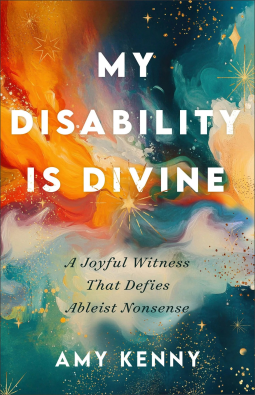
My Disability Is Divine
A Joyful Witness That Defies Ableist Nonsense
Sign In or Register Now to see if this title is available for request.
Buy on Bookshop.org Buy on WaterstonesSend NetGalley books directly to your Kindle or Kindle app
1
To read on a Kindle or Kindle app, please add kindle@netgalley.com as an approved email address to receive files in your Amazon account. Click here for step-by-step instructions.
2
Also find your Kindle email address within your Amazon account, and enter it here.
Pub Date 22 Sep 2026 | Archive Date 30 Sep 2026
Baker Academic & Brazos Press | Brazos Press
Talking about this book? Use #MyDisabilityIsDivine #NetGalley. More hashtag tips!
Description
In My Disability Is Divine, award-winning author and disabled scholar-practitioner Amy Kenny offers a dynamic spiritual meditation on the beauty and brilliance of disabled lives. Drawing from history, nature, and disability culture, she explores
● ways that disability reveals divine creativity and presence;
● how Scripture celebrates disabled bodyminds; and
● why access, interdependence, and joy are central to the community of creation.
Packed with forgotten histories, witty clapbacks, and shrewd observations, this book is a call to radically reexamine our assumptions about disability--and ourselves.
Both fierce and funny, My Disability Is Divine is a necessary guide for anyone ready to unlearn ableism, celebrate the sacredness of the disability community, and catch a clearer glimpse of how we can create communities of co-flourishing.
Available Editions
| EDITION | Other Format |
| ISBN | 9781587437045 |
| PRICE | $19.99 (USD) |
| PAGES | 192 |
Available on NetGalley
Available to Buy
Buy on Bookshop.org Buy on WaterstonesAverage rating from 8 members
Featured Reviews
 Abigail B, Reviewer
Amy Kenny has written a really remarkable book that tackles a disability theology and advocacy with humor and heart, while also not shying away from calling out the church as a whole with their ableist attitudes and resistance to change. While nonfiction isn't normally my go-to, books about disability are a deeply personal exception as my husband and I raise disabled children and navigate church, school, and the world with them. My husband even owns Kenny's first book (My Body is not a Prayer Request), so when I saw this on Netgalley, I jumped on it.
I highlighted so many sentences and paragraphs throughout this book, because a lot of it spoke to me. It's hard to narrow things down, because there's so much to love in this book - from the explanations of how disability is divine (it's probably not what you think she means by that) to the creativeness to the loneliness and lament to the joy and interdependence.
Christians and church leaders everywhere need to read this book with an open mind and a nearby mirror to reflect on their own presuppositions about disability and how disabled people are in God's image and deserving of love, community, and so much more. I can't say enough good things about this book.
 Literary R, Reviewer
A moving look through a Holy lens at how disability is reflective of the Creative Divine, rather than a "less than" condition. Gave me a new and deeper understanding of how we are all made in God's perfect image.
 Charla R, Reviewer
This book was quite different from what I was expecting. As a Christian living with multiple chronic illnesses and disabilities, I was genuinely excited to read something I felt I could relate to and that would offer encouragement through a scriptural lens. Unfortunately, that was not quite my experience.
I understand that the author’s intention was to raise awareness of disability, but the title and blurb led me to believe this would be a more personal exploration of finding divinity within disability, grounded in scripture. While there were certainly some scripture-based points that I found meaningful and that encouraged me to see things from a different perspective, the book largely felt centred on criticising the church and other Christians for their inability to understand and accommodate disabled people.
In my own experience, the church has actually been one of the places where I have found the most acceptance and genuine care, with congregations willing to adapt to my needs rather than expecting me to fit in. That said, I recognise this is not always the case outside the church, and I understand why the author felt the need to address these issues. Even so, I found the tone somewhat troubling, as it felt as though the church as a whole was being painted with the same brush, which gave the book a rather negative feel towards Christianity.
That said, I do think this book carries an important message about ableism, the treatment of disabled people, and the ways society can do better to accommodate different needs. I feel it would be especially valuable for readers without personal experience of disability, as it could help open their eyes to prejudice they may not have noticed, challenge some of their own assumptions, and encourage greater inclusivity.
If the book had been marketed in that way, I think I would have approached it with different expectations and likely a different response. As it was, it gave the impression that it would be more of a devotional, using scripture to explore disability in the Bible as its central focus.
Based on my personal experience with the book I would give it a 3 stars, however coming from the perspective of raising awareness for disability I would give it 4 stars.
 Richard P, Reviewer
Disabled Joy is a real thing, and it's at the heart and soul of Amy Kenny's latest effort "My Disability Is Divine: A Joyful Witness that Defies Ableist Nonsense."
Kenny, an award-winning author and disabled scholar/practitioner who serves as the founder and director of the Disability Cultural Center at Georgetown University, first really came to the public eye with her book "My Body Is Not a Prayer Request." With "My Body Is Not a Prayer Request," Kenny, whom I prefer to call Dr. Kenny because she is Dr. Kenny, does a deep and emotionally resonant dive into the world of contemporary Christianity's institutionalized ableism. As a lifelong paraplegic with spina bifida and a seminary graduate with a ministry background, it was a book that I loved and it was a book that made me downright excited when it was announced that Dr. Kenny would be back with "My Disability Is Divine."
"My Disability Is Divine" is less about exegesis and more about spiritual meditation, a book that starts from the foundational belief, and you should probably guess this from the title, that disability is divine and not a weakness, deficit, sin, or anything else it's often portrayed to be in the Christian institutions that quite often simply don't know what to do with it.
While there's much joy to be found in the pages of "My Disability is Divine," Dr. Kenny is also a little more no-holds-barred here. She's unrelenting, edgy, snarky, achingly vulnerable, and absolutely convicted in her literary call toward a celebration of what she refers to as "disabled bodyminds." Dr. Kenny draws from history, nature, and a rich disability culture to explore the myriad of ways that disability is revealed in Scripture and in divine presence. We learn how and often why access, interdependence, and joy are a part of the disabled life and part of what places disability so centrally into faith communities.
Dr. Kenny also feels a little angrier here, not brutally so but obviously so. It feels like she's tapped into more rejections, more ableism, and more failures by the church.
Truthfully, I'm here for it.
Interdependence, in particular, has been an obsession of mine as of life. Throughout "My Disability Is Divine," I found myself exclaiming "That's what I've been trying to say!" or "Exactly, that's my point." I found myself particularly moved in discussions around those who speak the disability language, a gift that instantly allows my heart, mind, and body to relax.
Dr. Kenny balances vulnerability with confidence and a communal spirit with a refusal to compromise on the absolute sacredness of co-flourishing. She's perhaps more revealing of her own journey here from life in an inter-abled marriage to being an academic to her myriad of physical challenges.
"My Disability Is Divine" is truly filled with joy, but it's a hard-fought for joy that comes from claiming a space many would think you ought not have. She's witty, knowledgeable, deeply compassionate, and still somehow hangs in there with a church that is so regularly disappointing. I've often proclaimed myself that just once I'd like to find a sign proclaiming "all are welcome" where all are actually welcome. I don't think I've ever found a truly accessible church, a particular disappointment given my expectations are actually quite low.
"My Disability Is Divine" is a lovely effort, a next literary stop on a powerful and necessary journey from Dr. Kenny, an entertaining and beautifully informed journey from one of the strongest and most exhilarating voices to burst forth advocating within the arenas of faith and disability.
Often both raging and hilarious, "My Disability Is Dine" is spiritual enlightenment for the uninformed and poorly informed while being a remarkable spiritual companion for those of us who exhaust ourselves trying to survive in an institution that seems to so often not want us.
Hold on to hope, Dr. Kenny seems to be proclaiming. Disability is sacred and together we can create communities where all flourish and where we celebrate accessible co-existence within our churches and with an accessible God.
 Pete F, Media/Journalist
While I really appreciated Amy Kenny’s first book, My Body Is Not a Prayer Request, I felt disappointed with this second book. Continuing from her first book, she proclaims that “We are not the ‘before’ picture of a prayer makeover or the symbol of sin used to guilt others into repenting.” She lives with joy “to resist the notion that disabled lives are not worth living.”
However, this felt like the sort of book written to encourage readers who already agree rather than to winsomely reach those who don’t yet realize they need this message. The title of the book appears to be intentionally provocative. While she does clarify that “To be divine is to be of, from, or like God”—not a claim to be God—it felt like more of a buzzword than a theological claim. Throughout the book, chapter titles call her disability “Radiant,” “Prophetic,” and “Powerful.” Other times we saw the phrases “show up and show out” and “do the work.”
One of her rare mentions of Jesus was that “Jesus cares about meeting access needs.” Her examples include: “Jesus offers remote access to the centurion’s servant (Luke 7:1-10) & Jesus speaks in plain language.” While I agree with some of these examples, I don’t think the point of Jesus going off to pray was that we should build sensory rooms.
The chapter titles reflect that disability is not a unitary experience. Each chapter title begins “My Disability Is…” Her story is “not one strictly of disability positivity or pessimism but a nuance that comes from the wisdom of knowing that life is more complicated than that.” However, the way this nuance was presented often felt like being yanked between two extremes.
Time and again we were dropped into an anecdote, often an example of the “Ableist Nonsense” mentioned in the subtitle. While she later says that we should not cancel people “because they get one word wrong,” this was hard to land after she spent much of the first half of the book sharing righteous anger about microaggressions she has experienced.
She directly addressed how she uses humor to cope and point out idolatry. While I realize she has been hurt by people in church communities, the humor often felt acidic. I was not in the mood for the snark or even her puns (and I usually love puns!). In addition, there were cultural references I didn’t get: for example, once she mentions how in building accessible spaces “silence is golden (and duct tape is silver)”—without any more context on the duct tape.
I appreciated her chapter “My Disability is Interdependent,” in which she points out that everyone has access needs. “An access need is anything someone needs to be able to fully participate in a community.” While I don’t remember her using the term “temporarily abled,” she was going for that idea. She values her disability’s honestly because “some of my peers get to fool themselves longer than I do.” In another chapter, she gave examples of accessibility innovations that benefit everyone. “We are equipped with a divine creativity to solve problems that nondisabled people didn’t even know we had.”
I found her examples of disability art in the chapter “My Disability Is Radiant” to be fascinating. I’ll be spending some time enjoying work from the artists she includes.
Rachael N, Reviewer
Thanks to NetGalley and the publisher for the e-ARC. This is a compassionate rallying cry to the world to see people with disabilities not as problems to be solved but creations of God to love and be loved by.
 Mark K, Educator
My Disability Is Divine helped me see disability not as a defect to erase but as a meaningful part of human diversity, identity, and spiritual worth. I learned that ableism can appear through inaccessible spaces, harmful religious teachings, and the expectation that disabled people should be grateful for receiving basic respect or accommodations. Another important lesson was that disabled communities contribute creativity and practical innovations that often make life easier and more inclusive for everyone. The book also taught me to value rest, changing access needs, interdependence, and different ways of moving, communicating, and participating in community. Its combination of humor, honesty, faith, grief, and joy makes its challenge to ableism both powerful and deeply personal. For readers interested in disability justice, inclusive faith, and recognizing the worth of every body and mind, this is a book I am highly recommending.
 Reviewer 1821119
I was so glad to find this book and have the opportunity to read an arc from Net galley. Due to undiagnosed ADHD and autism as a child social anxiety depression and mood adjustment disorders from adolescence and chronic fatigue I have spent much of my life negotiating a world that was not easy for me for much of that time many of my disability have been invisible but as a current ambulatory disabled woman who use a range of mobility aids from sticks to mobility scooters this book really touched me.
As a Black woman I have in resent years started to see and explore Black Joy but even though I know that through my many health related disabilities I have gained in my understanding of and compassion for other. I have often struggled to reconcile it with my Christian faith and not thought of it in terms of Disabled Joy.
Readers who liked this book also liked:

Kathy Hoopmann
Children's Nonfiction, Health, Mind & Body, Parenting, Families, Relationships
Kathy Hoopmann
Children's Nonfiction, Health, Mind & Body, Parenting, Families, Relationships
Kathy Hoopmann
Children's Nonfiction, Health, Mind & Body, Parenting, Families, Relationships

We Are Bookish
General Fiction (Adult), Literary Fiction, Women's Fiction
We Are Bookish
General Fiction (Adult), Romance, Women's Fiction

We Are Bookish
Multicultural Interest, Mystery & Thrillers, Teens & YA

We Are Bookish
Arts & Photography, Health, Mind & Body, OwnVoices

We Are Bookish
General Fiction (Adult), Romance, Women's Fiction

We Are Bookish
Mystery & Thrillers, OwnVoices, Teens & YA

We Are Bookish
Historical Fiction, Mystery & Thrillers, Teens & YA
We Are Bookish
Business, Leadership, Finance, Nonfiction (Adult), Self-Help

We Are Bookish
Multicultural Interest, OwnVoices, Teens & YA