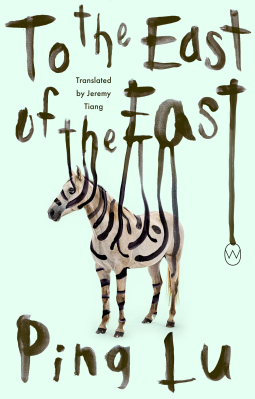
To the East of the East
Sign In or Register Now to see if this title is available for request.
Buy on Bookshop.org Buy on WaterstonesSend NetGalley books directly to your Kindle or Kindle app
1
To read on a Kindle or Kindle app, please add kindle@netgalley.com as an approved email address to receive files in your Amazon account. Click here for step-by-step instructions.
2
Also find your Kindle email address within your Amazon account, and enter it here.
Pub Date 3 Nov 2026 | Archive Date Not set
Talking about this book? Use #TotheEastoftheEast #NetGalley. More hashtag tips!
Description
While chasing business opportunities in China, Min-Hui’s husband disappears without a trace, forcing her to uproot her quiet life as a writer in Taiwan and travel to Beijing, where the chaos of the city leaves her reeling. Does the Chinese government truly have her best interests at heart, and how hard are the authorities looking for her missing husband? Marooned in the ancient capital, Min-Hui encounters the enigmatic Shangjun, a self-proclaimed human rights activist who seeks refuge in her hotel room. As their relationship blooms, Min-Hui allows him to read her novel in progress: a young Qing emperor confined within the Forbidden City becomes fascinated by pirate merchant Zheng Zhilong’s tales of the Taiwanese seas. All the while, Min-Hui contemplates the discord in the marriage she is desperate to save. Exploring the universal longing for freedom with her signature multi-layered narrative, Ping Lu interweaves Min-Hui’s search for her husband and her Beijing love affair with the historical backstory of her novel and unsent letters from her vanished husband. To the East of the East offers a profound meditation on liberation, destiny and the contingencies of national histories by one of Taiwan’s most sophisticated contemporary voices.
Advance Praise
Praise for To the East of the East
“Not only does Ping Lu’s novel offer a captivating story, she also uses glimpses of omniscient narration to reveal the razor-sharp, penetrating perspective of the cultural critic.”— Shih Ju-Fang, playwright
“Ping Lu’s acuity dispels the questioning of dialecticism and the unrestrained attacks of criticism, piercing through numerous hypocricies and falsehoods, stabbing the reader into pain and wakefulness.” —Professor Fan Ming-Ju, Graduate Institute of Taiwanese Literature, National Chengchi University
“Reading a Ping Lu novel brings the same pleasure as solving a riddle.” —Professor Hao Yu-Hsiang, National Taipei University of Education
“Ping Lu captures the most contradictory, yet most understandable, aspects of humanity.” —Chen Bo-Ching, author of Mr. Adult
Marketing Plan
- Advance galleys and digital reader copies
- Digital assets including trailer & author video
- Signed book plates available
- National TV, radio, print, and online review campaign
- Consumer-facing national advertising campaign on Shelf Awareness, Lithub, NPR, Foreword Reviews, Goodreads
- Virtual or in-person author events
- Book club discussion guide
- Bookstore co-op available
- Excerpt placement
- Social media campaign & Goodreads Giveaway
Available Editions
| EDITION | Other Format |
| ISBN | 9781642861679 |
| PRICE | $19.99 (USD) |
| PAGES | 220 |
Available on NetGalley
Available to Buy
Buy on Bookshop.org Buy on WaterstonesAverage rating from 38 members
Featured Reviews
 Sucharita B, Reviewer
To the East of the East by Ping Lu is a literary fiction that beautifully portrays the struggles of a wife searching for her missing husband in an unfamiliar city. The story moves between the past and present, presenting both the husband’s and wife’s perspectives, taking readers on an emotional journey from Taiwan to China.
Min Hui’s character reflects the loneliness and confusion of a woman trying to find her own identity beyond the role of a wife. Throughout the narrative, it feels as though both characters are justified in their own ways. The story explores how moving to another country with dreams of a better life can bring unexpected challenges, especially when expectations between partners begin to clash.
What stood out most was Min Hui’s narration, which connects the scattered pieces of the story. However, the book does not provide a definite conclusion, leaving readers to interpret the ending in their own way. It is a unique and thought-provoking read, unlike my usual choices.
 Reviewer 1478224
I really enjoyed this novel! It uses narrative (and narrative within a narrative even) to explore Taiwanese history and tensions the between Taiwan, China, and Macau. Rather than tracing this history as a chronicle, the book follows it through relationships and memory, so desire and geopolitics are tangled together -- very interesting.
There are many layers to this book but it didn't feel overloaded to me. I was also quite satisfied with the end, especially because at first I felt like there could be a lot of loose ends and no real ending, but actually lots of questions were answered.
I recommend it for those who already know a bit about the history of this region and want to explore it more with a layered fictional lens. I think if you don't already have that baseline understanding, it might be a bit difficult to visualise and get through.
 Alexander W, Reviewer
To the East of the East by Ping Lu.
I received an ARC from World Editions on NetGalley and this is my honest review.
Ping Lu’s To The East of the East centers on Min-Hui, a Taiwanese writer who travels to Beijing to search for her husband after he abruptly disappears during a business trip. Left stranded in an unfamiliar, bureaucratic landscape, she ends up meeting an enigmatic activist who seeks refuge in her hotel room, sparking a quiet shift in her journey. As Min-Hui navigates the uncertainty of her missing spouse and her evolving dynamic with this new companion, the narrative weaves together her immediate reality, fragments of her husband’s perspective, and the draft of a historical novel she is writing. Through these layered threads, the book probes the tricky intersections of personal freedom, marital expectation, and cross-strait history without leaning into heavy-handed melodrama.
What shines brightest here is the book's intense, quiet emotional gravity. Ping Lu handles Min-Hui’s inner life with remarkable delicate care, capturing that distinct, suffocating blend of isolation, grief, and sudden independence that comes from being truly on your own in a foreign space. The writing, rendered smoothly in translation, treats emotional conflict not as a plot device to be solved, but as something messy and deeply human. It manages to make the grander geopolitical backdrop feel entirely personal, grounding broad questions of identity and belonging inside the fragile, aching core of a failing marriage.
The novel drops the ball slightly right around the middle, however, when a prominent new character is introduced to the fold. Up until that mark, the story relies on a tight, claustrophobic intimacy that works brilliantly to build tension. Bringing this additional figure into the dynamic disrupts that momentum; the pacing stumbles, and the shift in focus feels a bit abrupt compared to the seamless, subtle layering of the earlier chapters. It takes a little too long for the narrative to find its footing again after this structural pivot, leaving a portion of the midsection feeling somewhat disjointed.
Despite that mid-point wobble, To The East of the East is a rich, evocative piece of translation that leaves a lasting impression. The book’s strength lies in its quiet moments—the slow unraveling of memory, the weight of unsent messages, and the bittersweet realization that losing something can sometimes be the only way to find yourself. It offers a sharp, empathetic look at human connection across physical and historical divides, making it a genuinely rewarding read for anyone who appreciates thoughtful, introspective fiction.
Reviewer 1765543
Min-hui, the wife, travels from Taiwan to Beijing in search of her missing husband. He's disappeared out of the blue and tries to follow any leads. During her time in Beijing, she starts writing out a plot for her new book, which originally started out as a letter to her husband.
Chien-I, the husband, might have disappeared for a good reason. He starts writing letters to his wife on his situation, on why he disappeared, his feelings of his marriage to Min-Hui and his relationship with his own father, who happens to be Min-Hui's Professor.
Shangjun is the third character in this story. He suddenly appears at Min-Hui's hotel. Who is he, and what is he hiding from? Min-Hui seems to start accepting him into her life and hotel room, and they talk about their situations. Min-Hui also starts talking to him about the book plot she is writing...
A story of Taiwan and China's relationship in finding a missing Taiwanese person.
Wasn't sure of the link of Min-Hui's story... but I'm guessing it's to do with Chien-I and his father's relationship.
Four stars! Thanks to Netgalley and World Editions for this ARC!
Reviewer 1694782
This is an interesting novel that combines three storylines. One is about the protagonist travelling to Beijing. Her husband told her he was repositioned there for work, but she hasn't heard from him in a long time. Fearing that he's missing, she goes there to investigate. Along with that are a collection of letters, most of them written by the main character's husband. In between those there's a manuscript for a historical novel, parts of which the protagonist reads to another person.
It's a book of opposites and overlaps, of things facing each other. Two partners in a relationship, China and Taiwan, past and present, what could have been and what is. There are many lenses to use to look at this novel with, many layers intertwining with each other. There's a balance of warmth and cynicism that I liked. Both the cover art and the book's title get explained at a certain point too, I find it very satisfying when that happens.
My favorite part of the novel were the letters. I think they were really well done. People can write what they're scared to say out loud to one another, as these sections show. Secrets get revealed, emotions get processed, the characters' fears come to light. It's very sad, how life can go. How years of trauma and insecurity can build up, preventing communication...
At first I didn't expect to enjoy the manuscript parts that much. Its setting is centuries ago and the narrative makes some jumps. But I came to really like it. It feels like it's truly written by the protagonist, not the book's author. There are word choices and descriptions that fit the main character and her experiences well. Slowly it reveals how everything is linked. Her and her creative work, but also China and Taiwan's political situation, and how bonds between individuals and bonds between countries might share some tensions.
The one disappointment I had in the book was one particular scene. It's hard to describe without spoiling anything, but I thought it was an overused cliché. Especially in TV shows I see this happen a lot, where a sex scene is combined with a different scene that displays something like a tragic event happening or a memory that's being relived. The focus shifts from one to the other continuously, contrasting the two settings. This book has one of those scenes. Yes, it technically fit and yes, it had its function. I guess it's an issue of my personal taste, but I'm not too fond of it. To me, the flashback, memory, reflection part of that scene was one of the most beautifully written parts of the book. I'm not sure how the author could have shown us this side of the character without combining it in this way, but still it made it feel a bit corny, which was a pity.
Overall it was a good read, one that needed some time to sink in. During the reading process I wasn't too sure how it would all come together, but the more I think about the book afterwards, the more I've come to like it. A recommend for anyone who enjoys to ponder things while looking out over the sea.
 The Secret B, Reviewer
To the East of the East follows Min-Hui, who leaves Taiwan for Beijing after her husband mysteriously disappears while working in China. While searching for answers, she meets Shangjun, a supposed human rights activist who unexpectedly takes refuge in her hotel room.
I enjoyed the unusual relationship between Min-Hui and Shangjun. Their conversations are awkward and sometimes tense, and I was curious to see what would develop between them.
The story moves between Min-Hui's search, her husband's letters and the historical story she is writing, exploring Taiwan and China's complicated relationship alongside marriage, identity and independence.
A thoughtful, multi-layered read about love, freedom and finding your own way forward.
Read more at The Secret Book Review.
Reviewer 1600053
To the East of the East — 4 Stars ⭐⭐⭐⭐
*To the East of the East* was a thoughtful, layered, and beautifully constructed novel that took me a little while to settle into, but ultimately gave me a lot to think about. I really enjoyed how Ping Lu blends a personal story of marriage and disappearance with questions about freedom, identity, history, and the complicated relationship between individuals and the countries they call home.
At the centre of the story is Min-Hui, a Taiwanese writer whose husband suddenly disappears while pursuing business opportunities in China. What begins as a search for a missing husband quickly becomes something much more complicated as Min-Hui travels to Beijing and finds herself navigating an unfamiliar city, uncertain authorities, and a situation where she isn't entirely sure who she can trust.
I really liked Min-Hui as a protagonist. She isn't presented as someone who has all the answers, and I appreciated the way the novel allows her to question her marriage, her choices, and what freedom actually means to her. Her search for her husband gradually becomes a much more personal journey, and I found the emotional side of the story particularly interesting.
One of my favourite aspects was the way the novel plays with **stories within stories**. Min-Hui is working on a novel about a young Qing emperor confined within the Forbidden City and his fascination with the stories of pirate merchant Zheng Zhilong and the Taiwanese seas. At first, I wasn't completely sure how all these different threads would come together, but I gradually became more interested in the connections between them.
The historical storyline adds another fascinating dimension to the book. The contrast between people physically confined by political circumstances and people struggling against emotional or personal limitations works really well. There is a constant conversation throughout the novel about what it means to be free and whether freedom is something that can ever truly be given to us by someone else.
I also enjoyed the relationship between Min-Hui and Shangjun. Their connection is complicated by the circumstances surrounding them, but it gives Min-Hui another perspective on her own life and marriage. I liked that the romance wasn't simply treated as an escape from her problems. Instead, it becomes another way for her to question what she wants and what kind of life she actually wants to lead.
The setting was another strong point for me. Beijing feels chaotic, unfamiliar and almost overwhelming through Min-Hui's eyes, and I enjoyed how the city itself becomes part of her experience. There is a real sense of displacement throughout the book, particularly as Min-Hui finds herself caught between Taiwan and China, between her past and present, and between the person she thought she was and the person she might become.
This isn't necessarily the fastest-paced read, and there were definitely moments where I found the multiple narratives and philosophical elements a little challenging to follow. Some sections required more patience from me than others, and I occasionally found myself more invested in one storyline than another. However, I think the layered structure is also what makes the novel so interesting.
What I appreciated most is that the book doesn't offer simple answers. Marriage, freedom, national identity, love and political power are all presented as complicated and sometimes contradictory. Min-Hui's personal search becomes intertwined with much larger questions about history and destiny, making the story feel much bigger than simply a mystery about a missing husband.
Overall, *To the East of the East* was an intelligent and thought-provoking read. I really enjoyed its combination of literary fiction, historical storytelling, mystery and romance, and I especially appreciated the way Ping Lu uses multiple narratives to explore the idea of freedom from different perspectives.
It may not be the easiest book to fly through, but it's one that rewards taking your time with it. There are plenty of ideas here that stayed with me after finishing, particularly the questions surrounding how much control we really have over our own lives and how personal freedom can become entangled with history, politics and relationships.
**4 stars ⭐⭐⭐⭐** — A beautifully layered and thought-provoking story about disappearance, marriage, history and the complicated search for freedom.
Reviewer 1752153
Lu explores the thinness and fragility of the stories we concoct to fool others and ourselves through a narrative that alternates between a wife's search for her missing husband and his attempt to come clean about the events that led to his departure. The more flowery language of Min-Hui's self-narrative and the excerpts from a story she is writing balance her husband's franker account. There's a Scheherazade-like quality to Min-Hui's attempts to prolong the moment when she has to face reality. Unfortunately, as the story she's writing winds down, she's forced to confront the unsatisfying truth, and we're left with a somewhat unsatisfying conclusion.
Thanks to World Editions and NetGalley for the advance reading copy.
Andre l, Reviewer
Min-Hui, a writer, travels to Beijing after her husband, Chien-I, disappears. Ping Lu starts To the East of the East there.
The rented apartment hands her objects before it hands her answers. Unfamiliar lingerie, cups marked with lipstick. The refrigerator has been left to spoil. Employment and banking records show that Chien-I left his job and drew his money out over time. The record is orderly, and it covers everything except where he went. She cleans the rooms and searches.
Chien-I is writing the explanation while she looks for it. From Macau, he addresses letters to Min-Hui and does not post them. He sets out the departure with May, the woman he left with, and the casino work he took under another name. He writes about his father, and about the shame of being his son. He implicates himself freely. He is careful about the sequence. He absolves Min-Hui, then lists her orderliness and her distance among the things he needed to leave. He names himself the cause of the failure. He arranges the evidence around that admission. The letters reach her in the end. By then there is no marriage left to put a question to them.
The marriage had practised this distance for years. In Taipei, Min-Hui had known her husband by what food he tolerated and by the way he slept. Once she heard running water and laughter down the telephone. A woman, perhaps. She settled on a harmless explanation. Raising it "might pierce the surface, and she wasn't prepared to take the risk." Her care was real. So was the practice of leaving dangerous questions unasked. Chien-I later reads that practice as coldness. Min-Hui writes her own letter once the search is over, and admits there that marrying into his family was part of her way up. The admission complicates her standing as the injured wife. Her letter comes as late as his.
A pirate merchant sits in a Beijing prison, describing the sea to an emperor who has not seen it. Zheng Zhilong postpones his execution by deciding what the Shunzhi emperor is permitted to hear. The stories win the emperor over. In Min-Hui's version that affection is the crime Zheng is executed for. Melchor tests the official version in This Is Not Miami. Min-Hui writes these scenes while her own marriage comes apart, and puts into the historical chapters the speech she avoids at home.
Min-Hui repeats the method in Beijing with Shangjun, a man whose past she does not investigate. Shangjun says he is on the run. She chooses proximity over verification. He attends to her with the care she had spent years directing at her husband. She reads him her novel about the Qing court to hold his attention. Min-Hui wants to be waited for and cherished, and she would take the lie to get it. She imagines a hand at her throat. The appeal is that thinking stops. The sex scene then explains what the affair has shown, gathering childhood poverty and marital anger into one encounter until Ping Lu is diagnosing Min-Hui in the act of depicting her.
May pays for the rebirth. Chien-I got her out of Beijing after one of her clients died, and in the letters she is a stray he took in. In his account, her dependence restores what his wife's competence took from him. Tash Aw counts it in The South. Almost everything the novel shows of May comes through his letters. May cleans rooms in Macau.
The novel stops to gloss itself. Chien-I compares the marriage to teeth rotting under an invisible film, and then explains the comparison. Shangjun tells Min-Hui that the writer is telling her own story, which the historical chapters have been doing in plain sight. The final letters move with a fluency closer to finished psychological casework than to speech found late. Jeremy Tiang's English lets the domestic sentences stay plain and the official ones stiffen. The explanatory passages stand out against it. The arrangement distributes what each person knows, and then a character says it out loud.
Officials receive Min-Hui at a desk, with the report ready. She declines to read it. A thumbprint is still required, and she presses it onto the sheet. The officer stamps the box and shuts the folder. "Case closed." She has gone to letters and to invented courts for an account of her marriage, and at the desk she marks the state's version without opening it. The Straits Exchange Foundation calls the disappearance an isolated incident and undertakes to raise expatriate safety at future trade talks.
 Isla J, Librarian
‘To the East, of the East’ explores a woman’s journey across China as she aims to find her missing husband. It reveals new connections along the way and a broad understanding of isolation in a community and political environment that is different from the main characters originating location. The evolution in this landscape changes the main characters goals and transforms the plot of the novel.
The characters evolution was well done and followed nicely alongside the journey she was taking. Her desperation is represented not only in her actions but also in her inner-monologue and at no point does this fall flat. I just thought that the plots pacing was at times clunky and could have used with some smoothing out at certain times.
Thank you to #netgalley for this e-arc
 Dana W, Reviewer
In this work of mysterious literary fiction, a woman travels from Taipei to Beijing to look for her missing husband. She meets an odd man in her hotel lobby, and he comes to her room to hide from the police. The woman expounds upon long monologues about her life, her childhood, her husband; the interaction between the two is superficial but meaningful in a strange way. A component of the narrative is the husband's letters to his wife, which, like most of the book, are quite confusing. A third aspect of the novel is excerpts from a book the woman is writing; this part was the least interesting to me and it really dragged on in a mostly boring way. Nonetheless, this is a well written book that will be appealing to fans of international fiction.
Thanks to NetGalley, the publisher, and the author for providing a review copy in exchange for my honest opinion.
 Margaret C, Reviewer
There is a lot going on in this multilayered story of a Taiwanese wife in search of her husband, a businessman who goes missing when he is on a business trip to China.
I struggled to keep track of the many themes and stories within stories that hopped around between different time frames and their relevance, particularly when Min-Hui is relating parts of her novel to Shangjun.
Overall though it is a good story with some really interesting themes.
Thank you to NetGalley, World Editions and the author for this advanced reader copy.
Sílvia F, Reviewer
Today I’m talking about "To the East of the East", by Ping Lu. It’s one of those books that starts off really well, but as you keep reading, you begin to wonder whether the author may have tried to do too many things at once.
📖 The protagonist, Min Hui, lives in Taiwan. Her husband goes to Beijing for work and, little by little, he stops getting in touch until eventually he disappears altogether. She decides to go and look for him, but all she finds is an empty apartment and a few unsettling details, such as women’s clothes that do not belong to her. From there, an investigation begins, combining mystery with a look at the relationship between Taiwan and mainland China.
🇨🇳 I particularly liked the sense of estrangement that follows the protagonist throughout her stay in Beijing. The authorities appear to be helping her, but you are never quite sure whether they are actually investigating or simply going through the motions. That underlying distrust works very well as background noise and gives the novel a distinctive character.
✉️ The problem is that the book does not stop there. There is also a relationship with a man she meets in Beijing, the letters her husband writes to her while he is missing and, above all, a long historical novel set during the Qing dynasty which, in theory, is being written by the protagonist herself.
🤔 This is where, for me, the novel starts to lose steam. Not because these storylines are bad, but because they end up competing with one another. I kept feeling that every time the main plot started to gain momentum, the book changed direction. I never quite understood what the historical section, in particular, added to the novel as a whole, and it made the reading experience a little more uneven for me.
📚 Overall, it is a novel with a very appealing premise and some interesting moments, but I think it would have worked better if it had trusted the strength of the main story more and abandoned some of the other paths it opens up. In any case, many thanks to Net Galley for the copy, which, despite my reservations, still has some interesting things to offer.
 Sara A, Reviewer
A missing husband, a mysterious stranger who moves into her hotel room like it's Airbnb, and a novel-within-a-novel about a Qing emperor and a pirate.
There are genuinely gorgeous passages, ideas that made me stop and reread, and I appreciated getting an actual ending instead of just vibes. A fractured, occasionally frustrating meditation on freedom and connection. Worth it for patient readers of translated fiction, less so if you need your suspension of disbelief kept intact.
Reviewer 816112
Didn't manage to finish this, but thought it was decently written anyway. It would be entirely unfair to say otherwise. The narrative didn't hold much of my attention. Hope it falls into the hands of more suitable readers.
 Becky C, Reviewer
A Taiwanese woman follows her husband to Beijing and finds herself playing supporting wife in a marriage, and a city, that never quite feel hers. She's a fish out of water, critically uncertain of herself at every turn.
Honestly, this one didn't fully land for me. The prose is fractured and tips into pedantic in places, and the plot asked more suspension of disbelief than I could give it (a woman letting a total stranger hide out in her hotel room, no less). There are gorgeous passages and sharp ideas scattered throughout, but I closed it still wanting a truer window into the experience it was reaching for.
Unlike some other reviews I've read, I did enjoy the historical Surrey Min-Hei writes whilst in Beijing. I thought it was one of the smoothest and most engaging of the multiple perspectives and tones. There's lots to appreciate in this book, but not a top read for me.
 Dorothee C, Reviewer
I wasn’t sure exactly what I was walking into when I started this book but found it to be a meditative reflection and exploration about the missed connections and understandings between people and places both historically and today. Told in three narratives: A Taiwanese woman goes to Beijing to search for her missing husband and encounters both the local police force and a stranger who quickly inserts himself into her life, the letters of her missing husband, and the historical fiction piece she is writing. Ping Lu has a great feel for people and there were several sections and passages that made my mind wander off the page and truly digest what was being said. I also was pleased that there was a full arc and conclusion to this story and it was not purely meditative. However, I still would’ve liked a few more concrete links between the sections for it to have truly blown me away. As it is, I enjoyed the read and would recommend to anyone interesting in works in translation.
Reviewer 2040130
The story follows Min-Hui, a Taiwanese woman who travels to Beijing to find her husband, reportedly missing. There are three “plots” in the story: Min-Hui’s journey in Beijing where she stumbled upon Shangjun, letters written by her husband Chien-I telling what actually happened to him, and a historical fiction story Min-Hui’s writing during her trip.
This premise caught my attention because I have been trying to read more East Asian literature outside of Japan. I expected the story to be both emotional and mysterious, given the fact that it revolves around a woman trying to find her husband in a foreign country. However, I think the mystery part wasn’t that much explored in the book. It relies heavily on the emotional side, with less movement and actual plot progression, and more self-reflection and pondering about the characters’ past.
The most interesting thread to follow, for me, was Chien-I’s letters because it was the whole reason for Min-Hui’s arrival in China. However, I personally think that his portion was not that big. It wasn’t until halfway through the book that I was finally able to grasp Chien-I’s character and backstory.
I don’t really have enough knowledge about Chinese history and that’s totally on me, so it was hard to follow the story that Min-Hui was writing. I find that section of the book to be very dragging and it was a bit hard for me to get through. I know there should be a connection between the story she was writing with her actual condition (missing husband and all) but, as I stated before, it was difficult for me to connect the dots because I lack the knowledge.
Nonetheless, it was still a good experience. The book feels a bit quiet since it’s more character-driven, so it was enjoyable to read without rushing. Curious to see other works from Ping Lu too, seems like she is a celebrated Taiwanese author.
Thank you NetGalley and World Editions for the ARC!
Debbie J, Reviewer
An important author. This just wasn’t my cup of tea. I could see it could have a lot of fans. Thank you to the author. Thank you to # NetGalley and the publisher for an ARC.
 Jack R, Reviewer
This novel begins with a compelling premise - a Taiwanese woman travels to China after her husband, who relocated there for work years earlier, suddenly disappears. The story is told through three separate threads: her journey to uncover what happened to him, a collection of letters he wrote but never sent, and excerpts from a historical manuscript she is writing about the relationship between China and Taiwan's early history.
The book's greatest strength lies in its emotional insight. It captures the quiet loneliness that can develop inside long-term relationships and examines what happens when two people drift apart without fully acknowledging it. There is a persistent sadness running through the novel, particularly in its portrayal of people who spend years avoiding difficult truths until they become impossible to ignore. It is interested in longing, resentment, dependency and the search for meaning beyond familiar routines.
The husband's letters are easily the standout element. They provide an intimacy and honesty that the other sections often lack, revealing thoughts and feelings that were never expressed when they still had the chance to matter. Reading them creates a growing sense of tragedy, not because of any single revelation, but because of the recognition that so much pain might have been avoided had these conversations happened face to face.
The novel also raises interesting questions about desire and fulfilment. Both central characters find themselves confronted by possibilities that had long been absent from their marriage, and the book is at its most perceptive when exploring the consequences of those discoveries. The resulting feelings of envy, loss and regret are handled with considerable nuance. The historical sections occasionally reinforce these ideas, and the parallels between personal relationships and the broader political tensions between Taiwan and China are thought-provoking.
Yet for all its strengths, I never felt the novel came together successfully. The structure feels unwieldy, with the three narratives competing for attention rather than enriching one another. The historical material in particular never felt sufficiently connected to the main story to justify its prominence. While I could appreciate what the author was trying to achieve, I rarely found myself invested in that part of the book.
I also found the central mystery less engaging than I had hoped. The protagonist is easy to spend time with, but the search for her missing husband lacks the urgency and intrigue needed to sustain the novel's length. As a result, the pacing often feels sluggish and sections that should have generated tension instead felt laborious.
In the end, my response was one of partial admiration rather than enjoyment. There are powerful observations about marriage, communication, and the risks people take in pursuit of happiness. However, the novel never fully capitalises on its strongest ideas. The individual components contain flashes of brilliance, but they remain just that: individual components. I could see the outline of a remarkable book, yet the finished product never quite lived up to that promise, and reaching the final page felt more dutiful than rewarding. 2.5 stars rounded up.
Reviewer 1117702
A husband goes missing and a wife goes to look for him. She meets a stranger along the way and is also writing. novel herself. The husband tries to explain himself in letters to her (this was the most engaging part of the book for me). I would guess that this story works well in the original language but unfortunately it does not seem to translate so well in to English. There's nothing obviously wrong with but it is just not engaging. I hate to give a negative review and I hope that have just missed the point and that other people are able to enjoy this book more
 Federica r, Reviewer
This was a rollercoaster and, for the most part, I enjoyed it, but I wanted more!! I loved the writing style, the narrative moved between letters, historical chapters and our main character's POV making the reading experience more dynamic than I had expected. I really appreciated how Ping Lu was able to weave into the mystery reflections on the art of storytelling and human fragility. Nonetheless, I do wish this was longer. I found the ending to be anticlimactic. After all that build up I was expecting more. Overall, I really appreciated what this short novel tried to do, but I do wish some aspects were explored more in depth. I'll be sure to check out more of Ping Lu's novels in the future.
 Nicki M, Reviewer
To the East of the East was a book I could appreciate in some ways but which fell flat for me in others. In the early chapters I was invested. Min-hui's husband had gone missed in Beijing. What could have happened to him and what will she discover as the journey unfolds? I was completely on board for that tale. What didn't work for me was how much was crammed into what is really a novella/short novel only. Having Min-hui's POV was fine, although she was such a passive character it often felt like she wasn't doing much and only reacted as things happened to her. I also didn't mind the husband's POV in the form of his letters to her, as they offered us the other side of the story and another viewpoint on their relationship. But then there were the long sections of the novel Min-hui was writing. Had it just been a case of reading her novel, I may well have found it interesting, but juxtaposed with the rest of the narrative, it didn't feel like it had a natural place, even if there was some sense of everything coming together by the end. As a story about marriage and relationships it was fine and had some interesting things to say, but the execution overall just didn't gel with me completely. For that reason, I am giving it 3.5 stars. If you are interested in Asian contemporary fiction and don't mind a little disjointedness in your narratives, it would be worth a read.
I received this book as a free eBook ARC via NetGalley in exchange for an honest review.
Reviewer 1267807
'My writing is jumbled because my heart is confused'
To the East Of the East is centred around a woman who's husband has gone to mainland China for work and after a period of poor communication from them both, he goes missing. She flies over from Taiwan to be briefed on the investigation and to uncover what kind of a life her husband had been living.
I enjoyed Min Hui's realisation that her marriage had slipped into routine and that they had slowly lost the spark that they had once had. She does seem to be quite complacent though for most of the book.
There are a few different point of views in this book. I did really enjoy the husband's letters and most of the current periods of Min Hui in Beijing. The swapping between the sections of the book made it feel quite long even though it is quite a short book.
Unfortunately, I don't see the need for the book that Min Hui is writing, for me, it slowed down the story quite a lot. It seems like this would be better as a separate book as it was interesting but just didn't seem to have a place here.
The last couple of chapters seemed to pick up the pace a bit, so the book ends on a higher note.
 Sreeranjini A, Reviewer
Thank you to the publisher World Editions and NetGalley for providing me with an advance reading copy.
To the East of the East is an ambitious novel that explores identity, memory, history, loss, and storytelling through multiple narrative layers. The book combines the protagonist’s present-day narration, her recollections of the past, a historical Chinese novel she has written, and a letter from her missing husband. While I appreciated the author’s attempt to weave these elements together, the execution did not fully work for me.
My biggest challenge with the novel was its structure and pacing. The story frequently moves between past and present within the protagonist’s narration, while also incorporating lengthy sections from the historical novel and the husband’s letter. As a result, I found it difficult to remain immersed in any one storyline for an extended period. Just as I became invested in the main narrative, the perspective or timeline would shift again.
The historical novel in particular was the most difficult aspect of the reading experience for me. Although I understand its thematic relevance and the role it plays in the larger narrative, these sections felt overly long and slowed the momentum of the story. I often found myself eager to return to the protagonist’s contemporary storyline, and there were points where the historical chapters almost made me consider setting the book aside altogether.
That said, there were elements I appreciated. The themes of displacement, belonging, family history, and the relationship between personal and collective memory are thoughtfully explored. The novel is clearly carefully constructed, and readers who enjoy literary fiction with layered narratives, metafictional elements, and historical parallels may find much to admire here.
Ultimately, while I could see what the author was trying to achieve, the multiple narrative strands and frequent shifts in timeline affected my engagement with the story. The novel felt significantly longer than its page count because of these interruptions, and I struggled to maintain a connection with the characters and central plot throughout.
Overall, this was an interesting and ambitious read, but one whose structure and pacing prevented it from fully working for me.
Reviewer 962747
This book was... interesting. When reading books in translation, I make a point to set aside expectations around storytelling conventions and go in with a blank slate. That said, this had an unusual structure, and not all of it worked for me. The main thread of the story was told as conventional narration, following as Min-Hui searches for her missing husband in China. This was fine; the logistics of the search are less important that Min-Hui's slow realisation that her marriage was over before it began. Part of the story was epistolary, which I thought was a really great way of filling in the husband's side of the story while maintaining the distance and disconnections that was ultimately the heart of the narrative. The final element was excerpts from a historical novel written in-book by Min-Hui, and this was a total miss for me. I couldn't find a link to the main story and those chapters became a slog to read, a waste of precious page space in this short book. Like I said, interesting. Didn't love it, but did have a lot to chew on.
Veronica R, Librarian
I really wanted to like this however it was too long and I couldn’t believe that. would be taken in so quickly and easily by Shangjun. He was giving her enough clues. This part of the story was too long.
I did enjoy the history as I know very little of Chinese dynasties and I found this very fascinating and quite touching.
The letters from Chien I were so open and it’s so sad that he hadn’t been able to say these things to her face. Marriage can be hard if there’s no honest communication from the start. Min Hui never explained to her husband about her background and how that affected how she behaved. I feel that it was only her education which separated her from her husband’s mistress May.
Overall an unsatisfactory read
 Anna O, Educator
Thank you to NetGalley for this early read! Though I enjoyed the very different perspectives and storytelling in the writing, none of it really came together for me. I loved the husband’s letter, Min-Hui’s perspective, and the writing of the history of China and Taiwan. However they did not all come together into a cohesive single storyline for me. I found the history and sociopolitical information interesting but the story was lost.
 Nicole J, Reviewer
I was interested in reading this novel based on its premise and plot points, however, I found it a bit tedious and dense overall.
This novel follows a Taiwanese woman who sets out to find her husband who has gone missing in Beijing. While the prose and overall premise are solid, I found myself having a lot of difficulty engaging with large chunks of this novel, and I felt the overall plot was very slow moving.
I did quite enjoy the letter written from her husband’s perspective, and wish that the author had leaned more into that piece. Overall this was a fairly interesting read, and it you don’t mind a slower pace, it might be a good fit for you. This novel was labelled a thriller- which it absolutely is not and falls firmly in the category of contemporary or literary fiction.
 Petri P, Reviewer
I’m in a bit of a reading slump right now and this book didn’t help me with it. I thought the writing was very vivid and good, but the story dragged a certain drive that didn’t make me want to pick it up.
My favorite part were the letters from the husbands POV and least favorite parts where the story the main character was writing.
 Jason M, Reviewer
Okay, this was a very comprehensive read for such a short book - and I’ll start off by saying that the page count is perfect for the story this book aims to tell. It is not too short nor too long.
To the East of the East is about a husband disappearing in mainland China and the wife;
Min-Hui traveling from Taiwan to Beijing to find her missing husband.
I went in with no expectations, and no prior knowledge. My initial reaction was ooh- is this a thriller, I mean missing husband? Possibly kidnapped, tortured or killed even (I’m not the ideal reader for thrillers), but I have read John Grisham so I may possibly like it.
I was proven wrong, it’s true to its genre contemporary and I am entirely impressed by both the author and the translator, the concepts and the ideas explored and the way it has been translated is nothing short of absolute praise. I love a good atmospheric writing style and reading the sombre tonality of this book, especially Min-Hui’s early chapters were a pleasure - the mundane acts of buying grocery and cooking and how it fades into routine with loss and grief.
The author is a bit experimental with the format - there’s 3 povs in the (very short) book - one being the letters of Min-Hui’s husband written in first person pov, then we’ve got two Min-Hui povs, one of story she is writing and another with a man she is counters in Beijing. It’s a bold move for such a small story - and I don’t think it landed well with me, especially the fictional story inside this novel.
Taking that out, this book read like Letters to Milena meets Us and Them (2018), both of which is high praise from me.
Its the dread and blunt realization of marriages that have no spark, how love is hollow without passion and this books explores both the wife and the husband finding passion, and when that is found - the jealousy and the grief that comes after. The fictional story about the emperor sort of works in parallel with the characters and their thematic experiences as well as the parallels to Taiwan and China, which was an intriguing commentary to read from.
My only qualms is that I would have liked to delve deeper into Min-Hui’s mind and state of mind pre and post her husbands disappearance instead of the novel she was writing.
The letters - my absolute favorite part of the story, it was reminiscing and nostalgia and breaking down actions and reactions and the past, I absorbed the melancholy straight to my bones and I wish we got more!!!!!!
It’s an overall 6/10
Readers who liked this book also liked:


Jess Mills
Biographies & Memoirs, Nonfiction (Adult), Parenting, Families, Relationships




Céline Fitzmaurice
Biographies & Memoirs, Mystery & Thrillers, True Crime