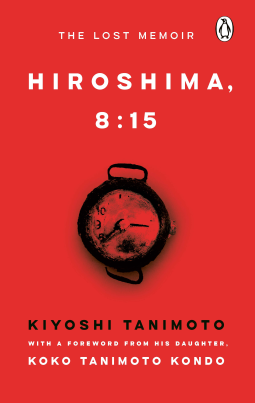
Hiroshima, 8:15
The Lost Memoir
Sign In or Register Now to see if this title is available for request.
Buy on Bookshop.org Buy on WaterstonesSend NetGalley books directly to your Kindle or Kindle app
1
To read on a Kindle or Kindle app, please add kindle@netgalley.com as an approved email address to receive files in your Amazon account. Click here for step-by-step instructions.
2
Also find your Kindle email address within your Amazon account, and enter it here.
Pub Date 6 Aug 2026 | Archive Date Not set
Ebury Publishing, Penguin Random House | Ebury Press
Talking about this book? Use #Hiroshima815 #NetGalley. More hashtag tips!
Description
A newly discovered firsthand account of the Hiroshima bombing and its aftermath from one of the survivors—a lost classic that brings unprecedented immediacy to our understanding of this world-changing event.
The whole city was covered with dark clouds, and conflagrations were breaking out in various directions. Could all of this have happened at once? It was then that black drops of rain, as big as blackberries, began to fall – rain caused by the atomic bomb. I wondered what had happened to my home and church. With a pale face, I ran down the Koi highway…
When the atomic bomb fell on Hiroshima at 8.15am on 6 August 1945, Methodist minister Kiyoshi Tanimoto was just beginning his day by helping a neighbour on the outskirts of the city. Unbeknownst to him at that moment, the events that awaited him over the following days and weeks were full of horror, but through his courageous determination to save his family, church and city from total devastation, Tanimoto would become internationally recognised as a hero of Hiroshima. In 1946, he featured in American journalist John Hersey’s seminal book Hiroshima which catapulted Tanimoto into global fame – but it is only now that we have discovered the manuscript that he wrote in his own words.
With a powerful introduction from Tanimoto's daughter, Koko Kondo, a renowned peace activist in her own right, Hiroshima, 8:15 is a remarkable eyewitness account of this devastating moment of history. Written in the immediate aftermath of the bomb, the manuscript had been lost for many decades and was only recently discovered in a university archive.
Today, over eighty years later in a world fraught with conflict, Tanimoto’s story is a moving and powerful reminder of how the strength, love and resilience of the human spirit will always triumph over the things that divide us.
PRAISE FOR HIROSHIMA, 8:15
"A gripping real-time search for life and hope" — The Guardian
“A stunning historical discovery and a heartrending testimony.” — Kai Bird, Pulitzer Prize–winning coauthor of American Prometheus, the book behind Christopher Nolan's Oppenheimer
"More than 80 years after the bombing, Tanimoto’s voice rings out… Hiroshima, 8:15 flows with the relentless intensity of eyewitness testimony." —The Economist
"An extraordinary find" — The Sunday Times
"Now, more than ever, we need what Tanimoto supplies: a fresh, vivid reminder of the tragedies these weapons inflict on the innocent" – The Telegraph
"We have apparently spent eighty years forgetting what atomic warfare actually looks like. This intensely moving book is also an unsparing chronicle of the reality of mass destruction. Pray God it will restore some sense of urgency to our commitment to a nuclear-free world." — Rowan Williams, former Archbishop of Canterbury
"More urgent today than at any time since the end of the Cold War.” — Serhii Plokhy, author of The Nuclear Age and Chernobyl
"A rare and important addition to history." — Susan Southard, author of Nagasaki: Life After Nuclear War
Available Editions
| EDITION | Other Format |
| ISBN | 9781529992731 |
| PRICE | £16.99 (GBP) |
| PAGES | 256 |
Available on NetGalley
Available to Buy
Buy on Bookshop.org Buy on WaterstonesAverage rating from 63 members
Featured Reviews
 Reviewer 1580946
Such an honest, touching memoir. It strikes right to the heart. You can almost feel the witnesses fatigues and shock. The trauma he is holding as he tries to help in what is not less than a colossal event in history.
There is no falsity in the words, or forced feelings and fakeness, just pure genuine words and emotions.
One almost can feel themselves walking alongside the Father and the spirit of his Faith in what he is tasked with, is simply astounding.
I actually was left speechless and often in tears as I had a panoramic shot of everything going on.
Pure mastership and it really helps others who can never imagine except through historical recounts, to really feel the place.
100 OUT OF 100
Thank you netgalley for the ARC
 Jen B, Reviewer
I was first introduced to Kiyoshi Tanimoto's story through John Hersey's Hiroshima, one of the most important works of journalism of the 20th century, so I was keen to read his own account.
Hiroshima, 8:15 is a powerful and deeply affecting memoir of the atomic bomb and its aftermath. Tanimoto's understated prose is extremely moving as he relates not just the horror of the event itself, but the challenges of radiation-sickness, rebuilding and commemorating the dead. Through his own words, you get a real sense of the care and respect Tanimoto felt for the dead, the dying and his church community at a time of total devastation.
I particularly appreciated the foreword by his daughter, Koko, whose reflections on her father's lifelong commitment to peace add another valuable perspective.
Not an easy read, but Hiroshima, 8:15 is an important and deeply human account of an event that must never be forgotten.
 Jane B, Reviewer
I was interested about this book as this is a lost manuscript and historically so significant and we all know this nuclear bomb ended the war in Japan and ultimately the end of World War 2.
Growing up the feeling from relatives who had lived through the war was this was so necessary but was it ? apart from famous footage I knew very little of the lives of the people of Hiroshima on the 6th August 1945 - 81 years ago. This is not someome who has researched this, this is first hand and does make for uncomfortsble reading but this is their story and it needs to be told.
These were real people who were not part of Japanese cruelty, they did not personslly invade Singapore and Malya they were ordinary people who happened to be a target to end a world war.
There was the sheer helplessness of the people who did not know the long term effects we do now but why would they have known. Written by the author and understandably is his way of writing in english so ignore the reviews about being stilited this is his personal account. I particularly aplaud his daughter for writing the forward and from a childs view as well.
This is such an importsnt historical account not just on the day but for remembrance, rebuilding a city looking beyone to peace and why these events should not happen. The human cost of war in this story is just so unforgivable.
This needs to be on school curiculums for history GCSE and A Level. There is so much to learn here.
A recommended read to understand this time in history where soon there will be no one left to tell this story.
Due for publication August 6th 2026
Thank you to NetGalley, Modern Library and the people of Hiroshima for letting me read this significant historical account.
Pam C, Reviewer
Such an interesting read. A timely reminder of the effects and aftermath of the atomic bomb on Hiroshima. The contemporary account is an excellent record of the impact of the bomb on both people and places, not just in the seconds after the bomb was dropped but in the hours, days, weeks, months and years afterwards. Recommended.
 Simon D, Reviewer
Thank you to NetGalley and Penguin for the opportunity to read Hiroshima, 8:15 as an ARC. All views are my own.
This newly discovered memoir, written by converted Japanese Christian (Methodist) Kiyoshi Tanimoto in the immediate aftermath of the Hiroshima bombing, offers an unfiltered, eyewitness account of the devastation that unfolded at 8:15 a.m. on 6 August 1945. Tanimoto records not only the physical destruction but also the suffering, injuries, and confusion experienced by the people of Hiroshima in the hours and days that followed.
The memoir highlights the often heroic efforts undertaken by Tanimoto and members of his church as they worked tirelessly to rescue survivors, treat unimaginable injuries, and provide comfort amid chaos. The descriptions are harrowing—an assault on the senses at times—but never gratuitous. Tanimoto does not glorify the events of that day, nor does he express hatred toward the Americans. Instead, he reflects on the Japanese government’s deception of its own people and acknowledges that, had Japan possessed the bomb, it likely would have used it too.
I found the smaller details particularly fascinating: how Japanese society functioned during the war, the social and financial pressures people lived under, and the profound shifts that occurred after the bomb. The book also touches on the devastating psychological impact on the crew of the Enola Gay—something rarely discussed and, at the time, deliberately hushed up.
My one frustration was the length and content of the foreword. It reveals so much of Tanimoto’s life and the memoir’s key moments that it undermines the emotional impact of discovering those details within the diary itself.
Overall, this is a powerful and important account. I recommend it to anyone interested in everyday life in wartime Japan, the human experience beneath the mushroom cloud, and the extraordinary dedication of those who fought to keep others alive in the aftermath.
Irene M, Reviewer
This is a deeply shocking first hand account of the moment the atomic bomb detonated, the horrors of the following days and weeks, and the writer’s campaign for peace. The simplicity of the account serves to make it all the more chilling. It is hard to comprehend an event which changes a whole city in a single soundless moment, the shock and the pain of such devastating injuries, but Tanimoto takes the reader with him around the burning city as he searches for the members of his church, describing in stark detail the scenes he encountered.
Having not read about Hiroshima before, one of the most interesting aspects was that the Americans who came to help were not blamed. Rather there was a strong feeling that Japan had brought this upon itself by the atrocities it committed and blame fell on its leaders.
This book should be read by everybody in the world who is waging war, armed with the capability to unleash nuclear weapons, as a reminder of the horrific human cost,
Reviewer 1787447
I've read several accounts of Hiroshima over the years (and visited both Hiroshima and Nagasaki when I was a student living in Japan). So while I am not an expert in the topic, I've heard plenty of accounts before.
However, most of the accounts I read are cobbled together and rewritten by a proper writer. This is far more matter of fact, and somehow more impactful because of it. It covers not just the bombing but afterwards, the confusion, the sickness. It makes it somehow more mundane and more horrific as it feels so much more "real" (if that makes sense as obviously its a true story).
Definitely worth a read.
Victoria B, Reviewer
"The future world is a world for everybody".
Unsurprisingly, this is not an easy book to read but it absolutely captivated me.
There is a forward written by his daughter, which I assumed would be a couple of pages but is actually about 15% of the book. It gives us a completely different view of this all too famous tragedy, a child's view, which I found very interesting.
Kiyoshi's way of writing (I think he wrote this originally in English) is...stilted in parts, quite matter of fact, but still with emotion weaved in. And I don't care that it doesn't necessarily read in a perfect flow, because that's not important in this case. It is eye opening to read and shocking. It reads as if written by someone who didn't quite know the effects the disaster would have long-term - which is true. The idea that we have all this history but we still don't seem to have learnt from it would appal him.
This is such an important book. The problem with disasters of this scale is we only see the numbers. But with this book, we are learning about the individuals behind those numbers.
We all know about Hiroshima and what happened there, but this is the first time I've read a survivor's story, from moment to moment. It's so tender but cruel and raw and honest and so sad but strangely uplifting and powerful.
What I did find interesting is that he talks about what happens after. We all know what happened on that day, but we don't think about what happened to the people the day after, the week after, the month after. This wasn't a one-day thing and it had a wide reaching disastrous effect on so many.
For a man for whom English is a second language, he's done a great job of describing the heart and soul and pain of it all.
It is a bit stilted, the flow not perfect, but for a book like this it doesn't matter, and in my heart I know I cannot give this any other star ranking than 5/5.
Whilst I was reading it, I kept googling things he was talking about, which was very grim and I don't advise it, especially when it's your night-time reading.
I know it's not always possible but it would be great to read more of the kind of books, first-hand experience of human or natural disaster. I have found it such a brilliant book that I think it needs to be taught in schools.
Reviewer 1730437
“Memory is our hope for survival as human beings, and for the survival of the beautiful world we inhabit. The famous inscription on the Hiroshima Memorial reads: “安らかに眠って下さい過ちは繰返しませぬから” "Please rest in peace, the error shall not be repeated."
.
We must never forget. Yet it is hard not to feel anxious now. We have a sitting US president threatening to wipe out an entire civilisation. Hatred of others and a distrust of peace seem to be on the rise, and one can’t help but fear what the future holds. We should read this and do everything we can to prevent such horrors from happening again.
.
I know this reads as a bland blandishment on Instagram, virtue-signalling in the parlance of those who seem only to live their lives in hate and division, but really, each of us should, in our small and likely inconsequential ways, live lives that encourage peace and love, even towards those with whom we disagree. If we cannot extend that grace to one another in our everyday lives, then we should not be surprised when hatred takes root on a far greater scale. The sobering image of a burnt mother continually holding on to her dead baby in the hope that her husband will return to say his final goodbye will forever remain in my mind. It is an image that should remain in the minds of those who commit war.
.
Tanimoto, in a calm and dignified manner, outlines his experience of surviving the bomb. In a detached way, he describes the hellscape of a completely ruined city: the masses of victims who lay dead, those wandering with no clothes and skin hanging from their bodies, the kindness of strangers, and, importantly, Tanimoto’s own heroic efforts to help others survive. This is a powerful book about what it means to survive, to believe in peace, and to believe in humanity.
.
Thank you to Ebury publishing and to NetGalley for the advanced copy.
Readers who liked this book also liked:
Sarah Dunnakey
Crafts & Hobbies, Entertainment & Pop Culture, Mystery & Thrillers
Jess Mills
Biographies & Memoirs, Nonfiction (Adult), Parenting, Families, Relationships