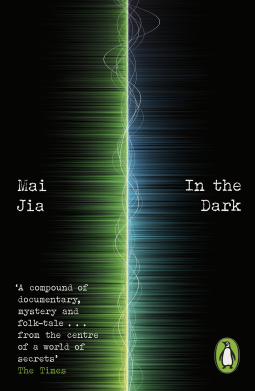
In the Dark
with Christopher N. Payne (Translator)
Sign In or Register Now to see if this title is available for request.
Buy on Bookshop.org Buy on WaterstonesSend NetGalley books directly to your Kindle or Kindle app
1
To read on a Kindle or Kindle app, please add kindle@netgalley.com as an approved email address to receive files in your Amazon account. Click here for step-by-step instructions.
2
Also find your Kindle email address within your Amazon account, and enter it here.
Pub Date 27 Aug 2026 | Archive Date 23 Feb 2027
Penguin Press UK – Allen Lane, Particular, Pelican, Penguin Classics | Penguin Classics
Talking about this book? Use #IntheDark #NetGalley. More hashtag tips!
Description
The thrilling international bestseller by 'China's answer to John le Carré' (Financial Times)
Hidden deep in the mountains, the recruits at 'Unit 701', China's secret services, operate in a dark, shadowy world. There is the 'wind-listener', a blind surveillance officer who can hear sounds from miles away; the beautiful, unstable maths genius who meets a violent end; the old man who deciphers codes in his dreams; the spy who recounts a dangerous mission from beyond the grave.
In this story of conspiracies, geniuses, revolutionaries and terrible moral choices, people sacrifice everything for a world of secrets - until, ultimately, it destroys them.
Available Editions
| EDITION | Other Format |
| ISBN | 9780241811382 |
| PRICE | £10.99 (GBP) |
| PAGES | 464 |
Available on NetGalley
Available to Buy
Buy on Bookshop.org Buy on WaterstonesAverage rating from 1 member
Featured Reviews
 Lysandra M, Reviewer
Thanks to Penguin Press UK/Penguin Classics and NetGalley for the ARC! The review is personal and unaltered by external factors.
5/5
“In the Dark” by Mai Jia is a collection of novellas presented under the form of declassified files of “Unit 701” uncovered and redacted through investigative journalism. The journalist in question (who “coincidentally” has the same name as the author) presents his sources before every declassified file and states his form of research — primary sources under the form of interviews, journal entries, letters. The novellas are intercalated and all share a common leitmotif — patriotism, love for the Party, the country, the people, even at the cost of one’s life. A painful yet beautiful devotion. All events presented in the declassified files occurred during the Cold War, during periods of time of historical importance.
“I made her swear an oath (that she would keep this a secret and never let anyone else know) in front of a statue of Chairman Mao.”
I will mention firstly that are certain nuances in the prose and exposition which are incredibly subtle and I am unsure if someone who has no experience with communism can easily detect them. Nonetheless, their sprinkled presence throughout the entire book is delicately and sensibly executed, managing to capture a certain nostalgic feeling from those in the know. If one still lives under communism, I would daresay the sentiments regarding certain societal aspects are even more intense, as the occurrences are still a part of reality.
“If you’re talking about love, that’s the very greatest kind of love. It is the living embodiment of our love for the country, our love for the Party, our love for the people, and for Communism.”
I will focus briefly on each declassified file. Each file has a central hero/ine of a certain leftist progressive nature; the overall book has a patriotic and innovative framing in regards to its protagonists.
>> Wind Listeners • Blind Abing
Lu Jiabing is a blind and intellectually challenged young man with a very keen sense of hearing. Upon news of his talent reaching Director Qian of Unit 701, he had to recruit Abing for a particular mission which involved the urgent discovery of 86 stations and 1516 frequencies of X Country. His brilliance in the domain overwhelmed the entire Unit, the blind man identifying also tonal variations and operators’ traces, which he describes as “fingerprints”. His life after success was as the golden boy of the Unit and a hero of the people and consequently, the Party had decided to reward him with a marriage.
“Well, at that time, in Unit 701, we considered marriage and other things of that nature to be all part of the revolution: there was no separation between our private and collective lives. What’s more, this type of belief – faith, really – filled our lives with an incomparable sense of warmth and belonging.”
However, as brilliant as blind Abing was, he was still childlike in mind, not prepared for such a step forward in his life. His genius had made him even more so tender-hearted, and upon reaching disillusionment with his personal life, the man’s mind shattered completely. He had given everything best of himself to the Party, but the reward had ultimately broken him. Director Qian however, an almost fatherly figure to Abing, does him justice.
>> Wind Readers • An Angel with Problems
The second declassified file focuses on Huang Yiyi, a brilliant mathematician, and “the only woman cryptographer ever to have become a Bureau Chief in the history of Unit 701”. Her story is presented strictly from Director An’s perspective, under the form of a monologue rather than an interview, and focuses on how he managed to get to know Yiyi, recruit her and ultimately work with her as her superior. An Zaitian, an undercover agent in Moscow at a time when Sino-Soviet relations are becoming more and more tense, is recalled to Beijing to aid and monitor as Deputy Director of Unit 701 and the head of the team deciphering RECOVERY, a high-level cipher used by Chiang Kai-shek and Taiwan. Recently widowed, Zaitian focuses on his work, making it his priority to find the best mathematician to join the team.
“I suddenly noticed there were a couple of people sitting on one of the sofas. One of them was a woman who stared at me with bold, hot eyes, with something of the air of a femme fatale. She must have been about thirty, maybe a little bit older, and her lips were painted deep red. She wore a narrow-striped black and white Lenin suit, and her hair was tied back with a white scarf, somewhat in a Western style. She looked just like a spy in a film.”
Huang Yiyi, an University Mathematics Professor, catches the eye of Zaitian, not only due to her looks but also due to the fact that her passion for Mathematics is genuine, borderline obsessive. She is especially interested in the tests he prepared as part of his recruitment process and imposes herself upon him, wanting to solve them as quickly as possible. She loves her profession, but stands out due to her more bourgeois tendencies — she is an archetypal femme fatale, never modest, bold, a bit cheeky and not at all what the Party envisions for both a professor and a cryptographer.
“Whether you consider her intelligence, her abilities, her position, or her good looks, they were all amazing: she was absolutely dazzling. That kind of woman is very special – you might happen across one but you are not going to find one by looking for her. But at the same time I could sense a kind of evil spirit in her, passionate, coquettish, obsessive, daring, bitter, dissolute, selfish, fearless, contemptuous of all authority – shameless, like a witch.”
Upon taking up her new role, Yiyi falls to extremes. She either does not work at all or overworks herself to the point of exhaustion. She is very passionate about her work, but her behaviour falls short of spectacular. She is moody, whiny, clingy towards Zaitian, and falls into the mental trap that she cannot decipher Code RECOVERY because she is not loved.
“Zaitian, I really don’t know what to say . . . I know I shouldn’t be here now demanding your love . . . I should wait until we’ve cracked RECOVERY . . . but, Zaitian, this failure was a terrible setback for me. God isn’t helping me, God isn’t on my side . . . I ask myself all the time, why? Why isn’t God helping me? And it’s because I haven’t made you love me . . . Someone who isn’t loved by a man can’t hope to be loved by God . . . Zaitian, believe me, I love you, I need your love . . .”
Zaitian constantly rejects Yiyi but still remains extremely possessive of her, creating a very toxic dynamic between the two of them. Finally realising she cannot get him to admit that he genuinely cares for her, Yiyi drowns herself in work, finding the love she needed to reach divine inspiration in other places. Because she is a favourite of the Party, considering her genius and contributions for the country, Yiyi behaves in a very libertine manner, having several affairs. Others blame it on the fact that she had previously studied in the USA, so she became of a different nature there, and this liberal aspect of her had made me think she could actually be on Taiwan’s side — however it proved to be that it was her own undoing. For no matter what acts of bravery and heroism one does for their country, not even the best protection can stop karma from occurring.
Her descent into frivolous behaviour had ultimately cost Yiyi her life.
“Yiyi, this is an invisible battle line, but it’s crucial for preserving the security of the Party and our country, and having chosen it, we have chosen a revolutionary life. That means that personal advantage, hopes, ideas and our futures don’t matter any more; they are all subordinate to the necessities of the revolution. A revolution demands sacrifices, it demands discipline, it demands selflessness – that you forget about yourself. Every individual has to throw themselves wholeheartedly into the revolution, to make it even more glorious, even more brilliant.”
>> The Shadow of Chen Erhu
The following declassified file focuses on the intertwined fate of cryptographers Chen Erhu and his disciple Shi Guoguang. It is narrated under the form of journal entries and letters, revealing the events following Chen’s death, but also how his career connected him with his most cherished protégé. There is a leitmotif of a shadow in this novella, starting from the shadow of the man Chen used to be, and how Shi will always be in the shadow of his shifu.
“In such a short period of time, life had become a burden to him, something unbearable. He would spend the whole day shut up in his room, reduced to a shadow of his former self as he paced up and down.”
After his retirement, Chen fell into a depression which evolved into a mild dementia. His two children had tried everything in their power to please their father, find him a new purpose, first under the guise of the game of go, and later on, during his tumultuous period, taking care of him and even seeking the aid of his former superior at work. Considering the horrible state of his mind, Chen was taken back to the Unit, where he spent his last days happy — as a cryptographer. His mind was previously breaking because it had nothing to do after stopping work.
“In order to crack a cipher all that is needed is the faintest trace of rationality to it. If such logic exists, then its door can be found and eventually prised open. Who is most suited to this kind of work? Again, it’s a madman, and that’s because decrypting is the other side of the coin. In fact, when all is said and done, encrypting or decrypting is the kind of work that is very much akin to insanity.”
Following the letters of his children, Shi reveals his complicated past with Chen. Due to their close proximity and the nature of their work, they often had to sleep in the same quarters. During those times, Shi found out that Chen was talking in his sleep, his mind never ceasing to work, constantly decrypting transmissions. Shi took notes and eventually cracked the code FIRE, decrypting it through the aid of Chen’s sleep-talking analysis. When confessing to Chen about this, he does not believe Shi and questions the veracity of the fact on the base that Shi has no proof aside from his notes, such as a recording. Shi is shamed by the fact that he did not think of that, but insists it is the truth. The credit for the decryption is given primarily to Chen, as the more superior expert, and Chen lives with a heavy heart due to this until his final days, when he confesses to his superior. Now Shi lives in the shadow of Chen, knowing his beloved master has died still tormented by the event.
“In the world of cryptography, there is nothing that can be seen by the naked eye. Whatever you see with your eyes is not what you think it is, you certainly are not you, I certainly am not me, the table certainly is not a table, the blackboard certainly is not a blackboard, today certainly is not today, the sunshine certainly is not the sunshine.”
>> Wind Catchers • A Vietnamese Ghost Story
This story focuses on the period of time China had focused on the ‘resist America, aid Vietnam’ movement, with several agents of China being sent to Vietnam in its aid, including Mr Lü. Our investigative journalist discovers a mysterious figure is Mr Lü’s declassified journal, and finds out Vĩ Phu’s story, from several sources, and decides to retell it from the perspective of Vĩ Phu’s ghost, giving it an eerie atmosphere. The shortest novella of this book, this is also the one most tailored to the espionage thriller genre. Vĩ Phu, a young man who had recently recovered from tuberculosis, joins the army for the sake of the country and the Party, and his fate meets with tragedy. Nonetheless, his story does not finalise with his death, for he servers a noble purpose even after meeting his end.
“I told her I wasn’t H ồ Hải Dương. I told her I was Vĩ Phu. Vĩ Phu!”
The prose of the entire book is generally straight and to the point, suiting the espionage genre, but in Chinese fashion, it is laced with metaphors and thought-provoking proverbs and fables. It is also quite dense at times, focusing a lot on the existentialist philosophy of both espionage and cryptography.
I would particularly recommend this to people who enjoy reading declassified files and investigative journalism — while it is a collection of short stories, it holds a lot of subtle details of life under communism will allow the Western reader who has no experience with the regime to gain a sense of the general atmosphere, should they pay close attention to what is between the lines. I don’t know if I would recommend this to John le Carré’s fans alone; to me, this felt more like the work of the secondary characters surrounding Ian Fleming’s James Bond. While of a different nature, all agents involved in this book had a certain element of his.