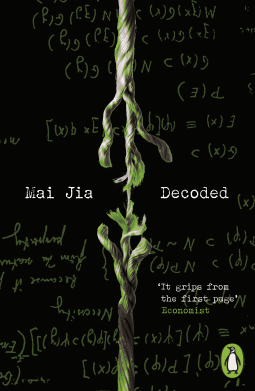
Decoded
A Novel
with Olivia Milburn (Translator); Christopher N. Payne (Translator)
Sign In or Register Now to see if this title is available for request.
Buy on Bookshop.org Buy on WaterstonesSend NetGalley books directly to your Kindle or Kindle app
1
To read on a Kindle or Kindle app, please add kindle@netgalley.com as an approved email address to receive files in your Amazon account. Click here for step-by-step instructions.
2
Also find your Kindle email address within your Amazon account, and enter it here.
Pub Date 27 Aug 2026 | Archive Date 23 Feb 2027
Penguin Press UK – Allen Lane, Particular, Pelican, Penguin Classics | Penguin Classics
Talking about this book? Use #Decoded #NetGalley. More hashtag tips!
Description
The international bestseller by China's foremost thriller writer
Decoded tells the story of Rong Jinzhwen, one of the great code-breakers in the world. A mathematical genius, Jinzhen is recruited to the cryptography department of China's secret services, Unit 701, where he is assigned the task of breaking the elusive 'Code Purple'. Jinzhen rises through the ranks to eventually become China's greatest and most celebrated code-breaker; until he makes a mistake. Then begins his descent through the unfathomable darkness of the world of cryptology into madness.
Decoded was an immediate success when it was published in 2002 in China. Taking place in the shadowy world of Chinese secret security, where Mai Jia worked for decades, it introduces us to a place that is unfamiliar, intriguing and authentic. And with Rong Jinzhen, a character who is deeply flawed yet possessing exceptional intelligence, it tells a gripping story of genius, brilliance, insanity and human frailty.
Available Editions
| EDITION | Other Format |
| ISBN | 9780241811375 |
| PRICE | £10.99 (GBP) |
| PAGES | 384 |
Available on NetGalley
Available to Buy
Buy on Bookshop.org Buy on WaterstonesAverage rating from 1 member
Featured Reviews
 Lysandra M, Reviewer
Thanks to Penguin Press UK/Penguin Classics and NetGalley for the ARC! The review is personal and unaltered by external factors.
5/5
“Decoded” by Mai Jia is a historical espionage novel set during the period of World War II and the Japanese occupation of China and during the times that followed, after the war finished and the new regime had settled in. Before I comment on anything else, coming from a former communist country and having had experienced everything that entails, I highly appreciate the delicacy and fine sensibility with which Mai Jia depicts the earlier days of the communist regime — they are portrayed as neither bad nor good, but merely as a fact which occurred, a reality nobody can deny, and this whispered realism reveals an impact with such a finesse that is quite rare to witness in contemporary authors. I am unsure if this sophistication in his exposition is noticed by those who had no personal experience with such a regime or ideology — again, it is something whispered not shouted, but its impact serves its purpose to the “correct” crowd. It is there. That is what matters.
“[…] a couple of months earlier, the remnants of the family property at Tongzhen had been seized in the Land Reform, and the only thing that was left in their possession was a few ramshackle buildings in the old mansion. One commercial property remained in the provincial capital, but a few days earlier at the welcome ceremony for the new mayor, Young Lillie (as a member of a well-known patriotic family) presented it to the People’s Government of C City as a sign of his support for the newly established People’s Republic of China. The decision to select such a public occasion for making the gift might seem like he was currying favour but in fact this was not the case – it was the recipients who decided it should be done this way. Furthermore, he agreed with their reasoning that it would set an example encouraging other members of wealthy and socially prominent families to support the new government.”
That being said, the novel focuses on the life of Rong Jinzhen, an autistic mathematical genius, and is presented under the form of investigative journalism, done by our objective author who now and again interferes with commentary about his own circumstances and explanations regarding the methodology used upon doing his research, which consists of primary sources under the form of both interviews and journal excerpts of Jinzhen. What is to be appreciated most about the structure of the novel is that Mai Jia doesn’t go into the mind of Jinzhen — when authors show a perspective of a genius character, sometimes it ruins the brilliance of said genius. Instead, through outsider standpoints, we as readers get to see Jinzhen shining like the Sun. He is brilliant from start to finish and I have deeply enjoyed that depiction of a genius.
“[…] he was like a god, he had created everything; he was also the devil, the destroyer of all things, including my own mind. Standing in front of this man, I felt devoted, awed and terrified; through and through I felt the need to prostrate myself in front of him.”
However, the novel is quintessentially progressive in nature, showing us a genius who also suffers from several medical conditions. His humanity is not completely forgotten. Coming from an originally rather rich family, Jinzhen was born an orphan, and was initially raised by a foreign employee/friend of the family, an interpreter of dreams, Auslander, who mainly taught Jinzhen in English and also shared his Christian faith with him. Even after Auslander’s death, Jinzhen remained a Christian, having been witnessed reading the Bible very often, if not daily. After his adoptive father’s death, Jinzhen was taken in by his great-uncle, a Mathematics Professor at the University the Rong family founded. Through this opportunity given to him by Young Lillie (his great-uncle), Jinzhen becomes fluent in Chinese, attends school and university, and experiences the proper life of a loved child within a warm family. In fact, Young Lillie own love for Jinzhen shines throughout their relationship, being the one to name the boy in the first place, and his hopes for the child being very gentle and genuine, full of parental love.
His genius mind is soon discovered by Mathematics Professor Jan Lisiewicz, a Jew employed at the family’s university due to the circumstances of the Second World War. Lisiewicz soon takes Jinzhen under his wing, and from this stems a very complex and intriguing relationship between the two. There’s a mentor/mentee relationship, but Lisiewicz’s feelings at times turn especially fatherly. I don’t want to spoil, but Lisiewicz is perhaps the most layered character in the novel. His character arc has several twists and turns, all very entertaining, but regardless of all the controversies, one aspect is crystal clear — Lisiewicz wanted Jinzhen to work with him, to nurture his brilliance and to further discover and establish new innovations in the field of artificial intelligence. He saw Jinzhen as a diamond from the very start and never hid this for one moment. His appreciation and awe was always genuine.
“The world has changed, people are becoming more and more short-sighted and profit-orientated; they want to see some immediate and concrete benefit and are less and less interested in topics of purely theoretical application. This is completely stupid. It is no less stupid than entirely subordinating pleasures of the mind to those of the body.”
Following the end of the Second World War and Jinzhen becoming an influential mathematician who works in classified artificial intelligence research, he is then recruited by the Secret Services. Who they belonged to — the government, the army, the police — is an ongoing mystery throughout the entire novel and it is quite fun. In addition, the mystery of country X’s identity was a fun twist, particularly for those who don’t know which country used Code PURPLE in real life. I was a bit disheartened when Lisiewicz let it slip in one of his letters which real country Country X is, nonetheless this ongoing censorship of locations throughout the novel was very entertaining — it felt like the investigative report was properly checked and censored by the Services. Very witty writing technique.
“‘Look outside,’ said Zheng the Gimp.
‘They aren’t getting the kind of quality of food that you are eating; and they only have rice gruel to drink.’
Jinzhen raised his head and looked over. The people outside were all holding bowls, but he had been given a cup. There was milk in his cup.
‘Do you know why?’ asked Zheng the Gimp.
‘Is this some kind of special welcome?’
‘No. It is because your work is much more important than theirs.’”
Throughout his work as a cryptographer, Jinzhen becomes a national hero. His own status brings numerous benefits for his family, saving them from peril. He cracks Code PURPLE in record time, and gains the respect and recognition of not only the entire department, but the Party and the government. He is never without a security guard by his side. His brilliant mind helps the country, the people, and keeps them all safe.
“The fact is that Rong Jinzhen was a genius – there were many things about him that an ordinary person simply could not understand. He could go for months, maybe as long as a year, without saying a word to anyone – it really didn’t seem to bother him – but when he did finally open his mouth, he would say something that quite possibly was more important than everything you have said in your entire life put together. Whatever he did, it seemed as though he did not care about the process at all, the only thing that mattered was the result. The results of what he did were always perfect – it was amazing! He seemed to have an uncanny ability to get to the crux of the matter, but the way that he went about it was unique, peculiar; something that you would never have thought of in a million years.”
However, every genius has his downfall. For Jinzhen, it started with Code BLACK, the successor of Code PURPLE. It is not as easy for him to decode this one, and Jinzhen’s newly found responsibility as a repercussion of his success becomes a severe source of anxiety for him. Ultimately, the events surrounding the decoding of Code BLACK are what bring Jinzhen’s mental downfall — while he does solve the problem, he loses himself to the darkness. His brilliance had cost him his very own sanity.
“A genius is the spirit of this world, there are few but they are the finest of humankind, they are noble, they are to be treasured. Like any other treasure in this world, they are delicate, fragile as a newly planted bud; once hit they crack; once cracked they fracture. These words hit Rong Jinzhen like a bullet . . .”
The depiction of insanity is beautifully written by Mai Jia, showing complexity in Jinzhen’s character — his relationship with faith and God, his struggle with darkness and his own loneliness, for nobody could truly actually understand him and the workings of his mind. He is alone in deciphering the most challenging code known until that point.
“They cannot see your intellectual magnificence, and if they did, they would only be afraid of it. But I cannot understand nor trust their reasoning. To appreciate something that is truly beautiful requires courage and talent; without this, beauty can only terrify.”
The prose is relatively simple yet sprinkled with poetic metaphors when one least expects it; it is however quite dense, condensing a lot of information regarding the theory of mathematics and cryptology, along with the philosophy and emotions surrounding the subjects. Nevertheless, there is never a dull moment, for the exposition is done in accordance to the requirements of a thriller. The execution is flawless.
Regarding the overall style, there were two authors who kept popping into my mind as I was reading. In terms of genre and atmospheric approach and everything that encompasses, John le Carré. The manner in which this book was structured through interviews and investigations however made me think a lot of Anne Rice, particularly her novel “Interview with the Vampire”. I personally would recommend this book to fans of both those authors, because the stylistic choices Mai Jia makes would please both.