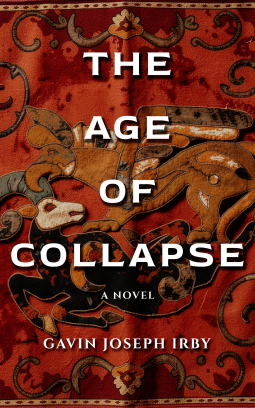
The Age of Collapse
This title was previously available on NetGalley and is now archived.
Send NetGalley books directly to your Kindle or Kindle app
1
To read on a Kindle or Kindle app, please add kindle@netgalley.com as an approved email address to receive files in your Amazon account. Click here for step-by-step instructions.
2
Also find your Kindle email address within your Amazon account, and enter it here.
Pub Date 4 Sep 2026 | Archive Date 27 Aug 2026
KDP | Independently Published
Talking about this book? Use #TheAgeOfCollapse #NetGalley. More hashtag tips!
Description
The port city of Kalathon — jewel of the civilized world. For generations, its wealthy rulers have used the patient arts of bribery, marriage, and betrayal to keep the warlike nomads of the steppe divided. When a powerful clan leader threatens this order, Kalathon’s king executes a ruthless plan to defeat the nomads, taking the clan leader’s daughter as a prize.
But the king's prize is more dangerous than he ever imagined.
As she turns the king’s sons against each other and a horde of nomads gathers outside the gates, the woman who was meant to be a trophy plays Kalathon’s own game more skillfully than the men who seek to possess her — the only question is who will be left standing when the dynasty burns, and what kind of ruler will inherit the ashes.
Lush, mythic, and steeped in the texture of a vanished world, The Age of Collapse is an epic of empire, devotion turned to ruin, and the founding of a new age. For readers of Madeline Miller, Guy Gavriel Kay, and Mary Renault — a debut that reads like a myth recovered from the deep past.
Available Editions
| EDITION | Paperback |
| ISBN | 9798244502435 |
| PRICE | $12.99 (USD) |
| PAGES | 312 |
Links
Available on NetGalley
Available to Buy
Buy on Amazon Buy on Bookshop.org Buy on WaterstonesAverage rating from 5 members
Featured Reviews
 Alena B, Reviewer
This one definitely had me thinking! I really enjoyed the darker, almost unsettling feeling throughout the story and the way it explored what happens when everything we consider "normal" starts falling apart. There were moments that genuinely made me wonder what I would do in the same situation.
The pacing slowed down a little for me in places, but the overall concept kept pulling me back in. I especially liked that this wasn't just about surviving chaos; there was a lot going on with the characters and how people change when they're pushed far enough.
 Libby K, Reviewer
Thanks to NetGalley for the ARC!
Steeped in history and rich in cultural detail, The Age of Collapse is historical fiction as full of twists, turns, betrayals, and negotiations as any political thriller set in the modern day. Occupying a world at once familiar and alien, Irby deftly plays his cast of characters off against each other, each angling to secure their win until the reader isn't sure who they really want to come out on top. Though I felt it could have benefitted by having a little meat added to the bones in some places, this novel was still a really gripping read.
Irby is great at immediately setting the stakes for his world and characters, both in the framing narrative, where we find an American professor talking for his life to try and convince a Russian officer he's not a CIA agent, and in the main story, where he immediately sets up the brewing conflict of interests between the port city of Kalathon and the nomads of the steppe. Throughout the book, everything is centred on throwing up conflicts related to this central concept - who will rule Kalathon? Who will control the flow of trade? Who will Aushalun marry? - which makes the whole plot feel cohesive, and provides a huge draw to keep reading to find out how everything resolves. I was totally gripped by the political thriller twists and turns, and had multiple moments where I suddenly realised how something that had been set up previously was going to be drawn to a satisfying conclusion later in the story.
The characters were also all really interesting, with their own distinct personalities, strengths, and flaws. Irby didn't give in to the common pitfall of sweeping historical epics where the author tries to juggle hundreds of characters at once; he introduces us to a select set of characters, the movers and shakers who drive the narrative forward. My favourite by far was Aushalun; I have to admit that I'm 100% subscribed to the legend of Empress Aushalun. I enjoyed her revenge story and political ascension plot so much! I almost wished the whole book was from her POV, though I think Irby made the correct choice to switch POVs to relevant characters for each section, which also helped deepen our understanding of each character. One thing I really liked about the way Irby wrote Aushalun is that her power wasn't just taking on the martial role of a man, but utilised her own skills as a dancer and a politician, as someone who deeply understood the people around her. I also liked that this didn't mean she was immune to failure, as with her misinterpretation of what her father wanted her to do with Muhangzeb, and leaving Yaksoila alive at the end. My absolute favourite scene was her dance where she symbolically becomes a daughter of Death, the clever way Aush ties symbolism and religious belief to political matters. I could totally see that scene before my eyes!
The setting was also really interesting, and rich with historical detail. I felt like I ended the book really understanding the world in which the Elani and the steppe people lived. The idea of humans domesticating older, now extinct species was so cool! I believe the big cats were supposed to be sabertooth tigers, though I couldn't identify the others. I was also super interested in the so-called "titans" who built megastructures and then disappeared, and I do wish we'd had a little more explanation as to who they were supposed to be, maybe in the framing narrative. I believe Irby has also constructed two different conlangs (or has enough knowledge of real historical language to build plausible variants, I'm not sure) which is super impressive!
The only thing I think this story really needed was a bit more room to breathe in certain places. It was very enjoyable as it was, but in places the pacing was really sharp and well done, while in others it felt a bit like the plot of an epic fantasy novel had been squeezed down. The section with Isaiyat's kingship is a good example; I felt like we needed to see a bit more of him actually acting as king to really believe he wasn't very good at it, or actually see some of his bad choices (of action, of supporters, etc.) to get a sense of his failure as king.
Something that didn't help was that there were several places where the story felt like it was telling too much, rather than showing. In places, I felt like I was reading a summary of the book, or the author's planning notes. There were places where the narrative felt overloaded with historical, worldbuilding, and geographical details all at once in a rush, especially in the first chapters. This does do a lot for the sense of atmosphere and rich historical detail, but it was a noticeable pattern that every time the characters entered a new space, or a new scene began, the narrative would stop dead to describe everything around them in detail. Also, these descriptions always had noticeably little variation in sentence length; it was always a sequence of relatively short, single phrase sentences. I was conflicted about this, because I did like getting all these details! The richness of detail included was great, but I just wonder if it could have been weaved better into the narrative. In fact, I felt the action and dialogue were often a little more snappy in the framing narrative scenes, with the descriptions integrated better.
Also I guess this is a fairly small nitpick, but I was left wondering why the title was 'The Age of Collapse.' I assume this refers to the Bronze Age Collapse, but it felt a little unfitting for the novel, as by the end of the story we didn't get hints of such a major collapse, and Aushalun actually built a new empire.
Overall though, I really enjoyed the characters, plot, and historical setting of this novel. I had a good time reading The Age of Collapse, and would definitely recommend others pick it up!
 Hazel G, Reviewer
This was such a compelling and atmospheric read! 👑⚔️
I loved the rich, mythic feel of the world and the layers of political intrigue, betrayal and shifting power. The story kept me invested as alliances fractured and the fate of an entire dynasty hung in the balance.
Dark, immersive and beautifully dramatic, this was a fantastic debut that feels like an old legend brought back to life. ✨
Readers who liked this book also liked: