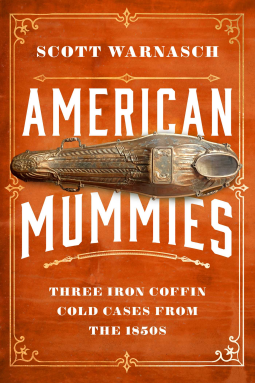
American Mummies
Three Iron Coffin Cold Cases from the 1850s
Sign In or Register Now to see if this title is available for request.
Buy on Bookshop.org Buy on WaterstonesSend NetGalley books directly to your Kindle or Kindle app
1
To read on a Kindle or Kindle app, please add kindle@netgalley.com as an approved email address to receive files in your Amazon account. Click here for step-by-step instructions.
2
Also find your Kindle email address within your Amazon account, and enter it here.
Pub Date 4 May 2027 | Archive Date 7 May 2027
Globe Pequot | Lyons Press
Talking about this book? Use #AmericanMummies #NetGalley. More hashtag tips!
Description
American Mummies explores life in the first half of the nineteenth century from a unique perspective, combining American history with cold case investigation. The three mummies—discovered in Egyptian-looking iron coffins that naturally preserved their remains—aren’t the relics of defunct ancient empires; they died in New York and New Jersey in the 1850s. Yet their stories crackle with accounts of life and death during a critical period in our country’s history when fundamental decisions regarding race, sex, and power were becoming encoded into the nation’s DNA. The diversity of their experiences—Black, White, male and female—presents a vivid cross-section of everyday life from over 175 years ago, while the integration of forensic science, archaeology, and genealogy offer granular details—even capturing fleeting glimpses of the mummies’ final hours among the living.
Recounted by the former forensic archaeologist who found them, the mummies’ shocking discoveries and painstaking identifications lead from abandoned burial plots to morgues, labs, and funeral homes. Assisted by experts from the Smithsonian Institute, the NYC Medical Examiner’s Office, and various universities, the meticulous analysis and research weave the deceased’s lives, families, and social networks into a tapestry of interconnections, tragedies, and triumphs.
Their stories brim with riots, fires, jailbreaks, and contagions, offering both local details and wide vistas of a seminal and dangerous period in American history. And the curious circumstances surrounding their discovery pull back the muddied veil of the dead’s place in the urban landscape, raising key questions like: How long does one get to rest in their grave? Who decides when that time is up? And what happens then?
Advance Praise
“A fascinating detective story of mummies, coffins, smallpox, and American social life of 150 years ago—and it’s all true. Warnasch gives us a great story of forensic archaeology in a crisp, colorful prose that reads like a mystery novel. Whatever he does next, I want to read about it.”
~Barbara Butcher, author of What the Dead Know
"If you enjoy digging into a David McCullough history lesson or watching old episodes of Dr. G: Medical Examiner then American Mummies is your next read. Rich with historic detail, Scott Warnasch manages not only to solve the mysteries but also to bring the cases to life."
~Todd Harra, author of The Embalming Surgeons: Lincoln’s Body, Morbid Science, and the Birth of Modern American Death Rituals
“This absorbing account explores the lives of three Americans—one man and two women—identified in death and discovered hundreds of years later undisturbed in their sealed iron coffins. Their bodies and biographies provide compelling narratives about life in a newborn nation. In this deeply researched book, archaeologist Scott Warnasch plays the role of detective and brings you along as he almost literally unravels three American mummies. Find out who they were, how they died, and why they were placed in iron coffins for burial rather than in wood. Most important, what can their life and death tell us about the America we know today?”
~Andy McPhee, author of The Doctors' Riot of 1788: Body Snatching, Bloodletting, and Anatomy in America
Marketing Plan
The strongest publicity hook is irresistible: these aren’t ancient Egyptian mummies—they’re 1850s Americans whose remarkably preserved bodies became real-life cold cases. American Mummies combines the suspense of forensic investigation with American history, archaeology, genealogy, medicine, and the macabre. That gives the book unusually broad media potential and, importantly, access to the enormous true-crime audience. Edison Research estimates that 84% of Americans age 13+—roughly 230 million people—consume true-crime content through television, podcasts, YouTube, social media, or other formats.
Scott Warnasch is uniquely qualified to tell this story because he actually discovered, analyzed, and identified the three people at the center of the book. He is a professional archaeologist with more than 30 years of experience, a leading expert on iron coffins, and served as the primary forensic archaeologist for New York City and senior anthropologist of the World Trade Center Office at the NYC Medical Examiner’s Office. Rather than simply pitching him as an author discussing historical mysteries, we will offer media a forensic archaeologist walking audiences through exactly how a forgotten human body becomes an investigation—and how science, archives, genealogy, and physical evidence can restore that person’s identity. National targets include NPR, PBS NewsHour, Smithsonian, National Geographic, Scientific American, Popular Science, Atlas Obscura, HISTORY, and major newspaper feature sections.
Forensic science gives us an especially strong way into the true-crime market. Edison found that 48% of true-crime podcast listeners say they are drawn to the forensic science behind cases, while 50% enjoy trying to solve the mystery themselves. That is almost exactly the reading experience American Mummies delivers: mysterious remains are discovered, investigators determine who these people were, and their identities gradually emerge through forensic evidence and historical research. Podcast targets will include Buried Bones, Morbid, Criminal, and other forensic, historical-crime and mystery shows, alongside archaeology and science podcasts.
The book already has a proven television story to build on. Warnasch’s investigation of the Queens mummy became the PBS Secrets of the Dead episode “The Woman in the Iron Coffin,” which follows the forensic investigation and identification of the woman believed to be Martha Peterson and explores New York’s nineteenth-century Black community. We should return to PBS/WNET around publication, while also using the existing episode as a powerful credential when approaching television producers, podcasts, reviewers, and digital media: this is a story that has already demonstrated strong visual and documentary appeal.
2027 gives the Queens story an important historical-news hook. The year marks 200 years since New York’s 1827 emancipation law took full effect; the National Park Service reports that roughly 4,600 people became free on July 4, 1827. American Mummies then takes readers into the lives of Black New Yorkers in the decades immediately following emancipation. That creates strong opportunities around Black History Month, the 2027 bicentennial, Juneteenth, and July 4, with outreach to Black-history, New York-history, public-radio, museum, educational, and general-interest media. The messaging should focus on what forensic archaeology and genealogy can reveal about the lives of ordinary free Black Americans whose stories rarely entered traditional historical narratives.
Genealogy provides another substantial audience that may not initially think of itself as a true-crime readership. An Ancestry survey found that 66% of Americans want to learn more about their family history, and American Mummies shows genealogy functioning almost like detective work—using censuses, burial records, family relationships, historical documents, and scientific evidence to put names and life stories back onto unidentified remains. Outreach should include Family Tree Magazine, FamilySearch, genealogy societies and newsletters, and podcasts such as Extreme Genes and Genealogy Gems.
The New York/New Jersey regional story is exceptionally strong—and already has demonstrated viral potential. The three subjects died in New York and New Jersey, the Newark mummies were discovered during construction of the Prudential Center, and Warnasch already has a relationship with NJ.com. Recent content about the Newark mummies generated approximately 300,000 views and 20,000 shares on TikTok and Instagram, giving us proof that this story can break out beyond traditional book media. We will pursue NJ.com, New Jersey Monthly, Gothamist/WNYC, New York Magazine, Queens and Newark media, regional television and radio, and local-history outlets. The “Are the mummies beneath the Prudential Center haunting the Devils?” angle can also be revived opportunistically during hockey season as a highly shareable gateway into the book.
The visual and social-media potential is unusually strong. Iron coffins that resemble Egyptian sarcophagi, forensic reconstruction, nineteenth-century photographs and documents, burial sites, scientific analysis, and the circumstances of the discoveries all lend themselves to compelling short-form content. Channels like Facebook's Funetorium audience of approximately 110,000 followers give us an existing platform for videos explaining questions such as Why didn’t these bodies decompose? What exactly is an iron coffin? How do you identify a person dead for 170 years? What happens legally when a body is discovered during construction? These are strong hooks for TikTok, Instagram Reels, YouTube Shorts, and media-created social video.
History media can take the book well beyond the mystery of the bodies themselves. These three lives open a window onto the turbulent America of the 1850s—race, gender, epidemics, burial customs, urban development, riots, fires, crime, and the everyday realities of life before the Civil War. Targets include Smithsonian, HistoryNet, American History, history podcasts such as Stuff You Missed in History Class, American History Tellers, and The Bowery Boys for the New York material.
The campaign should ultimately position American Mummies as much more than a book about unusual burials. It is three real cold cases in which the detective is also the archaeologist who found the bodies. Every identification leads into a larger American story, and the three subjects—Black and White, male and female—allow Warnasch to reconstruct a cross-section of life more than 175 years ago. The strongest pitch is the transformation at the heart of the book: three anonymous bodies emerge from the ground, and forensic science, archaeology, and genealogy give them their names—and their stories—back.
Available Editions
| EDITION | Hardcover |
| ISBN | 9781493003006 |
| PRICE | $29.95 (USD) |
| PAGES | 272 |