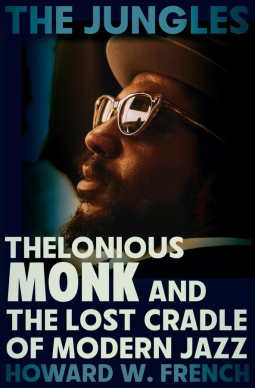
The Jungles
Thelonious Monk and the Lost Cradle of Modern Jazz
Sign In or Register Now to see if this title is available for request.
Buy on Bookshop.org Buy on WaterstonesSend NetGalley books directly to your Kindle or Kindle app
1
To read on a Kindle or Kindle app, please add kindle@netgalley.com as an approved email address to receive files in your Amazon account. Click here for step-by-step instructions.
2
Also find your Kindle email address within your Amazon account, and enter it here.
Pub Date 2 Feb 2027 | Archive Date 31 Jan 2027
W. W. Norton & Company | Liveright
Talking about this book? Use #TheJungles #NetGalley. More hashtag tips!
Description
A hidden history of twentieth-century American modernity that re-examines a mere twelve-block area on Manhattan’s Upper West Side with Thelonious Monk as its guiding star.
The Jungles reclaims the largely forgotten world of San Juan Hill, a predominantly Black neighborhood on Manhattan’s West Side, was one of the most fertile centers of American cultural life in the twentieth century.
At once a biography, an urban history, and a cultural reckoning, Howard W. French’s The Jungles reveals how the neighborhood that would encompass Lincoln Center, previously known as the Jungles, fostered numerous pathbreaking Black artists, among them a young Thelonious Sphere Monk (1917–1982).
The story opens in Cuba in 1898, where we watch as Teddy Roosevelt’s forces triumph on San Juan Hill, with close to one-fifth of the overall invading force consisting of Black soldiers whose valor went largely unrecognized. After returning to the US, these veterans joined a broader wave of Black migrants moving northward, eventually settling in a Manhattan -neighborhood that would take the battle’s name. San Juan Hill became a lively, artistic Black community that preceded the Harlem Renaissance and inspired some of the highest twentieth- century creative triumphs—giving rise to the stride piano style and nurturing the genius of Monk, whose mold-breaking artistry struggled to gain traction in an industry then dominated by white producers.
As Robert Moses began tearing down the neighborhood under the guise of “urban renewal,” Monk became its most famous holdout, staying put in his cramped apartment in the Phipps Houses at 243 West 63rd Street, his upright piano protruding from his bedroom into the kitchen as he continued to make his iconic music.
By the late 1950s, Monk’s genius had finally been recognized, but the erasure already felt irreversible, extending even to the musical West Side Story, which reimagined the neighborhood’s streets as Latino gang territory, whitewashing the predominantly Black and Caribbean community that had actually lived there.
A compelling history from one of our finest American historians, The Jungles ultimately emerges as a new way of telling the history of music, of New York, and of America. The cradle of jazz was not only in New Orleans but also in San Juan Hill, and French’s magnificent recreation of that vanished world, and of the miraculous life of Thelonious Monk, restores to American cultural memory what erasure nearly stole for good.
About the Author:
Howard W. French is a professor of journalism at Columbia University and a former New York Times bureau chief for Central America and the Caribbean, West and Central Africa, Japan and the Koreas, and China, based in Shanghai. The author of six books, including Born in Blackness and The Second Emancipation, French lives in New York City.
Advance Praise
"Like the legendary pianist whose greatness he brilliantly explores, Howard W. French...uses a highly integrated two-handed approach to deftly narrate the compelling story at the heart of The Jungles.... A bracing biography in his active left hand, and a stirring analysis of dissonant political tones in his right, French plays a robust tune of percussive social history at its finest." -Michael Eric Dyson, author of Tears We Cannot Stop
"Howard W. French’s Thelonious Monk biography is that onomatopoeia miracle of prose to music—of enraptured chords heard as we read. From a musical prodigy’s Tar Heel beginnings to Lincoln Center’s erasure of San Juan Hill, from those mean cabaret cards Jim Crowed by cops who almost killed bebop at Minton’s Playhouse to the beginnings of Monk’s long-delayed breakout at Paris’s Salle Pleyel and Monk’s final Town Hall coronation primed by a Rothschild Jazz princess—all of it rendered in a biographer’s musical epiphany." -David Levering Lewis, author of When Harlem Was in Vogue
"All those many midcentury jazz records are proving to be more imperishable with every passing year, and it is important to remember how that fabulous music came out of not just communities, but neighborhoods—meaning literally buildings, parks, and commissioner’s offices.... The Jungles is an unprecedented look at varied zip codes and architectural fashions. I never think to whistle ‘Blue Monk’ when walking through Lincoln Center Plaza, and now I know why." -Ethan Iverson, pianist, composer, and writer
"With a jazz fan’s passion and a historian’s care, Howard W. French shows us what the legendary pianist and composer of such classics as ‘’Round Midnight’ and ‘Straight, No Chaser’ owed to the lost Black world of San Juan Hill, the New York City neighborhood where Monk grew up, and where he returned to live even as it was being razed to create today’s Lincoln Center." -Mark Whitaker, author of The Afterlife of Malcolm?X and Smoketown
Available Editions
| EDITION | Hardcover |
| ISBN | 9781324097372 |
| PRICE | $31.99 (USD) |
| PAGES | 320 |