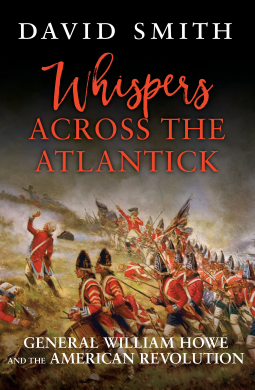
Whispers Across the Atlantick
General William Howe and the American Revolution
This title was previously available on NetGalley and is now archived.
Send NetGalley books directly to your Kindle or Kindle app
1
To read on a Kindle or Kindle app, please add kindle@netgalley.com as an approved email address to receive files in your Amazon account. Click here for step-by-step instructions.
2
Also find your Kindle email address within your Amazon account, and enter it here.
Pub Date 19 Sep 2017 | Archive Date 19 Dec 2017
Description
General William Howe was the commander-in-chief of the British forces during the early campaigns of the Revolutionary War (1775-1783). He was an enigma, who appeared on multiple occasions to be on the verge of winning the war for Britain, only to repeatedly fail to deliver the final blow.
Howe evoked passionate reactions in the people he worked with; his men loved him, his second-in-command detested him, his enemies feared him, and his political masters despaired of him. There was even a plot to murder him, in which British officers as well as Americans were implicated.
This book will be the first major work on this inscrutable British general for more than 40 years. Previously largely ignored by historians due to a lack of primary source documents upon which to draw, the author's recent archival discoveries, and ground-breaking research means that there are fascinating new insights to be told about Howe's performance during the American Revolution.
Howe's story includes intrigue, romance, and betrayal, played out on the battlefields of North America and concluding in a courtroom at the House of Commons, where Howe defended his decisions with his reputation and possibly his life on the line. The inquiry, complete with witness testimonies and savage debate between the bitterly divided factions of the British Parliament, forms the framework for the book, giving it the flavor of a courtroom drama rather than a standard military narrative history. As Howe struggles to clear his name, the titanic forces at work during the birth of the United States of America rage around him.
Available Editions
| EDITION | Other Format |
| ISBN | 9781472827951 |
| PRICE | $34.00 (USD) |
| PAGES | 256 |
Links
Available to Buy
Buy on Amazon Buy on Bookshop.org Buy on WaterstonesAverage rating from 6 members
Featured Reviews
 Andy L, Reviewer
The war with the American Colonies was a black hole for the British Officer Corps. There was a crafty enemy who didn’t play by the rules, a chronic shortage of manpower, a good chance of losing, and even victories weren’t all that valued when they were against British subjects. Some officers refused to take command positions, some did their best to avoid the duty, and yet others, for whatever their reasons, took the assignments.
General William Howe was the British Commander in the colonies from Lexington and Concord through the first two years of the war. He didn’t really lose the war during this time, but he didn’t really win it. As a result, he was not especially well thought of, and sought to clear his name in front of the British Parliament. This book is the story of his service in America, and his “trial” in front of the House of Commons.
=== The Good Stuff ===
* David Smith writes in an easy-to-read style, and avoids overly complicated sentences, long paragraphs and obscure vocabulary. The book was easy to read, and it made its point clearly. There was a minimum of direct quotations from 18th century journals, something that I always have trouble understanding very well. Even the direct quotes that are in the book seem selected for their ease of comprehension by modern readers.
* The author does his best to tell the tale from the point of view of the British generals in command. George Washington is a minor figure in the book as we concentrate on the actions and motivations of Howe, General Sir Henry Clinton, General John Burgoyne, General Cornwallis and a few lesser British Generals and Admirals. There is also enough of the correspondence between the military and political leadership (Lord Germain, Lord North) to give a feel for the conflicts and struggles between these groups.
* The book is written around Howe’s defense of his actions in front of Parliament. He was accused of being overly cautious, squandering his troops and resources, neglecting the official British strategy and of losing--- or at least not winning --- the war in two years. During this defense, we see General Howe throw his German allies under the bus, cast aspersions on other British Generals, and be abandoned by his supposed friends in the officer corps.
=== The Not-So-Good Stuff ===
* Howe either comes across as naïve, confused, and not too smart. It seems unlikely that such a person would rise to the level of theater commander in the British Army, so the reader must wonder if we just do not understand Howe’s position and motivations. He gives a less than convincing defense of his own actions and you can help but wonder if he has another agenda. Perhaps covering up for someone else, or avoiding conflict with his political masters for some future payoff, or maybe he just didn’t want to risk too many British subjects in what he felt was a “civil” war. Maybe he sees the writing on the wall, and wants to be relieved of his command before the final British defeat. David Smith abandons the readers to solve this for themselves.
* The needed material is likely lost to history, but a portrait of General Howe never really emerges. He is described as having a great temper, of being somewhat naïve in his understanding of tactics versus strategy, and we see his difficulty in dealing with talented subordinates. But the book comes up a bit short on what makes the man tick.
=== Summary ===
I enjoyed the book, and found it to be a refreshing look at the American Revolution from the other side of the battle. None of the British Generals seemed to consider Washington a master tactician, even if he did get lucky on occasion. They point out the many fundamental errors he made in the battles of Long Island, Brandywine, and others. However, as the author points out, they never quite caught on to the strategy of Washington-he could afford to lose almost every battle and still win the war, as long as he didn’t lose too badly.
Generals Giap and Westmorland would re-enact this same scenario 200 years later.
Melissa M, Reviewer
I became interested in the Howe brothers while reading “Washington’s Crossing” by David Hackett Fischer. “Whispers” is a fascinating complement to that rebel-centric volume, and focuses on the performance and politics of the British War after America declared independence. This is a very readable history, filled with personal details. I particularly liked the setting as Howe’s personal defense in the House of Commons played out at the beginning of every chapter.