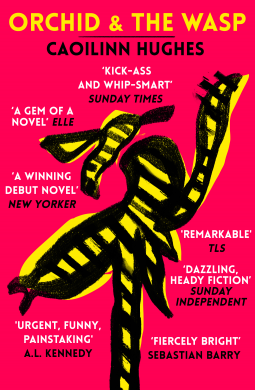
Orchid & The Wasp
This title was previously available on NetGalley and is now archived.
Send NetGalley books directly to your Kindle or Kindle app
1
To read on a Kindle or Kindle app, please add kindle@netgalley.com as an approved email address to receive files in your Amazon account. Click here for step-by-step instructions.
2
Also find your Kindle email address within your Amazon account, and enter it here.
Pub Date 7 Mar 2019 | Archive Date 27 Feb 2019
Talking about this book? Use #OrchidandTheWasp #NetGalley. More hashtag tips!
Description
Orchids are liars.
They use pheromones to lure wasps in to become unwitting pollinators. In nature, such exploitative systems are rare. In society, they are everywhere.
Gael Foess is a heroine of mythic proportions. Raised in Dublin by single-minded, careerist parents, she learns from an early age how ideals and ambitions can be compromised. When her father walks out during the 2008 crash, her family falls apart. Determined to build a life-raft for her loved ones, Gael sets off for London and New York, proving how little it takes to game the system - but is it really exploitation if the loser isn't aware of what he's losing?
Written in electric, heart-stopping prose, Orchid & the Wasp is a dazzlingly original novel about gigantic ambitions and social upheaval, chewing through sexuality, class and politics with joyful, anarchic fury, announcing Caoilinn Hughes as a rising star of literary fiction.
Advance Praise
‘Highly ambitious… Kick-ass, whip-smart and with “a tongue like a catapult”, Gael belongs to a venerable tradition of feisty heroines…readers are going to love her.’ Sunday Times
‘Fiercely bright and moves like a bullet train.’ Sebastian Barry, Costa Book of the Year-winning author of Days Without End
‘A remarkable, propulsive debut novel... No precis can adequately convey the novel’s startling, impressionistic prose, nor its corrosive humour. Jewels of observation glitter amid the earthy gags... Exuberant... it zings with energy, ambition and daring.’ Times Literary Supplement
'Original, clever, and frequently very funny. Hughes's luminescence is staggering, breezing a determined young Gael from Dublin to London to New York and back again with scarcely a breath drawn. Brilliant.' Irish Independent Best Books of 2018
Available Editions
| EDITION | Mass Market Paperback |
| ISBN | 9781786074997 |
| PRICE | £8.99 (GBP) |
Links
Available to Buy
Buy on Amazon Buy on Bookshop.org Buy on WaterstonesAverage rating from 8 members
Featured Reviews
 Nick B, Reviewer
Orchid and the Wasp is a completely character driven novel. We spend ten or so years in the company of Gael Foess, a smart, sassy Irish girl growing up through the rise and fall of the Celtic Tiger. We open with Gael as an 11 year old girl selling “virginity” pills to her school friends to restore their hymens. Whether they work or not is immaterial – they work for Gael.
Then we meet Gael’s immediate family, her father Jarlath, a senior banker with Barclays, and her mother Sive, an internationally renowned orchestral conductor. Gael’s brother Guthrie is a delicate boy who is bullied at school. Gael seems to draw strength from her parents’ expectations, Guthrie seems to have given up trying.
Gael, like so many of her Gaelic ancestors, sets off to seek her fortune first in England and then in New York. Although she never takes success for granted, she displays no fear of failure. She is willing to blag, cheat and blackmail her way to the top. She’s like a computer gamer, wanting to get off to the fastest start possible or die in the attempt. She is willing to bet her last cent on an outside chance - she’s not even gambling on red and black, she’s putting her chips on the numbers. Except she knows the House has the edge, so she has to become the House.
There is a plot; it’s based on art and it only really starts half way through the book. Up until that point it is all just establishing the scene. While that happens, the reader may wonder whether it is going anywhere at all – the answer is oh yes, it certainly is!
But the plot is not the selling point. It’s the sidetracks within sidetracks. The romance with Harper, the start of the Occupy movement, the bohemian art forger. It is a comic delight in the same vein as The Sellout and Joshua Ferris. There are witty references and word games aplenty.
And at the end, the reader realises that Gael is not the grotesque and greedy figure we first imagined. Yes, she is a complete con artist. But only because she enjoys the conning; the rewards are incidental and can be given away lightly. We love her for it, but deep down we know that it is not a sustainable business model. Gael is Ireland, born of the earls and the Sidhe, her heart is captured by a Harp, her future uncertain but the present day is a gas.
Orchid and the Wasp is a fabulous novel and must be one of the best of 2018. It deserves to win prizes.
Graham F, Reviewer
Caolinn Hughes is an award winning poet – and this is her debut novel; published in the UK by the independent publisher Oneworld Publications (remarkably winners of the Booker Prize in 2015 and 2016). My thanks to them for this ARC Via NetGalley.
The book is narrated in the first person by Gael Foess – over a 10 year period from 2002 (when Gael is 12) to 2011. It chronicles her life in Dublin, London and New York over that time and her interactions with her immediate family (her father Jarleth – an investment banker, her mother Sive an orchestral conductor and her enigmatic and ethereal slightly younger brother Guthrie). It is set against a background of the fallout of the economic crisis of 2008 (including the fall of the Celtic Tiger and the Occupy movement in New York) and of the New York modern art scene.
Gael is a compelling and memorable female protagonist. We first meet her in an opening set piece trying to set up a business of persuading school girls to break their hymens and then buy supplies of blood “virginity” capsules from he, an act which leads to her and (by association) Guthrie being expelled from their school.
Guthrie suffers from a particular form of Somatic Delusional Disorder whereby he believes he suffers from epilepsy and, to the frustration of his driven, careerist father, reins in his life ambitions as a result of self-induced fits. Sive is equally driven in her career but she and Jarleth (never married and in an open relationship) split in 2008, Jarleth moving to London where he is followed by Gael who goes to college there and forms a relationship with her roommate Harper and Sive losing her orchestral position. Guthrie at a young age becomes the single father of twins.
Gael’s early virginity pills scam sets the pattern for her life. She is a self-willed force of nature, someone who does not so much break the rules as simply and casually change the rules to suit her and her ends and whose sheer self-believe enables her to deceive those around her who she views simply as means to those end.
Those ends, at least as she sees them, are reacting against the money-driven, single-mindedness of her father and furthering the careers of her mother (she attempts to get her orchestral roles and to have some of her compositions played by major authors) and the fortunes of her brother (travelling to New York to sell paintings he draws immediately after his ecstatic fits and hype him as a major international modern artist).
However Gael seems to be suffering from her own delusions. Her efforts are not fully appreciated by either her mother or brother. I was reminded somewhat of Jane Austen’s Emma – a feisty, opinionated and manipulative – while still attractive – character whose efforts to assist others are so often counterproductive.
Further it seemed clear to this observer that much of her apparent reaction against Jarleth is actually a acceptance of his beliefs – for example that money can solve all problems (he tells her the Parable of the Talents when she is young – and clearly takes it as a literal exhortation to use your natural gifts or start in life to make money) and later reminds her
“You were only twelve” Jarleth says, “maybe younger when I told you to memorise a maxim about the art of business. Do you recall it. I told you: commit it to memory and return to it later to see if it pans out.” Gael looked at her father’s loosened tie the way she had done as a child when she needed the special focus he demands of you. “Business is the art of extracting money from another man’s pocked without reverting to violence”
I felt the strongest parts of the book were three set pieces when Gael comes up against institutional male power: London Business School interviewer (after she has blagged her way to an unlikely MBA interview); US Customs official (trying to explain the paintings she is carrying are not imported goods, as well as her lack of a flight home); policeman (after she is arrested at the Occupy protests for fighting with Harper – all three confrontations ending surprisingly even.
In the Acknowledgements Hughes says that “Gilles Deleuze and Felix Guattari’s concept of the orchid and the wasp inspired this book.
I found some details of this concept on the internet, for example under https://groundcondition.files.wordpre...
“How could movements of deterritorialization and processes of reterritorialization not be relative, always connected, caught up in one another? The orchid deterritorializes by forming an image, a tracing a wasp; but the wasp reterritorializes on that image. The wasp is nevertheless deterritorialized, becoming a piece in the orchid’s reproductive apparatus. But it reterritorializes the orchid by transporting its pollen. Wasp and orchid, as heterogeneous elements, form a rhizome …………. A becoming-wasp of the orchid and a becoming-orchid of the wasp.”
My interpretation is that Gael and Jarleth form this orchid-wasp interaction.
Gael simultaneously reacts against her father’s values and moves away from him, but uses his ideas to achieve her own values and further circles back to him (in both London and New York she moves there after Jarleth – the first knowingly the second unknowingly) – and clearly Gael undergoes something of a becoming-Jarleth (although it is less clear that Jarleth in any way has a becoming-Gael).
Explaining her ageing and dementia suffering Father’s increasingly difficult behaviour, Sive tells Gael
"People get locked into one mode …… related to how they were, or what their profession was, but tangentially. If someone was a social butterfly, they might get stuck in that loop, where you can’t get off the subject of arrival and departure and what’s to eat and drink and where are the napkins, or others maybe their thought-rut will be dirtier, darker. And it’s a horrible shock for people who knew them. It makes sense an actuary’s default state would be one of suspicion "
It is perhaps as an actuary then that my default state with any debut novel which comes with such high praise, is one of suspicion that the book can be as good as the hype.
However there is no doubt that Caolinn Hughes is an exceptional talent and has produced a remarkable protagonist.
 8stitches9lives ️, Reviewer
Orchid & the Wasp is a special novel and Caoilinn Hughes is a talented new literary voice ready to hit you with her character-driven, sharp as a tack debut novel. This is realist fiction at its finest, with a spiky protagonist in Gael Foess who certainly provided me with a fascinating life in which to study. She's a ruthless, intelligent individual whose beauty betrays her revealing the ugly psychopathic traits which lie just below the surface.
As others have mentioned, it is a little sporadic or episodic, but there are indeed some flashes of genuine brilliance throughout its pages. Sharply observed and quietly amusing, this is a thoroughly enjoyable romp through the trials and tribulations of a Dublin family who are falling apart. Hughes's prose, somewhat unsurprisingly, is beautiful; having discovered her past life as an award-winning poet I will be picking up some of her other work.
Many thanks to Oneworld Publications for an ARC.
Readers who liked this book also liked:
Valeria Luiselli
General Fiction (Adult), Multicultural Interest, Women's Fiction