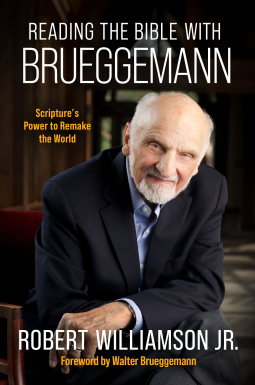
Reading the Bible with Brueggemann
Scripture's Power to Remake the World
Sign In or Register Now to see if this title is available for request.
Buy on Amazon Buy on Bookshop.org Buy on WaterstonesSend NetGalley books directly to your Kindle or Kindle app
1
To read on a Kindle or Kindle app, please add kindle@netgalley.com as an approved email address to receive files in your Amazon account. Click here for step-by-step instructions.
2
Also find your Kindle email address within your Amazon account, and enter it here.
Pub Date 11 Nov 2025 | Archive Date Not set
Abilene Christian University Press & Leafwood Publishers | Abilene Christian University Press
Talking about this book? Use #ReadingtheBiblewithBrueggemann #NetGalley. More hashtag tips!
Description
Let the Word speak freely.
Walter Brueggemann has been one of the most influential Old Testament theologians of the late twentieth and early twenty-first centuries. With an almost relentless pace, Brueggemann has significantly shaped biblical theology in the modern era, publishing 150 books and numerous articles. In his faithful and provocative interpretation, Brueggemann insists that the Bible has the power to remake the world, wresting the church’s imagination away from the military consumerism of the dominant culture and toward a radical vision of God’s reign, characterized by love of God and justice for the neighbor.
Reading the Bible with Brueggemann presents the development of Brueggemann’s thought through nine of his most significant works, from the foundational Prophetic Imagination to the magisterial Theology of the Old Testament and beyond. In a clear and readable style, Williamson allows scholars, pastors, and laypeople alike to read the Bible with Brueggemann and learn from and apply Brueggemann’s theological method.
Advance Praise
“What would Walter Brueggemann say to the world now on fire? When we need him most, his friend and student, Robert Williamson, appears with the perfectly timed Reading the Bible with Brueggemann. A systematic overview of Brueggemann’s major works, this book is an essential primer for re-reading Brueggemann in one hand while holding the Bible in the other—before picking up today’s issue of The New York Times. Brueggemann has long been an essential tool, and Williamson is here to rekindle our memory, applying our mentor’s interpretive genius in the context of our current crisis. This book is the first move in a strategy ‘to hew out of the mountain of despair a stone of hope.’”
—David Fleer, The Fred D. Gray Institute for Human and Civil Rights, Director of Advancement
“Walter Brueggemann is the most prolific biblical scholar in recent memory. His work is profoundly important and widely influential, but its sheer immensity can complicate access and analysis. Where does one begin? How does any one of his many publications differ from the others? Robert Williamson has done us a great service by affording entry into Brueggemann’s work through nine of his most important books. Williamson offers expert commentary on each of these while at the same time setting Brueggemann’s publications within the story of his life, scholarly career, and wider academic discussions. Williamson even includes an appendix teaching all of us how to read the Bible like Brueggemann. This is a fantastic volume, and I couldn’t be more delighted to see it in print.”
—Brent A. Strawn, D. Moody Smith Distinguished Professor of Old Testament and Professor of Law, Duke University, author of The Incomparable God: Readings in Biblical Theology
“Williamson is just the guide we need to chart a path through the vast body of work penned by Walter Brueggemann, one of the most important biblical scholars and Christian theologians of our age. With clear and careful prose, Williamson not only walks readers through key elements of Brueggemann’s thought but also invites us to read like Brueggemann, reminding us that biblical interpretation is a process of discovery open to all. This invitational approach is itself a tribute to Brueggemann, whose career has harnessed the best insights of the academy for the sake of the church, empowering Christians everywhere to read the Bible with confidence and to testify to the profound hope of the gospel of Jesus Christ.”
—Cameron B. R. Howard, Associate Professor of Old Testament, Luther Seminary, author of The Old Testament for a Complex World: How the Bible’s Dynamic Testimony Points to New Life for the Church
“Robert Williamson has given a tremendous gift to students of Walter Brueggemann, whether they are new to his writings or are seasoned readers of his oeuvre. Reading the Bible with Brueggemann introduces the more than fifty-year shape of Brueggemann’s writings, not only by attending to the specific claims of each of his works but also by helping readers appreciate the methods, scriptural passages, and theological emphases that animate Brueggemann’s distinctive and influential approach to biblical interpretation. Whether one is seeking to understand better one of Brueggemann’s books or appreciate his unique contributions to the church and the academy, there is no better guide than Williamson’s Reading the Bible with Brueggemann.”
—Jonathan Kaplan, Associate Professor of Middle Eastern Studies, The University of Texas at Austin, author of My Perfect One: Typology and Early Rabbinic Interpretation of Song of Songs
“From one of Walter Brueggemann’s most insightful and incisive students, here is an ideal introduction to his most important and influential books and a perfect companion to read alongside them. A gift to biblical theology students and scholars alike.”
—Timothy K. Beal, Distinguished University Professor, Case Western University, author of When Time Is Short: Finding Our Way in the Anthropocene
“Williamson here discloses a Brueggemann shaped by the Bible even as he carefully unpacks Brueggemann’s central contributions shaping how so many of us read and interpret scripture. Brueggemann retired from teaching about 25 years ago, with Williamson among his last students, yet his pace of publication increased in retirement. Williamson proves perfectly situated to be our wise guide across the many decades of Brueggemann’s publications, as intimately familiar with early, foundational works as he is impressively apace with more recent, substantive contributions—and with criticisms of Brueggemann’s work by other scholars! This book not only offers an insightful introduction to Brueggemann’s life and work, it will also make you want to read the Bible like Brueggemann as it gives you step-by-step instructions on how to do so.”
—Davis Hankins, Associate Professor of Religion and Philosophy, Appalachian State University, author of The Book of Job and the Immanent Genesis of Transcendence
“A lucid and elegant introduction to Walter Brueggemann’s most important works. It is a difficult task to capture the intellectual genius of Brueggemann, and to do so with humility and a keen eye is a challenging feat. Williamson has accomplished it.”
—Clover Reuter Beal, Pastor, Montview Boulevard Presbyterian Church, coauthor of An On-Going Imagination: A Conversation about Scripture, Faith, and the Thickness of Relationship
Available Editions
| EDITION | Paperback |
| ISBN | 9780891124405 |
| PRICE | $24.99 (USD) |
| PAGES | 272 |
Available on NetGalley
Available to Buy
Buy on Amazon Buy on Bookshop.org Buy on WaterstonesAverage rating from 11 members
Featured Reviews
 Reviewer 117981
A Door into Brueggemann: Reading the Bible with Brueggemann by Robert Williamson Jr. (Abilene Christian University Press, 2025)
Walter Brueggemann is one of the most important Bible scholars of the last fifty years. He has published 150 books and numerous articles, shaping biblical theology at a remarkable pace. But for many readers, that output is overwhelming. Where do you start? Which book do you pick up first? Robert Williamson Jr. has written the answer to that question.
Williamson studied under Brueggemann and knows his work from the inside. In a clear and readable style, he allows scholars, pastors, and laypeople alike to read the Bible with Brueggemann and learn from and apply his theological method. That last word matters. This is not just a summary of ideas. It is a guide to a way of reading.
The book walks through nine of Brueggemann's most significant works, from the foundational Prophetic Imagination to the magisterial Theology of the Old Testament and beyond. Each chapter focuses on one book, explains its main ideas, and shows why it matters. By the end, you have a real picture of how Brueggemann thinks and what drives his reading of Scripture.
The central idea running through all of it is this: the Bible has the power to remake the world, pulling the church's imagination away from the values of the dominant culture and toward a vision of God's reign, characterized by love of God and justice for the neighbour. That is a strong claim, but Brueggemann earns it, and Williamson shows you why.
One of the most helpful sections deals with the Psalms. Brueggemann reads them through three movements: orientation, disorientation, and reorientation. Life goes well, then something breaks, then God meets us in a new way. That framework alone is worth the price of the book for anyone who preaches or leads a small group.
Brueggemann invites us to consider the text as art, to let it hold the meaning of itself. Each text speaks for itself. Williamson passes that invitation on to the reader in a way that feels generous and honest, not academic or distant.
This book will not replace reading Brueggemann himself. But it will make you want to, and it will prepare you well. For pastors, students, and curious readers who have heard the name but never known where to begin, this is the right place to start.
Recommended.
 Quiara H, Reviewer
This is an excellent book full of the kind of deep insight one expects from Bruggeman. His lost was a great dismay to me. I was privileged to hear him in person. I think this book honours his work and memory in a great way.
 Rebekah F, Reviewer
As someone who studied theology at BA and MA level and a local preacher I was excited to read this book. I was not disappointed and will be purchasing a physical copy as well as recommending it to others.
David T, Reviewer
Having read a few of Brueggemann's books and writings, when this title became available, I of course jumped at the opportunity to request.an ARC.
I was not disappointed.
Robert Williamson' takes us through 8 or so of Brueggemann's books, highlighting and at times revealing Brueggemann's thoughts and beliefs.
Fascinating and insightful reading and it made me want to dive deeper in Brueggemann's vast body of work.
If you are wanting to dive into his work but are unsure where to start, I highly recommend this book as a.starting point.
Scott W, Reviewer
Brueggemann blows apart the Enlightenment that there is only one correct interpretation of any biblical text. He encourages us to think that our interpretations are clearly from the interpreter’s perspective (local), based on experience and environment (contextual) and subject to change when new life experiences or learnings occur (provisional). [Even that last statement does not really do justice to Brueggemann’s argument.] Williamson Jr puts together a striking compendium of Brueggemann’s major works, summarizing them with critical commentary. Additionally, he describes academic dialogues between Brueggemann and his critics regarding various works. The author is not silent and often becomes an apologist for Brueggemann against his critics though recognizing the validity of the raised concerns. It’s often helpful when the author also provides clarification based on conversations with his mentor, Brueggemann.
Brueggemann’s works often suggest an economic equity framework to understanding God’s intent, a revelation of God’s heart through scripture. God is more interested in justice and mercy than we may have originally believed or been taught. Yes, many, many passages often deal with money, wealth, economic justice, poverty and several other aspects of consumerism, greed and so on. Therefore, it’s not totally obtuse to explore our perspective of God through this framework. Not only a review of the book, “A Theology of the Old Testament,” but also “Money and Possessions” and another chapter dealing with “Sabbath as Resistance” and “Materiality as Resistance,” Williamson cogently describes how all the works fit together and a bit of evolution in Brueggemann’s scholarship. Some of the final chapters dealing with the critics and summarizing the overall themes of Brueggemann’s writings are a benefit, putting several puzzle pieces into the larger picture of his body of work.
Brueggemann is also comfortable not resolving passages that seem in conflict. He wants us to struggle with the particular lesson(s) any one passage is trying to teach us. In any regard, we will not fully understand the text or the tension without trying to live it and making it real in our lives—particularly how we relate with God, Jesus and the Holy Spirit. Our faith and understanding of God’s heart is more than just oral recitation.
While Brueggemann criticizes the Enlightenment and Systematic Theologies, he seems to have his own weaknesses. Though he strongly suggests that interpreters are projecting their own perspectives onto the text, he rarely, if at all, cites non-Western analysts. We may be aware that a sculptured figure can be described differently from six different orientations, or an elephant described differently by a group of blind people, he does not promote any other socio-ecclesial-political-economic-educational-ethnic perspectives. How do First Nation readers bullied by a more powerful people group engage with these texts? How do formerly enslaved people-group engage with these texts? How does a poor person engage with these texts? (Brueggemann emphatically suggests the church—the preachers—help us engage with psalms of lament, but yet what are we lamenting?)
I do applaud Brueggemann’s challenge to academicians, theologians and any other church-complacent people. I see resonance in other “rebellious” works like Brennan Manning’s “Ragamuffin Gospel” and Howard Snyder’s “The Problem with Wineskins” and McNeal’s more recent “The Present Future: Six Tough Questions for the Church.” If you don’t want to spend a lot of time reading Brueggemann directly, this book is a good introduction.
I’m appreciative of the publisher providing an advanced copy.
 Jeannine L, Reviewer
I have a couple of books by Walter Brueggemann that I picked up on sale, but I just hadn’t gotten around to reading them and then I saw this volume in the net galley selections and thought this would be a wonderful way to get an introduction to Brueggemann‘s overall thought, and to decide which books I would like to read in what order. The author, Robert Williamson Junior has done a masterful job summarizing the major works by Brueggemann throughout his career. He does not hide the fact that he was a student of Brueggemann and speaks highly of his works, but that does not stop him from engaging with them critically. The author does an in-depth analysis on work such as the prophetic imagination, a theology of the Old Testament, money and possessions, Sabbath as resistance and materialism as resistance among others. He is able to artfully draw out Brueggemann‘s main lines of thought, and I feel that my reading of Brueggemann‘s works will be greatly enhanced by the fact that I have gotten some idea of his direction and where he’s going. This has gotten me excited to read Walter Brueggemann a bit more deeply.
#ReadingtheBiblewithBrueggemann #NetGalley
Rosa S, Educator
If you enjoy the theology of recently-deceased Brueggemann, wonder what the fuss was about his thinking, or want to broaden the scope of what it means to live as God's people, this one's for you.
Williamson presents an overview of Brueggemann's writings that is appropriate for the curious beginner in a review that is helpful for seasoned theologians. Whether you agree with the presentation or it expands your understanding, this one's for academics and lay readers alike.
Readers who liked this book also liked:



Céline Fitzmaurice
Biographies & Memoirs, Mystery & Thrillers, True Crime