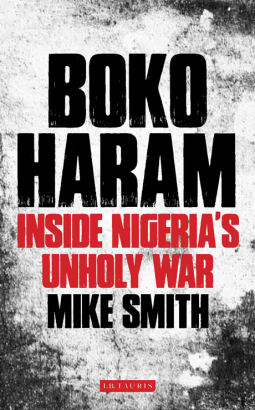
Boko Haram
Inside Nigeria's Unholy War
by Mike Smith
I.B.Tauris
I.B.Tauris & Co Ltd
Pub Date 28 Apr 2015
Description
Can Boko Haram be stopped?
Leading expert on Nigeria introduces us to the ordinary people on the frontline in the war against one of the most feared terrorist groups
An insurgency in Nigeria by the Islamist extremist group Boko Haram has left thousands dead, shaken Africa’s biggest country and worried the world. What began as small Islamist sect in the country’s remote northeast, led by a baby-faced but charismatic preacher, has transformed into a hydra-headed monster, deploying suicide bombers and abducting innocent schoolgirls.
Reporting from the ground, Mike Smith traces the roots of this mysterious violent organization and speaks to Nigerians who find themselves caught between frightening insurgents, brutal abusive security forces and an inept government.
Journeying through the sleaze and corruption, which is robbing Africa’s biggest oil producer of its potential and allowing it to become a fertile ground for extremism, the author questions how this unholy war (waged against the backdrop of an evolving extremist threat worldwide) begun and how it might eventually be stopped.
Can Boko Haram be stopped?
Leading expert on Nigeria introduces us to the ordinary people on the frontline in the war against one of the most feared terrorist groups
An insurgency in Nigeria by...
Description
Can Boko Haram be stopped?
Leading expert on Nigeria introduces us to the ordinary people on the frontline in the war against one of the most feared terrorist groups
An insurgency in Nigeria by the Islamist extremist group Boko Haram has left thousands dead, shaken Africa’s biggest country and worried the world. What began as small Islamist sect in the country’s remote northeast, led by a baby-faced but charismatic preacher, has transformed into a hydra-headed monster, deploying suicide bombers and abducting innocent schoolgirls.
Reporting from the ground, Mike Smith traces the roots of this mysterious violent organization and speaks to Nigerians who find themselves caught between frightening insurgents, brutal abusive security forces and an inept government.
Journeying through the sleaze and corruption, which is robbing Africa’s biggest oil producer of its potential and allowing it to become a fertile ground for extremism, the author questions how this unholy war (waged against the backdrop of an evolving extremist threat worldwide) begun and how it might eventually be stopped.
Advance Praise
No Advance Praise Available
Marketing Plan
No Marketing Info Available
Available Editions
| EDITION | Hardcover |
| ISBN | 9781784530747 |
| PRICE | US$28.00 (USD) |
Available on NetGalley
| Send To Kindle (PDF) |
| Download (PDF) |
Featured Reviews
|
My Recommendation
|
|
Boko Haram, the Sokoto's Caliphate, The Delta of The Niger, Emir and Salafites: this book is pretty clear and give us a lot of information about what is currently happening in the northern part of Nigeria. It is scary mostly because the deep reason could be trace to the oil money and the 7 sisters and the complete lack of culture and law. Boko Haram, il Califfato di Sokoto, il delta del Niger, Emiri e salafiti: questo libro è abbastanza chiaro e ci da un sacco di informazioni su quello che sta accadendo nella parte settentrionale della Nigeria. È spaventoso soprattutto perché la ragione profonda potrebbe essere rintracciabile nei soldi del petrolio e quindi alle 7 sorelle e la totale mancanza di cultura e di uno stato di diritto che solitamente affligge i paesi africani dove iprovvisamente arrivano tanti tanti tanti soldi. THANKS TO NETGALLEY AND I.B.TAURIS FOR THE PREVIEW! |
My Recommendation
|
|
My Recommendation
|
|
I am just a person that reads and occasionally watches world news online. Meaning, I'm no expert on the subject other than what BBC has been showing me, nor did I fact-check the book. With my limited knowledge, I can say I found this book very informative and interesting in it's own way. That said, I'm giving it a 4/5, because while I did like it, the writing style could've been better as it's very important while writing/reading non-fiction books. It's the writing and the information it includes that keep the reader interested and while it was well-written for the most part, especially at first, it started to lack this after a while. Apart from that, while I wouldn't use this for references, it provides good and, contrary to many sources I could find about the subject, orderly information. 4/5 |
My Recommendation
|
|
My Recommendation
|
|
I enjoyed this book a lot more than I expected to. The background information on the group puts a lot into context that I hadn't considered before, and I appreciate the way the author writes in, drawing a lot from personal experience and not focusing entire chapters to trivial information that seems to be habitual with some nonfiction authors. I will absolutely read more from Mike Smith and would definitely pay money for this book. |
My Recommendation
|
John G, Reviewer
|
My Recommendation
|
|
Boko Haram, once a Salafist sect based in Nigeria’s northeast, has become something far more deadly and ruthless: a hydra-headed monster further complicated by imitators and criminal gangs who commit violence under the guise of the group, according to Mike Smith in his book Boko Haram: Inside Nigeria’s Unholy War. However, the lack of faith in both the government and the military has remained one of the most important reasons why the insurgency has not been stopped. Boko Haram began around 2002 when the charismatic preacher Mohammed Yusuf attracted a following by denouncing the corruption and injustices of the Nigerian government, army and police. Yusuf, who believed that the earth is flat and that Western education is evil, was arrested in 2009 and killed in police custody following an uprising by his followers which had resulted in over 1,000 deaths. The group has since engaged in violent attacks against police, the military, schools, mosques, churches, government institutions and unarmed civilians. Interestingly, the group’s current leader Abubakar Shekau appropriates the rhetoric of peace when describing one of the group’s main aims: “Seeking Allah’s help to establish Sharia so that Muslims will have peace to practise their religion.” After being named a “global terrorist” by the United States, requiring his assets there to be frozen, Shekau responded in a video message: “I know the United States exists, but… I don’t know where it is, not to talk of freezing my assets there.” To understand the environment in which Boko Haram thrives, it is necessary to comprehend the extent of corruption and injustice in Nigerian society. The army typically responds to Boko Haram raids first by running away during an attack, then by returning in numbers to slaughter some people indiscriminately and burn down houses, on the conjecture that some of them might have assisted or supported boko Haram. Today as I write this review, the newspaper has six full pages including the front page discussing terrorist attacks in France which have resulted in 17 deaths. There is a small article on page 18 describing a Boko Haram attack on the town of Baga which may have resulted in 2,000 deaths, with all of the houses burnt and destroyed. There are plenty of photos on the Internet of burnt houses and dead bodies from Baga, but they are from an attack by the Nigerian army almost 2 years ago when the army killed about 200 people and burnt down houses as revenge after Boko Haram fighters had ambushed some troops near Baga. With global terrorism on the rise, it has become increasingly important for all members of society to gain some understanding of the causes of terrorism. While this book reassures us that Boko Haram is essentially a Nigerian problem rather than a global problem, it does give some insight into how heavy-handed official responses to terrorist acts serve to intensify the terrorists’ grievances, resulting in amplification rather than suppression of the problem. |
My Recommendation
|
|
My Recommendation
|
|
If I had to describe this book in one sentence, it would be apt to say it is a detailed historical account of how Boko Haram started and gained momentum. The book gives an insight into what went on in Nigeria which had people supporting Boko Haram in the initial days. Of how Western democracy was seen as the problem because the way they saw Western democracy was elites lining their pockets while leaving the poor, even poorer. In such circumstances, leaders claiming that the Western education, Western ways were the root cause of all evil, is easy to accept and understand. The author has done a great job of capturing in great detail the insurgency in Nigeria. The rating is reflective of the fact that for me, it was a painful read. Probably because of the violence and the sadness, which is inevitable in a book like this, but if you want a comprehensive read of Boko Haram, this is a good book to pick up. |
My Recommendation
|
|
My Recommendation
|
|
The author quotes Chinua Achebe saying "The trouble with Nigeria is simply and squarely a failure of leadership. There is nothing basically wrong with the Nigerian character." This quote basically sums up the entire book. I've read quite a bit on the ongoing conflict in the Congo, the Rwandan genocide, and the Tuareg rebellion, but my knowledge of Nigeria and its recent trouble has been based on sporadic radio reports by NPR and the BBC. So as someone who actively tries to stay knowledgeable on African conflict issues, I was blown away with (and a little embarrassed) by how little I knew about Nigeria- which became immediately clear right from the beginning of this book. The author does an excellent job of combining history, semi-current events, analysis, and personal commentary. Even though the amount of information was overwhelming at times (though my fault, not the author's), I found the writing style very engaging and easy to understand. He explains Nigeria's current situation by going back in time and breaking down step by step how the original group known as Boko Haram came to be and how subsequent knock-off groups formed. My only problem with this book is that it leaves off at the end of 2013 when, as far as I know, the trouble with the many terrorist splinter groups was still in full swing. I hope he plans to follow it up in a few years time or write an additional chapter when the paperback is released. Towards the end of the book the author states that "In Nigeria, things are very often not what they seem." While other readers may balk at the lack of hard facts, I appreciated that throughout the text the author would follow up a section with some doubt as to whether what he just reported was true or not. When there is so much deceit and lack of leadership, how can anyone really say what is what. If you have a real interest in African conflicts, then this is just the book for you to catch you up on recent events in Nigeria. But for others, at over 300 pages this may be a bit much to get through. |
My Recommendation
|
|
My Recommendation
|
|
I choose to preview this book in an attempt to learn about the group and some of the history of Nigeria. It did not disappoint. The author appeared to be well-documented although I did not do any fact checking. The history of the country and turmoil is complex and fascinating. I can't say I completely understand who Boko Haram are but I have a better grasp on the history of Nigeria which helps understand who Boko Haram are. I would suggest this book for anyone who likes to read the work of journalists and wants to learn more about Nigeria and Boko Haram. |
My Recommendation
|
|
My Recommendation
|
|
A journalist, Mike Smith, provides insight into the history of Nigeria and information on its past, as well as details regarding its current, political and economic status. He concentrates on the well group known as Boko Haram, adding insight into the manner in which everyday Nigerians live in light of threats from this group and the current state of their nation. The story takes readers back in history to an early caliphate, offering connections between it and the current Boko Haram movement. Most notably, Smith gives details of the raid on the girls’ school that made worldwide headlines in recent months. It is difficult to look at the details of a place like Nigeria and not immediately draw comparisons to western cultures. The emphasis westerners have historically placed on honesty and openness in government, and the need for integrity among government officials, cannot be overstated. I invite anyone who thinks that it is acceptable to vote into office, a person with a track record that does not instill trustworthiness, to take a look at the current state of affairs in Nigeria. |
My Recommendation
|
|
My Recommendation
|
|
Review of Boko Haram by Mike Smith Islam has been well established in northern Nigeria for over two centuries; Muhammad Yusuf, has helped to firmly imbed radical and terroristic Islam there recently with the advent of Boko Haram. Roughly speaking the meaning of Boko Harum translates in English to “western education is forbidden”. Boko Haram attained notoriety with the kidnapping of 300 female boarding school students but even before then, this terrorist organization was brutally attacking police stations and other government institutions with impunity. They continue to capture international headlines and have pledged allegiance to ISIS. After the death of Yusuf, Abubakar Shekau assumed leadership of the group. This book studies the early history of Islam in Nigeria and then brings the reader into preset day for a face-to-face analysis as to the reason for the birth of Boko Harum. There are many antidotal first person stories about the personal impact left by terrorism in Nigeria and how that is linked to corruption in government and the oil boom that started in 1956. Because Nigeria was unable to build sufficient refineries, it was necessary to export its crude oil through a process that has become mismanaged and corrupt. The current Nigerian president, Goodluck Jonathan, a Christian, has been unable to reign in sufficient governmental support against the brutality of Boko Harum. Jonathan, always known for his heavy-handed militarist tactics, has done little to slow down the progress of terrorism. This is a well-detailed book but is hard to read and digest standing alone due to all of its content and history. What I did about half way through it was to start a mystery novel that brought a sense of escape and release form the mayhem currently taking place in northern Nigeria. Overall I found this book interesting and informative to the extent that Boko mimics the teachings of ISIS in Syria. I would rate this with 4 stars and recommend this widely. Gordon Reiselt Albuquerque, New Mexico February 24, 2015 |
My Recommendation
|
|
My Recommendation
|
|
When the name Goodluck Jonathan appeared I had a mental smile. Finally a name I recognized and could pronounce. That was my one and only smile, mental or otherwise. A look at the terrorist group Boko Haram. I have long pondered how a ragtag group of terrorists managed to grow and increasingly run rampant committing ever more daring and deadly atrocities. Already there exists an imitation of if not an actual link to ISIS and almost surely cooperation with Al-Quaeda in the Islamic Maghreb (AQIM) as well as possibly Al-Shabab. Although claiming to be in the name of religion these terrorists groups go against all that is holy, seeming rather to enjoy the opportunity to rob, rape, plunder and pillage while committing what can only be classified as genocide. I question why America has not stepped in when we as a country seek to eliminate these organizations posing an affront to humanity in the name of religion. This writing provides an examination of the inability or unwillingness of a government to confront and exterminate this plague. It further explains why we as a country stand on the sidelines. Also offering an insight to the question of financial support needed maintain and arm these groups. The most distressing take away is the plight of the inhabitants of this resource rich country, living in poverty and in constant fear of the aggressors. If one is to take for fact the findings of this report the aggressors are not only the terrorists but also those in the employ of the government assigned to protect the public. Although it can be somewhat dry it is a very worthy read for anyone seeking to understand the how and why behind the headline news stories, but the vivid descriptions of carnage will never be included in those headline stories. |
My Recommendation
|
|
My Recommendation
|
|
With the emergence of so many violent groups, and news reporting nearly every day of new atrocities, it is easy to loose track of who is doing what for why. This book lays out Boko Haram in an easy to read format. It covers the Chibok event that sent shivers around the world several times over, as well as other less reported events. I really appreciated the easy sense of writing that the author uses, that turns a potential dark forbidding and political area into something that is easy to read, even if the topic is not the most palatable. |
My Recommendation
|
|
My Recommendation
|
|
In “Boko Haram: Inside Nigeria’s Unholy War,” Mike Smith writes with a journalist’s sense of urgency, and with a deep understanding of the history, regions, economics, religions, and politics of Nigeria. Smith rapidly covers one millennium of Western African history as it relates to Nigeria and Islam, which is critical to understanding the current upheaval in this densely populated and poor corner of Africa. Islam's spread through Africa in the Tenth Century was not without conflict. Throughout the centuries, Islam fought on the defensive and offensive against other religions and cultures. As Islam began to dominate in many regions, including Northern and Central Africa, different factions and dynasties split and infighting occurred. According to Smith, “one of history’s most successful armed jihads occurred in what is today northern Nigeria [Bornu]” in the eighteenth century. Bornu became “an important centre of Islamic learning. Some 300 years later, Boko Haram would take root amid the remnants of that former empire, by then part of Nigeria.” In the last 100 years, Nigeria formed into one culturally and religiously diverse country, gained independence, underwent several civil wars and coups, became the most populous country in Africa with 170 million people, and “recently overtook South Africa as the continent’s biggest economy strictly in terms of GDP size.” Nigeria remains a country that is deeply divided by three main regions: the Islamic North, Christian South, and ultra-poor/religiously diverse Delta. Government corruption and corporate racketeering has accelerated animosity, leading to further unrest. Under this tension, Muhammad Yusuf, the first Boko Haram leader, and Abubakar Shekau, his successor, have usurped power in large parts of Northern Nigeria, causing murder, rape, and chaos everywhere they go. The government’s ineffective response, and its disgusting abuse of power, has only fueled the fire. Smith marvelously fills in the details, navigating the reader through this twisted history. Particularly relevant in light of recent events, Smith touches on a Mohammad cartoon debacle in 2005, Yusuf’s video broadcasts, wikileakes, the horrific April 14, 2014 school kidnapping which captured the attention of the world with the ‘Bring Back Our Girls’ slogan, and other major outbreaks and school kidnappings. I do have one reservation: Smith does not keep to writing linearly; instead he bounces around. For example, in one paragraph he writes about the first two leaders of Boko Haram (early 2000s), in the following paragraph he writes about the 18th century, then the 10th century, then the 18th, then the 13th, then 2014…. I found myself having to reread passages to be sure I was following along. When Smith switches between histories, he’s also switching between names for the same region, which can be exceptionally confusing if you’re not paying careful attention. Even in later chapters that cover the last 5 years, Smith was bouncing between incidents and debacles, making it hard to follow the sequence of events. Boko Haram: Inside Nigeria is an excellent read; however, it’s important for the reader to know that many things have changed in Nigeria since this book’s recent publication. Namely, Nigeria now has a new president and Boko Haram has officially aligned itself with ISIS. Still, Smith thoroughly catches the reader up through 2014, which is more than a sufficient to follow the news as it’s happening now. I highly recommend this book to anyone interested in learning more about Boko Haram, the changing face of ISIS, and Nigeria. NetGalley and I.B. Tauris, thank you for providing me with the gracious Advanced Reader Copy. I.B. Tauris, in particular, continues to publish superior non-fiction works, and I’m honored to receive first glimpses at each book published. Tags: Nonfiction, Military History, Politics, Africa, Western Africa, Muslim, Islam, Religious War, Ethnic War, Terrorism, Nigeria, Boko Haram, ISIS, ISIL, Civil War, Western Education, Muhammad Yusuf, Abubakar Shekau, Kanuris, Mohammad Cartoon, Bring Back Our Girls |
My Recommendation
|
Gopal I, Reviewer
|
My Recommendation
|
|
My many thanks to Net Galley, the publisher I.B. Tauris and the author Mike Smith for providing me with the ARC in exchange for an honest and unbiased review. Somalia and Nigeria are two hotspots of trouble in Africa. One affected by piracy and the other by militant Islamism. I don't believe in the fundamentalist interpretation of any religion. IMO it is just an excuse to cover bloodthirsty behavior. Islam is a peaceful religion, none of my friends who practice Islam subscribe to the school of thought propagated by the fundamentalist. It is their own greed for power that makes them cloak their fight in the garb of religion to give it legitimacy. Boko Haram is no different. Emerging through the crucible of Nigeria's impoverished North east region, Boko Haram is using religion to cloak its bloodthirstiness. Mike Smith has forged a convincing tale of emergence of this terror group from its initial years under radical preacher Mohammad Yusuf, the Boko Haram group was based on the Wahabi ideology. Initially attracting followers with his fiery speeches and opposition to Nigerian government rules and thoughts, the group evolved into a ultra conservative terror outfit after Yusufs death and the emergence of his deputy Abubakar Shekhau as the new leader of the group. Nigeria is a important country in African continent. It has a semblance of democracy and is oil rich. This makes it the de facto leader for growth, prosperity and stability in the African region which is inundated with myriad problems like famine, poverty and ethnic conflicts. Nigeria's is too divided between an impoverished and reeling under the aegis of Boko Haram North and the relatively affluent South with its oil riches. Overall the country is still in doldrums due to deep rooted corruptions and the lack of political will in the Nigerian leadership to grow the country. The schism between the top elite of the country and the poor is exploited by Boko Haram. Denouncing the government the group emerged initially as trying the overthrow the government to replace it with Islamic Caliphate. But the methods and the legacy left behind by the group is too bloody and too gory to justify any teachings of Islam and the group remains as a terrorist organization in its entirety. Mike Smith spins a cohesive story about the emergence of the group, the growth under Yusuf, the downturn after Yusuf's death and their bloody reemergence under the aegis of Shekau. It gives insights into the cultural, economic and social crucible that is Nigeria which has forged one of the most deadliest terror outfits in the world today. |
My Recommendation
|
Additional Information
Available Editions
| EDITION | Hardcover |
| ISBN | 9781784530747 |
| PRICE | US$28.00 (USD) |
Available on NetGalley
| Send To Kindle (PDF) |
| Download (PDF) |
Featured Reviews
|
My Recommendation
|
|
Boko Haram, the Sokoto's Caliphate, The Delta of The Niger, Emir and Salafites: this book is pretty clear and give us a lot of information about what is currently happening in the northern part of Nigeria. It is scary mostly because the deep reason could be trace to the oil money and the 7 sisters and the complete lack of culture and law. Boko Haram, il Califfato di Sokoto, il delta del Niger, Emiri e salafiti: questo libro è abbastanza chiaro e ci da un sacco di informazioni su quello che sta accadendo nella parte settentrionale della Nigeria. È spaventoso soprattutto perché la ragione profonda potrebbe essere rintracciabile nei soldi del petrolio e quindi alle 7 sorelle e la totale mancanza di cultura e di uno stato di diritto che solitamente affligge i paesi africani dove iprovvisamente arrivano tanti tanti tanti soldi. THANKS TO NETGALLEY AND I.B.TAURIS FOR THE PREVIEW! |
My Recommendation
|
|
My Recommendation
|
|
I am just a person that reads and occasionally watches world news online. Meaning, I'm no expert on the subject other than what BBC has been showing me, nor did I fact-check the book. With my limited knowledge, I can say I found this book very informative and interesting in it's own way. That said, I'm giving it a 4/5, because while I did like it, the writing style could've been better as it's very important while writing/reading non-fiction books. It's the writing and the information it includes that keep the reader interested and while it was well-written for the most part, especially at first, it started to lack this after a while. Apart from that, while I wouldn't use this for references, it provides good and, contrary to many sources I could find about the subject, orderly information. 4/5 |
My Recommendation
|
|
My Recommendation
|
|
I enjoyed this book a lot more than I expected to. The background information on the group puts a lot into context that I hadn't considered before, and I appreciate the way the author writes in, drawing a lot from personal experience and not focusing entire chapters to trivial information that seems to be habitual with some nonfiction authors. I will absolutely read more from Mike Smith and would definitely pay money for this book. |
My Recommendation
|
John G, Reviewer
|
My Recommendation
|
|
Boko Haram, once a Salafist sect based in Nigeria’s northeast, has become something far more deadly and ruthless: a hydra-headed monster further complicated by imitators and criminal gangs who commit violence under the guise of the group, according to Mike Smith in his book Boko Haram: Inside Nigeria’s Unholy War. However, the lack of faith in both the government and the military has remained one of the most important reasons why the insurgency has not been stopped. Boko Haram began around 2002 when the charismatic preacher Mohammed Yusuf attracted a following by denouncing the corruption and injustices of the Nigerian government, army and police. Yusuf, who believed that the earth is flat and that Western education is evil, was arrested in 2009 and killed in police custody following an uprising by his followers which had resulted in over 1,000 deaths. The group has since engaged in violent attacks against police, the military, schools, mosques, churches, government institutions and unarmed civilians. Interestingly, the group’s current leader Abubakar Shekau appropriates the rhetoric of peace when describing one of the group’s main aims: “Seeking Allah’s help to establish Sharia so that Muslims will have peace to practise their religion.” After being named a “global terrorist” by the United States, requiring his assets there to be frozen, Shekau responded in a video message: “I know the United States exists, but… I don’t know where it is, not to talk of freezing my assets there.” To understand the environment in which Boko Haram thrives, it is necessary to comprehend the extent of corruption and injustice in Nigerian society. The army typically responds to Boko Haram raids first by running away during an attack, then by returning in numbers to slaughter some people indiscriminately and burn down houses, on the conjecture that some of them might have assisted or supported boko Haram. Today as I write this review, the newspaper has six full pages including the front page discussing terrorist attacks in France which have resulted in 17 deaths. There is a small article on page 18 describing a Boko Haram attack on the town of Baga which may have resulted in 2,000 deaths, with all of the houses burnt and destroyed. There are plenty of photos on the Internet of burnt houses and dead bodies from Baga, but they are from an attack by the Nigerian army almost 2 years ago when the army killed about 200 people and burnt down houses as revenge after Boko Haram fighters had ambushed some troops near Baga. With global terrorism on the rise, it has become increasingly important for all members of society to gain some understanding of the causes of terrorism. While this book reassures us that Boko Haram is essentially a Nigerian problem rather than a global problem, it does give some insight into how heavy-handed official responses to terrorist acts serve to intensify the terrorists’ grievances, resulting in amplification rather than suppression of the problem. |
My Recommendation
|
|
My Recommendation
|
|
If I had to describe this book in one sentence, it would be apt to say it is a detailed historical account of how Boko Haram started and gained momentum. The book gives an insight into what went on in Nigeria which had people supporting Boko Haram in the initial days. Of how Western democracy was seen as the problem because the way they saw Western democracy was elites lining their pockets while leaving the poor, even poorer. In such circumstances, leaders claiming that the Western education, Western ways were the root cause of all evil, is easy to accept and understand. The author has done a great job of capturing in great detail the insurgency in Nigeria. The rating is reflective of the fact that for me, it was a painful read. Probably because of the violence and the sadness, which is inevitable in a book like this, but if you want a comprehensive read of Boko Haram, this is a good book to pick up. |
My Recommendation
|
|
My Recommendation
|
|
The author quotes Chinua Achebe saying "The trouble with Nigeria is simply and squarely a failure of leadership. There is nothing basically wrong with the Nigerian character." This quote basically sums up the entire book. I've read quite a bit on the ongoing conflict in the Congo, the Rwandan genocide, and the Tuareg rebellion, but my knowledge of Nigeria and its recent trouble has been based on sporadic radio reports by NPR and the BBC. So as someone who actively tries to stay knowledgeable on African conflict issues, I was blown away with (and a little embarrassed) by how little I knew about Nigeria- which became immediately clear right from the beginning of this book. The author does an excellent job of combining history, semi-current events, analysis, and personal commentary. Even though the amount of information was overwhelming at times (though my fault, not the author's), I found the writing style very engaging and easy to understand. He explains Nigeria's current situation by going back in time and breaking down step by step how the original group known as Boko Haram came to be and how subsequent knock-off groups formed. My only problem with this book is that it leaves off at the end of 2013 when, as far as I know, the trouble with the many terrorist splinter groups was still in full swing. I hope he plans to follow it up in a few years time or write an additional chapter when the paperback is released. Towards the end of the book the author states that "In Nigeria, things are very often not what they seem." While other readers may balk at the lack of hard facts, I appreciated that throughout the text the author would follow up a section with some doubt as to whether what he just reported was true or not. When there is so much deceit and lack of leadership, how can anyone really say what is what. If you have a real interest in African conflicts, then this is just the book for you to catch you up on recent events in Nigeria. But for others, at over 300 pages this may be a bit much to get through. |
My Recommendation
|
|
My Recommendation
|
|
I choose to preview this book in an attempt to learn about the group and some of the history of Nigeria. It did not disappoint. The author appeared to be well-documented although I did not do any fact checking. The history of the country and turmoil is complex and fascinating. I can't say I completely understand who Boko Haram are but I have a better grasp on the history of Nigeria which helps understand who Boko Haram are. I would suggest this book for anyone who likes to read the work of journalists and wants to learn more about Nigeria and Boko Haram. |
My Recommendation
|
|
My Recommendation
|
|
A journalist, Mike Smith, provides insight into the history of Nigeria and information on its past, as well as details regarding its current, political and economic status. He concentrates on the well group known as Boko Haram, adding insight into the manner in which everyday Nigerians live in light of threats from this group and the current state of their nation. The story takes readers back in history to an early caliphate, offering connections between it and the current Boko Haram movement. Most notably, Smith gives details of the raid on the girls’ school that made worldwide headlines in recent months. It is difficult to look at the details of a place like Nigeria and not immediately draw comparisons to western cultures. The emphasis westerners have historically placed on honesty and openness in government, and the need for integrity among government officials, cannot be overstated. I invite anyone who thinks that it is acceptable to vote into office, a person with a track record that does not instill trustworthiness, to take a look at the current state of affairs in Nigeria. |
My Recommendation
|
|
My Recommendation
|
|
Review of Boko Haram by Mike Smith Islam has been well established in northern Nigeria for over two centuries; Muhammad Yusuf, has helped to firmly imbed radical and terroristic Islam there recently with the advent of Boko Haram. Roughly speaking the meaning of Boko Harum translates in English to “western education is forbidden”. Boko Haram attained notoriety with the kidnapping of 300 female boarding school students but even before then, this terrorist organization was brutally attacking police stations and other government institutions with impunity. They continue to capture international headlines and have pledged allegiance to ISIS. After the death of Yusuf, Abubakar Shekau assumed leadership of the group. This book studies the early history of Islam in Nigeria and then brings the reader into preset day for a face-to-face analysis as to the reason for the birth of Boko Harum. There are many antidotal first person stories about the personal impact left by terrorism in Nigeria and how that is linked to corruption in government and the oil boom that started in 1956. Because Nigeria was unable to build sufficient refineries, it was necessary to export its crude oil through a process that has become mismanaged and corrupt. The current Nigerian president, Goodluck Jonathan, a Christian, has been unable to reign in sufficient governmental support against the brutality of Boko Harum. Jonathan, always known for his heavy-handed militarist tactics, has done little to slow down the progress of terrorism. This is a well-detailed book but is hard to read and digest standing alone due to all of its content and history. What I did about half way through it was to start a mystery novel that brought a sense of escape and release form the mayhem currently taking place in northern Nigeria. Overall I found this book interesting and informative to the extent that Boko mimics the teachings of ISIS in Syria. I would rate this with 4 stars and recommend this widely. Gordon Reiselt Albuquerque, New Mexico February 24, 2015 |
My Recommendation
|
|
My Recommendation
|
|
When the name Goodluck Jonathan appeared I had a mental smile. Finally a name I recognized and could pronounce. That was my one and only smile, mental or otherwise. A look at the terrorist group Boko Haram. I have long pondered how a ragtag group of terrorists managed to grow and increasingly run rampant committing ever more daring and deadly atrocities. Already there exists an imitation of if not an actual link to ISIS and almost surely cooperation with Al-Quaeda in the Islamic Maghreb (AQIM) as well as possibly Al-Shabab. Although claiming to be in the name of religion these terrorists groups go against all that is holy, seeming rather to enjoy the opportunity to rob, rape, plunder and pillage while committing what can only be classified as genocide. I question why America has not stepped in when we as a country seek to eliminate these organizations posing an affront to humanity in the name of religion. This writing provides an examination of the inability or unwillingness of a government to confront and exterminate this plague. It further explains why we as a country stand on the sidelines. Also offering an insight to the question of financial support needed maintain and arm these groups. The most distressing take away is the plight of the inhabitants of this resource rich country, living in poverty and in constant fear of the aggressors. If one is to take for fact the findings of this report the aggressors are not only the terrorists but also those in the employ of the government assigned to protect the public. Although it can be somewhat dry it is a very worthy read for anyone seeking to understand the how and why behind the headline news stories, but the vivid descriptions of carnage will never be included in those headline stories. |
My Recommendation
|
|
My Recommendation
|
|
With the emergence of so many violent groups, and news reporting nearly every day of new atrocities, it is easy to loose track of who is doing what for why. This book lays out Boko Haram in an easy to read format. It covers the Chibok event that sent shivers around the world several times over, as well as other less reported events. I really appreciated the easy sense of writing that the author uses, that turns a potential dark forbidding and political area into something that is easy to read, even if the topic is not the most palatable. |
My Recommendation
|
|
My Recommendation
|
|
In “Boko Haram: Inside Nigeria’s Unholy War,” Mike Smith writes with a journalist’s sense of urgency, and with a deep understanding of the history, regions, economics, religions, and politics of Nigeria. Smith rapidly covers one millennium of Western African history as it relates to Nigeria and Islam, which is critical to understanding the current upheaval in this densely populated and poor corner of Africa. Islam's spread through Africa in the Tenth Century was not without conflict. Throughout the centuries, Islam fought on the defensive and offensive against other religions and cultures. As Islam began to dominate in many regions, including Northern and Central Africa, different factions and dynasties split and infighting occurred. According to Smith, “one of history’s most successful armed jihads occurred in what is today northern Nigeria [Bornu]” in the eighteenth century. Bornu became “an important centre of Islamic learning. Some 300 years later, Boko Haram would take root amid the remnants of that former empire, by then part of Nigeria.” In the last 100 years, Nigeria formed into one culturally and religiously diverse country, gained independence, underwent several civil wars and coups, became the most populous country in Africa with 170 million people, and “recently overtook South Africa as the continent’s biggest economy strictly in terms of GDP size.” Nigeria remains a country that is deeply divided by three main regions: the Islamic North, Christian South, and ultra-poor/religiously diverse Delta. Government corruption and corporate racketeering has accelerated animosity, leading to further unrest. Under this tension, Muhammad Yusuf, the first Boko Haram leader, and Abubakar Shekau, his successor, have usurped power in large parts of Northern Nigeria, causing murder, rape, and chaos everywhere they go. The government’s ineffective response, and its disgusting abuse of power, has only fueled the fire. Smith marvelously fills in the details, navigating the reader through this twisted history. Particularly relevant in light of recent events, Smith touches on a Mohammad cartoon debacle in 2005, Yusuf’s video broadcasts, wikileakes, the horrific April 14, 2014 school kidnapping which captured the attention of the world with the ‘Bring Back Our Girls’ slogan, and other major outbreaks and school kidnappings. I do have one reservation: Smith does not keep to writing linearly; instead he bounces around. For example, in one paragraph he writes about the first two leaders of Boko Haram (early 2000s), in the following paragraph he writes about the 18th century, then the 10th century, then the 18th, then the 13th, then 2014…. I found myself having to reread passages to be sure I was following along. When Smith switches between histories, he’s also switching between names for the same region, which can be exceptionally confusing if you’re not paying careful attention. Even in later chapters that cover the last 5 years, Smith was bouncing between incidents and debacles, making it hard to follow the sequence of events. Boko Haram: Inside Nigeria is an excellent read; however, it’s important for the reader to know that many things have changed in Nigeria since this book’s recent publication. Namely, Nigeria now has a new president and Boko Haram has officially aligned itself with ISIS. Still, Smith thoroughly catches the reader up through 2014, which is more than a sufficient to follow the news as it’s happening now. I highly recommend this book to anyone interested in learning more about Boko Haram, the changing face of ISIS, and Nigeria. NetGalley and I.B. Tauris, thank you for providing me with the gracious Advanced Reader Copy. I.B. Tauris, in particular, continues to publish superior non-fiction works, and I’m honored to receive first glimpses at each book published. Tags: Nonfiction, Military History, Politics, Africa, Western Africa, Muslim, Islam, Religious War, Ethnic War, Terrorism, Nigeria, Boko Haram, ISIS, ISIL, Civil War, Western Education, Muhammad Yusuf, Abubakar Shekau, Kanuris, Mohammad Cartoon, Bring Back Our Girls |
My Recommendation
|
Gopal I, Reviewer
|
My Recommendation
|
|
My many thanks to Net Galley, the publisher I.B. Tauris and the author Mike Smith for providing me with the ARC in exchange for an honest and unbiased review. Somalia and Nigeria are two hotspots of trouble in Africa. One affected by piracy and the other by militant Islamism. I don't believe in the fundamentalist interpretation of any religion. IMO it is just an excuse to cover bloodthirsty behavior. Islam is a peaceful religion, none of my friends who practice Islam subscribe to the school of thought propagated by the fundamentalist. It is their own greed for power that makes them cloak their fight in the garb of religion to give it legitimacy. Boko Haram is no different. Emerging through the crucible of Nigeria's impoverished North east region, Boko Haram is using religion to cloak its bloodthirstiness. Mike Smith has forged a convincing tale of emergence of this terror group from its initial years under radical preacher Mohammad Yusuf, the Boko Haram group was based on the Wahabi ideology. Initially attracting followers with his fiery speeches and opposition to Nigerian government rules and thoughts, the group evolved into a ultra conservative terror outfit after Yusufs death and the emergence of his deputy Abubakar Shekhau as the new leader of the group. Nigeria is a important country in African continent. It has a semblance of democracy and is oil rich. This makes it the de facto leader for growth, prosperity and stability in the African region which is inundated with myriad problems like famine, poverty and ethnic conflicts. Nigeria's is too divided between an impoverished and reeling under the aegis of Boko Haram North and the relatively affluent South with its oil riches. Overall the country is still in doldrums due to deep rooted corruptions and the lack of political will in the Nigerian leadership to grow the country. The schism between the top elite of the country and the poor is exploited by Boko Haram. Denouncing the government the group emerged initially as trying the overthrow the government to replace it with Islamic Caliphate. But the methods and the legacy left behind by the group is too bloody and too gory to justify any teachings of Islam and the group remains as a terrorist organization in its entirety. Mike Smith spins a cohesive story about the emergence of the group, the growth under Yusuf, the downturn after Yusuf's death and their bloody reemergence under the aegis of Shekau. It gives insights into the cultural, economic and social crucible that is Nigeria which has forged one of the most deadliest terror outfits in the world today. |
My Recommendation
|