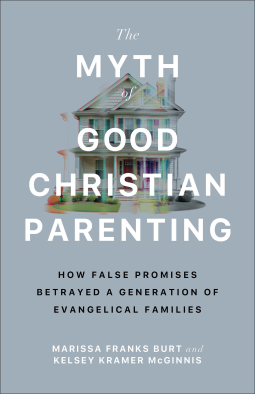
The Myth of Good Christian Parenting
How False Promises Betrayed a Generation of Evangelical Families
This title was previously available on NetGalley and is now archived.
Send NetGalley books directly to your Kindle or Kindle app
1
To read on a Kindle or Kindle app, please add kindle@netgalley.com as an approved email address to receive files in your Amazon account. Click here for step-by-step instructions.
2
Also find your Kindle email address within your Amazon account, and enter it here.
Pub Date 14 Oct 2025 | Archive Date 31 Oct 2025
Baker Academic & Brazos Press | Brazos Press
Description
Christian parents want to raise godly children, but what happens when popular biblical parenting methods cause more harm than good? The Myth of Good Christian Parenting exposes how the Christian parenting industry has sold families false promises for five decades, leaving a trail of religious trauma, damaged relationships, and lost faith in its wake. This groundbreaking analysis offers
● historical analysis - traces the development of the Christian parenting industry and its influential figures who built parenting empires;
● research-based insights - features survey data from adult children and parents affected by authoritarian parenting methods;
● theological examination - analyzes how popular teachings on authority, compliance, corporal punishment, and control diverge from Jesus's teachings; and
● encouragement for a better future - equips readers to pursue a new path of freedom and mutual respect within their families.
Marissa Franks Burt and Kelsey Kramer McGinnis combine rigorous research with compelling storytelling to reveal how evangelical parenting culture has shaped--and often strained--families from the 1970s to today. Drawing on history, sociology, theology, and extensive survey responses from adult children and parents, they trace the rise of Christian parenting empires that idealize obedient children and perfect households while leaving real families feeling inadequate. They also examine the lasting damage caused by popular Christian parenting teachings--including loss of faith, estrangement, religious trauma, and deep regret for older parents--and provide hope for healing.
Whether you're a Christian parent questioning traditional methods, an adult recovering from a strict religious upbringing, or a church leader seeking healthier family ministry approaches, this book equips you to pursue mutual respect, emotional safety, and authentic faith within your family relationships.
Advance Praise
"The Myth of Good Christian Parenting is a comprehensive reckoning of how abuse became sanctioned by Christian leadership. Religious trauma survivors know the fruit of that instruction all too well. This book belongs in every church, Christian counseling center, and trauma-informed therapist's office as a map that details how we got there and how we move forward differently."--Tia Levings, author of the New York Times bestseller A Well-Trained Wife and The Soul of Healing
"The Myth of Good Christian Parenting offers a courageous and compassionate critique of popular evangelical parenting models that shaped generations. By examining the sociopolitical undercurrents and doctrinal shallowness that have often characterized so-called biblical parenting, this work challenges long-held assumptions with clarity and care. Rather than offering a new formula, it invites readers to reclaim agency, embrace curiosity, and move forward with wisdom and humility as they disentangle cultural norms from the heart of Scripture."--David and Amanda Erickson, authors of The Flourishing Family: A Jesus-Centered Guide to Parenting with Peace and Purpose and founders of Flourishing Homes & Families
"Christian parenting needs rescuing, and The Myth of Good Christian Parenting reveals where things went so far off track."--Sheila Wray Gregoire, author of The Great Sex Rescue and founder of Bare Marriage
"Through fascinating historical and theological exploration, Burt and McGinnis graciously identify the pitfalls of Christian parenting tropes and invite readers to a more holistic, grace-filled posture. As a remarried widow in a blended family of nine, I needed this reminder and encouragement that there is no 'one right way' to parent!"--Clarissa Moll, four-time author and producer of Christianity Today's The Bulletin podcast
"Accessible and easy to understand, The Myth of Good Christian Parenting expertly surveys both the history of the evangelical parenting empire as well as the heartbreaking real-life stories from the children who survived it. Burt and McGinnis have created a groundbreaking and prophetic resource that will challenge and empower parents and other adults to see God's image reflected in children."--R. L. Stollar, author of The Kingdom of Children: A Liberation Theology
Available Editions
| EDITION | Other Format |
| ISBN | 9781587436642 |
| PRICE | $19.99 (USD) |
| PAGES | 240 |
Available on NetGalley
Average rating from 20 members
Featured Reviews
 Rachael N, Reviewer
Thanks to the publisher and NetGalley for the e-ARC. This is a thoughtful and thoroughly researched account of how certain doctrines shaped generations of parenting and what we can learn from (and learn not to do from) them. Particularly in an American context it’s vital reading and still valuable in my English context.
 Reviewer 627336
Meticulously researched, The Myth of Good Christian Parenting, is a journalistic and historical exploration of the Christian parenting empire in the 1970s to present, which touted “experts” such as James Dobson, Michael and Debi Pearl, and Tedd Tripp. Authors Marissa Franks Burt and Kelsey Kramer McGinnis identify the central myths of good Christian parenting, such as teachings on authority, children’s autonomy, sin nature, and of course, spanking. They also share interviews with adults who are recovering from the impact of these teachings, demonstrating the adults’ struggles with their sense of self, decision-making, faith, and relationship with their parents. This book is for anyone—whether you were a parent in this generation or a child—who is questioning the false promises of Christian parenting literature and wants to examine the outcomes.
Disclaimer: I received a free review copy from NetGalley and Brazos Press. I am friends with the authors and share a literary agent.
 Mary B, Reviewer
In the last 50 years, a crowd of Christian parenting gurus has sprung up, eager to share their knowledge and wisdom with parents desperately hoping to raise their children right. With the parenting advice also came an implicit promise: if you follow the correct method, you will raise good Christian children. With that first generation or two of children now grown into adults, the fruit of that movement is now becoming more clear, but it's hard to know how it all started and where many of these ideas came from. Throughout this book, Burt and McGinnis help to trace the origins of the popular Christian parenting authors and show how their ideas have shaped and continue to shape Christian families.
While some of these authors and thinkers referenced in the Myth of Good Christian Parenting have been around for a long time, it would be an error to assume that they are no longer active or that their ideas have been left in a previous generation. A few years ago, Ted Tripp, author of the popular Shepherding a Child's Heart book, presented a parenting conference at a church in my area. My own church arranged for a group of young parents to attend this conference, and so I read his book to decide whether or not to attend. Within a few chapters, I was absolutely horrified at the content. I could not imagine ever treating my toddler the way he was prescribing and calling it godly. After that, I began to realize how these books and ideas from my parents' generation were now being passed on to my generation.
It's high time we take a look at these ideas that have informed so many Christian parents and truly evaluate whether they resemble Christ and what we are called to as followers of Christ. Burt and McGinnis's overview and analysis of the Christian parenting industry gives parents the tools to be discerning and wise about the advice we are intaking. I pray their work will help lead to healthier and more Christ-like families!
Disclaimer: I received an advanced copy of this book in exchange for reading and reviewing it.
Angela C, Reviewer
I don't think we understand a topic until we learn the history, and this book is an invaluable look at "Christian parenting" books of the last 50 years, most all of which have been abysmally bad at best, abusive at worst. Abusive to the whole family, as the authors touch on the guilt and load laid on the parents as well as the unrealistic and unloving expectations on the children, most especially babies and toddlers. I was fortunate to escape the worst of things, being a "good" kid with reasonable and loving parents, and then being an attachment mom with my kids. All 8 turned out to be loving, responsible adults, so I know that gentle firmness works. But this is a work of history and analysis, not another parenting ,manual. Especially helpful is the chapter on sin and atonement, which I already have been rethinking with the help of other historical Christian views besides the one I was raised with.
 Sarah F, Reviewer
This is an excellent reckoning with a subject the western evangelical church is overdue to examine broadly. Burt and McGinnis look at the most popular/pervasive Christian parenting resources through a theological lens, inspecting the fruit as it has come. It is well researched and careful to keep the words of the books/teachers in proper context.
In short, many raised by the methods of these teachers have been deeply harmed, whether intentionally or not. Why is that, and is it in keeping with the character of God and the One we are told to emulate: Jesus? I will be recommending and giving this book to a lot of people in my life. It is not prescriptive; this is not another parenting method. They're just asking the right questions.
"Do Christians have the capacity to listen to the stories of the spiritual children of the church, to be angry and grieve and lament with those who sit among the ruins and to walk alongside those who want to rebuild? Is God incapable of preserving them—and all of us who make up the church (the sacred temple in whom he dwells!)—throughout this process? The pages of the psalms are filled with questions from lamenting children. God doesn't muffle or dismiss them. Indeed, the prophets remind people that performative empty obedience is never the goal. Religious communities are repeatedly called to collective repentance, and the kings of Israel, tasked with religious faithfulness, are publicly chronicled according to the sins of their fathers. The idea that humans can build and enact faith communities impervious to critique is erroneous. It's okay to be honest about the church's failings. We suggest that Christians not proceed from a posture of "How dare the children speak?" and "Shame on them for that tone!" Rather, let's be soberly aware that there's a day of reckoning for the emperors and tailors and pastors and parents and all who act as shepherds over God's people."
Kira Y, Reviewer
Whether you are a parent of adult children looking back on parenting, a young parenting trying to formulate your thoughts on the subject, just wanting to process your own upbringing, or curious about a historical deep dive on a niche topic, then this book is for you! Kelsey and Marissa do a fabulous job examining the history and culture behind the parenting empires as they arose in the 70s and how they have changed and morphed (or not) through the decades to today. They take thoughtful look at how culture shaped evangelic understanding of parenting in a “biblical” way and offer some hope of where do we go from here.
Dave R, Librarian
Marissa Franks Burt and Kelsey Kramer McGinnis have worked together to create a valuable resource for people who survived the Protestant Parenting Culture of the 1970s to current. The ideas that were used in the era had little scientific or scriptural basis, but were marketed as being Biblical. The intentions of the period authors aside, Burt and McGinnis explore how much cultural fears and fundamentalist expectations were more of a mode for parenting suggestions than they ideas were from a biblical exegesis.
As a young parent, Dr. James Dobson had dibs on nearly all decisions. Over time, our family joke became to say something outrageous and claim that it was heard on the daily Focus on the Family broadcast. In most ways, the Focus content was not as "Say What?" as Bill Gothard's Institute in Basic Youth Conflicts materials in our eyes. For me not coming from a home that I wanted to model, Dobson seemed reasonable, especially compared to other models we saw around us. We ended up like most parents, doing the best that we could in the cacophony of conflicting voices.
The book explores the ideas and follies that were used over the past several decades. The implications on later generations are set out. Although outside the scope of the work, the frequency of people deconstructing faith makes a lot of sense if the people were raised with some of the "Biblical" models that mixed inadequate views of children, overemphasis on The One Way To Raise Every Child, and a God who demands violence with hitting/spanking.
The resource identifies where the faulty ideas came from. It also provides a framework for evaluating parenting rubriks. The book serves as a great starting point for adult children to reconnect with parents, form better models for raising children, and have a place to evaluate what therapy is needed to unravel some of the generational pain. I look forward to sharing the book with my adult children and hope it can begin conversations to heal what was broken in the past.
Ethan E, Reviewer
Overall Review: 4/5
In The Myth of Good Christian Parenting, author and quasi-theologian Marissa Burt and youth-focused musicologist Dr. Kelsey McGinnis challenge many of the assumptions underlying modern evangelical approaches to parenting. Written for everyday Christian parents rather than academics or theologians, the book is approachable, well-researched, and aims to provoke thoughtful reflection rather than prescribe another “parenting method.” In their introduction, Burt and McGinnis critique the current state of evangelical parenting resources, inviting readers to evaluate the historical, sociological, and theological forces that have shaped the “Christian parenting” industry. They emphasize that each family (and each child) has unique needs, a point underscored by their observation that most parenting literature ignores children with disabilities.
Part One traces the rise of a capitalistic and consumer-driven “Christian parenting empire,” highlighting how pastors, theologians, psychologists, and entrepreneurs have worked together to market parenting formulas as biblical truth. The authors’ critique is sharp and well-documented, though at times it can feel more like a political or cultural commentary rather than a reforming of practices.
Part Two identifies several core “myths” in evangelical parenting thought, such as rigid hierarchies of parental authority, the conflation of sin with child-like behavior, and the tendency to view children as miniature adults who intentionally choose wrong and need to be controlled rather than divine image-bearers deserving respect. They note the irony of teaching that children are accountable for sin from birth but incapable of righteousness until maturity, and they question the popular analogy between God and parents promoted by authors like Tedd Tripp.
Part Three turns toward hope and reconstruction. Drawing on stories from those affected by these parenting ideologies, Burt and McGinnis encourage parents to adopt a posture of humility, curiosity, and love modeled after Jesus. Referencing scholars like Bruce Waltke, they call parents to reexamine familiar verses such as Proverbs 22:6 and to seek freedom from the anxiety of “doing it right.” While some readers might hope for more direction in how to rebuild their parenting style, Burt and McGinnis strongly encourage their audience to participate in the hard work of learning what is best for their individual families and children.
NOTE: The book does include a “Tool for Evaluating Resources” to help parents discern if certain books, podcasts, or other resources may be helpful or hurtful in their parenting journey. While I personally appreciate this, it can still fall flat for individuals who are looking for more direction.
In conclusion, The Myth of Good Christian Parenting is a clear, compassionate, and timely critique of the evangelical parenting industry. Rather than prescribing another method, the authors trace how modern “Christian parenting” has been shaped by consumerism, cultural politics, and selective theology, inviting readers to think critically about the assumptions they’ve inherited. Their writing is accessible and empathetic, particularly in its attention to the individual needs of each child (noting specifics like children with disabilities, who are often left out of many conversations) and its call for humility and curiosity over fear and control. While the book’s analysis can at times feel politically tinged and light on direct biblical exposition, it succeeds as a reflective and freeing guide for parents, pastors, and ministry leaders who want to move beyond formulas toward parenting rooted in grace, discernment, and love.
Strengths
Accessible and engaging: Written for everyday Christian parents, the book remains clear, readable, and well-researched without being overly academic or technical.
Insightful cultural critique: Burt and McGinnis offer a timely, fair-minded analysis of how evangelical and consumer influences have shaped “Christian parenting,” encouraging readers to think critically about inherited assumptions.
Empathetic and constructive: The authors show compassion for diverse families, including those with children with disabilities and other special needs, and conclude with a hopeful call toward humility, curiosity, and love.
Weaknesses / Limitations
Occasional political overtones: At times, the critique feels more reactive to political or cultural conservatism than rooted in biblical reconstruction.
More critique than guidance: The book excels in deconstruction but offers fewer concrete examples or theological depth for building a renewed parenting framework. Again, the “Tool for Evaluating Resources” helps to discern what materials you do find, but doesn’t offer anything in regards to what next steps the reader should take or where they should begin looking for sources.
Broad generalizations: The sweeping category of “evangelical parenting” risks oversimplifying the diversity of voices and approaches within that space.
Practical Usefulness
The Myth of Good Christian Parenting will be especially helpful for Christian parents who feel uneasy with formulaic or performance-driven approaches to raising children. It’s a refreshing resource for readers who sense something off in popular evangelical parenting models but haven’t had language to explain why. Pastors and ministry leaders who counsel families could also benefit from its insights, particularly in understanding the cultural and theological roots behind many parents’ anxieties.
That said, readers looking for a step-by-step guide or a deeply theological treatise may find the book less useful. It’s not a manual or a doctrinal exposition, instead you should think of it as an invitation to rethink assumptions. Those already confident in their parenting framework and uninterested in examining the broader cultural story behind it may not find it necessary.
Comparison
Burt and McGinnis enter a crowded field of evangelical parenting resources, but they do so with a markedly different goal. Rather than offering another “biblical parenting” model, The Myth of Good Christian Parenting pushes back against some of the most influential frameworks in recent evangelical history. They critique works like Tedd Tripp’s Shepherding a Child’s Heart and other “umbrella of authority” approaches that equate parental authority with divine authority and treat children primarily as sinners to be managed. They also challenge the market-driven nature of books such as James Dobson’s The Strong-Willed Child and Parenting Isn’t for Cowards, which blend pop psychology, conservative cultural values, and selective biblical proof texts into rigid formulas. In contrast, Burt and McGinnis invite parents to move away from control-based models and toward curiosity, humility, and Christ-like love.
Readers who resonate with The Myth of Good Christian Parenting may also appreciate:
Rachel Held Evans & Jeff Chu, Wholehearted Faith – for its invitation to faith marked by wonder and honesty rather than fear-based control.
Paul David Tripp, Parenting: 14 Gospel Principles That Can Radically Change Your Family – certainly different in how it may approach the pushback against conservative Evangelical parenting, this book does offer more practical tips for those who might be looking for something more practical.
Daniel J. Siegel & Tina Payne Bryson, The Whole-Brain Child – a secular work, but one that overlaps in valuing empathy, developmentally appropriate parenting, and child dignity.
Librarian 789836
Highly recommend this book - authors present an extensive, thoughtful take on the history of Christian parenting books and styles/methods and offer alternatives. Perfect for those that enjoyed Jesus and John Wayne or books by Beth Allison Barr.
Matthew C, Reviewer
For several months I have watched various videos from Marissa and Kelsey, read their posts on social media, listened to their deep dives into influential evangelical parenting books where they dissect the ideas within and expose the mythology behind the claims of self appointed evangelical parenting gurus. When they announced they intended to write a book on the subject of the falsehoods and abuses contained in popular evangelical parenting resources, I could tell they had already done a mountain of research on such issues and I expected it to be a throughly well researched success.
I was not wrong. In fact, they exceeded my already high expectations. With a tone of objectivity, they lay bare the various lies and false prosperity gospel promises of “good Christian Parenting” by drawing upon the testimony of childhood victims from Christian families; pulling apart the inconsistencies within the works of James Dobson, Tedd Tripp, Ginger Hubbard, Larry Christenson, Michael Pearl, Doug Wilson, Larry Tomczak, Bill Gothard, and others like Roy Lessin while also pointing out their incongruity with the words of Jesus; informing readers about the history of Religious Right political ideology and why it places such high importance on authoritarian parenting that relies on corporal punishment; and much more.
If I were to make comparisons with other exposés of evangelical culture, I would put it right up there with Kristen DuMez’s, “Jesus and John Wayne,” as both lay out a political history of the religious right and theology in church history with Marissa and Kelsey closely focusing on how those impacted evangelical parenting. I was impressed with how they drew upon the expertise of those in the fields of psychology, sociology, child development, religious trauma, and history; experts like Philip Greven, Dr. Stacy Patton, Janet Heimlich, Alice Miller, L.R Knost, William Sears, Elizabeth Gershoff, Ryan Stoller, etc…to draw attention to the ways evangelical parenting has caused religious and even generational trauma and research based suggestions for a healthier way forward.
This is a resource for any parent who feels their must be something better than the pain focused authoritarian parenting advocated by evangelical churches, evangelical authors, and influencers. It is also a necessary resource for any adult who is/or has deconstructed the faith of their childhood and wants to understand the impact of evangelical parenting on their trauma and their current faith journey. Marissa and Kelsey are brilliant women with a vast knowledge of history, theology, politics, child development, etc….all of which they drew upon to form this courageous and much needed resource.
Reviewer 1891935
This book is such a breath of fresh air for those of us who were taught there was only *1 right way* to parent our children, and only *1 desired outcome* for their growth to adulthood. There is so much pressure, anxiety, criticism, and shame around the way Christian parents interact with their children--it created huge conflicts for me as a young mom when all that "Christian" parenting advice was directly contradictory to what I knew about child development, and also clearly didn't produce the good fruit it promised. Every Christian parent needs to read this book.
Hannah C, Reviewer
I was raised in a conservative environment, and though I later left a great deal of the beliefs, I never would say my mom's parenting was a source of trauma. However, as I've parented my own child, I've realized there were practices that didn't feel right to me. It's hard to navigate both a love and respect for a parent and the feeling that something was off.
This book does a fantastic job showing the heavy yoke that parents have been placed under. This doesn't excuse them for harmful practices, but it shows why people chose shame-based strategies and corporal punishment. The authors cover the history of parenting teaching, along with a deep dive into the instruction given and why it is problematic. It gave me empathy for parents while showing me my gut is right--there is something dangerous in conservative Christian parenting teachings.
This is a book with a lot of grace. Even though it was hard to read, I felt encouraged in the end. I'm so grateful for the chance to have read this book, and I'm eager to share it with many of my Christian parent friends.
Reviewer 1891071
The Myth of Good Christian Parenting presents a needed perspective in a sea of "biblical" and authoritarian parenting resources that guide caregivers to detach from their intuition, treat children as subhuman, and promise prosperity. If you were parented with or surrounded by this popular teaching, you will be presented with its history, the harm it caused, and with the freedom to practice care for children that is rooted in their humanity and goodness.
Readers who liked this book also liked:
Elissa Yukiko Weichbrodt
Arts & Photography, Nonfiction (Adult), Religion & Spirituality
Sandra L. Glahn
Christian, Nonfiction (Adult), Religion & Spirituality