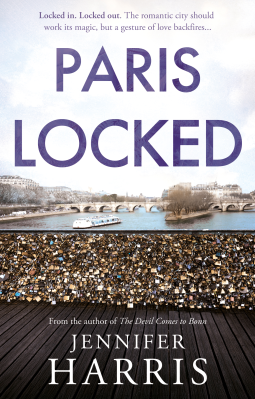
Paris Locked
This title was previously available on NetGalley and is now archived.
Send NetGalley books directly to your Kindle or Kindle app
1
To read on a Kindle or Kindle app, please add kindle@netgalley.com as an approved email address to receive files in your Amazon account. Click here for step-by-step instructions.
2
Also find your Kindle email address within your Amazon account, and enter it here.
Pub Date 28 Aug 2025 | Archive Date 1 Oct 2025
Troubador | Troubador Publishing
Talking about this book? Use #ParisLocked #NetGalley. More hashtag tips!
Description
A lovingly detailed novel of guilt and rumination in the City of Light. - Kirkus Reviews
A cleverly crafted and emotionally nuanced novel. - Independent Review of Books
A powerful story about accidental death, redemption, and ripples of effect that hold unintended results. - Diane Donovan, Midwest Book Review
Hitchcockian suspense with headier issues of genuineness and responsibility in art. – Paul W., NetGalley
Locked in. Locked out. Lovelocked.
The romantic city should work its magic but affixing a lovelock on a bridge backfires disastrously for Marian and Jason, leaving them floundering emotionally and morally. What do you do when decency demands that you do one thing, but your family needs another?
In this literary psychological novel, Marian and Jason come to Paris for Marian’s French debut art exhibition, but what should be a triumphant moment in her career coincides with her last desperate attempt to save her marriage.
When Marian and Jason put a lovelock on the Pont des Arts—a symbol to reaffirm their love after Jason’s infidelity—they unwittingly set in motion a tragedy that ripples through Paris as right-wing politicians seize a xenophobic opportunity. Marian finds herself locked in a moral quagmire. The impact of their lovelock reaches out to hurt the most unlikely and vulnerable people, leaving the couple lost in competing responsibilities in an event of international significance.
“Paris Locked” explores how the past becomes a prison. In a city where lovers immortalize their devotion with metal locks on romantic bridges criss-crossing the Seine, Marian must confront how places and actions lock people in—and lock others out—of narratives that frame our lives.
Available Editions
| EDITION | Ebook |
| ISBN | 9781836289715 |
| PRICE | £5.99 (GBP) |
| PAGES | 216 |
Available on NetGalley
Available to Buy
Buy on Amazon Buy on Bookshop.org Buy on Kobo Buy on WaterstonesAverage rating from 5 members
Featured Reviews
 Paul W, Reviewer
Jennifer Harris casts xenophobic clouds over the City of Light in her absorbing but not-for-everyone psychological thriller, “Paris Locked,” which combines Hitchcockian suspense with headier issues of genuineness and responsibility in art.
Of most interest for the general reader, though, will undoubtedly be the Hitchcockian element, which finds Australian artist Marian Featherstone opening an exhibit of what she calls her hyperrealistic art – paintings of children fashioned from photographs – at a Paris gallery curated by a Tunisian woman whose scary husband shares philandering predilections (in his case, combined with occasional violence) with Marian's husband, Jason.
Indeed, it's an attempt at domestic repair after
Marian discovers an instance of Jason's betrayal that makes for the novel’s precipitating crisis when, in a would-be reaffirmation of their love, the two affix a “lovelock” to a panel of Paris’ Pont des Arts bridge, an apparently common romantic gesture for Parisian lovers but new to me.
But inclement weather and faultiness of the panel to which they’ve attached their lock cause the panel to break loose and fall, which might or might not – they’ll not know for certain until later – be what causes the death of a Venezuelan girl in a boat passing underneath the bridge. Media reports in the next few days, though, will remove all doubt that their panel was indeed the culprit and make for them the question of whether to go to the police at a time when rage toward foreigners – the presumed culprits in the newspaper account – is being stoked by a right-wing politician whose France-for-the-French sentiments were reminiscent for me of a similarly themed French movie I saw recently, “The World of Yesterday.”
What if immigrants end up being punished for what they did, wonders Marian, who is more inclined than Jason to step forward, though she vacillates in her sentiment and, hard to imagine for me (I’d be immobilized with anxiety), is able to go relatively unperturbed about her daily activities, including preparing for her exhibit and casting about the city for fresh opportunities for her art.
The latter, in fact, makes for one of the more arresting moments in the novel for me, when she comes upon a child falling off a carousel and instead of offering assistance clicks a picture of the child, provoking comment from a friend she’s with, Alberta, that her behavior “looked a bit … well, off.” (Reminiscent the scene was for me of another novel I read just recently, C J Barker’s “Hungry Ghosts,” in which a son is put out with his acclaimed photographer father for not putting down his camera to help a nun he photographs immolating herself in protest of the Vietnam War).
Interesting and provocative, both the artistic issues that Harris’ novel raises (another one: whether facsimiles or copies are as valid as their originals) as well as its various story lines, including one in which Marian’s co-exhibitor, Stephanie, who has her own issues with the man in her life (as does Alberta, in a running theme in the novel) makes for an upsetting moment for Marian when she includes in one of her pictures a detail evocative of an especially disturbing incident in Marian’s earlier life.
A lot going on, then, in Harris’ novel, perhaps too much to be comfortably contained in a single work, something I also found true of her earlier “The Devil Comes to Bonn,” which for all its particular interest for me with its Third Reich setting had a couple of balls too many in the air for me. Also, there was an occasional excess of description and prose, as is also true of “Paris.” This, for instance: “The yellowing water spewed speckled, glazed bubbles that formed around the chief victims, the slimy soft stems of lisianthus.”
Still, for all my nits, and they are minor, both novels raise not just important artistic concerns but moral ones as well. In “Bonn,” for instance, the protagonist must weigh the very real peril that she could be putting herself and her husband in by working for the Resistance against the thousands of innocents she could be saving, and in “Paris,” Marian must weigh the undoubtedly unpleasant consequences for herself and her husband in coming forward against the scores of immigrants that she could be saving from roundups reminiscent of World War II.
Especially germane, that last, for our own current moment in America, when immigrants have become the bugaboo of our current administration (not to mention trans people), which together with its roundups and now with its boots on the ground in our capital city have made not so outlandish comparisons that have been made by some critics (among them, authoritarian expert Ruth Ben-Ghiat) between Trump 2.0 and the Germany of Harris’ “Bonn.”
 Reviewer 1491639
a thought provoking novel which lays lots bare and makes you want to think about all of it. the feeling of confusion, angst and quite het up feelings i had from this book, the subjects within and trying to figure out where my head is at with it is actually quite relatable to real our world. because there is a lot. a lot to think about that brings an unsettling existent for all, but for a fair few it must bring quite a lot of terror
but for the story itself i felt so deeply for our characters within particularly Marian. that woman has had it tough. the way the dominoes keep falling for her just feels unfair. she has marriage on the rocks to man who has cheated. her life is already riddled with other grief as shes lost her daughter and is still in the midst of that pain and not dealing with it. so she and her husband go on holiday, a break, to heal and feel together again. once there they do a symbolic action and tie a lock to a french bridge. but this causes another domino effect neither could have dreamed. in the worst way for these parents still grieving the loss of their own child, when the section of the bridge they locked on falls and kills a girl. no! now they face an unwelcome rise up when its believed, peddled that it was foreigners who caused this damage. and sides far and wide and very right come to the front. so do these two stay silent while innocent people are persecuted?
its all so mirroring of so much in our world today. it shines a certain mirror to it.
this can feel a tough book at certain points. at some i didn't feel quite clever enough for it. but then as the book went on and i got into the stride and managed to sort my thoughts out and be guided by the author on others i got it. and it tied it up in a way that felt right and was another deeply impactful set of moments. there is lots to take from this book and im really glad i got to read it.
Marian note to self. your husband showed you who he was. his cheating another symtom of this. believe him. leave him.
 Nicole R, Reviewer
Wow. There is a lot going on in this book.
We meet Marian, an artist and a mother, still carrying the deep grief of losing her daughter, a grief that’s never really been dealt with. Then there’s Jason, her husband, who’s cheated on her. She’s found out. They’re in Paris now, trying to patch things up and somehow rebuild their relationship while she’s also preparing for her debut art exhibition.
What should’ve been a turning point in their lives professionally and personally turns tragic when, in the middle of symbolically locking their love onto the Pont des Arts, a section of the bridge collapses, killing a young girl.
That moment changes everything. It spirals Marian deeper into facing her grief head-on, while Jason, yet again, emotionally checks out. The entire trip is meant to be a healing one, but it gets shadowed by guilt and loss.
At first, I found the book a bit confusing. There are so many themes: grief, betrayal, immigration, motherhood, identity, art. It was a bit overwhelming early on, and I wasn’t sure where the story was going. I honestly considered DNFing it around the 45% mark. But I stuck with it and I’m glad I did. It started to come together in the second half, and by the end, I appreciated what the author was building toward.
The ending, in particular, is what earned this a 3.5-star rating from me. It’s solid. Emotionally layered. Thoughtful. It tied things up in a way that made me reflect on the story differently than I did at the start.
As for Jason... yeah, he remained a douche in my mind. Infidelity is a hard plot point for me in any book, and this one was no exception. I found it challenging to connect with him or feel much sympathy, even when the story tried to offer depth to his character.
Tracy S, Librarian
Marion and Jason are in Paris trying to resolve issues in their marriage and set their relationship on a new step.
They have lost a daughter and grief is hard for Marian.
They decide to place a lovelock on the Pont des Arts and when a tragic accident happens killing a girl this sets of a course of events that will change their world
Thsis is a captivating and haunting read. I adored the Paris setting, the wintry backdrop helps with the emotions of the characters and marian in particular is a gorgeous character.
Readers who liked this book also liked:

We Are Bookish
General Fiction (Adult), Mystery & Thrillers, Sci Fi & Fantasy



We Are Bookish
General Fiction (Adult), Mystery & Thrillers, Sci Fi & Fantasy
Sarah Harman
General Fiction (Adult), Mystery & Thrillers, Women's Fiction