*This page contains affiliate links, so we may earn a small commission when you make a purchase through links on our site at no additional cost to you.
Part of Contemporary Asia in the World
Send NetGalley books directly to your Kindle or Kindle app
To read on a Kindle or Kindle app, please add kindle@netgalley.com as an approved email address to receive files in your Amazon account. Click here for step-by-step instructions.
2
Also find your Kindle email address within your Amazon account, and enter it here.
Talking about this book? Use #ChinasWeaponizationofTrade #NetGalley. More hashtag tips!
Description
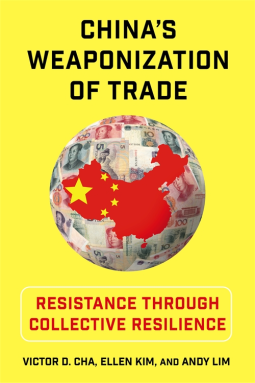
In recent years, China and the United States have each turned economic interdependence into an instrument of coercion, using their dominant positions in international trade to push states and firms to comply with their political goals. What is distinctive about this form of economic pressure, and how can other countries fight back?
This groundbreaking book explores the weaponization of economic interdependence and its implications for the international order through a wealth of new and original data on China’s economic statecraft. Victor D. Cha, Ellen Kim, and Andy Lim examine how and in what ways the United States and China have deployed economic coercion, focusing on China’s extensive use of this tactic over the past three decades. They analyze a vast data set that includes more than 600 cases of China’s economic bullying of states, companies, and individuals in North America, Asia, and Europe. Cha, Kim, and Lim propose a multilateral strategy of “collective resilience” to counter intimidation, showing how targeted states can band together, leverage trading relationships, and threaten retaliation.
Synthesizing new insights from unique trade data with international security expertise, this timely book sheds new light on how China exercises economic power—and it provides a playbook to deter bullies and rebalance the global order.
In recent years, China and the United States have each turned economic interdependence into an instrument of coercion, using their dominant positions in international trade to push states and firms...
In recent years, China and the United States have each turned economic interdependence into an instrument of coercion, using their dominant positions in international trade to push states and firms to comply with their political goals. What is distinctive about this form of economic pressure, and how can other countries fight back?
This groundbreaking book explores the weaponization of economic interdependence and its implications for the international order through a wealth of new and original data on China’s economic statecraft. Victor D. Cha, Ellen Kim, and Andy Lim examine how and in what ways the United States and China have deployed economic coercion, focusing on China’s extensive use of this tactic over the past three decades. They analyze a vast data set that includes more than 600 cases of China’s economic bullying of states, companies, and individuals in North America, Asia, and Europe. Cha, Kim, and Lim propose a multilateral strategy of “collective resilience” to counter intimidation, showing how targeted states can band together, leverage trading relationships, and threaten retaliation.
Synthesizing new insights from unique trade data with international security expertise, this timely book sheds new light on how China exercises economic power—and it provides a playbook to deter bullies and rebalance the global order.
*This page contains affiliate links, so we may earn a small commission when you make a purchase through links on our site at no additional cost to you.
*This page contains affiliate links, so we may earn a small commission when you make a purchase through links on our site at no additional cost to you.