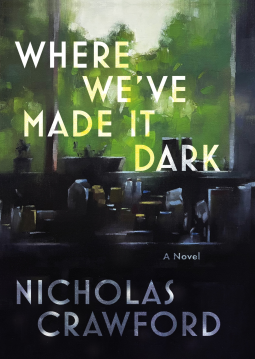
Where We've Made It Dark
by Nicholas Crawford
This title was previously available on NetGalley and is now archived.
Send NetGalley books directly to your Kindle or Kindle app
1
To read on a Kindle or Kindle app, please add kindle@netgalley.com as an approved email address to receive files in your Amazon account. Click here for step-by-step instructions.
2
Also find your Kindle email address within your Amazon account, and enter it here.
Pub Date 21 Oct 2025 | Archive Date 15 Oct 2025
ARC provided by Victory Editing NetGalley Co-op | Curtain Literary Press
Talking about this book? Use #WhereWeveMadeItDark #NetGalley. More hashtag tips!
Description
A work of sheer immediacy that realizes the zombie fantasy more fully than the fantasy itself.
Imogen starts summer vacation to find her brother watching zombies on the news. Quips fly, but the catastrophe in Indonesia still rips the future from anything she loves. The world ends before undead reach her door, and what Imogen faces is unthinkable: to leave her family in the apocalypse.
Containment slowly fails, and in an emptied out San Francisco, people have left for the hills, for survivorships, anywhere but cities. By the time the East Coast's plunged into extinction, SF's left one of the last places for the undead to touch. But that still doesn't mean its empty streets are safe.
Boba scavenging with a neighboring group of ex-techies makes life almost normal again, but each outing means more than just posturing every time they run into someone else. When the group needs unity, she stands her ground—but she's risking them too.
All her family wants is to keep safe, no matter what. But there's no more being yourself when everything about the world is gone. Whatever used to make sense, being brave or selfish, all that's there is life's end, violence the one thing that it brings.
And the only way forward for Imogen is out there, waiting—they all are.
Available Editions
| EDITION | Hardcover |
| ISBN | 9781968096014 |
| PRICE | $26.99 (USD) |
| PAGES | 486 |
Available on NetGalley
Average rating from 9 members
Featured Reviews
 Pixel B, Reviewer
“ A work of sheer immediacy that realizes the zombie fantasy more fully than the fantasy itself.
Imogen starts summer vacation to find her brother watching zombies on the news. Quips fly, but the catastrophe in Indonesia still rips the future from anything she loves. The world ends before undead reach her door, and what Imogen faces is unthinkable: to leave her family in the apocalypse”
To be frank, I ended up loving this book a lot more than I thought it would. I found it to be slowly paced in some sections, and the way that the dialogue was worded made it difficult to follow along, but I was so quickly sucked in. I found the world building to be utterly amazing, it almost felt like I was right there in the apocalypse.
Overall this book was both utterly heartbreaking and horrifyingly chilling that it left me actually wanting more, and I can’t wait to see what that author has in store next.
 Rhea I, Reviewer
Similarly to ‘The walking dead’ and ‘The last of us’, it focuses a lot on human relationships during a difficult time. How they grow, how they try to hold on onto their humanity, to their morality.
Where we’ve made it dark opens with a familiar, chilling premise: Imogen wakes to the news of a rapidly spreading, 28 Days Later-style virus originating in Indonesia, turning humans into raging, devouring beasts. The initial reaction—the predictable human scramble for essential supplies, including the now-classic pandemic trope of the toilet paper panic—offers a brief, humorous reprieve before the true dread begins to set in. However, if you expect an immediate, action-packed rush of survival horror, you’d be utterly disappointed, as the book quickly pivots from a study of the zombie threat to a deep, often uncomfortable, examination of the human condition.
Fair warning: there's a lot of dialogue here. The characters spend pages debating the entire zombie apocalypse—how they'd fight, what gear they need, what the infected would even do. These chats sometimes get philosophical or existential, which isn't automatically bad, but honestly, these conversations felt more like they were dragging things out, holding off on the fear and survival stuff we were really waiting for. The focus shifts when Imogen's dad makes her go back to college because the global threat seems distant. However, they settle down in a house with neighbours, which really sets the stage for the book's main conflict.
And here's the kicker: the real source of fear isn't the zombies (who barely show up until way too late for my taste). It's other people. The tension is all about cooperation versus the temptation of looting, and the brutal ethics of survival. This book absolutely nails the psychological aspect, making you wonder how fast societal veneers crumble under pressure. That human dread is super powerful, but if you came for classic horror movie scares, this book—despite its genre label—doesn't really deliver that suspenseful chilling thrill.
The things Imogen and her new group start doing while they seemingly ‘survive’ the zombie apocalypse will make you turn up your nose and feel disgusted by their rapid descent into immorality. It makes you think: if people can drop to this level so fast, maybe we've already lost the game as a species, zombie virus or not. This deep, cynical look at collapse is where the book shines, even though the long wait for any actual infected action had me convinced for a while that the whole zombie thing was a governmental deceit rather than an actual infection.
In the last 2 parts of the book Imogen will be alone for a while, no longer with her family and group. She'll find another community and try to integrate but of course doesn’t last. As we approach the end, we get less and less dialogue, a perfect change of pace to convey the loneliness of her journey. Eventually she will stumble upon Reed, the man she falls in love with (one of her romantic interests throughout the book). From this point forward, they will embark on a shared journey to discover their place in the new world.
The ending is just…sad and heartbreaking and yet somehow fits? You can feel the pain, the grief, it feels too real because the characters felt too real and the atmosphere trapped us in isolation on several accounts.
This is definitely a heavy, challenging read that puts the focus on psychological horror and social commentary instead of guts and gore. Totally recommend it if you love deep dives into character and existential debates in an apocalypse. If you're only here for the instant, gut-punching horror of a 28 Days Later movie, this might not be the book for you.
Many, many thanks to Nicholas Crawford, Victory Editing, and NetGalley for the ARC. This is a voluntary review, reflecting solely my opinion.
 Reviewer 1780693
This novel is a striking blend of horror, philosophy, and measured drama. While the framework is a zombie story, the novel quickly expands into something deeper, a reflection on fear, survival, and the fragile systems we exist in.
"Where We’ve Made It Dark" follows Imogen, who embodies the eldest daughter archetype. She’s cautious, pragmatic, constantly finding ways to hold herself and her family together when things are falling apart. Early on, she seems to lack a bit of nuance, viewing the zombie outbreak through the binary lens of good or bad. Don’t get me wrong, zombies are not ideal! However, in a world with zombies, the question becomes less about whether their existence is bad or good and more about how to contextualize life within the backdrop of impending zombie doom. That said, her rigidity speaks to her deep anxieties.
Nicholas Crawford’s writing style is unique in that it has the air of stream of consciousness but is not as verbose as is normal for that style of writing. It’s punctuated by short quips and observations. I’d say keep a dictionary handy when reading this book because Crawford drops SAT-level words. What I enjoyed the most is that the writing is both textual and contextual (perhaps a literary exercise in epistemology and ontology)? Crawford uses language itself as a way to explore what the UND infection, as biological, social, and emotional, really means to each of the characters but particularly to Imogen.
The chapters move quickly, making the book surprisingly easy to get through despite its heavy content. Within the brisk pacing, Crawford builds thoughtful discussions about the nature of humanity, community vs. rugged individualism, and the symbolic weight of zombies themselves. Philosophical threads are literally in conversation with one another through the characters. I will say I didn’t enjoy Sid, who comes off as heavy-handed and lecture-y at times. Also, despite perceiving himself as a sophisticated and level-headed thinker, Sid is shockingly naive in putting faith in American political institutions. I thoroughly enjoyed Imogen and Wes’s dynamic and philosophical musings.
A lot of the book’s strength lies in its layers and how timely (yet still potentially classic 20 years later) it feels. Reading it through a post-COVID lens adds more resonance to the narrative. It parallels real-world discussions about contagion, environmental collapse, and the uptick in zoonotic diseases. Case in point: when Imogen and Wes debate zombies vs. climate change, Crawford captures the sense that these crises are interconnected rather than separate. He deftly showcases how one influences the other and that survival depends on understanding that relationship on both a macro and micro scale.
Ultimately, Where We’ve Made It Dark is less about zombies than it is about what happens when humanity confronts its own reflection. Making it a coming-of-age story ensures that reflection is sharpened to a greater degree. How does one account for pivotal milestones when the world is falling apart? The book is thoughtful, haunting, and hopeful (without being saccharine). Crawford offers no easy answers, just the reminder that although life is a uniquely singular experience, living is never solitary, and that even in death, there’s room for rebirth.
4.7 stars!
 Kristi T, Reviewer
Where We’ve Made It Dark is a slow-burn literary horror, dystopian novel that unfolds against the backdrop of an impending zombie apocalypse. What’s interesting about Crawford’s approach is that the zombies don’t truly enter the story until the final third of the book. Before that, the horror comes from the breakdown of society and the increasing isolation of our nineteen year old protagonist, Imogen, as she tries to navigate a collapsing world where the dangers are both alive and undead.
The story begins with dialogue heavy scenes that establish Imogen’s relationships and the slow erosion of normal life. As the book progresses, her connections to others fall away until she’s almost completely on her own. This shift mirrors the transition from social tension to survival horror, culminating in her transformation from college student to reluctant survivor in a world where the rules have vanished.
The prose is distinctive and at time I struggled with its rhythm, the word choices, and sentence structures. There are no quotation marks, which at times made it difficult to follow who was speaking. The author’s style demands complete attention, this isn’t a book to dip in and out of casually. I found myself needing to read in longer stretches to stay grounded in the story.
I actually reached out to Nicholas Crawford to discuss some of these stylistic choices, and he was generous in sharing that the writing was meant to feel more "physical" to embody the tension and immediacy of the world he’d built. I appreciated that conversation and his openness to engaging with readers about his craft.
That said, the unconventional structure and lack of clear dialogue markers occasionally pulled me out of the story. While the premise is compelling and the final act delivers on the horror promised by the genre, the style and pacing made it harder for me to stay immersed.
Overall, Where We’ve Made It Dark is a thoughtful and ambitious take on the zombie apocalypse that leans more literary than action-driven, though there is plenty of action! Readers who enjoy experimental prose and slow, psychological horror will likely find it a worthwhile read. For me, it was a challenging read that required more focus than I expected, but I can appreciate what the author set out to accomplish.
Readers who liked this book also liked:
Kalan Chapman Lloyd
General Fiction (Adult), Literary Fiction, Women's Fiction
Views expressed in promotions/advertisements do not necessarily reflect those of NetGalley or its affiliates.
© 2026 NetGalley LLC
• All Rights Reserved


Views expressed in promotions/advertisements do not necessarily reflect those of NetGalley or its affiliates.