Swiftynomics
How Women Mastermind and Redefine Our Economy
This title was previously available on NetGalley and is now archived.
Send NetGalley books directly to your Kindle or Kindle app
1
To read on a Kindle or Kindle app, please add kindle@netgalley.com as an approved email address to receive files in your Amazon account. Click here for step-by-step instructions.
2
Also find your Kindle email address within your Amazon account, and enter it here.
Pub Date 27 Jan 2026 | Archive Date 15 Apr 2026
Talking about this book? Use #Swiftynomics #NetGalley. More hashtag tips!
Description
A feminist romp through pop culture that illuminates how women influence and shape the economy.
Taylor Swift isn't just a pop megastar. She is a working women whose astounding accomplishments defy patriarchal norms. And while not all women can be Beyoncé or Dolly Parton or Reese Witherspoon, the successes of these trailblazing stars help us understand the central role of women in today's economy.
Swiftynomics assesses the complex economic lives of everyday American women through the stories of groundbreakers like Taylor Swift, Misty L. Heggeness digs into the data, revealing women's hidden contributions and aspirations—the unexamined value they create by pursuing their own ambitions. She highlights the abundance of productive activity in their daily lives and acknowledges the barriers they still face.
Exploring critical reforms regarding caregiving and gendered labor, this book offers advice for women to thrive in an economy that was not built for them.
"Take a personal Eras tour with Swiftynomics and musically meander across the history of women in the economy, society, and family. Being a Swiftie has never been more meaningful."—Claudia Goldin, Harvard University, and Nobel Prize–winning author of Career and Family: Women's Century-Long Journey toward Equity
Advance Praise
"Take a personal Eras tour with Swiftynomics and musically meander across the history of women in the economy, society, and family. Being a Swiftie has never been more meaningful."
—Claudia Goldin, Harvard University, and Nobel Prize–winning author of Career and Family: Women's Century-Long Journey toward Equity
"Swiftynomics is the rallying cry we didn't know we needed. It's smart, fun, and asks exactly the right question: What happens when women own their economic power? Misty Heggeness shows us that whether you're filling stadiums or juggling three jobs while caregiving, you're part of a revolution. This book will leave you feeling seen—and ready to shake things up."
—Reshma Saujani, founder of Girls Who Code and Moms First, and author of Pay Up: The Future of Women and Work (and Why It's Different Than You Think)
"No one understands the Swift Effect quite like Misty Heggeness. With sharp analytical insight, she weaves together data and cultural lore to show how Taylor Swift and her contemporaries are rewriting the rules of the economy. Swiftynomics is a playbook for the rule breakers, the storytellers, and the dreamers determined to change the end game.”
—Cody Broadway, NBC Universal executive producer of The Swift Effect
"This upbeat and irreverent tribute to feminist economics shows what a can-do attitude can do: make big ideas sing."
—Nancy Folbre, author of Making Care Work: Why Our Economy Should Put People First
"Reading Misty Heggeness is like talking to a smart, funny, deeply knowledgeable friend. She shows us how a path to an abundant, prosperous society runs through women: as producers, consumers, storytellers, entrepreneurs, professors, change artists, and moms. Our era is now!"
—Anne-Marie Slaughter, Bert G. Kerstetter '66 University Professor Emerita of Politics and International Affairs, Princeton University
Marketing Plan
- National book tour planned -- following major Eras tour stops
- First serial placement
- Book review, off the book page, and podcast tour
- Influencer outreach
- Advertising in print and digital
- National book tour planned -- following major Eras tour stops
- First serial placement
- Book review, off the book page, and podcast tour
- Influencer outreach
- Advertising in print and digital
Available Editions
| EDITION | Hardcover |
| ISBN | 9780520403116 |
| PRICE | $26.95 (USD) |
| PAGES | 264 |
Available on NetGalley
Available to Buy
Buy on Amazon Buy on Bookshop.org Buy on WaterstonesAverage rating from 41 members
Featured Reviews
 Reviewer 1488466
Very Well Written. As a huge Taylor swift fan, I immediately wanted to read this, and it gave me a different perspective of her. I was not expecting this type of book but upon reading it, I found out i wasnt aware of what she was actually doing to the world around us. Such a great book!
 Jordan V, Bookseller
I will take any opportunity to talk about the pure magic and genius that is Taylor Swift, but having a literal report of the economic impact that she has created just shows what a powerhouse she really is.
I was lucky enough to attend The Eras Tour in 2024, and I saw firsthand the effects of the tour on New Orleans, LA - it was legitimately a different city that week! Small businesses were thriving, the streets were clean, the city was safe, and it was one of my favorite experiences.
Overall, this book is so well written and thought out, and I really enjoyed reading it!
Note: I understand that it's far too late for this comment, but "Swiftie" is always spelled with an ie, and not a y.
Thank you to the author and University of California Press for my advance digital copy!
 Literary R, Reviewer
A brilliant and beautifully written book about the profound impact of female mega talents like Taylor Swift on the economy. Women, own your economic power like Taylor, and your life will be immeasurably better!
Reviewer 1903196
I differ from other readers whose reviews I have seen in that I am not a fan of Taylor Swift and am not taken in by the power of her celebrity or in awe of her in that way. Yet, I found this book to be an incisive and interesting look at the socioeconomic and political history of women in work. In this book Heggeness uses Taylor Swift as a lens through which we can analyse and better understand how the role of women in the American workforce has transformed over time and how economic independence is just as fundamental a right to actively bolster and support in the fight for women's rights as reproductive rights, right to political participation, and the right to education are. I especially appreciate that the author doesn't shy away from discussing race, sexuality, invisible labour, caregiving and the current attack on initiatives such as diversity and equity. As a result of the choice to include these topics, Heggeness provides a rich and nuanced view of how we define and understand the role of women in the economy and challenges the way that we are taught to seek and interpret data about the circumstances of societies at large by walking the reader through the ways that certain kinds of data are prioritised whilst other more inconvenient data is either ignored or not even recorded.
 Lindsay C, Reviewer
Swiftynomics was a smart, empowering, and surprisingly fun read that made economics feel fresh and deeply relevant. The author blended pop culture, feminism, and data with wit and insight, showing how women, both megastars like Taylor Swift and everyday people, drive the economy in powerful ways. I loved how engaging and accessible it was while still delivering sharp analysis and real takeaways. It made me see both pop culture and economics through a new lens.
Thank you to NetGalley, the author and the University of California Press for providing me with a copy of this book in exchange for an honest review!
 Jen T, Reviewer
An enchanting read about the money side of Taylor Swift. It was interesting to read about the economic impact by her, especially with the Eras Tour and how she boosted the economic of cities.
 Sunanda V, Reviewer
“Swiftynomics” is a look at the macro and microeconomics impact of women in the world. This book is primarily concerned with women and labor, consumer choices by women, and the broader cultural impact of women as active participants in modern day capitalism. With this in mind, I found the title and framing of this book both confusing and a little strange.
The content of this book seems to have some interesting things to say about the intersections of gender and economics. However, I found that it was obscured by the often times awkward shoehorning of Taylor Swift into each chapter and paragraph. I found it very distracting to have subheadings that were all titles of Taylor Swift songs when the arguments of those sections often had nothing to do with the song’s subject matter. I found myself getting bogged down in wondering why the author chose to title each section and what the connections might be to Swift’s hyper intentional lyrical choices.
Each chapter does try to explicitly tie in some aspect of Swift’s life or career with the themes it’s exploring, but the connections were flimsy at best.
I was really looking forward to this book, as I’m both a swiftie and a behavioral economics nerd. If this book had been presented as quite simply a look at gender and economics in the 21st century and had ONE chapter that focused on Taylor Swift, that would have landed much better than what it is currently doing.
I also want to note that the title of this book is especially misleading and confusing — since the Eras Tour, the Swift effect is a known phenomenon used to describe the economic impact of Taylor Swift on countries and cities her tour visited. My thought initially was that this was going to be a book that focused solely on the economic impact of Taylor Swift or the economic power of swifties. While this book speaks to that briefly, the scope is much larger.
The research and writing in this book are clearly done with care and rigor. And I don’t object to the quality of the writing! I wish this book had been marketed differently and had tried less to shoehorn Swift into every single idea.
 Liz L, Reviewer
A fascinating deep-dive into women’s participation in the economy, structured around how Taylor Swift (and the Eras tour, her re-records and purchase of her masters, and everything else surrounding her) demonstrates it.
If you’re a fan, you’ll appreciate the references (each section begins with a lyric or quote). If you’re not a fan, don’t worry— this book uses Taylor as a starting point, but covers everything from other musical artists to actual economists.
(I got this ARC through NetGalley)
 Sharyn S, Reviewer
This was a great book about women's roles in the economy, as well as the challenges we face. The author discusses working mothers, pay inferiority, and how women are not treated equally as they should be. She used Taylor Swift, as well as other celebrities such as Beyonce and Madonna, as examples of hard working women who had to fight to get to where they are today. This book is perfect for feminists who need a boost to show how strong women are, and that we can do anything we set our minds to, even if we have to work a bit harder to get there. This book gave me hope that we're on the right path to women holding more leadership positions, and the changes we can make in this world.
Reviewer 937803
Part history. Part educational. Part love letter to Taylor Swift. I thoroughly enjoyed this well researched book that explained Taylor Swift’s impact not just as a musician and icon, but as a businesswoman. Thank you Misty Heggeness (go KU) and NetGalley for the opportunity to read Swiftynomics.
 Alexandra V, Reviewer
✨ Swiftynomics by Misty L. Heggeness
⭐️ 5/5 stars
Economics + Taylor Swift? YES, PLEASE! 💡
Swiftynomics is an absolute gem for anyone who loves Taylor Swift and wants to understand the economics behind her empire. Misty L. Heggeness combines sharp analysis with an engaging, witty tone that makes complex concepts feel approachable and entertaining. The book dives into how Swift’s business decisions, branding, and cultural impact intersect with economics—and it does so in a way that feels fresh and empowering.
What I loved most is how the author uses real-world examples from Swift’s career to explain broader economic principles. It’s smart, creative, and surprisingly inspiring. Whether you’re a Swiftie or just curious about the business of fame, this book is a must-read.✨ Swiftynomics by Misty L. Heggeness
⭐️ 5/5 stars
Economics + Taylor Swift? YES, PLEASE! 💡
Swiftynomics is an absolute gem for anyone who loves Taylor Swift and wants to understand the economics behind her empire. Misty L. Heggeness combines sharp analysis with an engaging, witty tone that makes complex concepts feel approachable and entertaining. The book dives into how Swift’s business decisions, branding, and cultural impact intersect with economics—and it does so in a way that feels fresh and empowering.
What I loved most is how the author uses real-world examples from Swift’s career to explain broader economic principles. It’s smart, creative, and surprisingly inspiring. Whether you’re a Swiftie or just curious about the business of fame, this book is a must-read.
Reviewer 1831887
3 Stars
I did not love this book, but I think there are plenty of other readers who will like this more than me (particularly anyone who is a Taylor Swift fan). On the positive side, I think this book is very accessible and unique, and it tackles important discussions about women's contributions to the economy. The writing was satisfactory and easy to understand. If you're looking for a feminist and empowering economics read, this book may be perfect for you.
Positives aside, I found the quality and arguments of this book suffered for trying to spotlight Taylor Swift as much as it did. The structure did not work well - it was at times clunky (like the chapter on motherhood, which essentially was introduced by saying Taylor Swift has a mother, so let's talk about mothers). The segment headers were all Taylor Swift song titles, which broke up the flow of the book and felt a bit forced.
While other female singers and pop culture hits were mentioned (including Beyonce, Madonna, and the Barbie movie), it truly was the Taylor Swift show in this book, and that framing minimized the success of women that came before her. Furthermore, I think there are several areas this book failed to confront issues due to the Taylor Swift framing. For instance, the author advocates for more government support of women and mentions Taylor Swift's status as a billionaire without making the connection that the existence of billionaires is inherently problematic - the taxes that billionaires should be paying has the potential to help women at all levels.
Additionally, because Taylor Swift is white, this book has a decidedly white perspective. I would have been interested to hear more about different groups of women, but it feels like that diversity of perspective was missed in this book.
Lastly, on the topic of politics, Taylor Swift is portrayed as a person who is always forthcoming about her politics and inherently supportive of women's rights. Her decision to vote for Kamala Harris was portrayed as an unforced public announcement (when in fact, Taylor Swift announced her endorsement to counteract deep fake videos of her endorsing Trump). Details like this made it feel as though the author could not or was not willing to say anything remotely negative about Taylor Swift, to the detriment of her overall argument.
While I am happy this book exists, and I hope that it finds its audience, I think there was a lot of room for improvement here. I think the book would've been much stronger had one chapter focused on the positive economic impacts of the Era's tour, and then delved into other topics using other powerhouse women to anchor the author's arguments. To focus so thoroughly on a single person diminishes the diversity of women and their unique contributions to the economy.
 Demetris P, Reviewer
Friendship Bracelets to Policy Blueprints: Why “Swiftynomics” Uses Pop Stardom to Expose the Real Rules of Work and Care
By Demetris Papadimitropoulos | February 1st, 2026
“Swiftynomics” is a book with an unruly premise and a disciplined agenda. Its author, an economist who writes with the gusto of a magazine essayist, uses Taylor Swift as both subject and structure: a living illustration of how women build value, protect it, lose it, and then, with the patience of someone rerecording an entire catalogue, take it back. The result is part cultural criticism, part care-economy manifesto, part history lesson, and part field guide for anyone who has ever been told that the things women organize, tolerate, and carry are “personal choices” rather than public design.
The easiest way to misunderstand this book is to assume it is simply about Swift’s GDP-adjacent impact: hotel bookings, resale platforms, friendship bracelets turned into micro-commerce, the traveling city of the “Eras Tour” and its economic wake. The author does cover that glittering terrain, but she treats it as an entry point, not the destination. Swift is a narrative lens that sharpens a larger argument: women have always been economic agents, yet the dominant stories and the dominant models keep rendering their labor partial, invisible, or sentimental.
The book borrows Swift’s own grammar of reinvention – eras, pivots, strategic withdrawals, returns with receipts – and turns it into a framework for women’s lives. The author’s key term is “mastermind,” a word Swifties recognize as a wink but that “Swiftynomics” insists we take seriously. To be a mastermind is to play the long game in a world that keeps asking you to accept the short one. Underestimation is not merely an insult in this telling; it is a recurring economic condition. The women who move through these pages do not simply “balance” or “have it all.” They plan, improvise, compromise, strategize, recalibrate, and sometimes burn out, then start again, because the system has been built to treat their endurance as an unpriced resource.
A central pleasure of “Swiftynomics” is its refusal to keep its influences separate. It can pivot from a fandom anecdote to labor-force participation, from a kitchen-table argument to a critique of macro models, from the anthropology of comment sections to the mechanics of a policy that “backfires” because it assumes men and women begin with the same endowments. The writing is eager to be read by non-economists, which means it favors clarity over academic throat-clearing and scenes over specification. That bias sometimes compresses nuance, but it also gives the book a decisive advantage over more timid nonfiction: it does not pretend its subject matter is sterile. It treats the economy as a story about time, bodies, households, and what a society chooses to subsidize.
The most persuasive chapters are the ones that treat care not as sentiment but as math. The author returns repeatedly to “buffers” – the formal and informal supports that make family life compatible with paid work. She argues that the United States modernized women’s opportunities in the labor market faster than it modernized the structures that make those opportunities livable. Prior generations widened educational access, fought for workplace rights, changed laws, and cracked open doors that had been bolted shut. But the deeper architecture of daily life – childcare, paid leave, flexible work without punishment, healthcare that does not function like a private luxury – lagged behind. Women entered a workplace built to imagine a worker without caregiving responsibilities, then were told to solve the mismatch through grit and better calendars.
The pandemic becomes, in this book, a brutally clarifying lab experiment. When schools closed and parents absorbed the extra shift, the author observed not only exhaustion but a national shrug. She recounts the rage of mothers who watched exemptions bend for certain businesses while families were expected to privately manage the mental, logistical, and economic fallout of remote schooling. The point is not nostalgia. The point is hierarchy: what the state rushed to protect, what it treated as a domestic inconvenience, and how quickly the burden defaulted back to women when institutions wobbled.
One of the book’s sharper insights is sociological rather than statistical: the insistence that parenting is private does not merely isolate families, it also rewrites gratitude into shame. When a neighbor helps, the help is framed as a burden; when a parent struggles, the struggle is framed as personal failure. The author’s diagnosis is that this is not a psychological quirk but an ideological inheritance. It is reinforced by policy choices like the 1970s veto of universal childcare and by a cultural story that treats caregiving as a moral identity rather than a shared civic project. In that story, “help” is generosity; it is never infrastructure. “Swiftynomics” wants to rename the problem: what families need is not sporadic kindness, but systems built for human lives.
If this sounds like familiar territory, it is because the book lives in conversation with a shelf of care-economy and gender-labor touchstones: “Fair Play,” “Holding It Together,” “Finding Time,” “Already Toast,” “Invisible Women,” and Claudia Goldin’s work on the career-family collision. But “Swiftynomics” is not merely a remix of that literature with a pop soundtrack. What it adds is pop-cultural immediacy and a knack for making abstraction feel like a lived scene. It is also cannier about persuasion than many books that share its politics. It understands that readers are not convinced by a moral scolding; they are convinced by recognition. A number becomes real when it is attached to a day, a household, a humiliation, a missed promotion, a postpartum body, a sick parent, a daycare waitlist.
When the author turns to political organization, she grows more hopeful without turning naïve. She describes the speed with which women can mobilize when a moment demands it: rapid-response Zoom calls, affinity groups turning community into infrastructure, fandom converting recognition into turnout mechanics. The subtext is clear: the tools exist; what’s missing is the willingness to treat care as a public good rather than a private hobby. In this section the book’s “we” can feel capacious, a coalition rather than a scold. The reader is invited into a modern form of civic life that is improvised, networked, emotionally fluent, and often led by women who have learned to build systems in the very places the state refuses to.
A late chapter on sports offers one of the book’s most concrete examples of institutional design. Kansas City Current’s purpose-built stadium becomes, in the author’s telling, an argument in architecture: spaces can be engineered to accommodate caregivers rather than treat them as afterthoughts. Breastfeeding rooms, sensory spaces, the presence of family life made visible instead of hidden. The point is not that sports will save us. The point is that environments can be built. Culture is not weather. It is a set of choices that become habitual, and then hard to see.
Celebrity, in this book, is not a distraction from politics and policy; it is a tutorial in strategy. The author’s most compelling celebrity case study is arguably not Swift but Beyoncé, whose 2016 “Daddy Lessons” backlash becomes a story about racialized gatekeeping disguised as genre purity. The book’s detour into Black cowboys and cowgirls is not decorative history. It is a demonstration of how power curates memory: who is allowed to belong, who is marketed as an anomaly, who is edited out and then blamed for not “being there.”
These chapters are energizing because they treat strategy as a craft rather than a mood. Reinvention, the author argues, does not mean erasing your past; it means minimizing what holds you back and building a future position that better fits your goals. It is here that Swift’s rerecordings become more than gossip. They are a case study in ownership, contracts, and the difference between being a revenue stream and being a rights holder. It is also here that the author’s Swiftian cadence – brisk, emphatic, motivational without (usually) turning saccharine – can feel like a pressure valve for the book’s heavier material. A reader is allowed, briefly, to feel the joy of someone outmaneuvering a structure designed to extract from her.
But the book is also at its most vulnerable here. Celebrity long games work partly because celebrities can afford time horizons and can survive periods of strategic silence. For an ordinary care worker, “play the long game” can sound like an instruction delivered to someone already holding two jobs and a mental load. The author knows this, and she tries to correct for it by pivoting back to policy. Still, the tension remains, and it is productive tension: individual strategy is not a substitute for structural change. If the book sometimes flirts with the fantasy that enough masterminds could individually outplay the system, it pulls itself back toward its own thesis. The point is not merely to survive. The point is to redesign the conditions of survival.
“Swiftynomics” is most rigorous when it insists that better narratives are not enough. We need measurement. We need statistics that count what has been treated as uncountable. Here the author introduces “The Care Board,” a project designed to quantify the economic contributions of care activities, from formal childcare and nursing home work to the unpaid labor of household maintenance. The plea is methodological as much as moral: if you do not measure an economy, you do not govern it well. If care is invisible to data, it becomes invisible to urgency, and if it is invisible to urgency, it becomes invisible to budgets.
This is also where the book leans on its personified abstraction: “Economic Man” versus “Economic Woman.” It is a useful heuristic, a way to dramatize what standard models omit. But like all binaries, it can flatten. At times “Economic Man” becomes a straw figure for every institutional failure, and the reader may crave more attention to the many women who enforce the same norms, or to the ways class and race rearrange the burdens inside “women’s work.” When the book does broaden its lens, it is often through the texture of lived example: who can pay for help, who can’t; whose job tolerates flexibility, whose doesn’t; whose fatigue is treated as a private weakness, whose is treated as proof of commitment. The book is strongest when it shows how “choice” often looks like triage.
In the conclusion, the book reaches its most explicitly political material. The author frames the overturning of Roe v. Wade as an economic story as well as a legal one: restrictions on reproductive autonomy shift costs and life trajectories in gendered ways. Children require resources. In a society that tolerates men’s ability to evade the costs of unintended parenthood, the removal of reproductive choice functions as a redistribution of risk onto women. The author’s point is not that everything is economics; it is that economics shows you who is forced to pay.
From there the book becomes a policy menu, and here it can feel, depending on your temperament, either bracing or breathless. The author calls for paying parents for invisible labor via robust child credits delivered monthly, universal paid parental leave with “use-it-or-lose-it” paternity provisions, universal affordable childcare, investments in before- and after-school care, flexible work rules that do not sabotage advancement, and a national dashboard that makes the care economy legible. She anticipates familiar objections about cost and “incentives,” and answers with a quiet dare: if the state can mobilize vast sums for banks, industries, and crises that threaten capital, why does it suddenly become allergic to investment when the beneficiaries are families?
This is where the book’s tone becomes more exhortative: vote, organize, stop accepting the bargain of perpetual overwork. There is rhetorical satisfaction in that pivot, and also strain. A reader may wish for more acknowledgement of political constraints, of how policy becomes law, of how backlash weaponizes “family values” to keep the care burden right where it is. But the book’s impatience is also part of its identity. It wants to move the reader from recognition to agency, and it prefers to risk being too direct rather than remain decorously academic while households quietly fracture.
The afterword is among the book’s most affecting sections. It shifts into herstory: grandmothers whose labor appears as gardens and holiday treats; a mother who bought a 1968 Mercury Cougar with her own wages and later divorced in an era that punished women for doing so; an obituary that reads like a résumé, proof that a woman wanted to be seen for contributions beyond her home. There is even the haunting story of a distant ancestor, Lisbet Nypan, accused of witchcraft for healing with herbs and prayer – punished, in effect, for the crime of being useful outside sanctioned channels. These stories are not mere ornament. They are the book’s closing proof that women’s work has always been economic, whether or not the official record acknowledged it.
This coda also clarifies the author’s voice. “Swiftynomics” is not written from a remove. It is written by someone who has done the commute with cranky children, who has felt the mathematical dread of a single income in an expensive city, who knows the motherhood penalty not as theory but as a shadow over lifetime earnings. The intimacy is an asset even when it occasionally leads the author to overreach. It explains, too, the gratitude in the acknowledgments: a lineage of women scholars and editors, including Nancy Folbre, appear not as prestige name-drops but as evidence of a community that made this kind of crossover book possible.
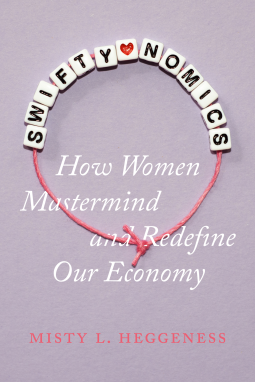
A small, delightful detail, and one that signals the book’s care for symbolism: the cover’s friendship-bracelet inspiration, and the use of Adobe Caslon, a typeface redrawn and digitized by Carol Twombly for Adobe in the 1980s. It is the kind of fact that would be trivial if the book were superficial, but here it lands as a quiet thematic rhyme. Women’s fingerprints are everywhere in the infrastructure of culture. We simply do not train ourselves to look.
“Swiftynomics” wants you to look, and then it wants you to act. Its method is to translate private fatigue into public structure, to reframe “help” as “infrastructure,” to turn a pop phenomenon into a language for policy. It sometimes hurries, sometimes sermonizes, and occasionally asks Taylor Swift to carry more argumentative weight than any single cultural figure should. But it is also lively, learned, and unexpectedly tender toward the reader, not because it promises you can transcend systems by positive thinking, but because it insists you are not imagining the burden. The burden has a shape. It has a cost. It has a history. And it can, with enough will and enough data and enough collective insistence, be redesigned.
I’d place “Swiftynomics” at 86 out of 100: an accessible, idea-dense work whose best pages make the economy feel newly visible, and whose weaker moments reveal the strain of trying to build a coalition out of both fandom and frustration. By the end, the book earns its own Swiftian flourish. Losing things doesn’t just mean losing. Sometimes it means gaining the vocabulary to demand them back.
 A C, Reviewer
A bright, feminist, pop‑economics read that’s far more fun than a book about labour markets has any right to be.
Carrie W, Reviewer
I loved this deep-dive into the phenomena that is Taylor Swift on her world tour. When I first read the BBC article about Taylor Swift's concerts contributing a significant amount to local economies via hotels, restaurants, and other activities, I was struck by the power of women's financial interests to move markets. I was so proud and awestruck because many patriarchal societies ensure that women do not reach their full financial power, but this movement really showed everyone, especially men, that even though they don't get paid as much, their interests and voices have more power than men would expect.
One aspect I particularly enjoyed about this book was the chapter titles touching on various Taylor Swift songs, or eras, because it shows not only the evolution of her music, but also how female fans grew up with her while experiencing their first financial milestones, such as getting an allowance to graduating to a part-time job, and so on. It was an echo of the growing financial power women will experience as they move from their pre-teens into their adult years, so hitting the last chapters felt like a crescendo. However, there is no telling when this phenomena will happen again, leaving the conclusion an open-ended curiosity of speculation.
 Abigail A, Librarian
Review of advance copy received from Netgalley!
As a huge Swiftie, I loved this and, as someone who reads a lot of activism related literature, a lot of the information included in this book wasn't very new to me. However, that does not detract from Ms. Heggeness writing a book that centered women in the economic sphere while consistently tying in fandom and doing it well.
I attended the Eras tour, as did many of my friends, and just my small friend group of Swifties alone easily contributed thousands of dollars to the phenomenon that is the Eras tour. Never had women had so much access to income as they have in recent years and I loved seeing how Heggeness showed us that that income heavily impacts our economy, locally and internationally, and always has, but hasn't been documented.
I was given the opportunity to read this title by NetGalley, in exchange for an honest review.
Heather M, Reviewer
Swiftynomics was a great insight into how Taylor Swift built her empire and the economic impacts that her status of an artist has brought to the country and world. I think being able to read about Swift and other women in the industry was a real eye opener and lent a different perspective for someone like me who loves Swift as an artist but wasn't as aware of just the extent of her overall reach and the impact to the economy. I think this is a testament to how impactful one person can be and how the strength behind the woman can make the difference.
Thank you to NetGalley and the publisher, University of California Press, for an advance copy of this book in exchange for my honest review.
Dana G, Reviewer
Great book of relating a power house girl boss to your own economic power. We can get a better understanding of how the role of women in the American workforce had changed over time.
 Melissa B, Reviewer
Swiftynomics by Misty L. Heggerness is a dynamic explanation of the cultural and economic influences surrounding the overwhelming success of Taylor Swift. By comparing the swirling patterns of the economic shifts of the nation to lyrics from Taylor's most famous songs to her rise in popularity, Heggerness has written a book that delves deeply into the inner workings of popular mainstream music.
Filled with reviews, analytical data, and glimpses of a world dominated by billboard topping superstars, Swiiftynomics is a fun and creative way for readers to reacquaint themselves with the current economy markets. Although, Heggerness takes a much more sophisticated and personal approach by using reflections of Taylor's concerts and music.
Reviewer 1498169
Swiftynomics by Misty L. Heggeness uses Taylor Swift's career as a framework for understanding how women create economic value in ways that traditional metrics consistently miss. Heggeness, an economist with a gift for accessible prose, grounds this work with pop culture references in real data. Overall, the book is warm, witty and genuinely engaging. People who have never picked up an economics book will find themselves absorbed, and the book's core thesis lands with real force thanks to Heggeness's combination of personal storytelling and statistical evidence.
The trade off though is the depth. This book covers an enormous amount of territory from historical gender inequity to personal empowerment. As a result, individual topics sometimes get a broader treatment. Using the Taylor Swift framing is a great hook, but it can feel more decorative than analytical. Still, it's entertaining and a great entry point for readers looking to explore topics related to women and the economy.
 Natalie J, Librarian
This book was too literary for me. By the cover, it appears to be lighthearted and easily digestible, but I found it hard to comprehend unfortunately. I am a huge Taylor Swift fan but this book seemed to be for a very specific audience. I feel if this book were "dumbed down" a little, it would appeal to many more people. It almost read like a research paper.
Reviewer 510528
This book did have a lot of good information. It was nothing new that I haven't seen in a ton of other sources, but having it all consolidated in one place helps to strengthen the arguments. The Taylor Swift messaging is also likely to draw in readers who may not normally be interested in an economics book, which also helps to further spread the message. The messages this book is trying to send are ones that many people need to hear. I appreciated the discussion of domestic labor and the comparison of a female running a household to a Fortune 500 CEO. However, I expected more analysis of how Taylor Swift's popularity drives this women led economy instead of just cute puns of her song titles as chapter and section headers.
Penelope B, Reviewer
I have loved my fair share of Taylor Swift music and moments. I think most importantly this book discusses future directions that will meaningfully bring equity to women, and in particular public policies that provide psychosocial safety nets to parents and children. This book provides concrete suggestions of things to support, such as universal childcare and recognition of women and care providers’ crucial role in the economy. These are extremely important points. In general, I think the author uses Taylor as an springing point to explore these crucial issues, and I am okay with that. And, maybe even six months ago, I would be even enthusiastic about the enthusiasm here about Taylor. Today, in March 2026? When she has remained unconscionably silent about so many pivotal events in America (and the world) and failed to use her platform, influence, or power to actually push forward the progressive and feminist and humanistic values we have all thought she possessed? That says a lot about a person’s character and has left me with a sour taste in my mouth for Taylor that I’m not sure anything could redeem at this point. I do think the larger points in this book are wonderful, I just think Taylor herself does not deserve as much credit as she is given here. Really, aren’t the heroes here the women who lift up other women and project meaning and purpose onto public figures, even if said figures are not fully deserving of it?
Reviewer 859611
If you're looking for a way for a subject like "Economics" (with a stigma of being dry) to be made interesting through the lens of Taylor Swift and women being the driving force of the economy, look no further than economist's Misty Heggeness' "Swiftynomics."
Following reading this, had the opportunity to also speak with Misty directly on the subject and was able to discuss further, which was shared on a recent episode on ACOFAE Podcast.
https://podcasts.apple.com/us/podcast/special-episode-26-swiftynomics-how-women-mastermind/id1544053785?i=1000752397629
 Tina R, Reviewer
Wow! Honestly I was not expecting so much from this book. There is now a rather substantial list of Women that I need to explore more and I have this book to thank for that. This does a great job of introducing and reminding us how far we have come and how far we still need to go while keeping a glimmer of hope that we have the power to make it there if we work in community. Highly recommend.
 Olivia W, Educator
I don’t have much background in economics, but I definitely know my fair share about Taylor Swift. As someone who would usually hesitate to pick up a book centered on economics, I found Swiftynomics to be equal parts interesting and enjoyable! Heggeness does a great job exploring the connections between fandom, labor, value, and power dynamics, and making those complex ideas easily digestible (and tied to Taylor Swift!) It felt like an invitation to see the systems we live in through a sharper, more informed lens. This was a fascinating read and one I will be recommending to other feminists, Swifties, and the economically curious in my life.
 Victoria H, Educator
Women have always participated in the economy but not always or often recognized as doing so, especially when caring for their own families.. Caregiving is work period. This, all women know. Unfortunately the targeting of this book to Swifties may find it preaching to the choir rather than changing perspectives. It seems like the author went to the publisher with an idea to either do a book on Taylor Swift and economics OR the role of women in the economy and was then encouraged to add the other element--but I would have preferred one or the other.
Still an engagingly written and interesting take!
 Becca D, Reviewer
Thank you to NetGalley and to the publisher for this e-arc in exchange for my honest review.
I really enjoyed the structure of this book and found it to be fairly interesting. Didn't appreciate the way that others were mentioned in a sort of minimizing type of way was a little odd, even though I do understand that this is a book about Taylor Swift but it still feels a bit odd to diminish other strong women.
 Taren H, Reviewer
"Swiftynomics" by Misty L. Heggeness is a book about women's role in modern society and economics packaged in Taylor Swift theming and anecdotes. I would place it on a shelf with Eve Rodsky's work, which is referenced a few times in the book. "Swiftynomics" is packed with interesting research that feels very up-to-date with content around the pandemic and its effects on women's careers.
If the Taylor Swift-inspired packaging encourages more people to pick it up, then that's a win because the subject matter is important, but I do feel like it was almost an afterthought and could be interchangeable with any number of female empowerment brands. Barbie, for instance, is mentioned a number of times throughout. While there are quotes and anecdotes around Taylor Swift and her business savvy, the book is much less about Taylor and her Eras Tour economic impact than one would be led to believe based on the cover and branding and more about general modern socioeconomic studies concerning women. Chapters are organized into sections with Taylor Swift lyrics and song titles as a way of organizing information, but often these are at face value and don't really relate to the content housed within.
Again, the material itself is important, and this is packaged in a way that makes it feel accessible and interesting to an audience who may not have picked it up otherwise. However, if you're hoping for a book mostly about Taylor Swift and her impact on business and the economies of the tour stops on the Eras tour, you may be disappointed, as that is more supporting content at best. The book is pretty interesting overall, and as a working mom around the same age as the author, I found the subject matter relatable and validating. If you're a fan of "Fair Play" by Eve Rodsky or books like "Invisible Women," you'll likely find this book a good read, especially if you're a Swiftie.
Thanks to the publisher and NetGalley for the advanced read.
Courtney M, Reviewer
“Some days it’s tempting to daydream about being The Man. But then I am reminded of his flaws and shortcomings and it’s enough to make me a mad woman” pg 34
I really enjoyed this book. The correlations made with the songs and the subject matters were so well done. I learned a lot about economics and I appreciate at the conclusion that she details what are government should be doing to move towards equity. I’m so energized by this book and appreciate that it comes at a time where we need it. This book is not just for Swifties it is for everyone. I like that the author doesn’t just focus on Taylor as I know most of her lore. I was interested in learning about Frances Perkins (where was she in US History class in high school?!?). Not only did I learn some great information but it made me reflect on where I got my feminist views from. What from my lore made me see the inequity and say I deserve more? And how much of that was seeing Taylor grow up in the public eye. Seeing how society treats a girl just trying to be successful in everything she does.
Emily N, Educator
I've consulted so many books on Taylor Swift, as i've taught two similar variations of a class on her, but I really appreciate this text. It's unique in how it folds in so much background information on people of all kinds. So that Swift's actions and especially her lyrics guide the book, but Heggerness makes the stories and economics more accessible and therefore more meaningful. I know that students would really respect that, and the book adds something to the conversation that I haven't found before in books on Swift. I also greatly appreciate the discussion of her writing and how she uses first names as a way to create a sense of gender parity throughout the book.
 Janet E, Reviewer
Whether you're a Swiftie or not I'm sure you heard of The Eras Tour as it was probably the biggest event of the past...10-20 years? It was the event that got all different types of people together in huge groups after Covid and proved touring could be hugely successful.
Taylor Swift has said she's always cared the most about her songwriting, but realises that what she does with her money and how she pays people/how she affects to countries she goes to matters and she wants that to be a part of her legacy.
Nobody could've guessed that this young woman would go from the girl next door who shared her journals with us through lyrics to becoming such a huge name that even she is breaking records that she previously held. No one is at the same level as Taylor Swift and this book shows that in numbers and hard facts.
It's very interesting to read a different view of Taylor where it's more analytical.
It's an easy read and if you're a student and taking econ. this could be a book you use for a project.
 Tally T, Bookseller
This was honestly fun in the most BWL Way possible.
Girlboss but make it so, that Tom from Accounting is weeping in his gym socks.
It wasn't to dryly written and the pop culture references made it fun, a book that feels like both educational and just a big rant.
 Jordan M, Reviewer
I wanted to love this, but unfortunately it reads as a part-celebrity history, part-opinion piece. It seems this book was written for white suburban moms, not all women. There were plenty of opportunities for more economic data and more intersectionality of women but the common thread was, Mom’s should be paid for unpaid labor (which I don’t totally disagree with) and not a look into women’s impact on the global economy.
Thank you to NetGalley and the publisher for this early copy in exchange for a review.
 Kari C, Bookseller
I learned a lot reading this book. The author premise is how Taylor Swift's Eras tour showed how women impact economics. While some things are better for women in economic terms we also have been moving backwards and have a long way to go. She brought up many points that I have not thought of. The author does repeat herself and some of the discussion can be dry. Overall it is an interesting look at economics from a woman's point of view.
Educator 1827406
Swiftynomics bietet einen spannenden Blick darauf, wie Taylor Swift zu einem globalen Wirtschaftsfaktor geworden ist. Das Buch verbindet Popkultur mit wirtschaftlichen Zusammenhängen und zeigt anschaulich, welchen Einfluss ihre Tourneen, ihr Marketing und ihre Fan-Community auf Unternehmen und ganze Regionen haben können. Dabei bleibt es verständlich geschrieben und liefert viele interessante Einblicke.
Eine empfehlenswerte Lektüre – nicht nur für Swifties, sondern auch für alle, die sich für Marketing, Wirtschaft und den Einfluss moderner Popkultur interessieren.
Laura A, Reviewer
This book was really intetesting. I love the mixture of economics with plenty of Taylor Swift references thrown. I would reccommend having an interest in both to choose this book.
 Kyle Wendy S, Reviewer
Swiftynomics takes an unconventional approach to economics by using Taylor Swift's career as a lens through which to examine women's labor, financial independence, and the often-overlooked economic value of caregiving. Misty Heggeness blends Swift's career milestones with historical examples of influential women and economic research, encouraging readers to rethink traditional ideas about work, power, and success. Even readers who aren't die-hard Swifties will find an engaging discussion about the intersection of economics, history, and culture.
I loved how the book celebrated women who have shaped history despite significant obstacles. I especially enjoyed learning more about trailblazers such as former US Secretary of Labor Frances Perkins, singer Dolly Parton, English Aristocrat Lady Idina Sackville, and economist Phyllis Deane. These stories added depth and context, reminding readers that progress has often come through the determination and resilience of women whose contributions deserve greater recognition. The book's positive message about women's autonomy and potential resonated with me throughout.
While I appreciated the research and many of the historical discussions, I occasionally found myself less persuaded by some of the author's conclusions. The economics sections became dense and academic, causing the pace to slow at times, and certain phrases (particularly 'long game' and 'lean in') were repeated often enough to become distracting. I agreed with many of the problems the author identified but wasn't always convinced that her proposed solutions allowed enough room for differing family dynamics, individual priorities, or personal choice. Those moments prompted me to stop and reflect, even when I disagreed.
One of the book's most compelling arguments is that many forms of labor traditionally performed by women - particularly caregiving, household management, and raising children - remain largely invisible despite their enormous economic value. Heggeness also examines persistent issues such as the gender pay gap, unequal expectations surrounding unpaid domestic work, and the structural barriers that can limit women's financial independence. Throughout the book, Taylor Swift's willingness to continually reinvent herself serves as a recurring example of how adaptability, creativity, and determination can empower women to gain greater economic agency and the freedom to shape lives that reflect their own goals and priorities.
Overall, Swiftynomics is a thoughtful and well-researched work that challenges readers to think differently about economics, caregiving, and women's contributions to society. Although I didn't agree with every conclusion, I appreciated that the book challenged me to examine my own assumptions and articulate why I felt differently. Any nonfiction book that teaches me something new, introduces me to remarkable historical figures, and continues the conversation long after I've finished the final page has earned its place on my bookshelf (and a solid four-star rating).
Whether you agree with every conclusion or not, Swiftynomics is the kind of nonfiction that encourages readers to think critically, question assumptions (including their own), and continue the discussion long after turning the final page.
Who Would Enjoy This Book?
• Taylor Swift fans looking for thoughtful cultural analysis rather than celebrity gossip.
• Readers interested in feminist nonfiction and women's history.
• Students and professionals in economics, public policy, marketing, or labor studies.
• Book clubs seeking a nonfiction title that encourages lively discussion.
• Anyone who enjoys books that blend biography, history, economics, and social commentary.
Readers who liked this book also liked: