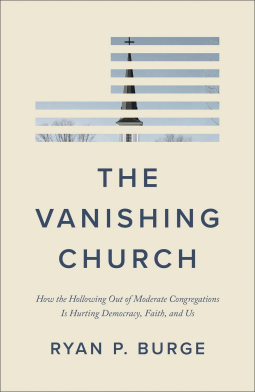
The Vanishing Church
How the Hollowing Out of Moderate Congregations Is Hurting Democracy, Faith, and Us
This title was previously available on NetGalley and is now archived.
Send NetGalley books directly to your Kindle or Kindle app
1
To read on a Kindle or Kindle app, please add kindle@netgalley.com as an approved email address to receive files in your Amazon account. Click here for step-by-step instructions.
2
Also find your Kindle email address within your Amazon account, and enter it here.
Pub Date 13 Jan 2026 | Archive Date 1 May 2026
Talking about this book? Use #TheVanishingChurch #NetGalley. More hashtag tips!
Description
The moderate American church is disappearing--and it's taking democracy with it.
Many people assume evangelicals are Republican, Democrats aren't religious, and moderate Christians no longer exist. But that wasn't always true. In the 1980s, evangelicals were just as likely sit beside a Democrat as a Republican at church.
What changed?
In this groundbreaking book, data scientist Ryan Burge reveals
● how religious polarization reshaped America and caused many to leave church,
● why faith became an identity in the culture wars,
● the hidden truth that Americans are more moderate than the media suggests,
● why polarization in our churches affects all aspects of social connection and community, and
● a path forward for churches to bridge political divides.
This book reveals how political polarization transformed American Christianity over the past fifty years and why this divide impacts every aspect of society. Drawing on extensive data, Burge shows how churches that embraced conservative politics during the culture wars drove away millions of moderate and liberal Christians, hollowing out congregations that once bridged political divides.
Burge makes a compelling case that America needs churches now more than ever--not as political battlegrounds but as spaces where people of different backgrounds and beliefs can come together. Blending personal stories with rigorous, up-to-date research, The Vanishing Church offers hope that faith communities can help heal our divisions and restore the common ground essential for democracy to thrive.
Advance Praise
“Ryan is a skilled and influential analyst of data about American religion, and in this book he brings years of research to bear on sketching out the contours of a church broken in half by polarization. With churches shifting to political and theological extremes, moderate Christians are left without faith communities to call home. The questions Ryan raises about political extremes and the fortunes of faith in America are some of the most critical questions of our time, and the answers he provides, though bracing, offer some room for hope.”—Elizabeth Bruenig, staff writer for The Atlantic
“Ryan Burge is my go-to source for data and analysis about religion in America, but his understanding goes far beyond statistics. He recognizes how the dramatic shifts in beliefs and congregations over the last thirty years have spilled over into every part of our culture, including politics, and this book will help those without much religious literacy understand the importance of these often-overlooked trends. Burge has also seen these changes up close as a pastor, and he brings that lived wisdom into his writing.”—Skye Jethani, cofounder and editor in chief of Holy Post Media
“When it comes to forecasting and analyzing demographic trends in American religion, there’s no one I trust more than Ryan Burge. In The Vanishing Church, he offers a sobering and data-rich portrait of a religious center that is rapidly disappearing. Even those who don’t share all his theological conclusions will find indispensable this book’s insights into polarization, pastoral fatigue, civic loss, and what the future of the American church will mean for all of us.”—Russell Moore, editor in chief of Christianity Today; author of Losing Our Religion: An Altar Call for Evangelical America
“In The Vanishing Church, Ryan Burge delivers exemplary and balanced research that confirms some of our deepest hunches about the state of churches today while also upending assumptions we didn’t realize we held. With clarity and compassion, he invites us into a more honest understanding of faith in America today. Most powerfully, Burge encourages Jesus followers to resist the pull of extremes and to authentically pursue the flourishing of both the church and our nation.”—Kara Powell, chief of leadership formation, Fuller Seminary; coauthor of Future-Focused Church
Available Editions
| EDITION | Other Format |
| ISBN | 9781587436697 |
| PRICE | $26.99 (USD) |
| PAGES | 232 |
Available on NetGalley
Average rating from 11 members
Featured Reviews
 Angie M, Reviewer
A thoughtful and well researched book from a political scientist or sociologist standpoint. Although Ryan Burge is a pastor, there isn't as much of a pastoral tone. There are lots and lots of data points, telling the reader the difference in how many people surveyed respond to data points such as "are you religious" "how often do you attend services" "Do you identify as evangelical" Over time those pages had a tendency to be a bit dry for me, but they are necessary to make the author's points. From a hope perspective, I learned that while church attendance for moderates is rapidly declining, more people have more moderate beliefs than we think. I think the typical reader would be a mainline protestant wondering why their church is losing members. This book will show that it may not be your church or denomination, that the religious right has increased in popularity, that more far left people identify as atheists.
Another point he makes over and over again is that "it wasn't always this way"- that in the 1980's the evangelical church was 50/50 democrat vs republican. That unfortunately churches have become a place that is "far right coded" and the more mainline churches are losing members. Social media highlights mostly fringe beliefs, even though more americans have more moderate views. For example, the southern baptist convention published a stance against IVF, but only 8% of members of the SBC were against IVF.
Thank you to NetGalley and Brazos Press for the ARC. Book to be published January 13, 2026
 Dave R, Librarian
When Ryan Burge mentioned that this book was in process in a recent podcast, I kept an eye out for it. I hoped it would provide some answers to questions I had in my own church. The Vanishing Church helps to define a problem that has arisen over the past decades, establishes ways to counter the problem, and provides an understanding for why church doesn't seem like home anymore.
A strength of a church can be its diversity of demographics, race, economics, and politics. A church that eliminates by choice or by inattention the ability for people of differing aspects of life to sit next to each other in the pews (or chairs) sets itself up for being locked in to a particular voice. The locking in might be successful in some aspects -- growing in numbers, growing in budget -- but has the distinct possibility of shredding connection to swaths of people. As churches pursue the purses of microsectors, other people are pushed out of the picture. The growth of religious "Nones" is one result of this trend. The pursuit also drives current attendees away, sometimes to another congregation (better than some options) and sometimes to quitting affiliation altogether.
Burge concludes with several takeaways that can lead to a more diverse congregational life in the church. The concepts he proposes are not necessarily new, but are a necessary reminder about the value of people who differ from ourselves. My fear is that the people who need to hear the message the most are the people who are the least likely to look and listen outside their echo chamber.
Kelly B, Reviewer
Ryan Burge is a political scientist who specializes in the impact of religion on American life. He is also a lifelong Christian who has worked in several churches. The Vanishing Church focuses on how political polarization has transformed American Christianity. Burge writes as both a researcher (who loves graphs and data), a practicing Christian (who deeply believes in the local congregation), and an American who cares about the public good. All three of these passions are revealed in this insightful and thought-provoking book.
He divides the book into three sections: Five Decades of Religious Polarization, Social and Political Polarization, and A Way Forward. His statistics are both illuminating and sobering. His theory is that moderate religion has declined rapidly, as a result of political polarization. Those who identify as Republican, by and large, are attending evangelical churches. Those who identify as Democrat, by and large, are identifying as atheist, agnostic, or "none" (no specific religion). There was a time when Republics and Democrats worshiped in the same pew, in the same United Methodist Church, for example. That church (and those like them) attracted those across the socioeconomic spectrum, people of different educational backgrounds. The local mainline Protestant church, then, was a place where people practiced listening to one another, learning from each other. People developed empathy; the social fabric was woven together more tightly. Without those churches (and all mainline Protestant denominations are rapidly declining), the polarization just becomes worse.
I learned a lot from this book. I learned that the Roman Catholic Church in America is becoming much more conservative (following its clergy). I learned, surprisingly, that the number of evangelicals is not rising (though their influence is.). I'm also left with many questions. Burge's last section is entitled, "A Way Forward" and he issues a passionate plea for the return of the moderate church, but it is not in the least prescriptive.
 Becki B, Reviewer
Listen, if you are in the small subset of people who find this topic fascinating, you are going to be *captivated* by this book! (That's me. I have told multiple people about this book while I've been reading it!) My story is that I grew up in a very evangelical, very conservative home during the 1970s, 80s, and 90s. Since 2016 I've experienced significant shifts in both my religious beliefs and my politics, and even now, I can not determine which set of beliefs changed first. I only know that I stopped calling myself a Christian when I grew overwhelmed by what felt like the very strong voice of unified Churchianity telling me that I was *not* part of them any longer.
Author and political scientist Ryan P Burge comes loaded with stats and presents the case that over the past 50 years, the American church has gone from being a community of diversity and moderation to being a near monolith, especially politically, but also socio-economically. He heralds the church as the one of the last remaining spaces where diverse populations could influence each other. From "The Vanishing Church", "Standing shoulder to shoulder with a bank president and a factory worker while reciting the Apostles' Creed can do wonders in creating understanding and compassion across the class and political divides facing the United States. However, the American church is continuing to fall far short of that ideal, becoming a haven for those whose lives have stayed on a narrow path. This has led to an increase in misunderstanding, a decline in empathy, and a further fraying in our social fabric."
Burge does a really great job of laying out the situation and the dangers. He is less forthcoming with solutions, which is my only complaint. Still, I'll continue to recommend this book because I think it was really eye-opening and brings specific data points to something that I had been feeling about religion and politics, but couldn't verbalize.
My thanks to the author, publisher, and #NetGalley for an ARC of this book. It drops Jan 13, 2026 and should be required reading for those who care about church health and growth.
Lori Z, Educator
The Vanishing Church makes for a compelling yet easily read book, as Ryan peels back the layers from the past, bringing them along into the present. Seeking to understand and explain the state of the moderate church and how we got where we are today. Clearly there is no one explanation and through the use of graphs and charts that tandem the writing we get a much clearer insight and understanding of those who have left, those who have stayed and a look at the demographics of these people, along with the a view of the church collective. It truly is a fascinating study of the church as it stands today and perhaps a hopeful look at a future for the church. This book isn't just for clergy and academics, it can be read by anyone who has questions about the future of their own church.
Kasia K, Educator
Well-researched and heartbreaking. There are lots of stats, percentages, and all of it is followed by reflection. It could be overwhelming and dry for many, but for me, it is very, very sad. Why? Not because the number of people who call themselves religious is declining rapidly, not because our society has literally ditched the church, BUT because we knowingly and willingly are turning away from our roots as a civilization, not just as a population. Our legislation, our lifestyle, our history, our art, and our traditions — all of these are based on Christian values. I think you don’t have to believe to be one. Christianity, for me and for many, means belonging. Belonging to Western civilization. If we turn away from ourselves, we will vanish, just like so many others before us.
Brandon B, Reviewer
Ryan Burge has a knack for getting to the point of data. His insight about the data he shares is aided by his sharing of the raw data. In the book The Vanishing Church, Burge highlights both issues and possible paths to solutions. His optimism comes through even though the subject can be discouraging for those of us in ministry. The solid data and analysis of that data is incredibly helpful.
 Reviewer 451445
Helpful and revealing look at the decline of Christian denominations and the history behind this. It could also be used as a wake up call to the church.
Librarian 789836
Important work for Burge that should interest both Christians and non-Christians in how politics has polarized church attendance over time. Will be purchasing for library.
 Baillie J, Librarian
It turns out that Ryan P. Burge and I are from the same area of Illinois, which I did not know until I started reading!
I appreciated the commentary in this book. I did not realize that traditional Protestant denominations were declining by such a drastic amount. As someone who grew up in the UMC, that makes me very sad. :(
Although very heavy on the statistics for my personal taste, this book definitely offered a lot of educational value and thoughtful perspective. An interesting read!
Readers who liked this book also liked:


Elissa Yukiko Weichbrodt
Arts & Photography, Nonfiction (Adult), Religion & Spirituality
Chantal Morales McKinney
Biographies & Memoirs, Nonfiction (Adult), Religion & Spirituality