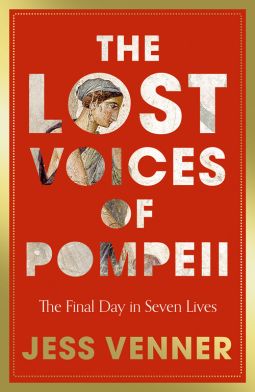
The Lost Voices of Pompeii
The Final Day in Seven Lives
This title was previously available on NetGalley and is now archived.
Send NetGalley books directly to your Kindle or Kindle app
1
To read on a Kindle or Kindle app, please add kindle@netgalley.com as an approved email address to receive files in your Amazon account. Click here for step-by-step instructions.
2
Also find your Kindle email address within your Amazon account, and enter it here.
Pub Date 23 Apr 2026 | Archive Date 29 May 2026
HarperCollins UK, Nonfiction | Mudlark
Description
Relive the dramatic last day in Pompeii in this immersive story, based on the city’s real residents
We all know how the people of Pompeii died.
But what about how they lived?
Drawing on the latest archaeological discoveries, Dr Jess Venner brings the ancient streets to life through the eyes of those who lived, worked, loved and ultimately met their fate in Pompeii.
Along the way, Venner reveals a community more complex, diverse and human than we ever imagined. We meet Julia Felix, a successful female entrepreneur defying Roman convention; Petronus, a slave grappling with his future after gaining his freedom; politician Gaius Cuspius Pansa, who cements his power and prestige by hosting the Plebian Games at the amphitheatre; and many others.
Pompeii is remembered for its destruction, but here we discover the vibrant lives that came before. Richly evocative and immersive, The Lost Voices of Pompeii vividly recreates the final twenty-four hours before the eruption, reminding us exactly what – and who – was lost in 79 AD.
Available Editions
| EDITION | Ebook |
| ISBN | 9780008756826 |
| PRICE | £9.99 (GBP) |
| PAGES | 320 |
Available on NetGalley
Available to Buy
Buy on Amazon Buy on Bookshop.org Buy on Kobo Buy on WaterstonesAverage rating from 28 members
Featured Reviews
 echoreads ., Reviewer
Thank you to the author and NetGalley for giving me an ARC of this book.
Dr Jess Venner creates a vibrant and vivid reconstruction of the lives of several figures on the last days of Pompeii, using archaeological evidence and written sources to provide accurate details of their lives. These figures include a recently freed slave, a affluent woman, a freed woman and her family, a politician, an innkeeper, and a business man. Through them, the last days of Pompeii are brought (back) to life.
I found the author's evidence for an eruption date in October extremely compelling. It makes more sense than the conventional date given, especially considering the types of clothing that people were wearing and the complicated way that the Roman calender worked.
I really liked the little details that worked to flesh out the different narratives, especially the inclusion of graffitti. The baths, gladitorial games, market place, and multi-cultural aspects of Pompeii were really brought to life in this book. I especially liked the inclusion of different ethnicities, particularly the North African Traders, and the clear influences from Greece on Rome's architecture and culture.
The events after the eruption were really well explained, whilst also highlighting the harrowing nature, and the loss of life. I appreciated the inclusion of slaves as, although there is little evidence for their lives, it really showed the different social aspects that made up Pompeii society.
All the sources used by the author were really well documented and expanded on.
 Victoria B, Reviewer
This was another victim of my "I have no work, therefore I have no money and have to cancel some pre-orders" spree, and so I was so excited to be sent an a-arc.
I have climbed Mount Vesuvius (back when I could walk and wasn't in a wheelchair) and have been to Pompeii - although I became very unwell halfway through and spent the second half of the tour sightseeing in the Pompeii bathrooms. But it was interesting just the same. I wish I'd gone to Herculaneum too, which was also a victim of the eruption, but you could only do the trip to Vesuvius with Pompeii and I really wanted to do Vesuvius. I think I need to go back to Pompeii on a day where I'm not poorly.
The introduction itself was enough for me to know this would be a special book. The passion Jess has for learning, education, history, and wanting to share the stories of 'forgotten' people is so moving. I love learning and she really hit the nail on the head when it comes to the importance of learning. It was such an inspiring opening.
I was always a bit of a history buff (and to this day I regret not continuing with it in my studies) and I am very interesting in the ancient world and so this was endlessly fascinating to me. I will definitely be keeping an eye out for future books to satisfy my nerdy cravings.
It's fascinating because she's written a non-fiction and a fiction in one. The opening sets up at the factual, historical side. And then each chapter is about a person or persons living in Pompeii at that time. She has used evidence to back her stories up, but there are imagined elements that help put all those pieces together, and I found that such an interesting and remarkable method to tell these stories.
Each story is its own story, but they're also linked which I liked, because this is what a community would have done. It helps add the humanity to it. Some stories I liked more than others, which isn't surprising when it comes to short stories, but overall they all bring something special to the book.
While this is a book about Pompeii, I appreciate her words about Herculaneum. Correct me if I'm wrong, but I believe actually about 80-90% of Pompeii citizens were able to evacuate before the crux of the eruption, but only about 10% of Herculaneums did. So why don't they get the historical attention?
What I wasn't expecting from a book advertised as a non-fiction was it to be so moving. I mean, I know what happened to the people of Pompeii and Herculaneum, it's nothing new. But it's true, we only know them as numbers of dead people. We forget they were real people with friends, families, jobs, children, pets etc. and so the bits she writes about the moment of impact is so moving that I found myself with watery eyes at times. I wanted to step in and save these fictional people almost 2,000 years old.
As a self-confessed member of the nerd species, I loved it, and I highly recommend it to nerds and non-nerds alike. I am generally not someone who buys a physical copy of a book if I'd read it on the Kindle, but this may be an exception.
 Reviewer 1652569
This was a fantastic book, following the everyday lives of seven people the day before, and day of, Vesuvius’ eruption. The characters come from a variety of different pathways including a slave, business owners, politicians and innkeepers providing a wide scope of different daily realities to discuss in the book. The book is set out in almost a story kind of way, showing us how the people in the book felt and lived their lives in Pompeii. (Very reminiscent of the style of the 24 hours in ancient history series), Venner combined imagined realities with what we can garner through archaeological excavations and research to create a complex idea of Pompeii as a city and the lives of people who lived there in a way that made the people in the past feel so very real. I was surprised by how much the book made me feel, the writing was brilliant and clever and did a good job of balancing historical fact with what we can piece together,. The idea of a nonfiction and historical fiction book in one worked really well and I will be keen to read more of Venners work.
 Catherine B, Reviewer
What a fantastic example of the power of non-fiction storytelling!
I'm fascinated by Pompeii, and even more so since reading The Wolf Den by Elodie Harper. This takes a closer look at the history behind those stories, and the final days of the people who lived in Pompeii, irrespective of social class. I thought Dr Venner brought an intelligent and insightful perspective which demonstrated her understanding of ancient societies, including its distinctions from our own sensibilities. There was a great focus on the harsh truth of Pompeiian life, and the dichotomy of its cruel systems of slavery, and the city's enduring intrigue for people in the modern day.
Non-fiction can sometimes be a difficult genre for me - I use it more for study than entertainment! But this brings the stories to life in a way that blurs the boundaries between the genres, making it both interesting and highly informative. Dr Venner brings these histories to life. I can't wait to see what she writes next!
Books with a similar vibe - Mythica by Emily Hauser, Mythos by Stephen Fry, The Silence of the Girls by Pat Barker, and The Wolf Den by Elodie Harper.
Susannah C, Reviewer
Dr Jess Venner explores life in Pompeii on the day before the eruption of Vesuvius through the lives of one family and 6 individuals. I really enjoyed this for the story telling and the social and cultural history.
There are many books on Pompeii but this one stands out for its use of critical fabulation or evidence based story telling where silence is not considered to be the end, but an opportunity to imagine how people in the past thought, felt and behaved. This is a controversial method reading some of the reviews here as it involves imagined dialogue and so some may see this as fiction, however I think this makes for an engaging reading experience and achieve’s venner’s goal to bring Pompeii and its inhabitants to life rather than simply writing a catalogue of finds and archaeological excavations.
The research here is excellent and footnotes are included which makes it clear what there is direct evidence for and where gaps have been filled with wider evidence of the lives of romans at the time. Also it is great to read a narrative that contextualises so many aspects of Roman daily life including entertainment, religious festivals, politics, trade. I think this book would be especially interesting to those who like social and cultural history. I would highly recommend reading this.
Charlotte S, Educator
Lost Voices of Pompeii is a nice introduction to the world of ancient Rome. It follows some slightly older scholarship, particularly when engaging with the Social War but is good for a general audience. It is certainly more of a collection of short stories and a work of historical fiction than a non-fiction book. The stories are loosely overlapping but come together nicely in the section on the people in the book and why they were chosen. The real highlight of this book for me was the detailed footnotes, which really helped to ground the stories in reality.
Rebecca B, Educator
This book is fabulous, gives a real and brilliant insight into the lives of those in Pompeii. I loved this book.
Alex D, Educator
WOW! I absolutely loved this book!
I am a historian which drew me to the book in the first place but once I started reading it, I couldn't stop! It's the perfect mixture of historical fact and storytelling. From what I gather, this book is based on the author's PhD thesis. As a recently graduate of a PhD programme, I know how different writing your thesis is and I have the outmost respect for how Dr Venner turned hers into this fascinating book.
I did not know much about Pompeii before reading this book and, like Dr Venner points out in the introduction, like most people I had an idea about the tragedy of it but no further insight into life before the volcano eruption. This book changed my entire understanding of it. I particularly enjoyed knowing that while I was reading a partly fictional account, all of the facts and descriptions of buildings, cultural life and people were based on actual archaeological evidence.
As a public historian, I will be recommending this book to show how academic research and story-telling for the public go hand in hand. I can't wait to read more of Dr Venner's work!
Meg W, Reviewer
The history of Pompeii is inextricably linked with the eruption of Mount Vesuvius and Dr Venner’s new book explores what life was like in this vibrant ancient city in the hours leading up to that infamous catastrophe. Starting with the story of a slave and followed by that of a wealthy businesswoman, the cacophony of life in all its glory is explored through the stories of individuals and families. The approach taken is described as evidence-based storytelling, whereby lives are imagined using the historical record as a basis for the stories shared. This created an engaging narrative.
I felt that this book effectively bridged the gap between ancient and modern peoples. As those depicted dealt with the minutiae of day-to-day life in Pompeii, the panoply of the human experience was explored, with universally understood emotions – such as hope, grief and fear - transcending the stories.
Since reading Robert Harris’ fictional work, Pompeii, I have wanted to learn more about the lives of those who lived and worked in Pompeii prior to the volcanic eruption. The Lost Voices of Pompeii was exactly what I was looking for.
Thank you to HarperCollins UK, Nonfiction | Mudlark and NetGalley for sharing an eARC with me in exchange for an honest review.
Reviewer 1394760
I had always been fascinated by Pompeii.
This book reminded me of the exhibitions I had been that had pieces related to Pompeii.
These are fascinating and deeply evocative accounts that transforms Pompeii from a distant historical tragedy into a vivid, human story. Drawing on new discoveries, Venner masterfully reconstructs the ancient city through the lives of its inhabitants, offering a perspective that feels both intimate and immediate.
What makes this book particularly compelling is its focus on individual voices. From Julia Felix, who n challengs societal norms, to Petronus, on a path from slavery to freedom, each narrative adds depth and emotional weight. The inclusion of figures like Pansa further enriches the story, illustrating the political and social dynamics that shaped daily life.
Rather than centring solely on the eruption itself, the book shines in its portrayal of Pompeii as a thriving, complex community. The final twenty-four hours unfold with a growing sense of tension, but it is the humanity of these stories that lingers long after the last page.
Rich in detail and beautifully written, *The Lost Voices of Pompeii* is both an enlightening and moving read.
I liked Venner's writing plenty.
 Fran W, Reviewer
I have always been fascinated by Pompeii and I’ve watched countless programmes and read books about it but for me this is one of the best.
I loved the concept of this book. Set in the 24 hours leading to the eruption the author takes real people, real evidence and real discoveries made in the city as a basis to weave an engaging connected narrative. A tale of seven lives including a slave, a priest and a councillor, it really gives a feel for what life in Pompeii was like at all levels.
The blending of fact and historical fiction worked so well for me. I’m not usually much of a non fiction reader but this was so skillfully done and well written that I could hardly put it down.
The author's passion and knowledge shine through in this book and I was absolutely captivated. Will certainly be buying a copy to read again
Rachael R, Media/Journalist
What a brilliant book that had me captivated from the start. Imagine Vesuvius is about to erupt and you are in Pompeii in AD 79. What are the people doing as they are oblivious to the coming disaster. The book tells the story of a newly freed slave, a fish sauce seller, and more. It is meticulously researched and a compelling read- especially for those planning to visit Pompeii.
Sarah B, Reviewer
Wow, Jess Venner really brings to Pompeii and its people to life in this book. Although it is based on the day before Vesuvius explodes she gives us a true insight in to everyday life across all levels of Pompeii society.
A brilliant read.
 Christy H, Reviewer
‘Today, Pompeii is known for how it ended rather than how it lived'.
In October 79 CE, Mt Vesuvius not only erupted, it obliterated the town of Pompeii - so entirely that the once thriving city was buried under metres of ash and pumice and lay dormant for 16 centuries, until excavation finally began. What was uncovered was not only the remains of Pompeii, but a remarkably well preserved time capsule of Roman life. Dr Jess Venner brings this snapshot to life by following six individuals and one family through the 24 hours surrounding the catastrophe.
Walking alongside slaves, freed men and women, merchants, and civic officials gives the narrative a real sense of texture; you’re not just learning about Pompeii, you’re inhabiting it. These figures are either real individuals or composites drawn from names recorded within the city itself, and through their lives we experience the sights, smells, and rhythms of daily life. It’s deeply immersive.
The interwoven connections between individuals help create a cohesive narrative thread across different perspectives. That said, this structure does occasionally lead to some repetitiveness.
One aspect I really appreciated was the use of footnotes for supporting evidence and clarification, as well as interspersing relevant photographs. Keeping these on the page, rather than tucked away at the back, makes it easy to stay engaged while still accessing the scholarship behind the story. It makes a big difference to the reading experience.
Overall, this is a fantastic example of evidence-based storytelling done well. Venner strikes a careful balance between informed speculation and established fact, clearly signalling where interpretations are plausible rather than definitive. It makes the book both accessible to general readers and trustworthy in its handling of history.
I’d recommend this to anyone who enjoys narrative non-fiction, or even historical fiction, that feels both grounded and alive.
‘Then came the silence. The eerie, absolute stillness that followed the death of the city and everyone left in it'.
 History B, Reviewer
Amazing, critical fabulation is the way forward for ancient histories. Jess Venner is faultless and a wondrous storyteller; the level of research is impeccable and brings the past to life
 The Secret B, Reviewer
The Lost Voices of Pompeii by Dr Jess Venner brings the ancient city to life through the stories of its residents, blending historical research with imagined perspectives to recreate the final hours before the eruption.
This is a fascinating and immersive book that highlights not just how Pompeii was destroyed, but how its people lived. The passion behind the writing is clear from the beginning, with a strong focus on education and giving voice to those often overlooked in history.
I really appreciated the structure, which combines factual insight with more narrative driven chapters. Each perspective adds something different, and together they build a vivid picture of a complex and interconnected community.
The blend of non fiction and storytelling works particularly well. The historical grounding gives weight to the narratives, while the imagined elements bring warmth and humanity to the individuals featured.
Some perspectives stood out more than others, but each contributes to the overall sense of place and loss. It creates a deeper understanding of Pompeii beyond its destruction.
An engaging and thought provoking book that brings history to life in a unique and memorable way.
Read more at The Secret Book Review.
 Gayle N, Reviewer
In AD79 Pompeii, a thriving city near the Bay of Naples in Italy, was devastated by the eruption of Mount Vesuvius which caused both earthquakes & the city to be buried under meters of volcanic ash. Dr Venner here recreates the possible lives of some of Pompeii's inhabitants the day before the eruption, from a slave shopping for that evening's feast for his master, to a typical day for a priest of the goddess Isis.
I have visited Pompeii & Roman history is one of my favourite subjects to read & learn about, so requesting this was a no-brainer. In this nonfiction/fiction hybrid, Venner uses the literary device of 'critical fabulation' which combines historical fact & evidence with fictional imagining to recreate a lost world. Or in this case, lost city. It mostly works to excellent effect here & I liked the little touch of characters from previous stories appearing as peripheral characters in the later ones so that everyone's stories eventually dovetailed together.
It was cleverly done, although in one or two cases the story went on for just a little bit too long. Minor quibble though, & overall I really enjoyed reading about the different characters whose imagined personal stories brought the past to life. I also appreciated the footnotes linking various aspects of the story to archaeological evidence from the advertisements graffitied on the walls of Pompeii to the remnants of the gardens there.
So this was a definite hit with me & I am not at all jealous that the author got to spend so much time studying Pompeii & also working at the British School in Rome. Nope, not jealous at all. I would recommend this to anyone who enjoys Roman history. 4.5 stars (rounded up)
SUMMARY:
Research: Excellent - I appreciated the footnotes linking various aspects of the story to archaeological evidence.
Writing Style: Very Good - The critical fabulations was cleverly done, although in one or two cases the story went on for just a little bit too long.
Enjoyment Level: High - This was a definite hit with me & I would recommend this to anyone who enjoys Roman history.
My thanks to NetGalley & publishers, HarperCollins UK/Mudlark, for the opportunity to read an ARC.
TWs: Child death, animal death, adult/minor relationships.
Reviewer 1322253
Drawing on the latest archaeological discoveries, Dr Jess Venner brings the ancient streets to life through the eyes of those who lived, worked, loved and ultimately met their fate in Pompeii in 79 AD.
Through six individuals and one family and focusing in on all levels of society, Venner brings these personalities into vivid life. Told through reconstruction of the evidence and any gaps filled by careful imagining, Venner creates an immersive and evocative world that had no idea what was to come.
The Lost Voices of Pompeii’s worldbuilding is stunning, and the interiority of the people reimagined movingly recreates the final twenty-four hours before the eruption. The book is full of fascinating asides that explain the material sources, but it is the human stories told that stay with you.
Thank you to @tandemcollectiveuk and @harpercollinsuk for a gifted copy for review - The Lost Voices of Pompeii is out now!
Readers who liked this book also liked:

Jess Mills
Biographies & Memoirs, Nonfiction (Adult), Parenting, Families, Relationships



Céline Fitzmaurice
Biographies & Memoirs, Mystery & Thrillers, True Crime