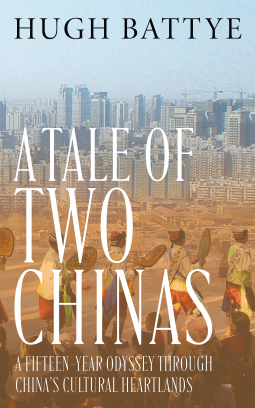
A Tale of Two Chinas
A Fifteen-Year Odyssey Through China's Cultural Heartlands
by Hugh Battye
This title was previously available on NetGalley and is now archived.
Send NetGalley books directly to your Kindle or Kindle app
1
To read on a Kindle or Kindle app, please add kindle@netgalley.com as an approved email address to receive files in your Amazon account. Click here for step-by-step instructions.
2
Also find your Kindle email address within your Amazon account, and enter it here.
Pub Date 17 Feb 2026 | Archive Date 15 May 2026
Talking about this book? Use #ATaleofTwoChinas #NetGalley. More hashtag tips!
Description
A Tale of Two Chinas is essential reading for anyone seeking a deeper understanding of the People’s Republic in the early-mid twenty-first century. Based on Hugh Battye’s own compelling fifteen-year China journey, the book takes the reader on a topical odyssey, covering a number of the major economic, political and cultural themes of the later Reform years, as well as of Xi Jinping’s current New Era. Through his vividly contrasting, yet complementary, descriptions of the “two Chinas” he experienced – the sophisticated society of the Chinese urban mainstream on the one hand, and the vibrant Muslim and Tibetan Buddhist minority cultures on the other – the author provides a fresh, holistic and accessible account of a country that, despite its superpower status, still remains largely opaque to many in the international community.
Available Editions
| EDITION | Paperback |
| ISBN | 9781919322704 |
| PRICE | £12.99 (GBP) |
| PAGES | 380 |
Available on NetGalley
Average rating from 9 members
Featured Reviews
 The Secret B, Reviewer
A Tale of Two Chinas by Hugh Battye offers an insightful look into modern China through the author’s personal experiences.
Exploring both urban life and minority cultures, the book gives a broad and accessible perspective on the country’s social, political, and cultural landscape. While there is a strong focus on religion, which may not appeal to all readers, it adds depth to the discussion of identity and tradition.
I particularly enjoyed learning more about everyday life in China and how different parts of society function.
An informative and thought provoking read.
Read more at The Secret Book Review.
 Elizabeth S, Reviewer
Thank you NetGalley and Hugh Battye for providing me this ebook in exchange for an honest review. I found this novel as a journal of Battye’s travels while studying and working in China. I enjoyed the author’s personal experiences and historical connections for all the areas whether urban or rural that he called home. The most thought provoking parts of his book was the discussions and descriptions of the minority muslim communities. I had no idea there were around 20 million muslims living in China or that in order to visit/study religion you needed special permission. The information regarding the everyday life and celebrations of the muslim community for intriguing. I found this book to be a great way to begin my journey into learning more about China.
 Media/Journalist 188366
Hugh Battye’s A Tale of Two Chinas is primarily a personal memoir of his years living, working, and studying in China. Evolving around this story is a general overview of the cultural and historical forces that shaped contemporary political, economic, and social issues. Through this is the additional presentation of minority cultures and rural life, and how these peoples have experienced China’s rapid changes. Much of these insights are based on the author’s postgraduate fieldwork in Muslim and Tibetan Buddhist communities in the central northwest. The book contains many themes but advances few arguments. Rather it is a collection of experiences, reflections and observations about how things are and have been. Some might find a lack of a firm argument to be a bit wandering, but to be honest my China book shelf is packed with China-related arguments, case studies and warnings, and it was rather refreshing to read something more descriptive than prescriptive.
Each chapter provides a historical overview, which covers a range of topics such as conflicts between Imperial China and the Western Nations, political developments and major key players, the one-child policy, and economic development. Although the author does not shy away from unpleasant points in history, it is the sort of explanations which would suit a dinner party. He doesn’t obscure the harsher realities, yet readers seeking detailed accounts of, for example, the implementation of the one-child policy, will need to look elsewhere. The section on air pollution counter measures felt like rare good news, and I hope this is an area where perhaps China could inspire other nations to take improving their air quality seriously. The discussions do occasionally ramble, but the chapters are short and sweet and generally revolve around a certain theme. It’s sort of like listening to a friend reminiscence and then get side tracked with a historical explanation to provide context and orientation.
The later chapters on minority cultures adopt a more academic tone, detailing subsistence practices, daily hardships, and local religious and cultural customs. The discussion of “the major fault lines of Chinese society the Han and the minorities, the urban and the rural” is well presented. Battye continues to interlace these analyses with his own amusements and misadventures, which makes the transitions between memoir and scholarship less jarring. He recalls, for instance, how “And, of course, with copious amounts of green tea , accompanied , on occasion, with a humungous lump of rock sugar to teach you the true meaning of the expression ‘bittersweet’. The art of sitting cross-legged on the kang for long periods during mealtimes took me a while to get used to, as, too, did the rules around bread consumption.” The book is at its strongest when probing the complexities of identity. He describes confusion over who counts as a minority, how sub-minorities exist within Tibetan culture, and how individuals may present different identities depending on context or bureaucratic categorisation. This encourages him to briefly reflect on his own identity and beliefs. Ethnicity and religion blur at the edges, and language barriers and cultural assumptions further complicate the picture.
The section on ethnic tourism is fantastic, particularly for readers who have encountered only the social media version of the phenomenon. I was keen to read what someone with a PhD in minority cultures of China had to say about the benefits and dangers of packaging minority culture up for the consumption of tourists. This includes “song and dance troupes, architectural replicas, even whole ‘ethnic villages’,” all designed for the tourist gaze. As he notes, communities often have little choice but to participate, though this doesn’t mean they are totally without benefit or agency. Many individuals have built careers as artists, entrepreneurs, or officials thanks to an increasing flow of tourists. Tourist money is often greatly desired in these rural areas. Yet the combined pressures of modernisation and Party ideology have reshaped both traditions and the people who perform them. Battye acknowledges that conditions have grown more restrictive for many minority groups in recent years and the experience of one group doesn’t necessarily mean other groups have similarly benefited.
The author’s years in China are similar to my own, so many of his experiences, troubles and moments of culture shock were very familiar. He mentioned many major China events of the 2000s, so this made for nostalgic reading. If you’re a long time China watcher who is familiar with most of the general historical information, I think these recollections will keep you interested. During the early 2000s, many Westerners in China cycled through English teaching, entrepreneurial ventures, modelling, or enrolment at local universities whenever visas or finances demanded it. I read with amusement that the author “… having been living in a state of denial for far too long, I resorted to the job that, in all fairness, I was probably the most suited to anyway: teaching English.”
Although Battye keeps his personal anecdotes lightly sprinkled through this book, I wish he had lingered more on how it was to live and study there. He wrote about his identity as a Christian who found more common ground with local Muslims than with many Han Chinese, yet the text offers little about his own tastes and interests. The PhD application process, his program, his supervisors, and the institutions themselves are mainly absent. Flat hunting adventures are a reoccurring event in this book, which comes with all manner of negotiations, misunderstandings and disappointments. I especially enjoyed the moment when he was looking for a flat and found that his prospective host family was of “the Public Security Bureau specifically responsible for overseeing the foreigners of the city, and while that revelation did manage to explain the quality of his English, for me the more important result was that living in that house suddenly didn’t make for the most relaxing of prospects.”
Battye is open about the art of seeking permission from authorities, or rather, seeking forgiveness after. He writes, “The logic followed that trying to get official permission for something – even if it was quite legal and straight-forward – would probably cause the powers that be to worry that something underhand was going on, and to thereby refuse the request; while, conversely, in the event that an apology for over-stepping the boundary was required, nothing much more would likely be said, as the relevant authorities would not want to draw undue attention to any problems occurring under their watch…. For the police it was mainly pragmatic: having a foreigner in the area was serious ‘mafan’, a common term which also regularly found its way into foreigners’ English conversations, and was used to sum up any situation that was less than convenient. If anything went wrong, they did not want to be the ones to take the blame. As a Westerner, I demanded a simple answer as to whether they would give me a stamp or not, and, if not, a logical reason why. From the Chinese perspective, however, the main aim would be to avoid a conflict.” His attempts to secure permissions to live and research in these areas are both exasperating and amusing. I was reminded of bringing nearly transparent sheets of delicate paper and booklets full of stamps to my local Chinese police station and hoping for the best. Against the popular image of corrupt, petty, obstructive officials, he notes that many officers are in fact warm, pragmatic, and willing to warn foreigners of potential issues before the fact. Most people are just trying move along with minimal risk to their own careers and avoid anything too horribly ‘mafan.’
Unlike many other travel memoirs, Battye’s personal life is largely absent. I wish this book had given more space to the tension between being a member of these communities, while maintaining distance. This is touched on when he chooses new, local names to go by, but how did that feel? These sections had the strongest impact when the author reflected on his own identity and religion, and what similarities it shared with these groups. Given that the book did discuss individuals, and not the group generally, I wondered at how it was to remain objective as a researcher while forming these emotional connections. Additionally, since so little was written about the author’s own background and personality, aside from a very slim introduction at the start of the book, I wondered if he had to overcome any biases or preconceptions. Were these reflections incorporated into his academic methodology, or did he consider such introspection too personal for inclusion? Did he experience isolation and loneliness while conducting this research in such remote areas, using languages / dialects that weren’t as strong as his skills in Standard Mandarin? Finally, he mentioned assisting people when they needed medical help or were experiencing legal troubles. What is the ethics of this? I would’ve loved it if the author had been encouraged to outline the personal risks and struggles of conducting this research. Not to sensationalise the experience, but rather so much seems to have been left unsaid, and a closer examination author’s own position within the community would have strengthened an already captivating book.
This book felt guarded, but true. For readers seeking an accessible overview of modern Chinese history, interwoven with glimpses of life in agricultural regions, it offers a worthwhile introduction. If you lived in China in the early 2000s to 2010s, you will recognise the author’s sincerity. The descriptions of a “land juxtaposed between Beijing, Mecca and Lhasa” with humility, admiration and grace. Travel writing can often inadvertently come off as overly romantic or whinging, but Battye’s work here is full of patience, understanding and concern. He notes that living and working in China taught him patience, and how to wait, and those lessons seems visible in his writing, which elevates this travel memoir to something which encourages understanding across a number of cultures. A Tale of Two Chinas is a sensitive engagement with the many Chinas that coexist within the nation’s borders.
Readers who liked this book also liked:

Esther Freud
General Fiction (Adult), Parenting, Families, Relationships, Women's Fiction






Anthony Quinn
General Fiction (Adult), Historical Fiction, Mystery & Thrillers

Views expressed in promotions/advertisements do not necessarily reflect those of NetGalley or its affiliates.
© 2026 NetGalley LLC
• All Rights Reserved


Views expressed in promotions/advertisements do not necessarily reflect those of NetGalley or its affiliates.