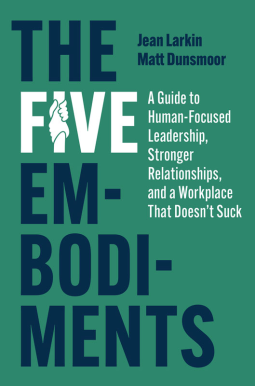
The Five Embodiments
A Guide to Human-Focused Leadership, Stronger Relationships, and a Workplace That Doesn’t Suck
by Jean Larkin, Matt Dunsmoor
You must sign in to see if this title is available for request. Sign In or Register Now
Send NetGalley books directly to your Kindle or Kindle app
1
To read on a Kindle or Kindle app, please add kindle@netgalley.com as an approved email address to receive files in your Amazon account. Click here for step-by-step instructions.
2
Also find your Kindle email address within your Amazon account, and enter it here.
Pub Date 13 Jan 2026 | Archive Date 30 Jun 2026
Talking about this book? Use #thefiveembodiments #NetGalley. More hashtag tips!
Description
The world feels more split apart by the day. Political, social, and economic differences grow, and the incessant growth of technology, especially AI, creates ever more confusion about what is to come. Meanwhile, we are experiencing a loneliness epidemic that calls into question our individual and collective well-being. Amid this uncertainty, traditional models of leadership are unfulfilling.
Jean Larkin and Matt Dunsmoor’s The Five Embodiments invites a new way, offering a research-backed and fully human approach to leadership. This book isn’t an academic exercise; it’s an applied tool kit for recalibrating connection in a fragmented world. The authors present “Human-Focused Leadership” as the necessary paradigm for our age.
Through rich personal stories and examples, plus meaningful perspectives from sociology, biology, psychology, and clinical research, they express the power of five core principles: Curiosity, Authenticity, Care, Gratitude, and Ownership. These “Embodiments” are not theoretical ideas; they are foundational components for ensuring authentic relationships, developing successful teams, and finding solutions for the nuances of the modern workplace.
This book tackles the persistent frustrations of burnout, disengagement, and the difficult skill of offering meaningful feedback. It includes tools to improve work units and create environments there where people feel heard, seen, and valued.
The Five Embodiments is an opportunity to rehumanize work and be the leaders who make the difference. Now is when we move beyond transactional leadership and seek a more empathetic, inclusive, and impactful path. Are you ready to become a leader who inspires, connects, and truly has an impact?
Join the movement. Become a Human-Focused Leader.
Advance Praise
“As a leader and entrepreneur, I’ve seen what can happen when you put humanity first at work: Connection deepens. Trust grows. Relationships flourish. And your bottom line? Better than ever. But I learned about it the hard way. The Five Embodiments is the guide to human-focused leadership that I wish I’d had when I started my business. It’s simple, accessible, and research-backed, and it will help leaders at all levels create cultures of connection and psychological safety. If you’re looking to bring humanity back to your workplace but aren’t sure where to start, start here.”
—Kristen Hadeed, CEO, author of Permission to Screw Up: How I Learned to Lead by Doing (Almost) Everything Wrong
“The Five Embodiments resonates with me on several levels. The way Matt and Jean connect the loneliness epidemic and the obstacles to making meaningful human connections at work is timely and on point. Work has a massive impact on our very being, and the framework this book offers is a novel solution to a widespread problem. When I was building businesses in the ’80s, interpersonal human relationships were far more front and center, yet today the norm is much more transactional. The ‘embodiments’ are an innovative approach to building the skills that many of today’s leaders lack. I love how they brought their ideas to life and wove in case studies, stories, and practical takeaways. This is not a system that any company I know of can look at and say ‘We already do that.’ Despite all the leadership training out there, no one is focusing on this. This is truly a different approach to leadership and in my opinion only has upside.”
—Steve Pruett, Executive Chairman, Cox Media; author, The Gain Principle
“If you’ve ever whispered, ‘There’s gotta be a better way’ into your coffee between meetings—this book offers it. The Five Embodiments is a guide and invitation to making leadership more relational, more intentional, and way more human. If you want to lead in a way that actually serves people and not just performance metrics, this one’s for you. It will help you show up with greater clarity, compassion, and the courage to act.”
—Stephen "Shed" Shedletzky, speaker; coach; author, Speak-Up Culture: When Leaders Truly Listen, People Step Up
“Finally, a leadership book that doesn’t just inspire. It equips. As someone leading sales, marketing, and culture for a large organization, I’ve read a lot of leadership books —but The Five Embodiments landed differently. The ideas aren’t new, but the way they’re framed—curiosity, authenticity, care, gratitude, and ownership—makes them feel accessible and actionable. This book gave me practical tools to grow and to bring my team along for the ride. The chapter wrap-ups and practice prompts made it easy to stay engaged—and easy to come back to. The consistency story from Jean (about yoga and learning to sway instead of staying rigid) hit me hard. Clear, actionable, and actually useful—this is the kind of leadership book you’ll dog-ear and revisit again and again.”
—Chad Allers, Vice President of Sales and Marketing, Bargreen Ellingson
Available Editions
| EDITION | Hardcover |
| ISBN | 9798891383579 |
| PRICE | $30.00 (USD) |
| PAGES | 200 |
Available on NetGalley
Average rating from 2 members
Featured Reviews
 Demetris P, Reviewer
“The Five Embodiments” and the Quiet Revolution at Work: Why Curiosity, Authenticity, Care, Gratitude, and Ownership Are the Only Leadership Skills That Still Matter
By Demetris Papadimitropoulos | February 4th, 2026
In “The Five Embodiments,” Jean Larkin and Matt Dunsmoor do something quietly radical for a leadership book: they refuse to pretend the workplace is merely a machine. It is, they insist, a relationship ecosystem – a place where our most human cravings (to be seen, heard, valued) collide with the most inhuman pressures (speed, scarcity, status, dashboards). Their wager is that culture doesn’t change by slogans or off-sites; it changes in micromoments, in the texture of conversations, in the small, sometimes messy choices leaders make when nobody’s clapping.
The book’s architecture is disarmingly simple: five “embodiments” that serve as both ethic and operating system – curiosity, authenticity, care, gratitude, and ownership. If those words sound like motivational-poster fare, Larkin and Dunsmoor spend the rest of the pages trying to rescue them from the poster. Each embodiment is framed not as a virtue you perform but as a practice you become – an identity you wear so consistently that other people can rely on it the way they rely on a sturdy bridge in bad weather.
Their tone is friendly but not fluffy: conversational, occasionally funny, quick to puncture the managerial habits that make work feel like an endurance sport. There’s a recurring low-grade disgust for what they call workplaces that “don’t suck,” a deliberately blunt standard that functions like a North Star precisely because it is not a KPI. The authors’ background in leadership development and organizational design shows in the way they move between the psychological and the procedural. They understand that leaders don’t fail only because they lack good intentions; they fail because they don’t yet have reliable defaults under stress.
Curiosity, the first embodiment, is treated as humility in motion: the willingness to admit you don’t have the full story and to ask questions that make other people feel interesting rather than interrogated. Curiosity here is not nosiness; it is an antidote to certainty, a refusal to let your first interpretation become a verdict. The book’s best curiosity moments are deceptively small: pausing before you reply, asking what you’re missing, inviting a perspective you don’t like, questioning the story you’ve already started telling yourself about someone’s motives. When curiosity is present, conflict becomes solvable. When it’s absent, conflict becomes identity.
Authenticity, the most abused word in modern management, is handled with useful skepticism. Larkin and Dunsmoor are not asking for performative vulnerability, the office confessional that makes everyone uncomfortable and then gets praised as “brave.” They push for something simpler and harder: congruence. Speak in your voice. Tell the truth you can stand behind. Don’t outsource your personality to a template. Authenticity, in their telling, is contagious because it gives others permission to stop acting like they’re auditioning for “ideal employee” and start showing up as actual humans.
Care is where the book’s moral center shows itself. Care is framed not as softness but as a commitment to others’ dignity – the belief that people are not resources to be extracted but humans to be developed. In practice, that means building psychological safety in ways that are concrete: setting expectations clearly; owning your impact when you miss the mark; regulating your emotions so your team doesn’t live under the threat of your unpredictability. The authors don’t romanticize care. They repeatedly point out how easy it is to confuse care with comfort, and how often the caring thing is clarity – the kind that prevents simmering anxiety and resentful guessing games.
Gratitude, the fourth embodiment, is where the writing turns most tender – and, interestingly, most neurological. Gratitude is described as attention discipline: a way of aiming the mind toward what is good without pretending what is hard isn’t hard. The authors nod to the brain’s negativity bias and to the way modern work trains us to catalog threats: rejection, risk, the fear of losing belonging. Gratitude becomes a deliberate counterweight, a habit that interrupts the default scan for what’s wrong. Crucially, they argue for specificity over sentimentality. Gratitude that lands is not generic. It is a precise acknowledgement of impact, a small act of witnessing that tells someone: I noticed you. You matter here.
Ownership, the fifth embodiment, is the book’s attempt to rehabilitate another corporate buzzword. Too often “ownership” is code for “take the blame,” or a demand that employees treat someone else’s business like a baby. Larkin and Dunsmoor argue for a three-dimensional definition that is both practical and clarifying: ownership integrates accountability (clear standards and consequences), autonomy (real agency over how work is done), and responsibility (the internal motivation that makes us care). The framework is neat, but it’s not merely neat. It becomes a diagnostic: when “ownership” collapses, which leg is missing?
This chapter is rich with leader-grade realism. The authors call out the damage of unexpected punishments masquerading as accountability. Consequences, they argue, are only accountability when expectations were expressed in the first place. Punishment for unspoken needs is not leadership; it is volatility. They also complicate autonomy in a way many books avoid: autonomy is not binary. It’s a dimmer switch. The right level depends on context – legal risk, scope, stakes, relationship history, track record, even the season a team is in.
Responsibility is the trickiest part of the ownership triangle, and the authors don’t pretend otherwise. Responsibility, they insist, is internal weather. You cannot force someone to feel it. You can influence behavior with incentives and consequences, but you cannot command an internal spark. That’s why their practical advice for leaders is relational rather than mechanical: learn what drives each person’s sense of duty. Some are motivated by purpose and impact. Others by mastery, status, competition, belonging, stability, or the simple pleasure of finishing a thing well. If you don’t know what motivates your people, you will build systems that accidentally punish them, and then wonder why they disengage.
Where the book earns its keep is in the sections that translate this framework into pre-work. Larkin and Dunsmoor argue that retrospectives and after-action reviews are useful, but often arrive too late. If you want ownership, start before the assignment. Ask about autonomy preferences. Clarify standards and what consequences will follow if they aren’t met. Identify what resources and context are needed. They offer a tidy, immediately portable tool called the “3Q method,” essentially a quick audit: Are we clear on accountability? Are we offering real autonomy? Are we setting conditions for responsibility? It’s not flashy, which is precisely why it’s usable.
The “practice makes progress” sections broaden the lens beyond the individual. On the team level, the book emphasizes guidelines and guardrails: draft clear norms so people don’t have to guess what “good” means; designate where blockers go; build a knowledge base that functions as a living source of truth; invite iterative improvement rather than treating process as a fossil. Perhaps the most quietly subversive suggestion is to normalize “no.” If people can’t say no, they can’t be owners; they can only be overloaded, resentful compliance machines. A culture that treats “no” as disloyalty will never get the kind of accountability it claims to want.
If the earlier chapters are about ingredients, “Where We Go from Here” is about cooking. The authors frame development as a pipeline: awareness becomes practice, practice becomes habit, habit becomes embodiment. They borrow the “dimmer switch” metaphor to normalize uneven growth – you can be innately high on care and low on ownership, courageous in meetings and avoidant at home. The point is not to score yourself; it is to notice patterns, ask how others experience you, and address the gap between intent and impact. This is one of the book’s strongest moves: it refuses the comforting illusion that self-perception is sufficient data.
Their section on consistency is a welcome pivot away from the productivity-industrial complex. Consistency, they argue, is not robotic repetition. It is integrity under variation – the capacity to “sway within a safe-not-to-fall range” around your core principles. The yoga story that anchors this argument is more than a charming aside; it’s a philosophy of leadership for unstable times. A consistent leader is not one who never deviates. A consistent leader is one whose deviations still make sense, whose people can predict the values underneath the behavior even when circumstances change. In a world of constant reorgs, that kind of predictability is a form of care.
The final chapter, “Make the Relationshift,” becomes openly exhortatory, and rightly so. The authors place their framework in a broader diagnosis: a leadership deficit alongside a loneliness epidemic, and work cultures that have long rewarded self-first behavior while calling it excellence. They argue that bosses shape well-being in outsized ways, that leadership is less “power over” and more responsibility for others. It’s here that the book’s central proposition becomes clearest: relationships are not a soft side quest. They are the infrastructure of performance, resilience, and meaning.
The section on feedback is among the strongest in the book, largely because it avoids the trap of scripts. Larkin and Dunsmoor focus on the container: trust built before the moment arrives, preferences discussed ahead of time, intention made explicit, fears named, scope clarified. They offer questions that feel immediately usable: How do you prefer to receive feedback? Are you more comfortable with compliments or critiques? When difficult feedback is necessary, how can I navigate that with you in a way that works? This is feedback as relationship maintenance, not feedback as courtroom verdict.
The authors’ “quick tips” for when you have to give feedback without a preexisting relationship are smart precisely because they are modest. Show up curious to learn what you might be missing. Be authentic rather than corporate. Demonstrate care by focusing on the person’s growth, not your irritation. Express gratitude that is relevant and recent. Practice ownership by owning your part and inviting theirs. None of this is new in isolation, but the book’s strength is the way it treats these as interoperable, as practices that compound.
As a piece of leadership literature, “The Five Embodiments” lives in a familiar neighborhood. It echoes “Dare to Lead” in its insistence that courage and vulnerability are skills, not personality quirks. It sits beside “Radical Candor” in its concern for feedback that is direct without being cruel, though it is less enamored with the cult of “candor” and more focused on relational safety. It nods to “Nonviolent Communication” in its attention to needs and to “The Fearless Organization” in its emphasis on psychological safety as a performance multiplier. There are also traces of “Atomic Habits” in the way the authors talk about practices becoming defaults over time, and a whisper of “The Culture Code” in the insistence that belonging is built through repeated signals, not declarations.
What distinguishes the book is not novelty of concept but the way it braids the moral and the operational without pretending they are separate. The authors understand that workplace misery is rarely created by one villain. It is created by small inconsistencies, by unspoken expectations, by systems that punish unpredictably, by leaders who haven’t learned to regulate themselves, by cultures that confuse speed with virtue. Their solution is not a single program but a set of embodied defaults – repeatable behaviors that, over time, change the emotional physics of a team.
There are, inevitably, places where the book’s optimism strains against reality. In organizations where incentives are warped – where leaders are rewarded for short-term metrics at the expense of human costs – the embodiments can feel like asking individuals to compensate for system design. “Show more care” is not a substitute for staffing levels that make care possible. Gratitude cannot repair a compensation structure that forces employees into chronic scarcity. Ownership cannot flourish when layoffs function as management strategy rather than last resort. In those environments, the book’s prescriptions are necessary but not sufficient, and the “workplace doesn’t suck” standard starts to look less like a North Star and more like a plea.
And still, perhaps that is exactly the point. Larkin and Dunsmoor are not promising utopia; they are offering leverage. You may not control the market, the macroeconomy, AI’s accelerating disruption, the return-to-office decree, or the next reorg. But you do control the nature of your conversations. You control whether you move from blame to ownership, from bargaining to commitment, from problem solving to possibility. You control whether the people around you feel like they matter in the minutes that make up the day.
Read that way, “The Five Embodiments” is less a management manual than a quiet argument for human dignity in the place where many of us spend most of our waking hours. It asks leaders to trade the thrill of being right for the longer satisfaction of being trusted. It asks teams to replace mind-reading with clarity, and punishment with standards. It asks high achievers to stop calling self-erasure humility. It asks all of us, in an era of frictionless communication and deepening isolation, to remember that leadership is not a title. It is how you make people feel when the room gets tight.
I’d place the book at 86/100: a smart, well-structured, emotionally literate framework that earns its warmth with specificity, and that will be most transformative for readers willing to treat leadership not as an identity they claim but as a practice they embody – one conversation at a time.
Views expressed in promotions/advertisements do not necessarily reflect those of NetGalley or its affiliates.
© 2026 NetGalley LLC
• All Rights Reserved


Views expressed in promotions/advertisements do not necessarily reflect those of NetGalley or its affiliates.