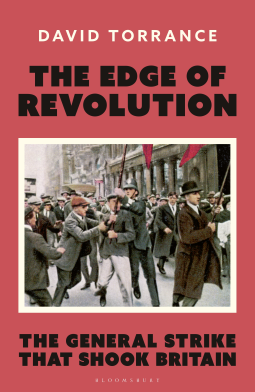
The Edge of Revolution
The General Strike that Shook Britain
This title was previously available on NetGalley and is now archived.
Send NetGalley books directly to your Kindle or Kindle app
1
To read on a Kindle or Kindle app, please add kindle@netgalley.com as an approved email address to receive files in your Amazon account. Click here for step-by-step instructions.
2
Also find your Kindle email address within your Amazon account, and enter it here.
Pub Date 26 Mar 2026 | Archive Date 25 Mar 2026
Bloomsbury Publishing Plc (UK & ANZ) | Bloomsbury Continuum
Talking about this book? Use #TheEdgeofRevolution #NetGalley. More hashtag tips!
Description
The author of the critically acclaimed The Wild Men explores another tumultuous and era-defining moment in British political history – The General Strike – on its centenary.
On Tuesday 4 May 1926, two million workers downed tools in the only nationwide strike ever held in Britain. The General Strike had begun. Industry was deprived of gas and electricity; public transport stopped; newspapers ceased publication; and workers abandoned mines and industrial works throughout the country.
The General Strike has entered our national mythology but it left a legacy of bitterness that has had a profound impact on modern-day politics.
The Edge of Revolution tells this dramatic story, drawing on the extensive archival research Torrance is celebrated for. Absorbing and eye-opening, this is a powerful look at this unique and pivotal episode in British history 100 years on.
Available Editions
| EDITION | Hardcover |
| ISBN | 9781399423595 |
| PRICE | £20.00 (GBP) |
| PAGES | 288 |
Links
Available on NetGalley
Available to Buy
Buy on Amazon Buy on Bookshop.org Buy on WaterstonesAverage rating from 4 members
Featured Reviews
 Colin E, Reviewer
I thoroughly enjoyed David Torrance’s book about the first Labour Government, The Wild Men, and I was delighted to see that he’s written a book about the General Strike: The Edge of Revolution. This year, 2026, is the centenary of Britain’s biggest general strike and I have realised, from reading Torrance’s book, how little I knew about what actually happened.
To summarise events, a coal miners’ strike in 1921, initially supported by the railwaymen and transport workers, had alerted the Government to the likelihood of a General Strike. The Government reinstated the subsidy of miners’ wages and matters simmered while yet another Royal Commission was held. This gave the Government a few years to put in place its procedures for dealing with emergencies. Unfortunately, the TUC didn’t use the time for similar planning.
On 30th April, 1926, while negotiating with the TUC, the Prime Minister, Baldwin, had ordered posters to be printed, declaring a state of emergency. While one could argue that Baldwin had ordered them “just in case”, the unions saw this as a sign of bad faith and their members voted overwhelmingly for a strike. At this point, the unions handed control of the strike to the TUC General Council. Similarly, the Government discovered that strike notices had been despatched while negotiations were still continuing – also seen as an act of bad faith.
Torrance shows that almost all Council members were against striking but the miners wouldn’t compromise. Jimmy Thomas, an MP and leader of the railway workers, was in tears at one point. Torrance quotes Fenner Brockway’s explanation for the end of the strike, “it was led by people who didn’t believe in it.” The Government downplayed the industrial dispute aspects of the strike and the severe hardship faced by miners’ families; and positioned the strike as a challenge to the constitutionally elected Government (hence the book’s title). The TUC’s organisation was poor and its preparation almost non-existent. Torrance shows, though, that one of the prime reasons for the TUC’s defeat was that it simply didn’t have a goal for the strike and a plan for measuring its success. That ambiguity meant that the miners’ leaders and the rest of the Council would never agree on tactics.
Torrance has used a wide range of primary sources, refusing to endorse the perception that the strike was peaceful and that the British behaved impeccably. Police with horses and batons did charge at rioting crowds; people were killed due to the actions of inexperienced volunteer railwaymen. Torrance’s clever usage of memoirs and official records shows how Baldwin’s greatest failure in leadership (allowing the General Strike to happen) was transformed into his greatest success: framing the strike as a constitutional issue was “a stroke of genius.”
This really is a highly readable account of the strike and contains some excellent analysis.
#TheEdgeofRevolution #NetGalley
Readers who liked this book also liked: