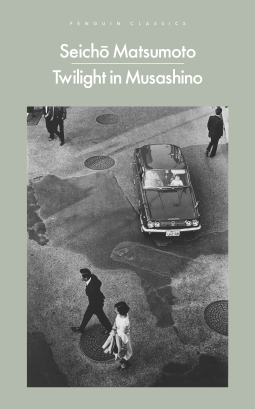
Twilight in Musashino
Sign In or Register Now to see if this title is available for request.
Buy on Bookshop.org Buy on WaterstonesSend NetGalley books directly to your Kindle or Kindle app
1
To read on a Kindle or Kindle app, please add kindle@netgalley.com as an approved email address to receive files in your Amazon account. Click here for step-by-step instructions.
2
Also find your Kindle email address within your Amazon account, and enter it here.
Pub Date 7 May 2026 | Archive Date 3 Nov 2026
Penguin Press UK – Allen Lane, Particular, Pelican, Penguin Classics | Penguin Classics
Talking about this book? Use #TwilightinMusashino #NetGalley. More hashtag tips!
Description
From 'a master crime writer' (Financial Times), a chilling story where Japanese tradition and Western crime collide – now available in English for the first time
Musashino, 1959. A young Japanese flight attendant is found strangled on the icy banks of the river. The police suspect foul play – but the deeper they dig, the more they collide with a wall of silence.
At the centre of it all stands a foreign priest and the Guglielmo Church, a charitable Christian mission. The dead woman’s connection to the church is undeniable. But what begins as a routine investigation quickly turns into something far more treacherous, entangling together narcotics, post-war relief schemes and the delicate web of international diplomacy.
As the story moves from back alleys to diplomatic sanctuaries, following the twists and turns of Detective Fujisawa's investigation, Seicho Matsumoto masterfully constructs a slow-burning procedural where truth is clear but justice is not permitted.
Translated from Japanese by Jesse Kirkwood
Available Editions
| EDITION | Other Format |
| ISBN | 9780241688748 |
| PRICE | £15.99 (GBP) |
| PAGES | 464 |
Available on NetGalley
Available to Buy
Buy on Bookshop.org Buy on WaterstonesAverage rating from 66 members
Featured Reviews
 Fe Y, Bookseller
As someone who loves Japanese detective stories, it was a no brainer to request this Titel. The translation is great, which makes the book even more enjoyable.
The story itself is a bit slow paces and we pretty much get all the information a out the murder and the people involved in it from the beginning. Still the story gets more and more intriguing the further you read and I think that's what makes this book even more amazing.
Definitely a title for people who want to read crime, but don't like the angst in these books.
 Nemra N, Reviewer
Twilight in Musashino is a concise psychological novel set against the quiet suburban backdrop of the Musashino area on the outskirts of Tokyo. Seichō Matsumoto shifts away from conventional detective plotting to focus on emotional tension, moral ambiguity, and the social pressures shaping his characters’ decisions. The narrative unfolds through careful observation and restrained prose, gradually revealing the consequences of secrecy and compromised judgment.
Matsumoto’s strength lies in his attention to atmosphere and social context. Beneath the measured pacing, the novel examines themes of reputation, desire, and the subtle constraints of postwar Japanese society. Twilight in Musashino stands as a controlled and quietly unsettling work that reflects the author’s broader interest in crime not only as an act, but as a product of circumstance and human weakness.
 Ariane D, Reviewer
Twilight in Musashino by Seicho Matsumoto, translated by Jesse Kirkwood, is a slow-paced but intriguing crime novel set in post-war Japan. Its unconventional structure of setting half the novel and building to the murder allows the story takes its time introducing a range of characters and the social tensions surrounding a foreign-run church before the central murder becomes the focus.
Matsumoto’s detailed descriptions bring the setting to life, offering insight into the political sensitivities, black market trade, and uneasy relationships between local communities and foreigners. The investigation unfolds gradually, often revisiting events from different perspectives as police and journalists piece together what happened in the second half of the novel.
Angela B, Reviewer
This is a fascinating story about the corruption of a religious sect working with gangsters after WW2 in Japan. Equally fascinating are the descriptions of the forensic work of the police inspector and journalist hoping to unravel the mystery at the centre of the book. It is altogether a very satisfying read, about a culture and country that I know very little about. I was so immersed in the story that I didn't want to put it down, and relished every page. It is set in the fifties, but could stand for any age, including today, where corruption lies at the heart of a wealthy and political society., where sins and misdemeanours are covered up.
Trevelyan W, Reviewer
This is a novel of two almost separate halves, and a great deal of its power derives from this. The first half introduces us to priests from the Guglielmo Church, a Christian missionary initiative in immediate postwar Japan. Struggling to compete with other more well-resourced sects, they hit on the idea of diverting to the black market goods donated in America for the poor and hungry and sent into the country via their networks. One of the chief movers in this operation is also breaking his vows in another way by sleeping with a Japanese woman who plays a central role in the smuggling. Having set this up, the perspective shifts to an intense psychological study of a younger priest and how he becomes enmeshed both in the smuggling and in a relationship. The second half shifts in tone and point of view to follow a police investigation of the violent death of a young woman, in which the Church quickly becomes involved.
This is not a conventional whodunnit, but much more of a combination of police procedural and thriller. We know the murderer and the victim as the act unfolds, but the suspense - and the second half will have you turning the pages to find out what happens - is in how, when and if the murderer will be caught.
Matsumoto is not for the impatient. His elaboration of the details of police procedure around alibis and identities is every bit as painstaking as those about railway timetables in Tokyo Express. I found this a more ambitious work - as his emphasis on psychological detail in the first half makes the dry details of the police and journalists at work in the second half much more affecting. The suburb of Tokyo that gives the novel its title is often depicted at dusk. Likewise the Church that is the central player, and its powerful allies in Japanese society, spend much of the novel in the twilight - both literally and morally. Against them Matsumoto explores how fragile and hamstrung the forces of morality can be.
 g m, Reviewer
“In other words, the pigeon must never forget the cord attached to its leg.”
This is quite slow as far as mystery novels go, but it was this slowness that felt like you were entering the world and being transported back to post-war Japan. The murder and whom did it was revealed pretty early on in the novel, only leaving behind other mysteries to be uncovered as the narrative pushed on, but I was still hooked.
This is more of a novel on the question of politics versus morality. We have the priests and then the cops. It’s pretty evident who committed the crime and at times I got frustrated at how slow these cops were. But actually they aren’t slow, it’s that they couldn’t avenge the crime of this poor citizen at risk of creating further conflict in the country. It’s in many ways the trolley problem — who to save?
Although this is a classic it didn’t read like one. The writing was accessible and fast moving, perhaps due to the modern translation. It read like many others contemporary Japanese publications with just as much grit and societal discussions. This is also a good read if you are interested in the historical context.
Sandra M, Librarian
The scene is set beautifully right from the start, and the mystery will keep you on your toes in an unfamiliar view of Japan, where a foreign church seems to be controlling some sort of subterfuge. Even the narrator seems reluctant to let us in on the details. When this is gradually revealed the reader has to admit to being quite stunned at the audacity and yes the downright evil intentions which emerge. The plot not only thickens but it gets a whole lot darker too. I was totally gripped, but also quite horrified by what transpires.
 The Secret B, Reviewer
Twilight in Musashino is quite different from what I expected. While it begins with the murder of a young flight attendant, this is far more than a traditional detective story. Instead, Seicho Matsumoto uses the investigation to explore post-war Japan, political influence, religion and the uneasy relationship between justice and power.
The first half is deliberately measured, introducing the people connected to the Guglielmo Church and carefully laying the foundations for everything that follows. It takes a little patience to settle into Matsumoto's meticulous style, but once the various threads begin to connect, the story becomes increasingly compelling. Knowing that the book was inspired by a real case only makes the mystery feel even more intriguing.
I particularly enjoyed how the investigation expanded beyond the murder itself. The involvement of foreign missionaries, diplomatic pressures and organised smuggling gives the novel a much broader scope than a typical crime story. Rather than relying on constant twists, the tension comes from watching Detective Fujisawa uncover uncomfortable truths while realising that solving a crime and achieving justice are not always the same thing.
For anyone familiar with Seicho Matsumoto, this is another excellent example of his thoughtful, methodical approach to crime fiction. Rich in historical detail and political intrigue, Twilight in Musashino rewards readers willing to immerse themselves in its slower pace, offering a mystery that's as much about the society surrounding the crime as the crime itself.
Read more at The Secret Book Review.
Readers who liked this book also liked:





Jess Mills
Biographies & Memoirs, Nonfiction (Adult), Parenting, Families, Relationships