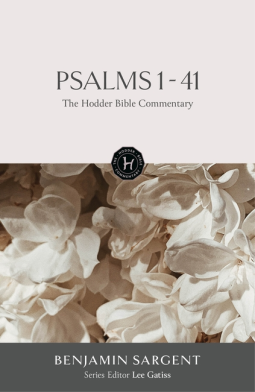
The Hodder Bible Commentary: Psalms 1-41
This title was previously available on NetGalley and is now archived.
Send NetGalley books directly to your Kindle or Kindle app
1
To read on a Kindle or Kindle app, please add kindle@netgalley.com as an approved email address to receive files in your Amazon account. Click here for step-by-step instructions.
2
Also find your Kindle email address within your Amazon account, and enter it here.
Pub Date 16 Jul 2026 | Archive Date 17 Jul 2026
John Murray Press US | Hodder & Stoughton
Talking about this book? Use #TheHodderBibleCommentaryPsalms141 #NetGalley. More hashtag tips!
Description
In Psalms 1-41, the people of God give voice to their trust in the goodness of God through lament, praise and petition. They are the source of ethics and morality, praise, penitence, prayer and doctrine. They have been part of the hymn book of the church in every place and in every generation.
Presenting new research alongside the best of old wisdom, Benjamin Sargent's commentary will inspire readers to discover the riches of the Psalms, to reflect deeply upon the living word, and - like the people of God in Psalm 29:9 - to cry out in stunned and fearful adoration, 'Glory!'
About the Hodder Bible Commentary
50 volumes. 4 million words. Global representation.
Engage with the latest theological thinking in this new, readable exposition of the Bible in 50 volumes. Covering all books of the Bible and including the full the Anglicised New International Version (NIV) text, the Hodder Bible Commentary series makes connecting scripture and scholarship easier than ever.
Explore how the Bible intersects with 21st century life with commentary that is doctrinally sensitive and globally aware, sourced from a team of contributors representing a variety of cultural and ecclesiastical contexts from around the world.
Designed to be accessible to all adult readers and particularly for those who preach, teach, and lead Bible studies, each book is split into manageable sections suitable for talks or study groups. Read the Bible text and the commentary side by side to gain a deep knowledge of scripture and the variety of interpretations that can be made from it.
Be refreshed with new understanding. Be encouraged to apply your conclusions to life today.
Available Editions
| EDITION | Other Format |
| ISBN | 9781399823883 |
| PRICE | £22.99 (GBP) |
| PAGES | 384 |
Available on NetGalley
Available to Buy
Buy on Bookshop.org Buy on WaterstonesAverage rating from 16 members

Featured Reviews
 Reviewer 1503116
Whenever I pick up a biblical commentary, I never begin with page one. I begin with the person behind the pages. A commentary is not simply information; it is interpretation shaped by a scholar’s training, convictions, experiences, and theological instincts. Before I trust someone to guide me through Scripture, I want to know who they are, how they think, and what perspective they bring to the text. The author’s background becomes the lens through which every insight is filtered.
That is why, before exploring The Hodder Bible Commentary: Psalms 1–41, I first turned my attention to its author, Benjamin Sargent. Understanding his academic formation, pastoral experience, and contributions to biblical scholarship provides essential context for appreciating the depth and direction of his work. Only after becoming familiar with the interpreter can we fully engage with the interpretation.
What follows is a closer look at Benjamin Sargent—the scholar, the priest, and the writer whose voice shapes this commentary.
Who Is Benjamin Sargent?
Benjamin Sargent is a British biblical scholar, Anglican priest, and author whose work bridges rigorous academic research with practical pastoral ministry. His background makes him an ideal contributor to accessible, theologically grounded resources such as The Hodder Bible Commentary: Psalms 1–41.
Academic Background
Sargent completed his doctoral studies in New Testament at the University of Oxford, where he focused on early Christianity, biblical interpretation, and the ways Scripture was understood in the first centuries of the church. His research interests include:
The Apostolic Fathers
The Catholic Epistles
Early Christian hermeneutics
The theological history of “single meaning” interpretation
He has published scholarly articles and books exploring how early Christian writers used and understood Scripture, demonstrating both historical insight and theological depth.
Ministry and Professional Roles
Alongside his academic work, Sargent serves actively in the Church of England. His roles have included:
Dean of Chapel at Winchester College
Priest in Charge of Bransgore and Hinton Admiral
Trustee of St Mellitus College
Member of the Church of England’s General Synod
His dual vocation as scholar and pastor gives his writing a grounded, pastoral tone—scholarly without being inaccessible, and devotional without sacrificing depth.
Published and Forthcoming Works
Benjamin Sargent has authored several books, including:
Written for Our Learning: The Single Meaning of Scripture in Christian Theology
Written to Serve: The Use of Scripture in 1 Peter
The Hodder Bible Commentary: Psalms 1–41 (forthcoming)
A forthcoming study on Ignatius of Antioch and early Christian use of Scripture
His work consistently explores how Scripture shapes Christian belief and practice, both historically and today.
Why He’s Well‑Suited to Write on the Psalms
Although Sargent’s doctoral work focused on the New Testament, his broader expertise in biblical interpretation and early Christian theology positions him well for writing a commentary on the Psalms. His pastoral experience adds another layer, enabling him to approach the Psalms not only as ancient texts but as living prayers that shape the spiritual life of believers.
His commentary is expected to combine:
Clear exposition
Historical and literary insight
Practical application
A pastoral sensitivity to the emotional and spiritual depth of the Psalms
How Sargent Approaches the Psalms
Before Benjamin Sargent begins his exposition of individual psalms, he lays essential groundwork by asking a foundational question: What is a psalm? Rather than assuming familiarity, he guides the reader through the nature and purpose of the Psalter—its poetic form, its role in Israel’s worship, and its enduring place in the life of the church. From there, he addresses authorship, acknowledging both the traditional attributions (such as David) and the broader collection of voices represented in the Psalms. He also explains the structure of the Psalter itself, noting the five internal “books” that shape its flow and theological movement.
Sargent then introduces the major theological themes that run through Psalms 1–41. He highlights the character of God, the centrality of covenant, the reality of suffering, and the forward‑looking hope that points toward Christ. These themes become interpretive anchors, helping the reader see each psalm not as an isolated poem but as part of a larger biblical and theological tapestry.
Once he turns to the individual psalms, Sargent follows a consistent and accessible pattern. Each psalm begins with a brief introduction—usually two or three sentences—that situates the psalm within its literary or historical context. The full text of the psalm is then presented in the NIV translation, allowing the reader to engage directly with Scripture before entering the commentary.
Sargent’s exposition is concise but rich. He offers a clear overview of the psalm’s message, tone, and theological significance without overwhelming the reader with technical detail. After this overview, he moves into a structured commentary, dividing the psalm into natural sections—sometimes three, sometimes four or more, depending on its length and internal movement. This sectional approach helps the reader follow the psalm’s progression of thought and emotion.
One of the most valuable aspects of Sargent’s commentary is his use of cross‑references. He frequently draws from other parts of Scripture—Old Testament narratives, prophetic writings, New Testament teachings—to illuminate the meaning of the psalm at hand. These connections enrich the reading experience and demonstrate how deeply interwoven the Psalms are with the rest of the biblical story. His cross‑referencing is never forced; it feels organic, pastoral, and rooted in a desire to help readers see the unity of Scripture.
Overall, Sargent’s method is both scholarly and devotional. He respects the text, guides the reader carefully, and consistently points toward the theological depth and spiritual relevance of each psalm. This structure makes the commentary approachable for everyday readers while still offering substance for those seeking deeper study.
 Abbie R, Reviewer
Benjamin Sargent's commentary on Psalms is great. Again, as with other Hodder Bible Commentary that I have picked up for review or reading I found that this one could easily be used as a personal bible study. But I also enjoyed using this one while I verse mapped some of the verses and dug deeper into the meaning setting there within the text.
 Sara H, Reviewer
The Hodder Bible Commentary: Psalm 1-41 by Benjami Sargent proved a smooth, educational, and insightful read. I am new to his work, but I would read other works by him in the future.
I read through the full introduction as well as the psalms I have studied and researched the most. I find I am most critical of the commentary section on the work I know best in other books. I was pleasantly surprised that in the psalms I have studied the deepest, I still learned new information. I know some might worry that could mean Sargent is stretching to add information, but that was not the case. I appreciated that he gave a couple avenues of thought but then took a stance and explained why. Again, I found I agreed with him. I will say, I initially was going to skip over Psalm 6 as it is not one I have studied much nor do I gravitate towards. However, I started reading his commentary on it and was engrossed.
I liked the format of this commentary. I easily see me grabbing this commentary off the shelf for future study. I think this commentary would be perfect for any everyday Bible learner as well as Bible Study leaders and similar jobs. It is not as “scholarly” as some commentaries, but I still feel it could be used in certain school settings. I appreciated that the Hebrew words provided give a broader definition to the reader by showing the various words that a singular word sometimes translates as. I hope to purchase these in the future.
This Bible commentary says it has global representation and based on the authors I have researched, they have different protestant affiliations as well (although Anglican heavy). As someone who reads many works from many protestant backgrounds (as well as Catholic and Orthodox), I find this commentary series fascinating. It will be interesting to see how it comes together as a complete collection, but I am hopeful and cannot wait to read more.
I received an eARC from John Murray Press US through NetGalley. All opinions are 100% my own.
Readers who liked this book also liked:

We Are Bookish
General Fiction (Adult), New Adult, Romance

Dave Hunter
Entertainment & Pop Culture, Nonfiction (Adult), Outdoors & Nature