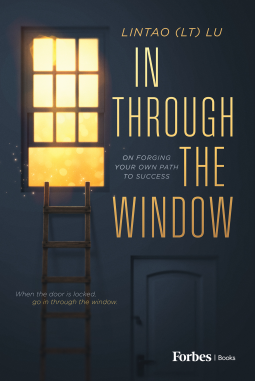
In Through the Window
On Forging Your Own Path to Success
This title was previously available on NetGalley and is now archived.
Send NetGalley books directly to your Kindle or Kindle app
1
To read on a Kindle or Kindle app, please add kindle@netgalley.com as an approved email address to receive files in your Amazon account. Click here for step-by-step instructions.
2
Also find your Kindle email address within your Amazon account, and enter it here.
Pub Date 21 Apr 2026 | Archive Date 28 Aug 2026
Talking about this book? Use #InThroughtheWindow #NetGalley. More hashtag tips!
Description
From a mud-walled home in rural China to boardrooms in New Jersey, In Through the Window traces Lintao Lu’s extraordinary rise. Born into a world of famine and political upheaval, Lu overcame every obstacle—language barriers, poverty, cultural bias—to become a multilingual engineer, a patent-holding innovator, an entrepreneur, and a trailblazer in the industry.
This candid memoir blends timeless wisdom with modern leadership strategies, delivering practical insights on resilience, leadership, and identity. Lu shares how he transformed rejection into opportunity, hardship into wisdom, and setbacks into strategy. His life offers a road map for professionals navigating systemic challenges and cultural fault lines in today’s global economy.
Written in a warm, conversational tone, this book speaks to immigrants, first-generation leaders, and global professionals. It offers both inspiration and executable ideas—from navigating the “bamboo ceiling” to building trust across cultures.
If you’ve ever felt like you didn’t belong in the room where decisions are made, this book shows you how to create your own window.
Advance Praise
“In Through The Window by Lintao Lu is a compelling, deeply personal and a poetic journey that merges life, identity, and introspection in a uniquely intimate way. The book feels like a curated exhibition of the author’s mind―a deeply personal yet universally resonant blend of imagery, narrative, and emotional vulnerability.
One of the most striking aspects is the way the book quietly infuses Eastern philosophies―particularly themes of impermanence, balance, and inner contemplation―with an undertone of industrious culture. The reader is left with a sense of harmony between thought and labor, between stillness and striving. This fusion adds a powerful layer of cultural and philosophical richness that deepens the emotional impact.
What stood out most to me was the quiet power behind its simplicity. The author refrains from overwhelming the reader with explanation, instead allowing meaning to emerge through tone, visual cues, and sparse but evocative language. It’s subtle, sincere, and haunting in its beauty.
This book will resonate most with readers who appreciate introspective works―those who find meaning in stillness and seek depth over drama. It’s not for the impatient reader, but for those willing to sit with ambiguity and draw their own interpretations, Lu Book offers a rare and rewarding experience.”
― Syed Irfan Ali, MD
Author, Fractured but Fearless; President, Pioneer Medical Group
"LT shares his struggles and triumphs from his very humble beginnings in China to becoming an extremely successful and well-respected business executive in the US. In Through the Window is a must read for young people of any background, and social status. A great book with practical advice paired with real life examples that is sure to inspire you."
― Jim Adcox
Wholesale Distribution and Manufacturing Executive; Former COO, Noland Company; SVP, Johnstone Supply
“In Through the Window is an inspiring and deeply personal memoir that captures the resilience and ambition of a generation shaped by adversity and transformation. I’ve known Dr. Lu since our doctoral study days in France, and this book is a powerful testament to his journey from rural China to global success―reminding us all to find opportunity where others see only obstacles."
― Feng Xu
Author and Inventor; Senior Scientist, Perfect Day; Staff Scientist, Novozymes
"This book offers a unique prospective on globalization, drawing on author’s experiences working for companies in many countries. Lu believes that 'we are a global family and our home is Earth.' An interesting reading for professionals working in a global setting."
― Yu Zuyao
Economist; Author, On Socialist Commodity Economy; Deputy Director; Institute of Economics, Chinese Academy of Social Sciences (CASS); Member, CASS Academic Division
"In Through the Window by Lintao Lu is a powerful and inspiring story about resilience and chasing dreams. Lu’s journey from a small fishing village to global success shows how determination can overcome any obstacle. This book is a great read for anyone looking for motivation to achieve their goals."
― Andrew Greaves
Director, Customer Experience, NAVAC Inc.
"Dr. Lu emphasized the importance of hope and optimism, in maintaining a positive mindset in the face of overwhelming adversity. He inspires the readers to get In Through the Window when the door is closed. A must-read for those trying to make it on their own."
― Dave Parks
Professor & Assistant Dean, Jindal School of Management, University of Texas at Dallas; Former EVP, Carrier Enterprise; Former President, Goodman Manufacturing
"I have had the pleasure of working with Dr. Lintao Lu in the past both at Fedders Corporation and Haier America. His book perfectly illustrates why he has been and will continue to be successful. LT never let obstacles prevent him from completing his task and he has always found a way to get through the window when the door is closed. His lessons clearly show a pathway to success."
― Mike Etter
Vice President, Kwik-Wall Company; Former President, Fedders Corporation
"A compelling account of a heroic journey of a remarkable individual and visionary leader who continues to inspire. From the shadows of poverty in a remote Chinese village to becoming a celebrated global energy expert, transformative CTO, and trailblazing CEO, this deeply personal memoir is not just a story―it’s a triumph of will, brilliance, and unshakable resolve. An unforgettable testament to what is possible when courage meets purpose."
― David Zhang
VP of Operation, NAVAC Inc.
"With In Through the Window, LT offers an essential and heartfelt guide to realize your potential regardless of your background. You may see yourself in these pages."
― Shi-Gang Sun
Academician, Chinese Academy of Sciences (CAS); Professor and Former Vice-Chancellor, Xiamen University
"LT Lu’s story is a powerful testament to resilience and ambition. Born into hardship in rural China, he overcame immense barriers to build a global career. In Through the Window is deeply inspiring―proof that with grit and purpose, even the steepest climbs are possible. If LT could do it, so can you.
― Bill Spohn, P.E.
Entrepreneur, President & Owner, TruTech Tools
"This is more than just a story; it's a testament. Lintao Lu's inspiring journey, from humble beginnings to becoming an industry leader in HVAC/R (Heating, Ventilation & Air-Conditioning/Refrigeration) industry time and time again, shows how one man can single-handedly shape an industry from behind the scenes. His story resonates with me as a powerful reminder and a clear guide: with unwavering resilience and the right perspective, absolutely anything is possible."
― Keith Keller
Vice President, HVAC, NAVAC Inc.
"Through personal experiences and vivid story telling, In Through the Window brings us into China during 1960s and 1970s when China was a very poor country. Although China today is very much industrialized and modernized, regional differences are still very large, and there are still so much poor and backward places in remote, rural areas. In a world-wide basis, there are so many countries and regions suffered from poverty and hunger. We should not take for granted the quality of the life afforded in modern industrialized nations, and we must strive to keep it going and make it even better.
― Terry Zhang
Chairman, China Universal Prudential Fund Management; Deputy GM, CITIC Investment Holding
"I was always in awe when LT told his stories. What deeply impressed me throughout his lessons are taking the first step and being relentless. Before this book, I feel like I was one of very select few of people, who had the opportunity to hear his stories firsthand. Now, you all get to hear these incredible stories that I have been so blessed to hear, first hand. I need you to get into this book ASAP!"
― Mike DeLisi
VP, NAVAC Vacuum Technology Business
"With In Through the Window, Dr. Lintao Lu told his compelling stories, deep refection and precious lessons. A must-read for emerging leaders pursuing their dreams and outsiders forging their own path to success."
― Prof. Li Hua
Honorary Dean for Life, College of Enology; Vice Chancellor, Northwest A&F University
"This book is a pleasant surprise to me as LT shares his private story. In U.S. markets, Lintao brought real life and more to Haier America’s Air Conditioning business from getting started to dominance in less than 3 years. Walmart, Home Depot, Cosco, Target, Sears…you name it, wherever you shop you see Haier’s Airconditioning products there. In the early 2000s, Lintao is an architect when it comes to a new project. He was your go-to-person in case of making or breaking it. Lintao is a leader of utmost capacity in building a complete pathway, run it, until success delivered! No exaggeration, he is, behind the facade of first impressions, a reserved person, and nevertheless, when you get to know him, you find him truly is a business leader of unyielding tenacity!"
― Shariff Kan
President & CEO, Haier America (Retired)
"A breathtaking odyssey from China to America, In Through the Window chronicles Lintao Lu’s extraordinary journey―one of resilience, ambition, and the life lessons that shape us. With wisdom woven through every chapter, this book will inspire readers to embrace their own path, push beyond obstacles, and carve out their future with courage."
― Abby Delahanty
Director of Human Resources, NAVAC Inc.
“In Through the Window tells remarkable stories and life experiences of Dr. Lintao Lu and reveals the power of resilience and perseverance. You will be surprised and delighted by his incredible journey, and it will change the way you think about success. An absolute must-read."
― Dr. Andy Yunlong Zhu
SVP, Goodbaby Group; CEO, EQO Testing & Certification Co., Ltd.; Chairman, ISO/PC 310 Committee
"It has been a true privilege to know Linto Lu for over 20 years. We first met at the AHR Expo shortly after I joined the Japan Air Conditioning, Heating & Refrigeration News (JARN). Perhaps because we come from the same generation and share similar roots in China, our conversations have always felt natural, sincere, and deeply resonant. Lintao is not only a brilliant and forward-thinking entrepreneur, but also someone with a rare ability to reflect on the past while envisioning the future. His journey, as told in this book, is filled with honesty, wisdom, and quiet strength. Many of the stories stirred memories of my own path, reminding me of the challenges, hopes, and dreams that shaped us. What touched me most is Lintao’s unwavering spirit of positive thinking. In every chapter, you can feel his resilience and optimism―qualities that are not only admirable, but deeply inspiring. As a peer and a friend, I have learned so much from him, and I believe this book will touch many others in the same way."
― Keisho Ka
President & CEO, JARN (Japan Air Conditioning, Heating & Refrigeration News, Ltd.)
Available Editions
| EDITION | Other Format |
| ISBN | 9798887507378 |
| PRICE | $29.99 (USD) |
| PAGES | 248 |
Available on NetGalley
Available to Buy
Buy on Amazon Buy on Bookshop.org Buy on WaterstonesAverage rating from 3 members
Featured Reviews
 Critiquing P, Reviewer
The book In Through the Window by Lintao Lu is an eye-opening story that reveals the real struggles many people face and must overcome. The events in the story explain how Lu’s journey began at the bottom, but through perseverance and determination, he eventually found success. Through a life full of sacrifice and dedication to his passion, Lu demonstrates how hard work and commitment can lead to achievement, making his story a true inspiration for all. - Critiquing Pages
 Demetris P, Reviewer
The Window Opens, but the Room Is Still Cold
In “In Through the Window,” Lintao Lu turns hunger, exile, engineering, illness, and corporate disposability into a memoir about the cost of proving you belong.
By Demetris Papadimitropoulos | April 19th, 2026
A lesser book called “In Through the Window” would stop once the window opened. Lintao “LT” Lu’s memoir is less obedient to its own slogan. After entry, it takes stock of the room: who is already at the table, which rules were never spoken aloud, what the climb has cost. The window works. What it does not guarantee is welcome.
Lu’s title phrase is his portable survival code: when the door is closed, find another way in. Born in 1960 to illiterate parents in a mudflat fishing village near China’s East Sea coast, he grows up during famine, collectivization, and the Cultural Revolution. The childhood chapters do not soften hunger into background for the executive he will later become. They lodge memory in appetite, skin, and scar. Coarse grain. Sweet potatoes eaten until disgust becomes its own seasoning. White rice as festival splendor. Fermented blue crab. Mudflats. Leaking shoes. Winter water. Hunger that goes to bed with him and wakes early, apparently refreshed.
One of the book’s best early scenes comes during the Dragon Boat Festival, when the young Lu is so delighted by a reed-wrapped zongzi that he dances on a narrow bench, falls, and splits open the back of his head. The scar remains. So does the pun in Chinese around “opening the head” and “beginning.” “In Through the Window” is not always subtle, but it has an instinct for the small bodily archive: a scar can remember both poverty and joy. It can be a footnote written by childhood before childhood knows it is making literature.
A résumé could make Lu’s ascent look frictionless, which is exactly what the better pages refuse. Dalian Maritime University gives him an opening. Graduate exams give him an ordeal. France gives him a doctorate in energetic physics and a fresh variety of helplessness. The United States gives him opportunity, loneliness, work, love, panic, citizenship, and corporate weather. He studies by kerosene after fieldwork. He reaches Dalian and finds a library so unimaginably abundant it feels like water after intellectual desert. He arrives in France and nearly drowns in language, math, coffee, Gauloises, and shame. He comes to Chicago and discovers that becoming comfortable in French has only prepared him to be marooned in English. He falls in love with Lily, watches Tiananmen from abroad, and understands that the return-to-China dream he had carried as a young scholar has been broken beyond repair. America becomes opportunity, certainly. It also becomes exile with better lighting.
The book is built like one of Lu’s machines: crowded, ingenious, sometimes overbuilt, and meant to turn pressure into usable force. It is immigrant memoir, leadership manual, industrial self-portrait, family record, philosophical commonplace book, and corporate postmortem. Its chapter titles often come from Chinese sayings or aphoristic wisdom: “Everyone Has a Buddha Inside Their Heart,” “A Journey of a Thousand Miles Begins with a Single Step,” “Water Flows to Low Ground, While Man Goes to High Places.” This design could easily have become moral embroidery hung too neatly on the wall. It works more often than it ought to because the sayings usually attach to pressure with names: hunger, exams, heat, money, shame. Bamboo matters because Lu’s education begins invisibly, in rootwork, before sudden growth. Drowning matters because he nearly drowns in Ardèche and also nearly drowns in graduate school. Entropy matters because he is an engineer of heat, cooling, and flow who eventually learns that bodies, marriages, companies, and ambitions also lose order when energy has nowhere humane to go.
The strongest undertow in “In Through the Window” is pressure. Political pressure. Exam pressure. Thermodynamic pressure. Visa pressure. Corporate pressure. Marital pressure. Market pressure. Chest pressure in an ambulance. Lu’s life is a series of closed vessels hunting for a release valve. At Rheem, his technical work on the compact 34-inch 90+ gas furnace becomes his “Mona Lisa,” and the phrase is less inflated than it sounds. The furnace is where his mathematical training, experimental discipline, and immigrant hunger converge. He can make hidden failure visible. He can trace the flaw in a heat exchanger and propose a different design. He can make heat legible.
Yet the same period collects its tax. He works late, eats badly, smokes, lives apart from Lily, fears losing his visa, and eventually ends up in an ambulance convinced he is having a heart attack. He is thirty-five. The diagnosis is anxiety, ulcers, and a body driven far past its age. The book’s language of triumph is never more convincing than when triumph looks like a man pushing an empty grocery cart around a bright supermarket because he cannot bear to return to his apartment alone. That image says more about immigrant loneliness, overwork, masculine pride, and the brutal privacy of ambition than a whole shelf of executive homilies.
The life keeps escaping the motivational casing. The counsel is familiar: persevere, aim high, take the first step, keep learning, turn failure into opportunity. The images have the longer memory. The empty grocery cart is not a slogan. Neither is the wrong hug at the Shanghai airport, when Lu returns after thirteen years away and his brother embraces a different man in a Western suit because absence has made even recognition uncertain. Lily’s long isolation in Fort Smith is not a slogan either. Her MBA, intelligence, and cosmopolitan ease cannot overcome the local machinery of exclusion: geography, racism, sexism, and limited opportunity. Nor does the domestic sorrow reduce neatly to lesson: the couple’s abortion, miscarriage, later infertility, and their decision years later to support Lu’s niece XingXing, born after they intervene to prevent another abortion under China’s one-child policy pressures. The book is most moving when sacrifice is allowed to remain sacrifice, not pre-wisdom in a nicer coat.
The prose is earnest and explanatory, generous to the point of escorting the reader by the elbow. Sentences tend to gather context, then reflection, then counsel. Lu’s narrative persona is the “wise uncle” he openly claims to be: direct, advisory, patient, sometimes repetitive, and occasionally too eager to make sure the reader has packed the lesson before leaving the chapter. The acknowledgments credit Mark Leichliter’s insight, research, and writing as essential, along with Elizabeth Kennedy’s editing, so it is best to speak of the book’s collaboratively shaped voice rather than pretend every sentence arrives from Lu alone. That voice is strongest when it attaches itself to things that have been handled, paid for, repaired, or endured: orange pants donated by a French secretary, a $300 Mazda that shakes violently above forty-five miles per hour, a stolen rice cooker in Chicago, the soot of a lab fire in Singapore, front panels for air conditioners hauled around to woo retail buyers, rice and curry eaten by construction workers on a punishing rooftop. When the prose trusts objects, it breathes.
The habit that most weakens the book is its tendency to explain what its most durable scenes have already made clear. Too often, the narrative pauses after a vivid passage to extract a principle, then restates the principle in a lesson box. Readers coming to “In Through the Window” for practical guidance may find that companionable. Readers coming to it as literary memoir may hear the scaffolding before they see the view. A man nearly drowning and realizing he must roll onto his back does not need much annotation. A lab fire in Singapore, followed by Lu watching poor laborers work in punishing heat while executives worry about supply-chain delays, already contains its own argument about class, perspective, and the simultaneous realities of global business. Lu’s habit of converting experience into instruction is both the book’s purpose and its toll.
The conversion can be clumsy. It is also often useful. Many business memoirs gesture vaguely toward innovation, as if innovation were a scented candle one lights before a strategy meeting. Lu knows machinery. He knows certification, component costs, supplier networks, retail buyers, testing labs, patents, and the small humiliations of trying to sell a product line when no one answers your calls. His nearby shelf includes “Shoe Dog” by Phil Knight and “Build” by Tony Fadell, but Lu is after something less sleek than founder mythology. He is not selling founder aura. He is showing how competence is made: through trial, appetite, embarrassment, repetition, and the willingness to look foolish while learning the next necessary thing.
Inside corporations, the memoir becomes sharpest on the limits of meritocracy. At Rheem, Lu learns that being technically right is not the same as being politically effective. At Fedders, he thrives in Singapore, bridging American directness and Chinese relationship-building, only to discover later that executive status requires a vantage point he has not fully mastered. At Haier, he swallows pride, accepts a lower role, helps build a major home-comfort business, rises to executive vice president, and then is pushed aside after Haier’s acquisition of GE Appliances reorganizes power around other executives and other loyalties. No corporation, however global, is obliged to love you back.
The Haier/GE humiliation matters because it prevents the book from becoming a clean little ladder of redemption. Lu is not fired once and enlightened forever. He is bruised, recovers, rises, and is bruised again. The second fall teaches what the first did not fully settle: institutions may value your contribution without valuing your person. The book does not abandon ambition, but it grows skeptical of borrowed status. After pages of measured reflection, Lu’s blunt “This is all bullshit” lands with almost medicinal force. A window flies open. The room needed air.
By the time Lu starts NAVAC at fifty-six, the question has changed. It is no longer “How do I get chosen?” It is “What can I build if I stop waiting to be chosen?”
NAVAC is where the book tries to turn injury into architecture, and also where the memoir drifts closest to brochure glow. Growth figures, awards, product categories, warehouses, and market claims accumulate quickly, and some should be independently verified before being treated as public fact. Yet NAVAC tests Lu’s philosophy where sentiment has to become policy: payroll, sick leave, commissions, customers. He says business is about people; then he describes education stipends, employee care, disability support, higher commissions, distributor relationships, and long-range planning. One may wish for more friction here, more voices from employees, more complication around founder benevolence. But the correction Lu tries to make is clear. Having been treated as replaceable, he wants to build a company where people are not asked to vanish into process.
The ending is strongest when it stops announcing wisdom and simply lets us inspect what Lu built with it. “Big Heart, Strong Will, Open Mind” is clean, usable, and perhaps a little too ready for a conference slide. The stronger ending is the structural one: the boy from the fishing village, the student at the library table, the exhausted engineer, the anxious husband, the fired executive, the older entrepreneur all arriving at a less glamorous but more durable definition of success. Not rank. Not title. Not even access. Authorship.
The same habits that make the book generous may make some readers impatient. Those who want restraint may find it too didactic. Those who want a pure literary memoir may tire of corporate background and leadership boxes. Those who want a business memoir may find the childhood hunger, marital loneliness, and reproductive grief more searching than expected. But readers attuned to immigrant overwork, the “bamboo ceiling,” global manufacturing, and the private cost of becoming indispensable will find something unusually resonant here. Lu’s life brushes against Asian leadership representation, U.S.-China business, burnout, tariffs, supply chains, and founder culture, but its authority returns to the local: one accent in one meeting, one worker on one roof, one husband in one empty apartment, one executive discovering that the thirtieth-floor view does not absolve him from remembering the street.
Rating: 82/100, which corresponds to 4/5 stars under the stated scale.
“In Through the Window” is strongest when it lets us feel the distance between access and belonging. The window opens many times in Lu’s life, and he climbs through with discipline, fear, pride, luck, and a startling tolerance for discomfort. But the rooms are colder than promised. By the end, the window is no longer merely an opening someone else forgot to lock. It is the first rough sketch of a door Lu will build himself.
Readers who liked this book also liked:


We Are Bookish
Business, Leadership, Finance, Nonfiction (Adult), Self-Help
Alec Litowitz
Business, Leadership, Finance, Nonfiction (Adult), Self-Help
Ryan Dewey Smith
Business, Leadership, Finance, Nonfiction (Adult), Professional & Technical
Michele Jolin
Business, Leadership, Finance, Nonfiction (Adult), Politics & Current Affairs