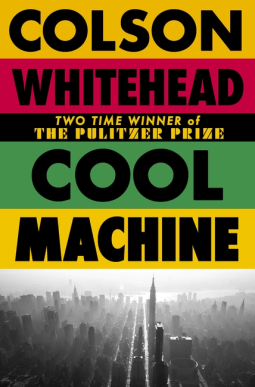
Cool Machine
by the two-time Pulitzer prize-winning author of The Underground Railroad
This title was previously available on NetGalley and is now archived.
Send NetGalley books directly to your Kindle or Kindle app
1
To read on a Kindle or Kindle app, please add kindle@netgalley.com as an approved email address to receive files in your Amazon account. Click here for step-by-step instructions.
2
Also find your Kindle email address within your Amazon account, and enter it here.
Pub Date 21 Jul 2026 | Archive Date 21 Jul 2026
Little, Brown Book Group UK | Fleet
Talking about this book? Use #CoolMachine #NetGalley. More hashtag tips!
Description
'Rejoice: the final instalment of the Harlem Trilogy is here' TELEGRAPH
'A hugely satisfying conclusion to a towering achievement' FINANCIAL TIMES
'Another tour de force . . . Whitehead's Harlem trilogy deserves to become a touchstone of the modern American literary canon' SPECTATOR
FROM THE #1 NEW YORK TIMES BESTSELLING AUTHOR AND TWO-TIME PULITZER PRIZE WINNER COLSON WHITEHEAD
AN EXUBERANTLY ENTERTAINING NOVEL THAT BRINGS 1980S NEW YORK TO VIVID, UNFORGETTABLE LIFE
1981. New York City is beginning to emerge from financial ruin and decline, energized by rampant real estate development and a Wall Street unchained by Reagan-era predatory capitalism. Up in Harlem, successful business owner/master fence Ray Carney has just been named Sterling Furniture's Dealer of the Month. When the banks won't give his beloved wife, Elizabeth, a loan for her new travel agency, however, Carney gambles on one last heist, and finds himself entangled with a legendary criminal mastermind.
1983. To some, Carney's friend and partner in crime Pepper is a stone-cold sociopath. To others, a top thief with questionable people skills. Either way, he's feeling his age in his troubled gut and his aching bones. When he takes on a bodyguard gig as a favor to Elizabeth, he's plunged into the alien territory of the East Village art and club scene. Luckily for him, whether you're uptown or down, everyone speaks the same language of violence - Pepper is a native speaker.
1986. Carney has always been haunted by his inability to save his cousin Freddie. Now, twenty years after Freddie's death, he has a chance to rescue Freddie's son from the violent forces of the city. But coming out of retirement and teaming up with Pepper again will mean risking the safety and security he's spent decades building for his family, with only one shot to get it right.
With his usual pitch-perfect prose, Whitehead paints a portrait of a city in transition, where shimmering skyscrapers rise to the heavens as displaced people huddle in abandoned tunnels below. In a dazzling display of protean imagination, Cool Machine roves all over the city, from Windows on the World to Sugar Hill, to show that in New York, and in the lives of Whitehead's vivid characters, it's what's below the surface that reveals the truth.
'Surely one of the richest creations in crime fiction. Cracking' DAILY MAIL
'Colson Whitehead's trilogy ends with a bang' SUNDAY TIMES
'An atmospheric, stylish finale'INDEPENDENT, BOOK OF THE MONTH
'New York, in all its filthy, frenetic, shabby glory . . . New York has never had a better valentine' THE ECONOMIST
'A triumph of molls, dolls and deadpan humour' STANDARD
'Masterly' MAIL ON SUNDAY
'A literary heist' TLS
'Freewheeling fun' GUARDIAN
'Bustling with energy . . . a whirlwind read' IRISH INDEPENDENT REVIEW
Available Editions
| EDITION | Other Format |
| ISBN | 9780349727677 |
| PRICE | £22.00 (GBP) |
| PAGES | 368 |
Available on NetGalley
Available to Buy
Buy on Bookshop.org Buy on WaterstonesAverage rating from 61 members
Featured Reviews
 Reviewer 1290184
Colson Whitehead’s Cool Machine is a dazzling, high-energy finale to the Harlem Trilogy that blends crime fiction, historical detail, and sharp social commentary into one unforgettable novel. Set in 1980s New York, the book captures a city in transformation—where money, ambition, and danger collide on every corner.
At the center of the story is Ray Carney, a furniture store owner who tries to maintain a respectable life while constantly being pulled back into the world of crime as a “fence” for stolen goods. Ray is a deeply human character—flawed, careful, and always calculating the cost of survival in a city that rewards risk.
Opposite and often alongside him is Pepper, one of Whitehead’s most magnetic characters. Pepper is tough, unpredictable, and almost frighteningly calm in violent situations. Despite his criminal nature, he has a strange sense of loyalty that makes him both dangerous and compelling.
Ray’s wife, Elizabeth Carney, also plays a key role. She is intelligent, determined, and frustrated by the limits placed on her ambitions. Her desire to build a travel agency pushes much of the story’s conflict forward and shows how even “legitimate” dreams are shaped by the same risky world as crime.
Other important figures include Uncle Rich, a legendary criminal mastermind who draws Ray into a major heist, and Freddie, Ray’s late cousin whose legacy continues to haunt him. Freddie’s son, Robert, becomes central to Ray’s final attempt at redemption and responsibility.
What makes Cool Machine so powerful is not just its characters, but how Whitehead uses them to show a changing New York—one where skyscrapers rise while old neighborhoods struggle to survive. The novel moves through different years (1981, 1983, and 1986), each revealing a new layer of ambition, violence, and survival.
Whitehead’s writing is sharp, stylish, and full of tension. Every scene feels alive, whether it’s a carefully planned heist or a quiet moment of reflection about family and regret. The book balances thrilling crime storytelling with deeper questions about loyalty, morality, and what it costs to build a stable life in an unstable world.
By the final page, Cool Machine feels both exciting and emotional—a perfect conclusion to Ray Carney’s journey and a brilliant portrait of a city constantly reinventing itself.
Final verdict: A masterfully written, gripping, and richly layered novel. Colson Whitehead delivers a five-star finale that is as intelligent as it is entertaining
 Pauline M, Reviewer
Thanks to Little, Brown UK and NetGalley for ARC.
This is a dizzying portrait of New York through a period of great transition in the 1980s and how the city and its inhabitants affected each other. It's also a cracking thriller, Set in three sections, it follows furniture store owner/specialist fence Ray Carney and the people in his circle through the decade, in an absolutely dazzling display of writing and plotting. Cannot recommend this highly enough
 Lara A, Reviewer
I have not read any other Colson Whitehead books and I will need to remedy that immediately because this was excellent. It's a three course meal of a book. Undoubtedly more enjoyable if you've read the first two, but I hadn't and still adored this. The characterisation, the delicious turns of phrase. This is the work of any author who knows how talented they are, but when the results are this good, it feels churlish to protest.
 Noel M, Reviewer
Cool Machine is the third book in Colson Whitehead's Harlem trilogy, a series that in its second installment was already shaping up to have as important a place in the author's depiction of the experience of the black community in America as his other Pulitzer Prize winning works. Perhaps even more so for the manner in which it extends that vision across the decades of the 60s in Harlem Shuffle and the 70s in Crook Manifesto. through to the 80s now in Cool Machine. The central figure who is witness to the changes and challenges that the years bring is principally Ray Carney in his efforts to become a legitimate businessman selling furniture in his own Harlem store despite the tug of the criminal underworld coming to his door seeking his services as a fence for stolen goods.
It's not just underworld connections that Ray has to navigate his way though, some of them genuine friends that he is helping give a leg up through the challenges of trying to survive as a black person in America with limited opportunities. Ray is aware that there is not just a criminal underworld of regular "crook crooks", but a criminal 'overworld' with "straight-world deputies of varying degrees of corruption". And, it's in how Ray and his crook friends and associates navigate their way through the straight-crooked world that provides terrific insights and thrilling escapades, but as always with Whitehead, with a human heart underneath.
Arriving in the 1980s, Ray faces new challenges in his reopened store after the fire that engulfed it in the conflagration - in more than one sense of the word - that erupted in the previous book, Crook Manifesto. These are times of major social change for some in Reagan years - "One day you're tuning in, turning on and dropping out, and the next you're salivating over your tax cut". Whitehead captures this period of New York in superficial glamour with a gritty and edgy undercurrent still running through it with some wonderful all is gritty colour, where "To describe a wall as “covered in graffiti” missed the mark; more accurately, the graffiti had some wall in it". It's not just clever writing whether it think this is clever or not, but it one of the many facets that characterise NYC in the 80s, and there are many others well-observed here.
Ray is doing well, his furniture sales business doing well, his wife Elizabeth setting up her own travel agency business, but they aren't "yuppies" by any means; money is needed to expand and the banks aren't lending. Definitely not to women and black women at that. Ray still hustles a bit on the side, partly for the money, partly to help out friends, but also because he just enjoys the game of it. It's always risky however and it can be very easy to get into something that is bigger than he would like. As he finds out when he is asked to handle a sapphire for Dwayne, not realising that the stone is hot and not realising that 'Dwayne' is actually 'Uncle Rich', something of a legend in Harlem. It ends up with him getting involved on a daring raid while another criminal outfit is looking to settle an old score with Uncle Rich. As Ray regretfully observes about the person who got him into this mess - "That's what you get for associating with someone who votes for Reagan."
I thought we were going to get more of a focus on Elizabeth in the second part, but she is wiser when it comes to not mixing business with criminal elements, something that inadvertently happens however when she recommends friend of the family Pepper to someone who is looking for 'security'. Older now, still suffering a stomach complaint, Pepper nonetheless knows the ropes when dealing deal with the crook factory that is NYC in the 80s and he hasn't made a break from the scene either. Elizabeth recommends him to Patterson, an art dealer looking for backup rather than a bodyguard, someone just to keep an eye on things in places that might not be safe for a man in his line of business. Patterson hasn't told him that the deal he is working in to acquire a valuable artwork is a little on the crooked side in a rather dubious location in the new underground freak nightlife and graffiti art scene, an art market dealing in stolen artefacts. Inevitably things go badly, even worse when the 'Melancholy Hitman' gets involved, and none of this does much for Pepper's stomach condition.
The third part of Cool Machine takes place several years later in the decade when Carney’s and Elizabeth's businesses are doing well, and Carney can keep himself out of the crooked dealings. But bad things still go down in NYC. Carney’s nephew - or whatever the son of a cousin is - has disappeared after the shooting of a lawyer he was working for, and Carney - known to get things done - has been asked to see if he can look in some places where he might be found. Again not very nice places but it's a different kind of not very nice. We are well into the 1980s now and gentrification is evident everywhere; yuppies and bankers are occupying old haunts, poverty and drugs are rife and crime has lost its old time hands-on glamour and has become almost industrialised. It's an ideal way to close the trilogy, capping the changes over the decades, where change hasn't necessarily always been for the better. It's not nostalgic for the bad old days, but it certainly underlines how we are where we are today.
The three 'escapades' in Cool Machine are not unlike the episodes in Crook Manifesto but the subject matter is relevant and it's the fact that this is part of a trilogy that makes it more than a fixed period piece (I know, talking about the 80s is ‘period’ now). The experience of the past is what has defined or failed to eradicate the problems of the past. As a whole, the series speaks as much about the American political, social, judicial and criminal systems as much as black experience of it. It's a fascinating, not to say entertaining opportunity to look back and reflect and that's what Whitehead, through Carney, does here. Carney recognises the "churn" of the changing face and pace of NYC and questions what he has done that has real value now in the moneyed times of the 80s, and the bigger question of whether the changes over the decades have necessarily brought any real value to lives arises naturally out of this.
Conceptually as part of the Harlem Trilogy, Cool Machine is brilliant, insightful, thrilling and entertaining. It's the writing really that shines, that guides you through the book as smoothly as Ray’s salesman patter, a skill that Carney finds comes in handy here in a tense situation in the third part of the novel. There is practically a gem on every page. If some of the references might go over your head or you are not as familiar with NYC and Harlem as Whitehead is familiar with it, it all has a wonderful ring to it, a richness of character and insightfulness. You will love the city in all its contradictions and crookedness as seen through the eyes of Ray Carney. Much like the first two books then, and this closing book is very bit as good and as every bit worth extending into a new era, another absolutely fascinating look back on the changes that take place over a lifetime and another worthy book for this acclaimed author. The ending is just perfect.
 Jill T, Reviewer
The final book in the author’s Harlem trilogy opens with Ray Carney being named Sterling Furniture’s Dealer of the Month.
Then circumstances lead him to risk one last heist.
A couple of years later, teaming up with Pepper his mad criminal mastermind friend, he risks everything he’s built up over the last few decades.
What shines through this book is the vivid way the author describes 1980s New York City, rising from its decline and the changes unleashed by unforgiving private enterprise at the expense of the poor.
Wonderfully inventive with an array of colorful characters and settings it’s a great entertaining read.
Many thanks to NetGalley & Little, BrownBookGroup UK for an ARC
 Ben D, Reviewer
Cool Machine, by the double Pulitzer winner Colson Whitehead, returns to New York in the 1980s, following two previous works exploring that city - Harlem Shuffle and Crook Manifesto - to complete his Harlem trilogy.
Ray Carney and his friend Pepper again take central stage in a series of stories - three here - which complete a picture of a New York City that is only a living memory now - a place no longer recognisably contemporary New York. Carney and Pepper are great characters, having taken us in previous novels through the 1960s and 1970s, and are now living in the age of big business and money and Wall Street - but neither of whom occupy that space but feel its weight on them. Their escapades again provide entertainment and insight.
As usual Whitehead's prose is electric - he was a real way with words, almost a free jazz at times - and he knows how to pull the reader straight in and keep their attention. I loved spending time with these characters again, and in this world, and a new Whitehead is always a delight.
Thank you to Netgalley and the publishers for the ARC.
Readers who liked this book also liked: