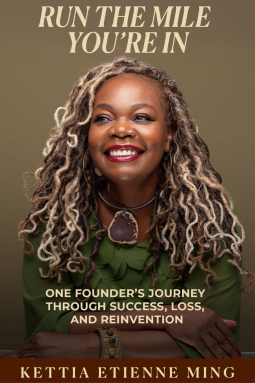
Run The Mile You're In
One Founder's Journey Through Success, Loss, and Reinvention
This title was previously available on NetGalley and is now archived.
Send NetGalley books directly to your Kindle or Kindle app
1
To read on a Kindle or Kindle app, please add kindle@netgalley.com as an approved email address to receive files in your Amazon account. Click here for step-by-step instructions.
2
Also find your Kindle email address within your Amazon account, and enter it here.
Pub Date 5 May 2026 | Archive Date 15 Sep 2026
Description
Kettia Ming built a multimillion-dollar childcare business from her Manhattan apartment. She scaled it. She sold it to a Fortune 500 company. Then they sued her to make sure she could never work in her industry again.
Run The Mile You're In is a real-life David and Goliath story. Years of legal battles. A career in limbo. And a woman who refused to let a non-compete clause become the last word on her life.
This memoir is for anyone who has ever been told that the next chapter isn't theirs to write.
Available Editions
| EDITION | Paperback |
| ISBN | 9798994639214 |
| PRICE | 24.99 |
| PAGES | 394 |
Available on NetGalley
Available to Buy
Buy on Bookshop.org Buy on WaterstonesAverage rating from 2 members
Featured Reviews
 Demetris P, Reviewer
The Rooms She Built, the Rooms She Survived
In “Run The Mile You’re In,” Kettia Ming turns childcare, ambition, litigation, motherhood, and reinvention into a memoir about what it costs to make space for everyone but yourself.
By Demetris Papadimitropoulos | April 27th, 2026
The first business plan in Kettia Ming’s “Run The Mile You’re In” is not written in a spreadsheet. It announces itself in a toddler’s slumped shoulders.
Ming arrives to pick up fifteen-month-old Sophie from a home daycare and finds, not the operatic protest of a child furious at abandonment, but the more frightening answer: silence. Sophie is not crying. She is not fighting. She is sitting there, emptied out, in a place that has taught her to shrink. Before the corporate sale, the non-compete fight, the divorce, the bankruptcy, and the reinvention paid for in rent arrears and quiet, this is a book about rooms: the ones that diminish us, the ones we build so others can flourish, and the ones we finally enter without performing gratitude.
Ming’s answer to Sophie’s silence is Smarter Toddler, a childcare business she creates with her husband, Robert, first in their Upper West Side apartment and then in commercial Manhattan locations. On paper, the premise looks ready for the shelf where ambition gets a subtitle and a launch plan: find the wound in the market, build the company, grow it large enough to attract families and corporate hunger dressed as admiration, sell it, suffer, return, and find the woman left after the door sign comes down. Ming’s version refuses the glossy exit fable. The check does not cure the self; the sale does not preserve the culture; the comeback does not restore the dream. And resilience, that virtue with a marketing department, turns out to be less a halo than a job description no one lets her resign.
The early chapters are the book’s most charming education in miniature. Robert, a fashion-trained designer with a couture impatience for “good enough,” helps Ming turn their basement into a childcare space that rejects the usual tyranny of plastic furniture, fluorescent cheer, loud colors, and cartoon clutter. There are real rugs, real wood, music in the walls, plants, art hung low enough to meet a child’s eyes, hooks and sinks low enough to mean it. This is not taste showing off. It is an argument with a floor plan.
A ceramic bowl quietly tells a toddler, I trust you with the fragile world. A room with real music instead of noise tells a parent, your child has not been abandoned to an institution. A classroom that feels like a home tells a teacher, your work is cultivation, not crowd control. The Reggio Emilia idea of the environment as a “third teacher” gives Ming language for what she and Robert have already understood instinctively: children know when adults have thought about them. Beauty, in Ming’s hands, is not decoration; it is a standard of care made visible in fixtures, rugs, bowls, and light. The daycare is Sophie’s silence answered with plants, policy, music, licensing, and a sink low enough to reach.
Ming’s prose moves like someone taking an emergency call while still trying to tell the truth. It is quick, direct, conversational, and warmest when a scene is still close to the bruise. She has a gift for the object that unlocks the feeling: Sophie’s silent reach, Margaret’s Nelson Mandela doll, the Cartier wedding band, the lunch Chloe packs for Sophie because she is not sure her mother will remember. Later come the affair itinerary on Robert’s computer and the champagne bottle opened after a closing that pays everyone else first. The prose is not finely carved so much as written with one hand on the wound and one on the invoice. It knows where the forms are. It also knows where the pain has filed itself.
Then the invoice arrives, punctual as rent. Smarter Toddler fills quickly. Word spreads. Ming leaves her corporate job after her boss treats her son’s kindergarten graduation as replaceable, and the decision feels both impulsive and correct. The business begins as a childcare solution, but it becomes an argument about whose emergency gets to be real.
Its least glamorous material is some of its best: the engine room of permits, payroll, ratios, inspections, insurance premiums, rent before revenue, and landlords with the spiritual warmth of a padlock. Here, the memoir earns its place on the shelf where vision meets Article 47 and a landlord with a calculator. It knows that entrepreneurship is not only courage, branding, and a tastefully lit origin story. A vision becomes a business the moment someone hands you a regulation manual and calls it your Bible.
Bright Horizons enters first as a buyer, then as the company whose ruler draws Manhattan differently from Ming’s feet. After she and Robert sell their first two centers for $7.2 million, they take a break, then attempt a relaunch. The relaunch becomes a legal trap measured by birds when Bright Horizons argues that Ming’s new Financial District location violates a non-compete clause. The phrase that slices through the book is “as the crow flies”: the distance between two centers measured in a straight line, not by the walking route Ming had checked with her Garmin.
Crows may fly through buildings. Families do not.
It is a phrase with a ruler hidden inside it. Ming measured the route herself but did not know she needed a professional surveyor to measure legal distance. That difference costs her a cease-and-desist, a court defeat, delayed opening, legal bills, punishing loans, and a $1.5 million settlement paid over four years. She opens the new center with that settlement already sitting on its chest. The rent does not care. Payroll does not care. The children still need teachers; the rooms still need to feel safe.
Ming reads the Bright Horizons fight as a contract dispute with teeth. She sees it as punishment for re-entering the market after a successful sale, for having the nerve to cash the check and rise again. The scenes carry that charge better than any declaration could: the landlord’s representative whose warmth cools when she sees Ming and Robert in person; the guarantor arrangement Ming calls the “Black Tax”; the investor who treats her Gucci shoes as evidence of financial unseriousness; the prospective parent who assumes the white receptionist must be the owner; the later KinderCare contract that tries to pocket the valuable Smarter Toddler trademark as if it were an extra set of keys.
These moments matter because they convert bias into deposits, guarantees, silence, and tone. Inequality is not only insult. It is math. It is more expensive permission to exist, a worse assumption disguised as prudence, a room that lowers its temperature when she walks in, a clause interpreted with maximum pressure. It is being mistaken for staff in the place you built.
The memoir tries to house too many lives at once, which is partly its flaw and partly its honesty. It is a founder story, a business guide, a motherhood reckoning, a Black woman’s testimony, an immigrant-family inheritance, a divorce narrative, a spiritual recovery account, and a reinvention story. That is too much for a neat floor plan. Yet Ming’s life does not divide cleanly. The lawsuit drains the business. The business strains the marriage. The marriage affects the children. The body registers what the self refuses to say through headaches, chronic pain, and the bleak revelation that surgery can begin to look like rest. Haiti, New York, church, discipline, beauty, ambition, and money all press against one another. The life has no spare room; the book, for better and worse, refuses to fake one.
Where the book weakens is in its urge to annotate itself before the scene has finished echoing. Ming occasionally turns lived revelation into takeaway, explaining the moral after the scene has already paid the bill. The book returns often to strength as armor, softness as recovery, rest as necessity, and legacy as something larger than ownership. These are essential ideas, but they are not always allowed to gather quietly. At times the memoir circles the block after finding the address. The advice passages will be useful to many readers, especially founders, mothers, professional fixers, and family fixers. Artistically, though, the strongest scenes need less escorting. Some of them could carry the furniture without the author pointing to the load-bearing wall.
The repetitions work because each return places the weight somewhere new. The prologue opens after Ming finishes the Boston Marathon, placing triumph and threat in the same breath. She has chased a finish line for six years. Then she opens an email that turns the finish into a false summit. That pattern governs the book. The first license leads to expansion. The first expansion leads to the “Black Tax.” The first sale leads to grief. The comeback leads to litigation. The settlement leads to bodily strain and marital distance. The second sale leads into COVID. Each victory leaves a bruise shaped like the next problem.
That design deepens the title. “Run the mile you’re in” begins as a runner’s mantra, then becomes a founder’s survival method, then a way to endure debt, shame, illness, divorce, and uncertainty without letting the whole future crush the present. The structure is not a straight hallway. It is a sequence of immediate miles, each demanding a different self.
Some of those miles are the kind no marathon jacket commemorates. Ming leaves her corporate job partly to be more present for her children, then builds a business that consumes her in another form. She remembers sacrifice, logistics, Sunday dinners, and achievement. Her children remember missed pickups, forgotten lunches, store-bought cupcakes, work calls, and the nanny’s dependable mac and cheese. The devastating scene is not grand. Chloe quietly packs lunch for Sophie “just in case.” A child has stepped into the gap. The myth of balance does not need to be denounced after that. It is already sitting at the kitchen counter with a sandwich bag.
The marriage to Robert follows a similar pattern of slow abrasion by logistics. Early on, he is the designer-magician of the book: the man with the paint chips, the custom installations, the instinct for beauty, the ability to turn a basement into a small kingdom of care. Later, he becomes the husband whose loneliness becomes betrayal. Ming does not erase his importance, nor does she absolve him. What hurts is the administrative neatness of it. She finds an itinerary: dinner, show, car service confirmed. Betrayal, here, arrives with scheduling. The man who could design a room down to the undertone of the paint could not, finally, preserve the room between them.
The Italian-monastery turn could have been the section where the memoir floats away in linen. A retreat after burnout is dangerous territory for any book not wishing to be mistaken for a brochure with better lighting. Ming mostly avoids the trap because Eremito is not offered as a cure. It is a quiet enough place for her to hear herself again. In a small group, she says what she has not yet admitted: she wants to sell the business. The importance of the moment is not serenity. It is stillness with a lawyer on speed dial. Shortly afterward, when a creditor threatens the company, bankruptcy becomes not a moral failure but a tool: a way to stop creditors, invite buyers, and create enough legal oxygen to think. Surrender is not passivity. It is strategy after panic has worn itself out.
The book makes its public argument through the service entrance: payroll, ratios, rent, frightened parents, exhausted teachers, and doors that must open before anyone else can get to work. Ming understands childcare as economic infrastructure before the pandemic turns the national lights on. When COVID arrives, parents discover what providers already knew: without childcare, the economy loses its babysitter. Yet the centers themselves are fragile. Enrollment collapses. Staff fear exposure. Regulations shift by the hour. Ming keeps the doors open partly because a sale to KinderCare depends on continuity, but each month burns equity she will never recover. When the deal finally closes in January 2021, more than $900,000 that might have been hers is gone, swallowed by rent arrears and obligations. The exit exists, but the windfall has already been eaten.
There is a class tension here the book touches but does not fully press on. Ming democratizes beauty philosophically, insisting that children deserve gorgeous, intentional spaces. In practice, she is also building premium childcare in Manhattan, in neighborhoods where families can buy the kind of care most parents can only wish existed. That tension does not undo the book’s argument, but it complicates it. The dream is humane. The market is not.
What finally lingers is the book’s refusal to make care vague. Childcare is art, trust, rhythm, employment, real estate, licensing, insurance, snacks, music, and payroll. Love without structure burns people out. Structure without love becomes institutional. Smarter Toddler, at its best, is Ming’s attempt to hold both: tenderness and compliance, wonder and rent, beauty and a working fire alarm.
Other limits remain. Some antagonists become more symbolic than complex. Some large claims about corporate motive and racialized punishment are compelling as Ming’s interpretation but not always given enough counterweight on the page. The direct-address lessons, while often earned, can flatten the literary tension by telling us what the story has already made plain. Compared with “More Than Enough” by Elaine Welteroth, it is less polished in its self-shaping; compared with “Rest Is Resistance” by Tricia Hersey, less distilled in its theory of rest; compared with “Believe It” by Jamie Kern Lima, far less interested in the clean shine of entrepreneurial victory. Ming’s book is rougher, fuller, more crowded at the door. That crowding is sometimes the flaw. It is also evidence that the life has not been buffed into brochure copy.
I land at 82/100, or 4/5 stars: emotionally forceful without being tidy, unusually specific, and carried by scenes vivid enough to withstand the repetitions and the occasional habit of turning revelation into instruction.
Ming sells the business, watches everyone else get paid first, leaves Manhattan, moves to Westchester, buys a car online, eats takeout among boxes, and learns the strange grammar of living alone. After years of designing rooms where other people’s children could feel safe, she begins to design one for herself.
That is the final reversal. The book begins with a child’s silence as alarm. It ends with a woman’s silence as restoration. Not defeat. Not vacancy. The first room in years where no one is waiting with a need, and no one has to be saved before she sits down.
 Kay O, Reviewer
I almost didn't read this book. So glad I did. This book was so much more than I thought. I loved authors perseverance, and her never-stop attitude.
Her love for her family showed. Really good book!
Thanks to author, publisher and Netgalley for the chance to read this book. While I got the book for free it had no bearing on the rating I gave it.