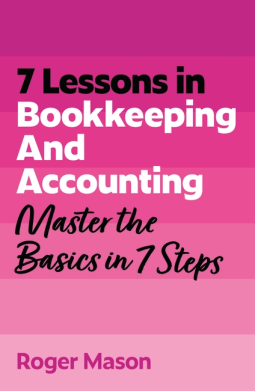
7 Lessons in Bookkeeping and Accounting
Master Bookkeeping Basics in 7 Steps
This title was previously available on NetGalley and is now archived.
Send NetGalley books directly to your Kindle or Kindle app
1
To read on a Kindle or Kindle app, please add kindle@netgalley.com as an approved email address to receive files in your Amazon account. Click here for step-by-step instructions.
2
Also find your Kindle email address within your Amazon account, and enter it here.
Pub Date 18 Jun 2026 | Archive Date 3 Jul 2026
John Murray Press US | John Murray Business
Talking about this book? Use #7LessonsinBookkeepingandAccounting #NetGalley. More hashtag tips!
Description
A SHORT COURSE IN BOOKKEEPING BASICS.
7 Lessons in Bookkeeping and Accounting is a quick course in understanding finace, giving you everything you need to know in just seven short chapters. From basic finance principles to different types of account and ledger, you'll learn to deal confidently with questions such as "Why does every bookkeeping entry have two sides?" and "What is the accountant talking about?".
* Lesson 1: The basic principles of bookkeeping
* Lesson 2: Different types of account and ledger
* Lesson 3: More aspects of bookkeeping
* Lesson 4: Preparation for the accounts
* Lesson 5: The profit and loss account
* Lesson 6: The balance sheet
* Lesson 7: Understanding published accounts
Explore the main themes and ideas in accounting, get a basic knowledge and understanding of the key concepts, and test your progress with practical and thought-provoking exercises. 7 Lessons in Bookkeeping and Accounting is your fastest route to success.
ABOUT THE SERIES
7 Lessons are for people who want to succeed at work. From negotiating and content marketing to finance and social media, the series covers the business topics that matter and that will help you make a difference today. Written in straightforward English, each book features a course of 7 short lessons so that with just a little work, you can quickly master the subject.
Available Editions
| EDITION | Other Format |
| ISBN | 9781399830515 |
| PRICE | £10.99 (GBP) |
| PAGES | 128 |
Available on NetGalley
Available to Buy
Buy on Amazon Buy on Bookshop.org Buy on WaterstonesAverage rating from 9 members
Featured Reviews
 Cristin P, Reviewer
Thank you Net Galley for this ARC. This gave me some great ideas, and things to think about for the future of my career. I have two more of this these book to read and can't wait to see what all I can use in my daily life.
 Elizabeth R, Reviewer
7 Lessons in Bookkeeping and Accounting by Roger Mason is a clear, approachable, and genuinely helpful introduction to bookkeeping for complete beginners.
This book does exactly what it promises: it breaks down the fundamentals of bookkeeping and accounting into seven short, well-structured lessons that are easy to follow and unintimidating. The explanations are straightforward, the progression is logical, and the concepts—from ledgers and double-entry bookkeeping to profit and loss accounts and balance sheets—are explained in a way that actually makes sense if you’re starting from scratch.
If you’re looking for a friendly, confidence-building starting point for understanding bookkeeping, this is an excellent place to begin. Clear, concise, and well organised—highly recommended as a primer.
Dana G, Reviewer
As someone who does not have an accounting degree this book was very insightful. I am running a small business and wanted to better educate my self in accounting. This book help me better get a understanding of the numbers.
 Demetris P, Reviewer
The Ledger Behind the Screen
Roger Mason’s “7 Lessons in Bookkeeping and Accounting” finds the old grammar of debits, credits, and balance hiding beneath modern financial tools.
By Demetris Papadimitropoulos | May 23rd, 2026
Accounting has a knack for making ordinary competence feel like trespass. Debit, credit, ledger, accrual, prepayment, trial balance, depreciation, working capital – the words do not merely name concepts; they stand around them like hired security. Roger Mason’s “7 Lessons in Bookkeeping and Accounting” earns its square inch of shelf space because it does not pretend this is a club with a clipboard at the velvet rope. It hands the reader a key and a floor plan, then explains why the door opens only one way.
This book does not arrive with revelation; it arrives with a ruler, a ledger, and a sharpened pencil. Mason’s best subject is not bookkeeping as vocabulary, but bookkeeping as grammar: every transaction has two sides, every claim belongs somewhere, every figure must eventually answer to another figure. The book’s wager is that accounting becomes less frightening once business activity is sorted into obligations, assets, costs, and claims. A sale becomes an entry. An entry enters a ledger. Ledgers produce a trial balance. The trial balance is adjusted. The adjusted balances become a profit and loss account and a balance sheet. Those accounts teach the reader how to approach published financial statements without wearing the grave little nod of someone pretending to understand wine.
The subtitle, “Master Bookkeeping Basics in 7 Steps,” carries the brisk promise of the short-course shelf. “Master” is doing a little unpaid overtime. Mason offers not mastery but a working map, and a map is sometimes the whole rescue. For anyone who has stared at accounting software, a treasurer’s report, a balance sheet, or a profit statement with the sensation of being mugged by columns, that may be precisely enough.
The warning comes early: most bookkeeping is now computerized, but software can let people use systems without understanding what those systems are doing. This is not a sepia campaign for quill pens and candlelit ledgers. His point is sharper. Computers have not abolished bookkeeping principles; they have hidden them behind clean, frictionless screens. They can process the work faster, arrange it more neatly, and generate prettier reports, but they cannot turn bad inputs into accounts that can bear weight. GIGO – garbage in equals garbage out – does the necessary scolding. The machine has no brain. Someone still has to understand the transaction.
The seven lessons advance like entries in a well-kept ledger: each carries forward what the last has established. The first begins with single-entry bookkeeping, the simple recording of income and expenditure. Mason grants its usefulness for small clubs and modest organizations, then shows its limits: it may not reveal errors, debts owed, money owed to the organization, or assets still in service after the money has left the bank. Double-entry bookkeeping enters not as bureaucratic fussiness but as a system of control. Every transaction involves the giving and receiving of a benefit. Every debit must have a credit. The total of the debits must equal the total of the credits. The rule is ancient, associated here with Luca Pacioli, but Mason presents it less as history than as architecture. If the building is going to stand, the foundations must be laid correctly.
From there, Mason classifies accounts into income, expenditure, asset, liability, and capital, then explains the nominal ledger, sales ledger, sales day book, purchase ledger, and purchases day book. In a weaker primer, this would be mere labeling. Here, sorting becomes understanding. Beginners often fail not because they cannot add, but because they do not know where things belong. Wages are not stock. Stock is not capital. Money owed by customers is not the same thing as sales. Owners are separate from the business, even when the owner and the business share a name, a bank branch, and possibly a kitchen table. The sales and purchase systems are presented as mirror images, a small structural elegance in a book that generally prefers fluorescent lighting.
Then comes the housekeeping of proof. The cash book, bank reconciliation, journal, petty cash, imprest system, and trial balance sound unlovely, but here they become the book’s ethic in action. Records are not enough; records must be tested against reality. The cash book and bank statement may differ for many reasons: outstanding cheques, uncredited receipts, standing orders, charges, direct debits, mistakes. Mason’s anecdote about Ernest Hemingway using unbanked cheques as bookmarks gives bank reconciliation a comic receipt tucked into the lesson, but the joke has a serious invoice attached. Reconciliation is the refusal to let difference remain vague.
One of Mason’s driest and most revealing warnings concerns suspense accounts, which attract “all sorts of nonsense.” It is wonderfully accountant-like, mild in volume and strict in implication. A suspense account is where money sits until the final accounting entry is decided, but temporary holding pens have a way of becoming cupboards no one opens. The line hints at a deeper truth the book rarely announces: financial mess seldom starts as catastrophe. It begins as a place where someone meant to come back later.
Once the records exist, Mason asks whether they tell the truth. Accruals, prepayments, reserves, provisions, depreciation, and the extended trial balance enter the course, and the worktable suddenly needs judgment. Accruals are costs incurred but not yet entered; prepayments are costs entered but not yet incurred. Bad debt reserves recognize that a sale may not really produce the money recorded. Provisions anticipate obligations such as discounts, warranty claims, legal settlements, or contract losses. Depreciation acknowledges that assets do not remain new because the books would prefer it. The rules remain plain; arithmetic starts needing judgment. Accounts do not merely report what happened. They classify, estimate, time, and discipline what happened.
That is the moment when the primer becomes more than a glossary with examples. It begins to show that accounting, even at its most basic, is not only arithmetic. It is timing, placement, skepticism, and proportion. An invoice that has not arrived may still belong to the period. A payment already entered may belong to the future. A debtor may look like an asset until reality quietly revises the sentence. Mason does not linger over the philosophy of this, which is wise; a seven-lesson accounting primer should not suddenly put on a black turtleneck. But the implication is there. The numbers are never just numbers. They are claims about when, where, and how value should be recognized.
When Mason reaches the profit and loss account, he is at his best making timing visible. A profit and loss account covers a specified period, and the period matters. A greetings-card shop looks different before Christmas than after the seasonal rush. A trading business must include the cost of goods sold, not simply the cost of goods purchased. A manufacturing business must separate production costs from overheads. These examples are plain, but they are well chosen: the reader sees how easily a business can misstate itself by putting the right figure in the wrong place, or the right cost in the wrong period.
The two key principles here – match cost to income, and prepare accounts prudently – are simple enough for newcomers and portable enough to matter beyond the exercise. Profits should not be taken before they have been earned; losses should be recognized when they can be realistically foreseen. There is a stern little weather system inside that sentence. It is the book’s quietest moral instruction: do not flatter the present by exporting trouble into the future.
The balance sheet lesson gives the primer weight. Mason’s distinction is simple and vital: the profit and loss account covers a period, while the balance sheet captures one fixed date. The balance sheet contains what remains after revenue and expense accounts have gone elsewhere: assets, liabilities, and capital. His explanation of ownership helps. Capital accounts are treated with liabilities because they represent what the business owes to its owners. Bridget Murphy the person is separate from Bridget Murphy the business, even if Bridget Murphy is both. That separation sounds technical, but it is one of the civilizing fictions on which business accounting depends.
The working-capital discussion is even more bracing. Net current assets – current assets minus current liabilities – finance the day-to-day running of the business. Mason states plainly that a business can be profitable and still be forced to close because it lacks sufficient working capital. This is one of the book’s most valuable lessons because it pricks the lazy romance of profit. Profit may flatter. Cash has to answer the door.
At that point, the primer steps out of the back office. Mason moves from internal bookkeeping to published accounts: why companies publish them, how they may be obtained, and how to read annual reports, notes, audit reports, cash flow statements, directors’ reports, and consolidated accounts. Accounting becomes not only private order but a public account rendered to investors, employees, governments, creditors, and everyone else invited to trust the figures.
This is also where the reader needs a penciled caution. The front matter notes that the book was first published in Great Britain in 2016 and appears here in a 2026 John Murray Business edition. The core bookkeeping instruction is stubbornly durable; the principles of double-entry, reconciliation, accruals, prepayments, depreciation, profit and loss accounts, and balance sheets do not expire like milk. But details about Companies House, audits, filing periods, thresholds, charges, and standards should be checked before being treated as up-to-date guidance. The book is strongest as an introduction to accounting logic, less secure as an up-to-date compliance guide.
Mason’s prose does its appointed work and rarely raises its hand for applause. His sentences are short-to-medium, declarative, practical, and intent on keeping the reader moving from step to step. The diction is plain without being patronizing. Technical terms appear, but they are usually explained before they stiffen into intimidation. He writes like an experienced instructor who has seen the same confusions many times and has no wish to embarrass anyone. There is kindness in that restraint. The book never treats confusion as stupidity; it treats confusion as a sign that the reader has not yet been shown the system in the right order.
There is little lyricism here, though there are small comic receipts along the way. The reference to “The Sound of Music” brings classroom brightness. Hemingway’s unbanked cheques give bank reconciliation its memorable image. St Paul’s Cathedral makes a brief appearance in a discussion of book value and depreciation. The closing accountant jokes are amiable, if familiar – the sort of thing one imagines at a professional lunch where everyone laughs because the biscuits are free. Still, the jokes matter in a minor key. They signal that Mason understands the subject’s reputation and is willing to smile at it without surrendering the work’s seriousness.
Form and lesson keep the same books. The orderly prose makes the subject feel orderly; the incremental explanations make accounting feel learnable. Because ideas recur – balance, foundations, debits and credits, computers following old principles – the reader begins to absorb not just information but habit. In an introductory manual, repetition is often not padding but pedagogy. Strange words become working words because they return. At times, yes, the book tells careful readers what they have already learned. It is a forgivable debit.
Its craft lies in sequence. “7 Lessons in Bookkeeping and Accounting” is not formally adventurous, but its progression is more intelligent than its plain packaging might suggest. Many beginner guides dump readers before financial statements and start naming the furniture. Mason begins in the floorboards. He understands that annual reports cannot be interpreted unless the reader first understands entries, accounts, ledgers, reconciliations, adjustments, and trial balances. The lesson pattern – explanation, example, exercise, summary, check – is not elegant in a literary sense, but it is fit for purpose. It teaches the way bookkeeping itself works: by placing things correctly, checking them, and carrying the balance forward.
Compared with Mike Piper’s “Accounting Made Simple,” Mason’s book feels more course-like and manual-ledger in temperament; compared with Darrell Mullis and Judith Orloff’s “The Accounting Game,” it is less playful and less narrative. It belongs near finance-for-nonfinancial-managers books, but Mason begins before management interpretation. He wants to show how the numbers are made before anyone starts using them in a meeting.
Mason’s best service is turning professional fog into working grammar. His strongest pages do not merely define terms; they show relations. Debit and credit, asset and liability, income and expenditure, accrual and prepayment, profit and cash, period and date: the book teaches by distinction. That is why its manual-ledger explanations work. They slow the system down enough for the reader to see the moving parts.
The price of that virtue is visible almost at once. The book is dry, modest, and narrow. It does not offer much historical depth, ethical drama, institutional analysis, or contemporary software texture. It is not trying to invent where it can clarify. Its accounting is sometimes so compressed that the messier areas – audit judgment, fraud, regulatory change, international variation, valuation, insolvency, policy choices – pass by as simplified instruction. For readers with any accounting background, it may feel elementary. For readers who want a sleek, software-first guide, its manual logic may feel sepia-toned.
Yet that manual-ledger temperament is also part of its usefulness. In an age of dashboards, apps, automated reports, and frictionless financial tools, Mason insists on the stubborn grammar behind the screen. The insistence is not glamorous, but it is healthy. A person who can click “generate report” without understanding the report is not empowered. They are merely faster at being confused.
The back matter, “7 × 7,” makes the reference purpose explicit: seven things to do, remember, avoid, forecast, quote, and joke about. Some of it is useful; some feels like series furniture being rearranged after the lesson. The best reminders are practical: do the bank reconciliation, clear suspense accounts, keep accruals and prepayments accurate, remember period for profit and loss, date for balance sheet, and do not put income accounts in the balance sheet or assets in the profit and loss account. The weaker material is harmless, though the jokes may test the reader’s depreciation policy on patience.
This is a book for ordinary readers; dressing it in a suit two sizes too large would only make it trip. It is not a major work of business thought, a stylish reinvention of financial literacy, or the last word on accounting. It is a compact, lucid, somewhat dry primer that does the job it set itself. That is enough, especially for newcomers who want to understand what their software, accountant, treasurer, employer, or annual report is saying.
My final rating is 81/100, which corresponds to 4/5 Goodreads-compatible stars: trustworthy where it teaches principles, but limited by dryness, modest originality, jurisdiction-specific context, and some potentially dated public-accounting details.
The finest thing Mason does is refuse mystification. He does not dress bookkeeping up as genius, wizardry, or entrepreneurial revelation. He treats it as a disciplined way of making claims answerable. What was received? What was given? What is owed? What has been earned? What has merely been entered? What value remains? What loss is already visible, even if no one has yet sent the invoice?
That is why the book’s plainness earns force. Beneath the ledgers and day books, beneath petty cash and depreciation, beneath the trial balances and published accounts, “7 Lessons in Bookkeeping and Accounting” is about the quiet obligation to make the story add up. Every figure has another side. Every benefit casts a shadow. The books may close, but the balance is always waiting.
Readers who liked this book also liked:





We Are Bookish
Literary Fiction, Multicultural Interest, Women's Fiction

We Are Bookish
General Fiction (Adult), Mystery & Thrillers, Sci Fi & Fantasy

We Are Bookish
Historical Fiction, Literary Fiction, Multicultural Interest






Eunice Amnell
New Adult, Romance, Sci Fi & Fantasy