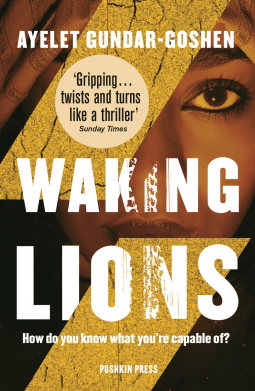
Waking Lions
by Ayelet Gundar-Goshen
Pub Date 1 Sep 2016
This title was previously available on NetGalley and is now archived.
Description
After an exhausting night shift, Dr Eitan Green leaves the hospital, gets into his luxurious SUV and speeds down a deserted, moonlit Negev road. Then, suddenly, he hits someone. He is horrified to discover that the injured man - an African migrant - has no chance of surviving. Eitan flees the scene.
The victim's beautiful widow knows everything. But when she turns up unannounced at Eitan's door, intent on blackmail, it isn't money she's after, but something quite different... something which will completely shatter Eitan's comfortable world.
At a time when heart-breaking stories of refugees dominate the news, Waking Lions takes an unrelenting look at the darkest corners of Israeli society and of the human soul; at the complexities of displacement and the fear of estrangement. Interlaced with extortion and power struggles, this is a tempestuous social and moral thriller; a story of intimacy at the heart of alienation and of erotic attraction across cultures which compels the reader to ask themselves, 'What would I do?'
The victim's beautiful widow knows everything. But when she turns up unannounced at Eitan's door, intent on blackmail, it isn't money she's after, but something quite different... something which will completely shatter Eitan's comfortable world.
At a time when heart-breaking stories of refugees dominate the news, Waking Lions takes an unrelenting look at the darkest corners of Israeli society and of the human soul; at the complexities of displacement and the fear of estrangement. Interlaced with extortion and power struggles, this is a tempestuous social and moral thriller; a story of intimacy at the heart of alienation and of erotic attraction across cultures which compels the reader to ask themselves, 'What would I do?'
After an exhausting night shift, Dr Eitan Green leaves the hospital, gets into his luxurious SUV and speeds down a deserted, moonlit Negev road. Then, suddenly, he hits someone. He is horrified to...
Description
After an exhausting night shift, Dr Eitan Green leaves the hospital, gets into his luxurious SUV and speeds down a deserted, moonlit Negev road. Then, suddenly, he hits someone. He is horrified to discover that the injured man - an African migrant - has no chance of surviving. Eitan flees the scene.
The victim's beautiful widow knows everything. But when she turns up unannounced at Eitan's door, intent on blackmail, it isn't money she's after, but something quite different... something which will completely shatter Eitan's comfortable world.
At a time when heart-breaking stories of refugees dominate the news, Waking Lions takes an unrelenting look at the darkest corners of Israeli society and of the human soul; at the complexities of displacement and the fear of estrangement. Interlaced with extortion and power struggles, this is a tempestuous social and moral thriller; a story of intimacy at the heart of alienation and of erotic attraction across cultures which compels the reader to ask themselves, 'What would I do?'
The victim's beautiful widow knows everything. But when she turns up unannounced at Eitan's door, intent on blackmail, it isn't money she's after, but something quite different... something which will completely shatter Eitan's comfortable world.
At a time when heart-breaking stories of refugees dominate the news, Waking Lions takes an unrelenting look at the darkest corners of Israeli society and of the human soul; at the complexities of displacement and the fear of estrangement. Interlaced with extortion and power struggles, this is a tempestuous social and moral thriller; a story of intimacy at the heart of alienation and of erotic attraction across cultures which compels the reader to ask themselves, 'What would I do?'
A Note From the Publisher
ABOUT THE AUTHOR
Ayelet Gundar-Goshen was born in Israel in 1982 and holds an MA in Clinical Psychology from Tel Aviv University. Her film scripts have won prizes at international festivals, including the Berlin Today Award and the New York City Short Film Festival Award. Waking Lions was a bestseller in Germany and is being translated into five languages.
ABOUT THE AUTHOR
Ayelet Gundar-Goshen was born in Israel in 1982 and holds an MA in Clinical Psychology from Tel Aviv University. Her film scripts have won prizes at international festivals, including...
A Note From the Publisher
ABOUT THE AUTHOR
Ayelet Gundar-Goshen was born in Israel in 1982 and holds an MA in Clinical Psychology from Tel Aviv University. Her film scripts have won prizes at international festivals, including the Berlin Today Award and the New York City Short Film Festival Award. Waking Lions was a bestseller in Germany and is being translated into five languages.
Advance Praise
'Gripping... twists and turns like a thriller' Sunday Times
'Brave and startling' Financial Times
'Classy... suspenseful' The Times
'I loved everything about it' Daily Mail
'Sophisticated, angst-filled' Spectator
'Exhilarating' Guardian
'Brave and startling' Financial Times
'Classy... suspenseful' The Times
'I loved everything about it' Daily Mail
'Sophisticated, angst-filled' Spectator
'Exhilarating' Guardian
'Gripping... twists and turns like a thriller' Sunday Times
'Brave and startling' Financial Times
'Classy... suspenseful' The Times
'I loved everything about it' Daily Mail
'Sophisticated, angst-filled' ...
Advance Praise
'Gripping... twists and turns like a thriller' Sunday Times
'Brave and startling' Financial Times
'Classy... suspenseful' The Times
'I loved everything about it' Daily Mail
'Sophisticated, angst-filled' Spectator
'Exhilarating' Guardian
'Brave and startling' Financial Times
'Classy... suspenseful' The Times
'I loved everything about it' Daily Mail
'Sophisticated, angst-filled' Spectator
'Exhilarating' Guardian
Available Editions
| EDITION | Paperback |
| ISBN | 9781782272984 |
| PRICE | £8.99 (GBP) |
Available on NetGalley
| Send To Kindle (PDF) |
| Download (PDF) |
Featured Reviews
Natasha R, Bookseller
|
My Recommendation
|
|
I read every book about Israel that I can, and this one is exceptional. It is well written and peopled with interesting characters, but the best part about it was that it shined a light on a different part of Israeli society and gave face and voice to those people. It is a book that is relevant to all societies in this day and age and it should be read by everyone. |
My Recommendation
|
|
My Recommendation
|
|
Tens of thousands of illegal migrants from Africa live in Israel, many of whom come from Eritrea and Sudan. This morally complex and suspenseful novel by Israeli writer Ayelet Gundar-Goshen explores what happens when the life of a “good” Israeli doctor becomes inextricably linked with the Eritrean community when one night he runs over and kills one of them – and decides not to own up. By this one impulsive action his life is upended and he is drawn into a web of lies, secrecy and moral equivocation. As much a thriller as an exploration of morality, responsibility and guilt, I found this a compelling and thought-provoking novel, opening up aspects of Israeli society I had previously known little about – immigration, the Bedouin community, racism, drugs and violence – a world that is completely alien to the beleaguered doctor, and which forces him to reappraise many of his long-held convictions. Boundaries between good and bad, right and wrong, are cleverly explored whilst keeping the narrative fast-paced and suspenseful. A social and moral drama, the novel is hard to put down and the gripping storyline keeps the reader guessing throughout. |
My Recommendation
|
|
My Recommendation
|
|
Waking Lions, Ayelet Gundar-Goshen's second novel, has a desperately compelling beginning. Tired and groggy after a long night shift Dr. Eitan Green gets into his brand new SUV and drives out to the desert. It's hours after midnight and dark; he should go home to where his wife Liat and two sons are still sleeping. Instead he takes his car off-road, looking for a quick burst of adrenaline at high speed under the stars. He turns the music up, feels his blood sing with exhilaration. His career isn't quite what he wants it to be, exiled to a hospital in the back of beyond, but he has a good life, a loving family. Then he hits a man, an Eritrean refugee. The man is still alive but barely, his head mushed to pulp in parts; even if Eitan called for an ambulance he would die anyway. His life would be utterly ruined. He could go to prison for manslaughter. So he makes a decision, to pretend it never happened. There was no night time drive. There was no man. Who is this man anyway? No one. A nameless black man amongst the thousands of undocumented black men flooding over the border from Egypt. Eitan gets back in his car, flees the scene and lets the man die alone by the road side. No one need ever know. Except someone does know. The next day there is a knock on the Green family front door. Eitan opens it to find a black woman standing there holding his wallet. The man who was killed - his name was Asum - was her husband and she watched the whole thing, unseen in the darkness. Panicked Eitan offers her money, a huge sum, but it isn't money she wants. Her name is Sirkit and she wants a doctor. So begins Eitan's shadow life. At night, after his paid work, he drives out to Sirkit's camp in the desert and treats an endless queue of migrants and refugees, all illegal and otherwise without medical care. Sirkit watches over him, avenging herself, demanding long hours and impromptu emergency visits. His life becomes a round of lies and evasions, at work and at home, the stress of concealing his "secret hospital" added to the pressing guilt of killing a man. As if matters weren't bad enough Asum's body is discovered and the case is picked up by none other than Eitan's police-officer wife. You might imagine, from that description, that Waking Lions is part crime novel, part thriller but it isn't really either. The book has two halves, quite distinct in character. In the first part we inhabit the minds of Eitan, Sirkit and Liat, almost completely immersed in their thoughts, assumption, fears and desires. Gundar-Goshen focuses unrelentingly on the psychological effects of the accident, and on the moral compromises that people make every day. It is narrow, claustrophobic reading with little space for peripheral characters, subplot or sense of place. The novel chews on just a handful of fundamental questions: what makes a person good? What evils are we capable of? Can bad actions ever be justified? The second part of the book broadens its scope and commits completely to the repercussions of Eitan's actions. As Liat draws closer to the Asum's killer and Eitan begins to lose control of his sense of self, Sirkit reveals a secret that sends the plot spinning off into high octane shoot outs and car chases. It's a jolting shift, which at first makes the whole feel off-balance. An intersection of racism and sexism lies at the heart of the book. Eitan's white male privilege is juxtaposed with both Liat's position as a woman in a male-dominated environment and with Sirkit's experience as a black woman, first in Eritrea and then in Israel. Sirkit observes that, even though Eitan is experiencing one of the most terrifying junctures of his life, he still walks without fear. He continues to assume that he deserves to be happy and comfortable and that he will be again. He looks people in the eye because he never occurs to him that he shouldn't. She, on the other hand, is practiced in the art of looking down or looking away. The power her husband's death gives her over Eitan's life is heady and addictive. It is the first time in her life that someone has to do what she tells them to. The novel's portrayal of Sirkit's assertion of will is one of it's most powerful and moving aspects, especially in light of the devastating ending. Sirkit's rise to power has the knock on effect of disempowering Liat, the other woman in Eitan's life, which in turn impacts on the lives of others. Cut out of her marriage, increasingly embattled at work, she colludes in the arrest and interrogation of a Bedouin teenager she suspects may have killed Asum. Her investigation eventually leads to his village, where a young girl steps forward to stand as his alibi witness. Admitting that she is the boy's lover is tantamount to suicide and it isn't long before her battered body finds it's way through the door of Eitan's desert clinic. Her's is one of many female bodies shattered, bruised and violated in the book as cultural norms - in Israeli, Bedouin and migrant communities - work to silence them. It makes for challenging reading. Even as Eitan grows to care about and respect Sirkit he continues to think of her in ways that exoticise and degrade her. Seen through his eyes she is the sculpted brazen African queen of Rider Haggard's She, her blackness a sign of a predatory sexuality. He fantasizes about her "velvety skin" and her long neck; it surprises him (and everyone else) that she can speak Hebrew. He interprets her blank silences as a form of aggression when actually they are an armour against her vulnerability. He despises the patients she forces him to treat, viewing them as senseless animals. Without language, without the ability to exchange a single sentence the way people do - one speaks, the others listen and vice versa - without words, only flesh remained. Stinking. Rotting. With ulcers, excretions, inflammations, scars. Perhaps this was how a veterinarian felt. He darn't allow himself to open himself to either their humanity or their plight. What would that mean for the cosy safe life he lives, or for the worth of the life he took? Like most people in his situation he does not want to engage with suffering. He recalls a school trip to Auschwitz, the photographs of starving people waiting to die. A friend asked the tour guide: "But why didn't they try to run away?". He remembers the guide's anger; he said anyone who didn't know terror couldn't judge. Back at the hotel the boys had a competition to see who could masturbate the quickest and Eitan "thought that deep down he had also hated them, all those emaciated Jews, walking skeletons, who seeped so deeply into your soul that you couldn't even jerk off decently." If it weren't clear already, Waking Lions is not a book about beauty or truth but about ugliness and lies. Nor is it a book about redemption or justice or how people are transformed by suffering. It is a thought experiment the shows how resistant we are to those things, especially if they require us to change our way of life. Compassion is in limited supply; it is limited still further by our prejudices. The style of the writing (and of the translation) mirrors this perspective. It is often perfunctory and bald, philosophical rather than poetic; like Sirkit, it only occasionally gives way to emotion. It makes the book hard to the touch, difficult to love, in spite of how compelling and thought-provoking it is. It feels long too but some threads of the story get short shrift in spite of it. In the second half of the book, for example, we're introduced to a new character, a Bedouin boy whose father works as a prop in an "indigenous" experience for holiday-makers. He's outraged by the way his dad is humiliated and gawked at night after night, which leads him to get involved in the local drug trade. His story has a lot to tell about cultural appropriation and the fetishisation of non-white people, but he isn't given enough space to grow and his trajectory is stunted. I recommend reading Waking Lions between light-hearted frothy books, the sort that leave you bubbly and buoyant. If it affects you as it did me you will finish it feeling slightly dirty, spoiled by whatever privileges and comforts you may enjoy, and guilty, definitely guilty, in your complicity in looking away from suffering. |
My Recommendation
|
|
My Recommendation
|
|
Nights at the hospital are hard for Dr Eitan Green. After one which was exceptionally exhausting, he does not drive home immediately but decides on speeding with his SUV. Suddenly, a man appears in front of him. He cannot stop anymore and runs him over. As a medical doctor he can assess the situation instantaneously: there is nothing to be done for this man. Should he call the police? Why? Just another illegal immigrant. And since he is dead anyway, nothing can be done to reverse it. Whom would it serve if he went to prison? Eitan gets back into his car and hurries away. His bad conscience follows him, but only a couple of days later does he realise how deep he is in trouble: he apparently lost his wallet next to the dead man and now a woman wants revenge. However, Sirkit does not expect money from him, she wants his expertise and forces him to help the illegal community who does not have access to medical treatment. Eitan cannot refuse and thus a double life begins which, obviously, cannot last forever, especially with a suspicious and clever wife at home. The author has picked a very tricky conflict which does not leave the reader unmoved: first of all, how to react if you did something wrong, if you are fully aware of your crime but if you have the chance to escape without being noticed? It is tempting of course. The fact that the victim is an illegal immigrant, helpless on the one hand, living on the legal residents on the other, does not make things easier. This this specific case, Ayelet Gundar-Goshen intensifies the conflict in choosing a medical doctor as protagonist: bound by his oath the help the people, he now is responsible for somebody’s death. What was most interesting to observe in the course of the action was the development of the relationship between Eitan and Sirkit. At the beginning, she has the upper hand, she can threaten him with her knowledge about his crime and he is bound to obey. However, in working together in the secret hospital, they get closer to each other and even some tension and attraction between them arises. Even though Eitan loves his wife, there is something fascinating about this woman who is definitely a most interesting character. Not only because of her strong backbone and command over people, but also because slowly, she is not anymore just black (or white), but develops into a very complex individual defined by the circumstances of her life, incorporating many contradictions created by the conditions and events she had to face. Both of them, Eitan and Sirkit, can represent the fact that a human being can be good and bad at the same time, devoted and egoistic, guilty and innocent. Not to be forgotten is Liat, Eitan’s wife. She has a special gift, her ability to read people, to see through them and thus provoke a confession – quite helpful for a detective. However, it does not help her with her husband who can hide his second life for quite some time. She is suspicious, but wants to trust him. She is fighting for the truth every day, but in this particular story, there might me several truths and one of them she has to believe in. Waking Lions is a stunning novel with much food for thought. It does not leave you unshaken if you are willing to engage in the action. It shows quite plainly that our human actions are multifaceted and complex and everything but easy to explain and understand. |
My Recommendation
|
Additional Information
Available Editions
| EDITION | Paperback |
| ISBN | 9781782272984 |
| PRICE | £8.99 (GBP) |
Available on NetGalley
| Send To Kindle (PDF) |
| Download (PDF) |
Featured Reviews
Natasha R, Bookseller
|
My Recommendation
|
|
I read every book about Israel that I can, and this one is exceptional. It is well written and peopled with interesting characters, but the best part about it was that it shined a light on a different part of Israeli society and gave face and voice to those people. It is a book that is relevant to all societies in this day and age and it should be read by everyone. |
My Recommendation
|
|
My Recommendation
|
|
Tens of thousands of illegal migrants from Africa live in Israel, many of whom come from Eritrea and Sudan. This morally complex and suspenseful novel by Israeli writer Ayelet Gundar-Goshen explores what happens when the life of a “good” Israeli doctor becomes inextricably linked with the Eritrean community when one night he runs over and kills one of them – and decides not to own up. By this one impulsive action his life is upended and he is drawn into a web of lies, secrecy and moral equivocation. As much a thriller as an exploration of morality, responsibility and guilt, I found this a compelling and thought-provoking novel, opening up aspects of Israeli society I had previously known little about – immigration, the Bedouin community, racism, drugs and violence – a world that is completely alien to the beleaguered doctor, and which forces him to reappraise many of his long-held convictions. Boundaries between good and bad, right and wrong, are cleverly explored whilst keeping the narrative fast-paced and suspenseful. A social and moral drama, the novel is hard to put down and the gripping storyline keeps the reader guessing throughout. |
My Recommendation
|
|
My Recommendation
|
|
Waking Lions, Ayelet Gundar-Goshen's second novel, has a desperately compelling beginning. Tired and groggy after a long night shift Dr. Eitan Green gets into his brand new SUV and drives out to the desert. It's hours after midnight and dark; he should go home to where his wife Liat and two sons are still sleeping. Instead he takes his car off-road, looking for a quick burst of adrenaline at high speed under the stars. He turns the music up, feels his blood sing with exhilaration. His career isn't quite what he wants it to be, exiled to a hospital in the back of beyond, but he has a good life, a loving family. Then he hits a man, an Eritrean refugee. The man is still alive but barely, his head mushed to pulp in parts; even if Eitan called for an ambulance he would die anyway. His life would be utterly ruined. He could go to prison for manslaughter. So he makes a decision, to pretend it never happened. There was no night time drive. There was no man. Who is this man anyway? No one. A nameless black man amongst the thousands of undocumented black men flooding over the border from Egypt. Eitan gets back in his car, flees the scene and lets the man die alone by the road side. No one need ever know. Except someone does know. The next day there is a knock on the Green family front door. Eitan opens it to find a black woman standing there holding his wallet. The man who was killed - his name was Asum - was her husband and she watched the whole thing, unseen in the darkness. Panicked Eitan offers her money, a huge sum, but it isn't money she wants. Her name is Sirkit and she wants a doctor. So begins Eitan's shadow life. At night, after his paid work, he drives out to Sirkit's camp in the desert and treats an endless queue of migrants and refugees, all illegal and otherwise without medical care. Sirkit watches over him, avenging herself, demanding long hours and impromptu emergency visits. His life becomes a round of lies and evasions, at work and at home, the stress of concealing his "secret hospital" added to the pressing guilt of killing a man. As if matters weren't bad enough Asum's body is discovered and the case is picked up by none other than Eitan's police-officer wife. You might imagine, from that description, that Waking Lions is part crime novel, part thriller but it isn't really either. The book has two halves, quite distinct in character. In the first part we inhabit the minds of Eitan, Sirkit and Liat, almost completely immersed in their thoughts, assumption, fears and desires. Gundar-Goshen focuses unrelentingly on the psychological effects of the accident, and on the moral compromises that people make every day. It is narrow, claustrophobic reading with little space for peripheral characters, subplot or sense of place. The novel chews on just a handful of fundamental questions: what makes a person good? What evils are we capable of? Can bad actions ever be justified? The second part of the book broadens its scope and commits completely to the repercussions of Eitan's actions. As Liat draws closer to the Asum's killer and Eitan begins to lose control of his sense of self, Sirkit reveals a secret that sends the plot spinning off into high octane shoot outs and car chases. It's a jolting shift, which at first makes the whole feel off-balance. An intersection of racism and sexism lies at the heart of the book. Eitan's white male privilege is juxtaposed with both Liat's position as a woman in a male-dominated environment and with Sirkit's experience as a black woman, first in Eritrea and then in Israel. Sirkit observes that, even though Eitan is experiencing one of the most terrifying junctures of his life, he still walks without fear. He continues to assume that he deserves to be happy and comfortable and that he will be again. He looks people in the eye because he never occurs to him that he shouldn't. She, on the other hand, is practiced in the art of looking down or looking away. The power her husband's death gives her over Eitan's life is heady and addictive. It is the first time in her life that someone has to do what she tells them to. The novel's portrayal of Sirkit's assertion of will is one of it's most powerful and moving aspects, especially in light of the devastating ending. Sirkit's rise to power has the knock on effect of disempowering Liat, the other woman in Eitan's life, which in turn impacts on the lives of others. Cut out of her marriage, increasingly embattled at work, she colludes in the arrest and interrogation of a Bedouin teenager she suspects may have killed Asum. Her investigation eventually leads to his village, where a young girl steps forward to stand as his alibi witness. Admitting that she is the boy's lover is tantamount to suicide and it isn't long before her battered body finds it's way through the door of Eitan's desert clinic. Her's is one of many female bodies shattered, bruised and violated in the book as cultural norms - in Israeli, Bedouin and migrant communities - work to silence them. It makes for challenging reading. Even as Eitan grows to care about and respect Sirkit he continues to think of her in ways that exoticise and degrade her. Seen through his eyes she is the sculpted brazen African queen of Rider Haggard's She, her blackness a sign of a predatory sexuality. He fantasizes about her "velvety skin" and her long neck; it surprises him (and everyone else) that she can speak Hebrew. He interprets her blank silences as a form of aggression when actually they are an armour against her vulnerability. He despises the patients she forces him to treat, viewing them as senseless animals. Without language, without the ability to exchange a single sentence the way people do - one speaks, the others listen and vice versa - without words, only flesh remained. Stinking. Rotting. With ulcers, excretions, inflammations, scars. Perhaps this was how a veterinarian felt. He darn't allow himself to open himself to either their humanity or their plight. What would that mean for the cosy safe life he lives, or for the worth of the life he took? Like most people in his situation he does not want to engage with suffering. He recalls a school trip to Auschwitz, the photographs of starving people waiting to die. A friend asked the tour guide: "But why didn't they try to run away?". He remembers the guide's anger; he said anyone who didn't know terror couldn't judge. Back at the hotel the boys had a competition to see who could masturbate the quickest and Eitan "thought that deep down he had also hated them, all those emaciated Jews, walking skeletons, who seeped so deeply into your soul that you couldn't even jerk off decently." If it weren't clear already, Waking Lions is not a book about beauty or truth but about ugliness and lies. Nor is it a book about redemption or justice or how people are transformed by suffering. It is a thought experiment the shows how resistant we are to those things, especially if they require us to change our way of life. Compassion is in limited supply; it is limited still further by our prejudices. The style of the writing (and of the translation) mirrors this perspective. It is often perfunctory and bald, philosophical rather than poetic; like Sirkit, it only occasionally gives way to emotion. It makes the book hard to the touch, difficult to love, in spite of how compelling and thought-provoking it is. It feels long too but some threads of the story get short shrift in spite of it. In the second half of the book, for example, we're introduced to a new character, a Bedouin boy whose father works as a prop in an "indigenous" experience for holiday-makers. He's outraged by the way his dad is humiliated and gawked at night after night, which leads him to get involved in the local drug trade. His story has a lot to tell about cultural appropriation and the fetishisation of non-white people, but he isn't given enough space to grow and his trajectory is stunted. I recommend reading Waking Lions between light-hearted frothy books, the sort that leave you bubbly and buoyant. If it affects you as it did me you will finish it feeling slightly dirty, spoiled by whatever privileges and comforts you may enjoy, and guilty, definitely guilty, in your complicity in looking away from suffering. |
My Recommendation
|
|
My Recommendation
|
|
Nights at the hospital are hard for Dr Eitan Green. After one which was exceptionally exhausting, he does not drive home immediately but decides on speeding with his SUV. Suddenly, a man appears in front of him. He cannot stop anymore and runs him over. As a medical doctor he can assess the situation instantaneously: there is nothing to be done for this man. Should he call the police? Why? Just another illegal immigrant. And since he is dead anyway, nothing can be done to reverse it. Whom would it serve if he went to prison? Eitan gets back into his car and hurries away. His bad conscience follows him, but only a couple of days later does he realise how deep he is in trouble: he apparently lost his wallet next to the dead man and now a woman wants revenge. However, Sirkit does not expect money from him, she wants his expertise and forces him to help the illegal community who does not have access to medical treatment. Eitan cannot refuse and thus a double life begins which, obviously, cannot last forever, especially with a suspicious and clever wife at home. The author has picked a very tricky conflict which does not leave the reader unmoved: first of all, how to react if you did something wrong, if you are fully aware of your crime but if you have the chance to escape without being noticed? It is tempting of course. The fact that the victim is an illegal immigrant, helpless on the one hand, living on the legal residents on the other, does not make things easier. This this specific case, Ayelet Gundar-Goshen intensifies the conflict in choosing a medical doctor as protagonist: bound by his oath the help the people, he now is responsible for somebody’s death. What was most interesting to observe in the course of the action was the development of the relationship between Eitan and Sirkit. At the beginning, she has the upper hand, she can threaten him with her knowledge about his crime and he is bound to obey. However, in working together in the secret hospital, they get closer to each other and even some tension and attraction between them arises. Even though Eitan loves his wife, there is something fascinating about this woman who is definitely a most interesting character. Not only because of her strong backbone and command over people, but also because slowly, she is not anymore just black (or white), but develops into a very complex individual defined by the circumstances of her life, incorporating many contradictions created by the conditions and events she had to face. Both of them, Eitan and Sirkit, can represent the fact that a human being can be good and bad at the same time, devoted and egoistic, guilty and innocent. Not to be forgotten is Liat, Eitan’s wife. She has a special gift, her ability to read people, to see through them and thus provoke a confession – quite helpful for a detective. However, it does not help her with her husband who can hide his second life for quite some time. She is suspicious, but wants to trust him. She is fighting for the truth every day, but in this particular story, there might me several truths and one of them she has to believe in. Waking Lions is a stunning novel with much food for thought. It does not leave you unshaken if you are willing to engage in the action. It shows quite plainly that our human actions are multifaceted and complex and everything but easy to explain and understand. |
My Recommendation
|